The Three Branches of Government Explained for the Citizenship Test
Congress makes the laws, the President carries them out, and the courts explain them. Here is everything the civics test asks about each branch.
On this page
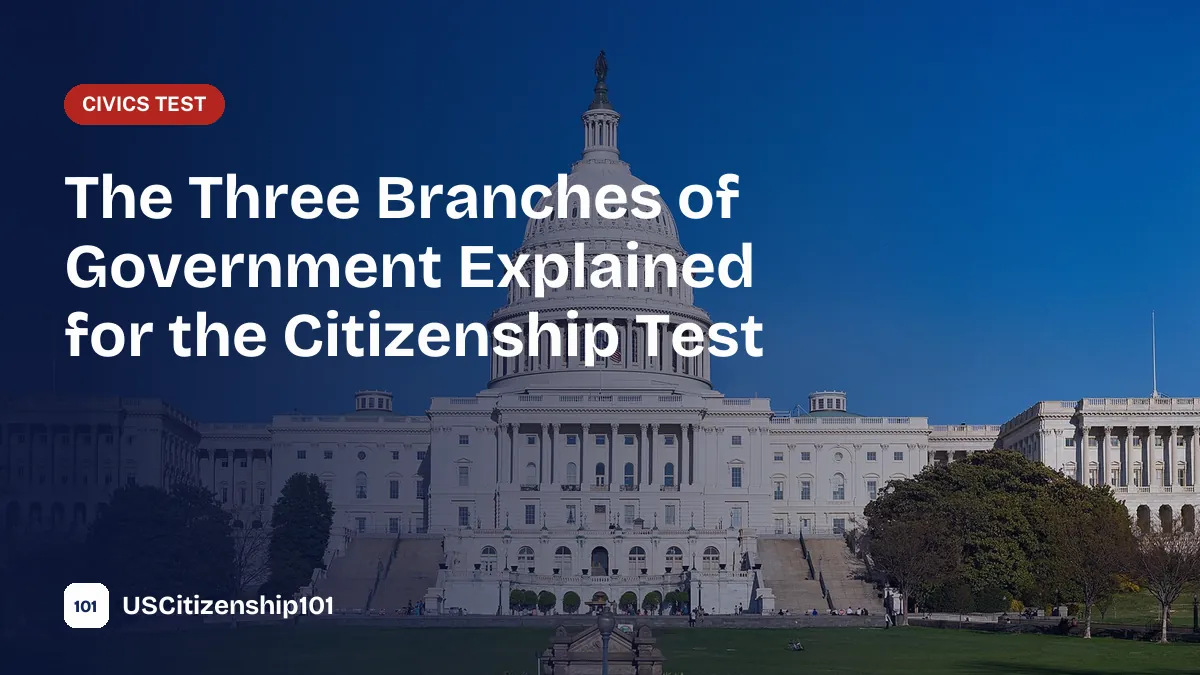
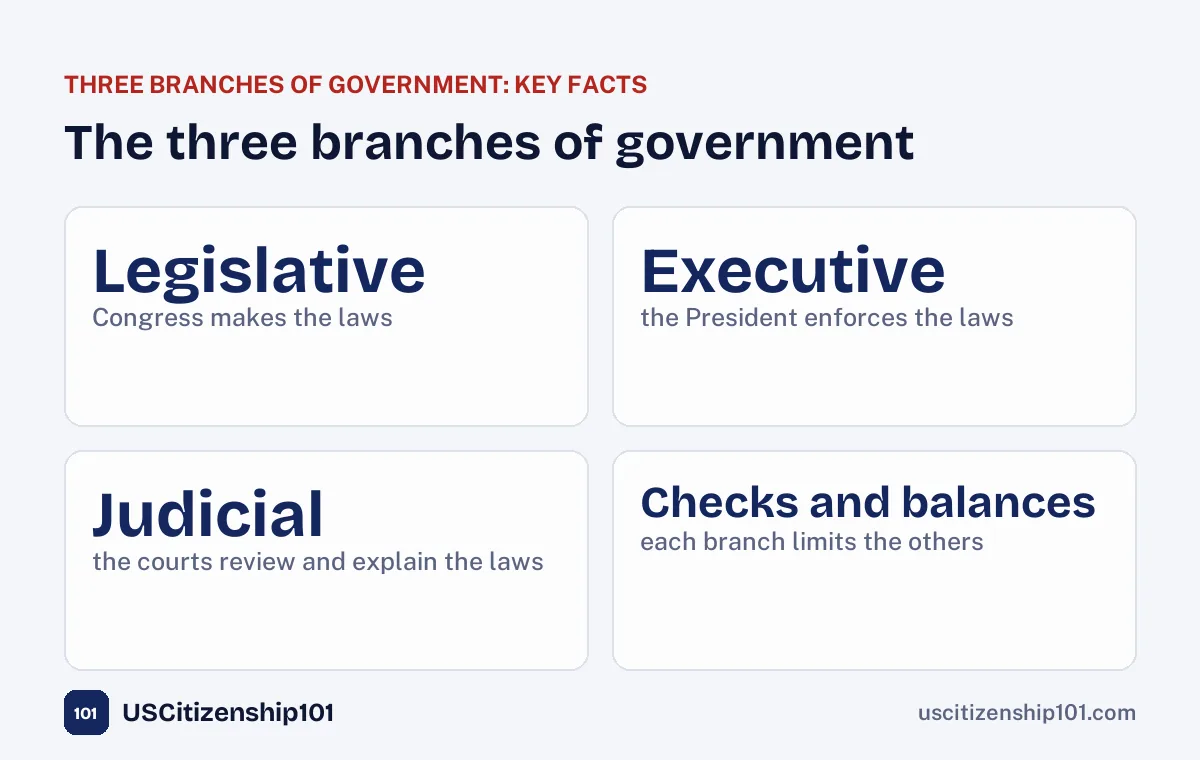
The three branches of government are the legislative branch (Congress), the executive branch (the President), and the judicial branch (the courts). The U.S. Constitution divides power among the three branches of government so that no single person or group can control everything. This idea, called separation of powers, is one of the most important topics on the naturalization civics test.
In fact, questions about the three branches of government make up a large part of the civics test in both the 2025 and 2008 versions. This guide explains each branch in plain English, shows how they check each other, and lists the exact civics test answers you need to know.
Key points about the three branches of government
- The legislative branch (Congress) makes federal laws.
- The executive branch (the President) carries out and enforces laws.
- The judicial branch (the Supreme Court and other federal courts) reviews and explains laws.
- Checks and balances let each of the three branches of government limit the others.
- This topic is one of the largest sections of the civics test.
Why the Constitution created three branches of government
The people who wrote the Constitution in 1787 had just fought a war against a king. They did not want any leader to have unlimited power again. At the same time, the first American government under the Articles of Confederation was too weak to work well. Their solution was a strong national government split into three branches of government, each with its own job and its own limits.
The first three articles of the Constitution describe the three branches of government in order: Article I creates Congress, Article II creates the presidency, and Article III creates the Supreme Court. That order is a handy memory trick for the test.
The legislative branch: Congress
Congress is the part of the three branches of government that makes federal laws. It meets in the U.S. Capitol in Washington, D.C. Congress has two parts, called chambers: the Senate and the House of Representatives. Having two chambers is called a bicameral legislature.
The Senate
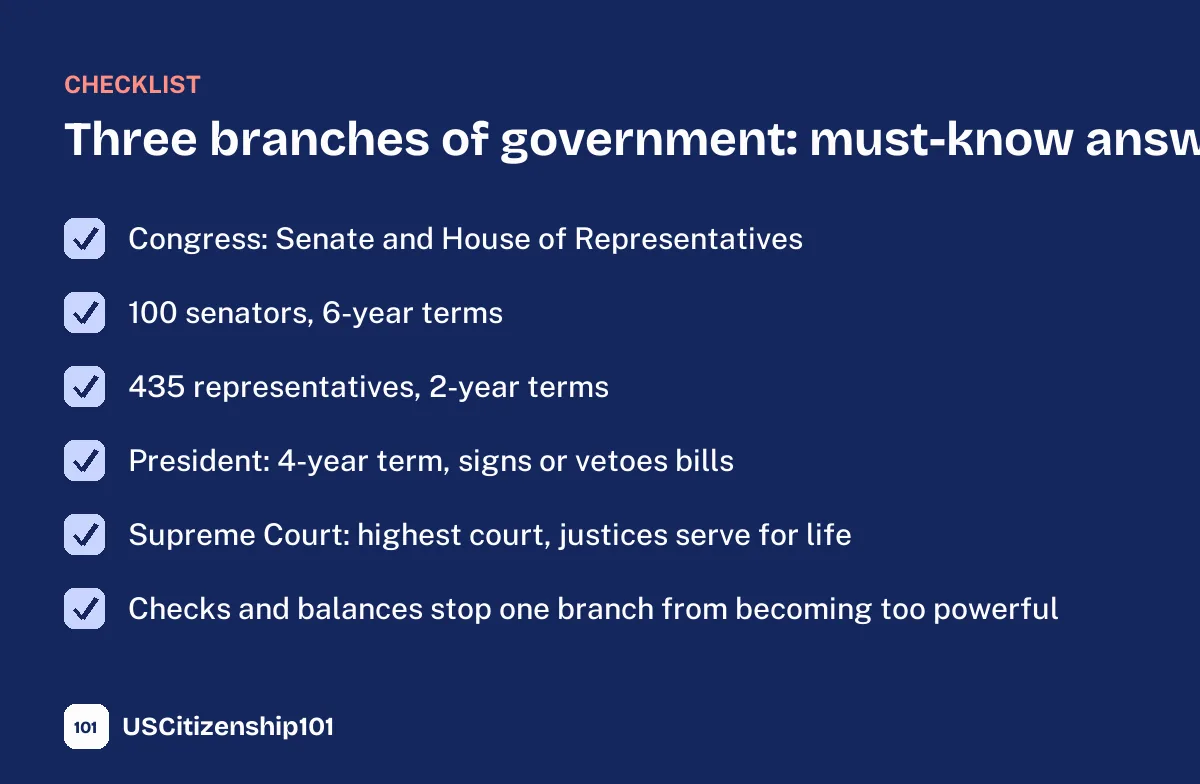
- There are 100 U.S. senators, two from each state.
- Senators are elected for six-year terms.
- A senator represents all the people of the state.
- The Senate confirms many presidential appointments, including Supreme Court justices, and approves treaties.
The House of Representatives
- The House has 435 voting members.
- Representatives are elected for two-year terms.
- States with more people have more representatives, based on the census.
- The House is led by the Speaker of the House.
Powers of Congress
Congress writes laws, declares war, and makes the federal budget. It can also raise taxes, borrow money, regulate trade, and create federal courts below the Supreme Court. Any of “writes laws,” “declares war,” or “makes the federal budget” is an accepted answer on the 2025 test when asked for a power of Congress.
The executive branch: the President
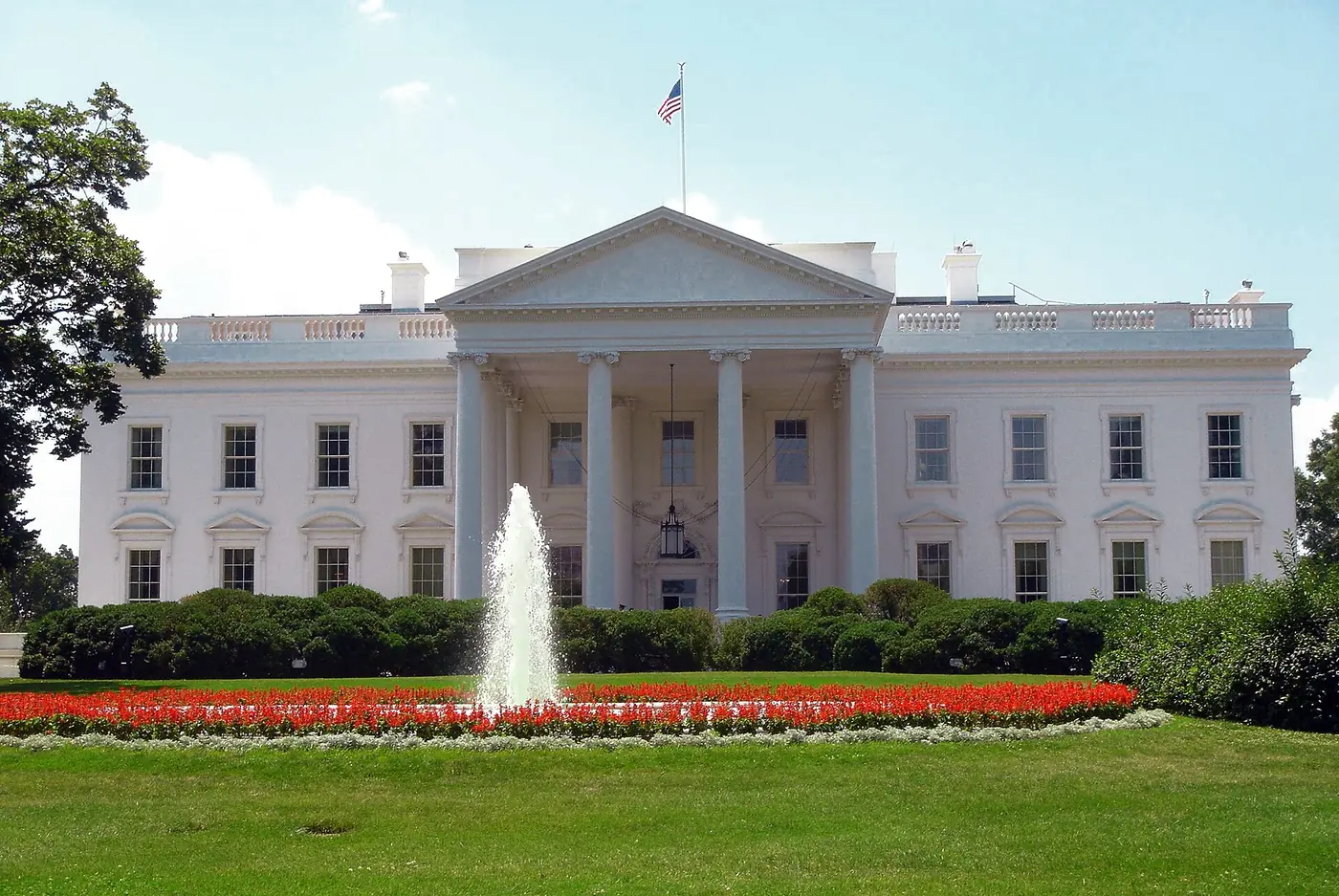
The executive branch carries out and enforces the laws that Congress passes. It is led by the President of the United States, who is both head of state and head of government.
- The President is elected for a four-year term and can serve only two terms because of the 22nd Amendment.
- The President is Commander in Chief of the military.
- The President signs bills to make them laws, or vetoes them.
- If the President can no longer serve, the Vice President becomes President. If both cannot serve, the Speaker of the House is next.
The Cabinet
The President’s Cabinet advises the President. It includes the heads of the executive departments, such as the Secretary of State, the Secretary of Defense, the Secretary of the Treasury, the Attorney General, and the Secretary of Homeland Security. The civics test may ask you to name one Cabinet-level position.
The judicial branch: the courts
The judicial branch reviews laws, explains laws, resolves disputes, and decides whether a law goes against the Constitution. The highest court in the United States is the Supreme Court.
- Supreme Court justices are nominated by the President and confirmed by the Senate.
- Justices serve for life (until they retire or die), so they can be independent of politics.
- The Supreme Court currently has nine justices, led by the Chief Justice.
- Usually five justices, a majority, are needed to decide a case.
The power of courts to strike down laws that violate the Constitution is called judicial review. It was established in the famous 1803 case Marbury v. Madison.
Checks and balances between the three branches of government
Checks and balances are the rules that let each of the three branches of government limit the power of the others. On the civics test, the answer to “What stops one branch of government from becoming too powerful?” is checks and balances (or separation of powers).
| Branch | Can check another branch by |
|---|---|
| Congress | Overriding a veto with a two-thirds vote; approving the budget; confirming judges and officials; impeaching the President or judges |
| President | Vetoing bills; nominating judges; enforcing court decisions |
| Courts | Declaring laws or presidential actions unconstitutional |
How a bill becomes a law
Following a bill through the three branches of government shows how they work together:
- A member of Congress introduces a bill in the House or the Senate.
- Committees study it and may change it.
- Both chambers must pass the same version.
- The President signs it into law, or vetoes it.
- Congress can override a veto with a two-thirds vote in both chambers.
- If the law is challenged, the courts can decide whether it follows the Constitution.
The three branches of government in everyday life
The three branches of government can feel abstract, but they affect daily life in concrete ways. When Congress passes a law raising the minimum age to buy tobacco, that is the legislative branch at work. When a federal agency writes the rules to enforce that law and inspectors check stores, that is the executive branch. When a company challenges the law in court and a judge decides whether it is constitutional, that is the judicial branch.
Your own naturalization case is another example of the three branches of government working together. Congress wrote the Immigration and Nationality Act, which sets the rules for citizenship. USCIS, part of the executive branch, reviews your application and interviews you. If someone disagrees with a USCIS decision after an administrative review, a federal court can review it. Seeing the three branches of government in your own journey makes the civics answers easier to remember.
Watching the news with this in mind is a good study habit. Each time you hear about a bill, an executive order, or a court ruling, ask yourself which of the three branches of government is acting and how the other two might respond.
Federal and state powers
The three branches of government also exist at the state level. Each state has a governor (executive), a legislature (legislative), and state courts (judicial). The Constitution gives some powers only to the federal government, such as printing money, declaring war, creating an army, and making treaties. Other powers belong to the states, such as providing schooling, protection by police, safety by fire departments, giving driver’s licenses, and approving zoning and land use.
Civics test questions about the three branches of government
Here are common questions from the official lists with an accepted answer for each. Practice saying them out loud.
- What are the two parts of the U.S. Congress? The Senate and the House of Representatives.
- How many U.S. senators are there? One hundred (100).
- How long is a term for a U.S. senator? Six (6) years.
- How many voting members are in the House of Representatives? Four hundred thirty-five (435).
- How long is a term for a member of the House of Representatives? Two (2) years.
- The President of the United States is elected for how many years? Four (4) years.
- Who is Commander in Chief of the U.S. military? The President.
- Who signs bills to become laws? The President.
- If the president can no longer serve, who becomes president? The Vice President.
- How many Supreme Court justices are usually needed to decide a case? Five (5).
- How long do Supreme Court justices serve? For life.
For the complete list, see our guides to the 128 civics questions and the 100 civics questions. Names of current officials change, so check civics test answers that change.
All official 2025 test questions about the three branches of government
The “System of Government” section of the 2025 civics test covers the three branches of government, federalism, and elections. Here are all of its questions with accepted answers, taken directly from the official USCIS list. If you know these, you know the largest part of the test. Where a question has several answers, you only need one unless it asks for more.
- Name the three branches of government. Legislative, executive, and judicial; Congress, president, and the courts
- The President of the United States is in charge of which branch of government? Executive branch
- What part of the federal government writes laws? (U.S.) Congress; (U.S. or national) legislature; and other answers
- What are the two parts of the U.S. Congress? Senate and House (of Representatives)
- Name one power of the U.S. Congress. Writes laws; Declares war; and other answers
- How many U.S. senators are there? One hundred (100)
- How long is a term for a U.S. senator? Six (6) years
- Who is one of your state’s U.S. senators now? Answers will vary. [District of Columbia residents and residents of U.S. territories should answer that D.C. (or the territory where the applicant lives) has no U.S. senators.]
- How many voting members are in the House of Representatives? Four hundred thirty-five (435)
- How long is a term for a member of the House of Representatives? Two (2) years
- Why do U.S. representatives serve shorter terms than U.S. senators? To more closely follow public opinion
- How many senators does each state have? Two (2)
- Why does each state have two senators? Equal representation (for small states); The Great Compromise (Connecticut Compromise)
- Name your U.S. representative. Answers will vary. [Residents of territories with nonvoting Delegates or Resident Commissioners may provide the name of that Delegate or Commissioner. Also acceptable is any statement that the territory has no (voting) representatives in Congress.]
- What is the name of the Speaker of the House of Representatives now? Mike Johnson (check uscis.gov/citizenship/testupdates before your interview)
- Who does a U.S. senator represent? Citizens of their state; People of their state
- Who elects U.S. senators? Citizens from their state
- Who does a member of the House of Representatives represent? Citizens in their (congressional) district; Citizens in their district; and other answers
- Who elects members of the House of Representatives? Citizens from their (congressional) district
- Some states have more representatives than other states. Why? (Because of) the state’s population; (Because) they have more people; and other answers
- The President of the United States is elected for how many years? Four (4) years
- The President of the United States can serve only two terms. Why? (Because of) the 22nd Amendment; To keep the president from becoming too powerful
- What is the name of the President of the United States now? Donald J. Trump (check uscis.gov/citizenship/testupdates before your interview)
- What is the name of the Vice President of the United States now? JD Vance (check uscis.gov/citizenship/testupdates before your interview)
- If the president can no longer serve, who becomes president? The Vice President (of the United States)
- Name one power of the president. Signs bills into law; Vetoes bills; and other answers
- Who is Commander in Chief of the U.S. military? The President (of the United States)
- Who signs bills to become laws? The President (of the United States)
- Who vetoes bills? The President (of the United States)
- Who appoints federal judges? The President (of the United States)
- The executive branch has many parts. Name one. President (of the United States); Cabinet; and other answers
- What does the President’s Cabinet do? Advises the President (of the United States)
- What are two Cabinet-level positions? Attorney General; Secretary of Agriculture; and other answers
- Why is the Electoral College important? It decides who is elected president.; It provides a compromise between the popular election of the president and congressional selection.
- What is one part of the judicial branch? Supreme Court; Federal Courts
- What does the judicial branch do? Reviews laws; Explains laws; and other answers
- What is the highest court in the United States? Supreme Court
- How many seats are on the Supreme Court? Nine (9)
- How many Supreme Court justices are usually needed to decide a case? Five (5)
- How long do Supreme Court justices serve? (For) life; Lifetime appointment; and other answers
- Supreme Court justices serve for life. Why? To be independent (of politics); To limit outside (political) influence
- Who is the Chief Justice of the United States now? John G. Roberts, Jr. (check uscis.gov/citizenship/testupdates before your interview)
- Name one power that is only for the federal government. Print paper money; Mint coins; and other answers
- Name one power that is only for the states. Provide schooling and education; Provide protection (police); and other answers
- What is the purpose of the 10th Amendment? (It states that the) powers not given to the federal government belong to the states or to the people.
- Who is the governor of your state now? Answers will vary. [District of Columbia residents should answer that D.C. does not have a governor.]
- What is the capital of your state? Answers will vary. [District of Columbia residents should answer that D.C. is not a state and does not have a capital. Residents of U.S. territories should name the capital of the territory.]
Memory tricks for the three branches of government
- “Make, carry out, explain.” Congress makes laws, the President carries them out, the courts explain them.
- Article order. Articles I, II, and III of the Constitution create Congress, the President, and the courts, in that order.
- Numbers ladder. Two years for the House, four for the President, six for the Senate, life for the Supreme Court.
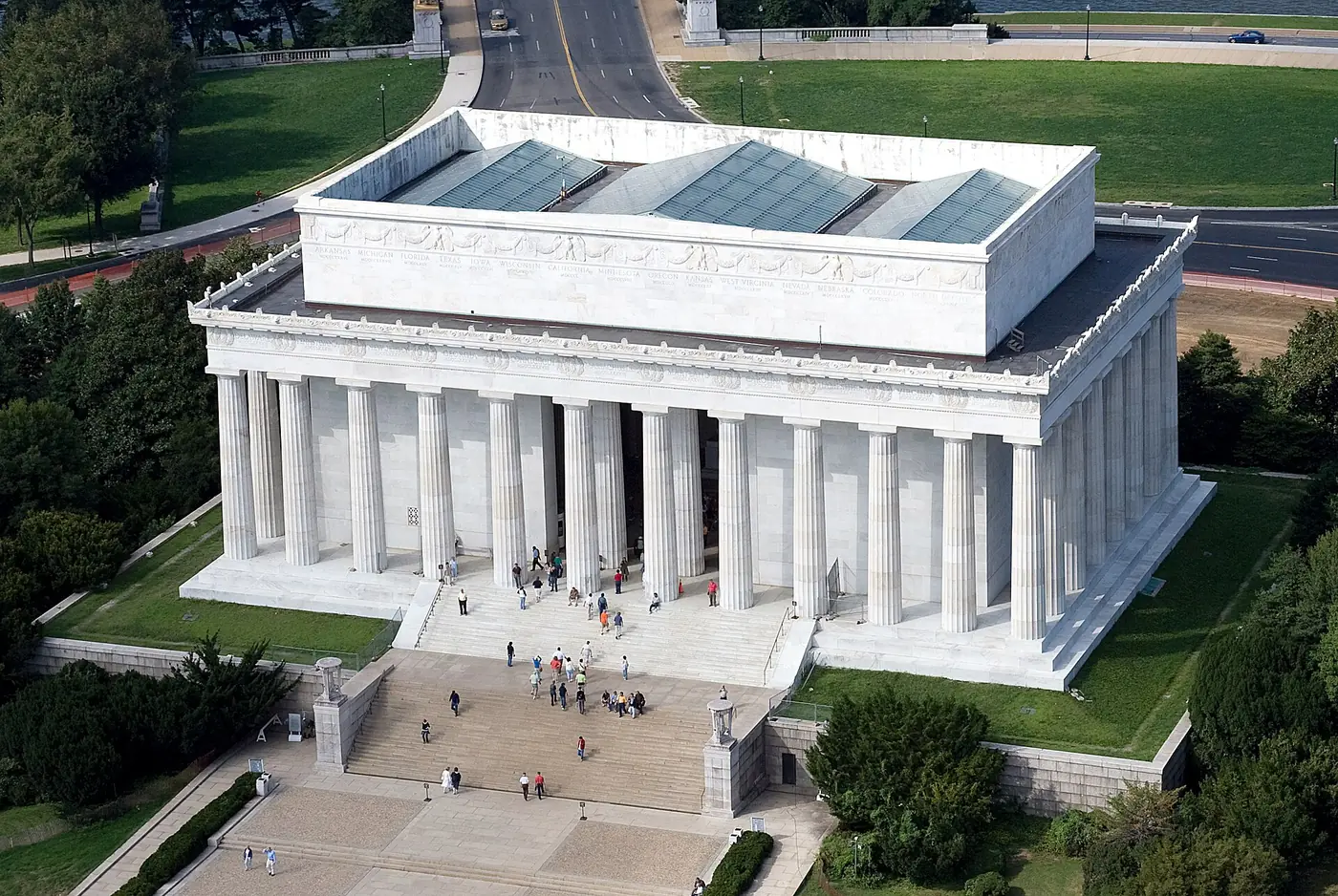
- Buildings. The Capitol for Congress, the White House for the President, and the Supreme Court building for the courts.
Frequently asked questions
What are the three branches of government?
The legislative branch (Congress), the executive branch (the President), and the judicial branch (the courts).
Which branch is the most powerful?
None. The Constitution designed the three branches of government to be balanced so that each can check the others.
Where does each branch work?
Congress works in the U.S. Capitol, the President in the White House, and the Supreme Court in the Supreme Court Building, all in Washington, D.C.
Are the three branches of government on the English test too?
Words like President, Congress, and senators appear on the official reading and writing vocabulary lists, so studying this topic also helps your English test.
Final thoughts
Once you understand the three branches of government, a large share of the civics test becomes easy. Remember who makes the laws, who carries them out, and who explains them, learn the key numbers, and practice the questions out loud. Then test yourself with our free civics practice test.
Sources: U.S. Constitution, Articles I to III; USCIS civics questions and answers (2025 and 2008 versions); USA.gov, Branches of the U.S. government. Last reviewed September 2026.
Free tools
This article is for general education, not legal advice. Always confirm requirements at uscis.gov.