Citizenship Test Practice: 25 Real Questions With Clear Explanations
Twenty-five real questions from the official 2025 list, with the accepted answers and a short explanation that makes each one easy to remember.
On this page
The best citizenship test practice uses real questions, real answers, and a reason to remember each one. This guide gives you 25 real questions from the official 2025 civics test list, the answers USCIS accepts, and a short explanation for each. The explanations are what make this citizenship test practice different: when you understand why an answer is correct, you remember it far longer than a memorized phrase.
Read each question out loud, try to answer before you look, then check the answer and the explanation. When you finish, take a full mock test in our free civics practice test to see where you stand.
Key points for citizenship test practice
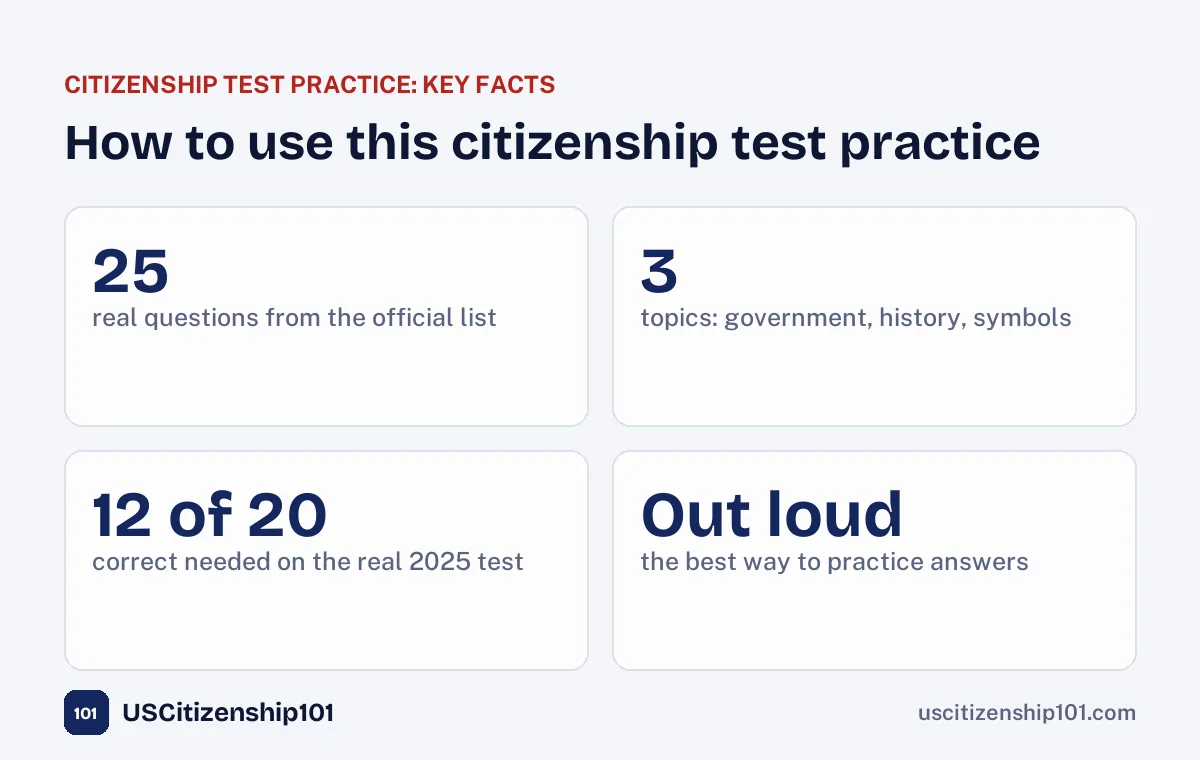
- These 25 questions come from the official list of 128 civics questions for the 2025 test.
- On the real test you need 12 correct out of up to 20.
- The test is oral, so do your citizenship test practice out loud.
- For questions with many answers, one is enough unless the question asks for more.
- Understanding the “why” makes answers stick.
Citizenship test practice: principles of government
What is the supreme law of the land?
Answer: (U.S.) Constitution
The Constitution is the highest law in the country. Every other law, federal or state, must follow it. If a law goes against the Constitution, courts can strike it down. Remember: “one supreme law.”
The U.S. Constitution starts with the words “We the People.” What does “We the People” mean?
Answer: Self-government
Also accepted: Popular sovereignty; Consent of the governed; People should govern themselves
“We the People” are the first three words of the Constitution. They mean the government gets its power from the people, not from a king. That idea is called self-government or popular sovereignty. Any accepted answer is fine, so choose the one easiest for you to say.
What founding document said the American colonies were free from Britain?
Answer: Declaration of Independence
The Declaration of Independence, adopted on July 4, 1776, announced that the 13 colonies were free from Britain. Do not confuse it with the Constitution, which came later in 1787 and created the government.
What is the rule of law?
Answer: Everyone must follow the law.
Also accepted: Leaders must obey the law.; Government must obey the law.; No one is above the law.
The rule of law means nobody is above the law, including the President and other leaders. It is a simple idea with several accepted answers, so pick the shortest: “Everyone must follow the law.”
There are three branches of government. Why?
Answer: So one part does not become too powerful
Also accepted: Checks and balances; Separation of powers
The founders split power into three branches so that no single part of government could become too powerful. Each branch can limit the others. This is called checks and balances, or separation of powers.
Citizenship test practice: how the government works
The President of the United States is in charge of which branch of government?
Answer: Executive branch
The executive branch enforces the laws, and the President leads it. A simple memory trick: “executive” sounds like “execute,” which means to carry out.
What are the two parts of the U.S. Congress?
Answer: Senate and House (of Representatives)
Congress has two chambers: the Senate, with 100 senators, and the House of Representatives, with 435 voting members. Always say both parts. Naming only one is an incomplete answer.
How long is a term for a U.S. senator?
Answer: Six (6) years
Senators serve six-year terms, much longer than representatives, who serve two years. Longer terms let senators take a longer view, while short House terms keep representatives close to public opinion.
Some states have more representatives than other states. Why?
Answer: (Because of) the state’s population
Also accepted: (Because) they have more people; (Because) some states have more people
The number of representatives each state gets depends on its population, counted every ten years in the census. California has the most representatives because it has the most people. This is a good citizenship test practice question to connect with the census.
Who signs bills to become laws?
Answer: The President (of the United States)
Congress passes bills, but the President signs them to make them law, or vetoes them. Picture the President at a desk with a pen.
What are two Cabinet-level positions?
Answer: Attorney General
Also accepted: Secretary of Agriculture; Secretary of Commerce; Secretary of Education
The Cabinet advises the President. It includes the Secretary of State, the Secretary of Defense, the Attorney General, and many others. This question asks for two, so learn at least three to be safe.
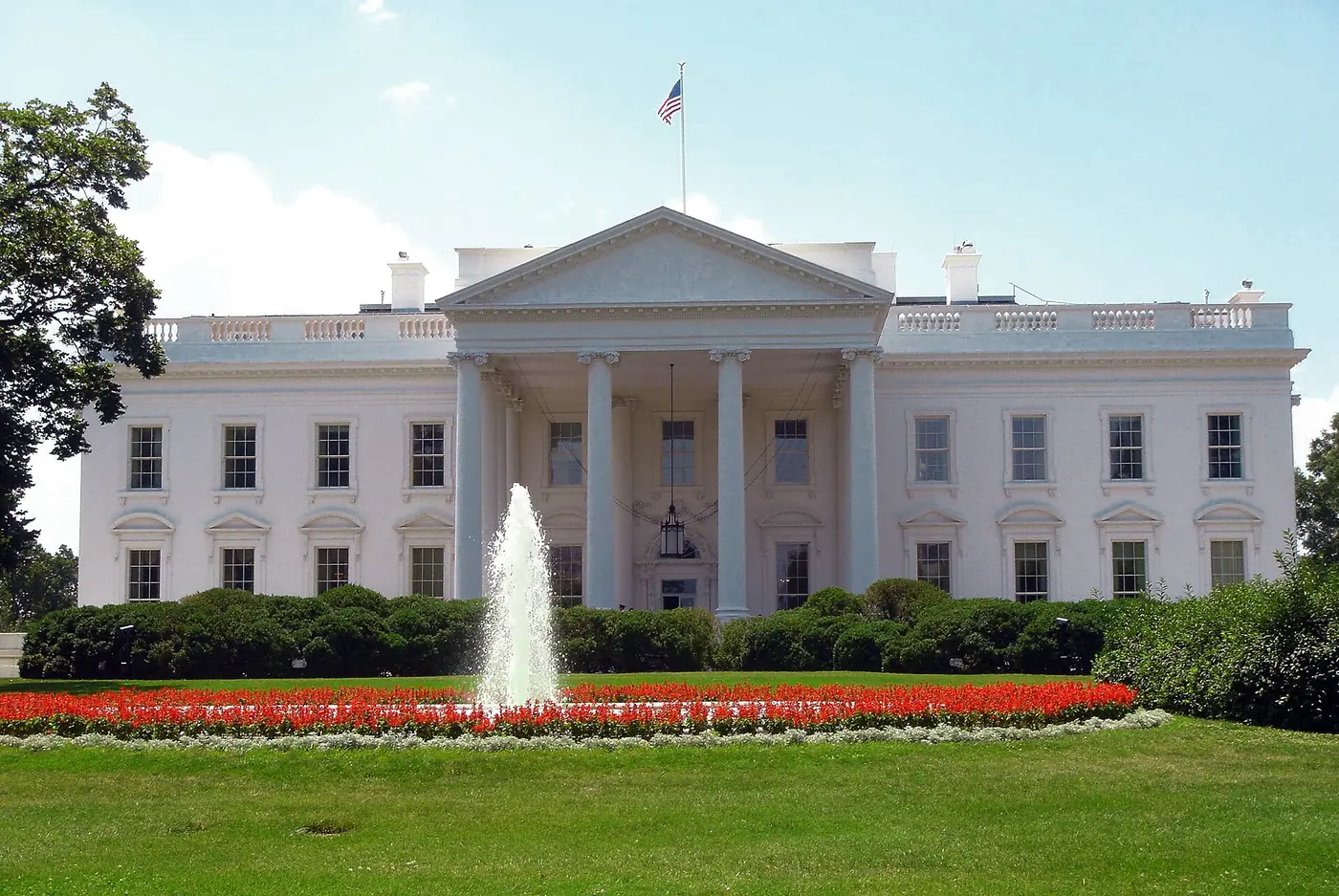
What is the highest court in the United States?
Answer: Supreme Court
The Supreme Court is the highest court in the country. Its decisions are final and apply everywhere in the United States.
Supreme Court justices serve for life. Why?
Answer: To be independent (of politics)
Also accepted: To limit outside (political) influence
Lifetime terms protect justices from political pressure. They do not need to win elections or please a President to keep their jobs, so they can decide cases fairly.
Name one power that is only for the federal government.
Answer: Print paper money
Also accepted: Mint coins; Declare war; Create an army
Some powers belong only to the federal government, such as printing money, minting coins, declaring war, creating an army, and making treaties. States cannot do these things. For your citizenship test practice, “print paper money” is short and easy to remember.
Citizenship test practice: rights and responsibilities
Who can vote in federal elections, run for federal office, and serve on a jury in the United States?
Answer: Citizens
Also accepted: Citizens of the United States; U.S. citizens
Voting in federal elections, running for federal office, and serving on a jury are rights and duties only for citizens. This is one of the clearest differences between permanent residents and citizens.
What do we show loyalty to when we say the Pledge of Allegiance?
Answer: The United States
Also accepted: The flag
When people say the Pledge of Allegiance, they promise loyalty to the United States and its flag. Either answer is accepted.
Citizenship test practice: American history
What war did the Americans fight to win independence from Britain?
Answer: American Revolution
Also accepted: The (American) Revolutionary War; War for (American) Independence
The American Revolution (1775 to 1783) was the war the colonies fought to become independent from Britain. George Washington led the army.
Who wrote the Declaration of Independence?
Answer: (Thomas) Jefferson
Thomas Jefferson was the main author of the Declaration of Independence. He later became the third President. Link “Jefferson” with “Declaration.”
The Federalist Papers supported the passage of the U.S. Constitution. Name one of the writers.
Answer: (James) Madison
Also accepted: (Alexander) Hamilton; (John) Jay; Publius
The Federalist Papers were essays written to convince people to support the new Constitution. Their authors were James Madison, Alexander Hamilton, and John Jay. You only need one; Madison is a strong choice because he is also called the “Father of the Constitution.”
Abraham Lincoln is famous for many things. Name one.
Answer: Freed the slaves (Emancipation Proclamation)
Also accepted: Saved (or preserved) the Union; Led the United States during the Civil War; 16th president of the United States
Abraham Lincoln was President during the Civil War. He preserved the Union and signed the Emancipation Proclamation, which freed slaves in the Confederate states. Any one of these is enough.
What amendment says all persons born or naturalized in the United States, and subject to the jurisdiction thereof, are U.S. citizens?
Answer: 14th Amendment
The 14th Amendment, adopted in 1868 after the Civil War, says that all persons born or naturalized in the United States are citizens. It is also the basis of equal protection under the law.
What was the Great Depression?
Answer: Longest economic recession in modern history
The Great Depression began in 1929 and was the worst economic crisis in modern American history. Franklin Roosevelt was President during most of it.
What did the civil rights movement do?
Answer: Fought to end racial discrimination
The civil rights movement of the 1950s and 1960s worked to end racial discrimination and segregation. Martin Luther King, Jr. was one of its most important leaders.
What major event happened on September 11, 2001 in the United States?
Answer: Terrorists attacked the United States
Also accepted: Terrorists took over two planes and crashed them into the World Trade Center in New York City; Terrorists took over a plane and crashed into the Pentagon in Arlington, Virginia; Terrorists took over a plane originally aimed at Washington, D.C., and crashed in a field in Pennsylvania
On September 11, 2001, terrorists attacked the United States, killing nearly 3,000 people. Any clear description of the attacks is accepted.
Citizenship test practice: symbols
Why does the flag have 13 stripes?
Answer: (Because there were) 13 original colonies
Also accepted: (Because the stripes) represent the original colonies
The flag’s 13 stripes represent the 13 original colonies, and its 50 stars represent the 50 states. Learning both together helps you remember each.
Bonus citizenship test practice: quick-win questions
These short questions are some of the easiest points on the test. Add them to your citizenship test practice this week.
What is the capital of the United States?
Answer: Washington, D.C.
Washington, D.C. is the capital of the country. Do not confuse it with Washington State.
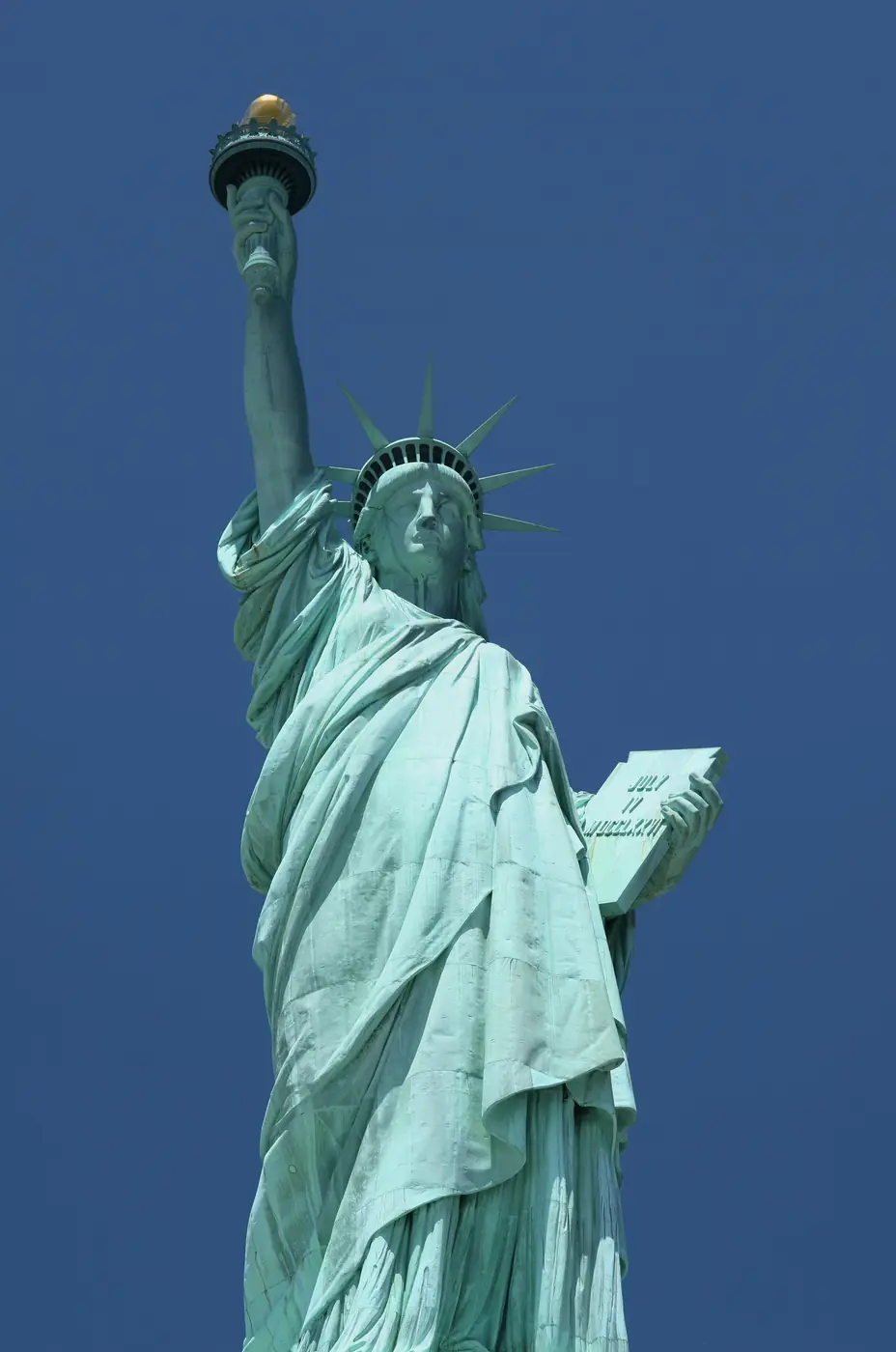
Where is the Statue of Liberty?
Answer: New York (Harbor)
Also accepted: Liberty Island [Also acceptable are New Jersey, near New York City, and on the Hudson (River).]
The Statue of Liberty stands on Liberty Island in New York Harbor. Saying “New York Harbor” is accepted too.
The President of the United States is elected for how many years?
Answer: Four (4) years
Presidential elections happen every four years, in November.
Name three national U.S. holidays.
Answer: New Year’s Day
Also accepted: Martin Luther King, Jr. Day; Presidents Day (Washington’s Birthday); Memorial Day
This question asks for three, so practice three in one breath: Independence Day, Thanksgiving, and Christmas.
What is Memorial Day?
Answer: A holiday to honor soldiers who died in military service
Memorial Day, in May, honors soldiers who died in military service. Veterans Day, in November, honors everyone who served.
Your last week of citizenship test practice
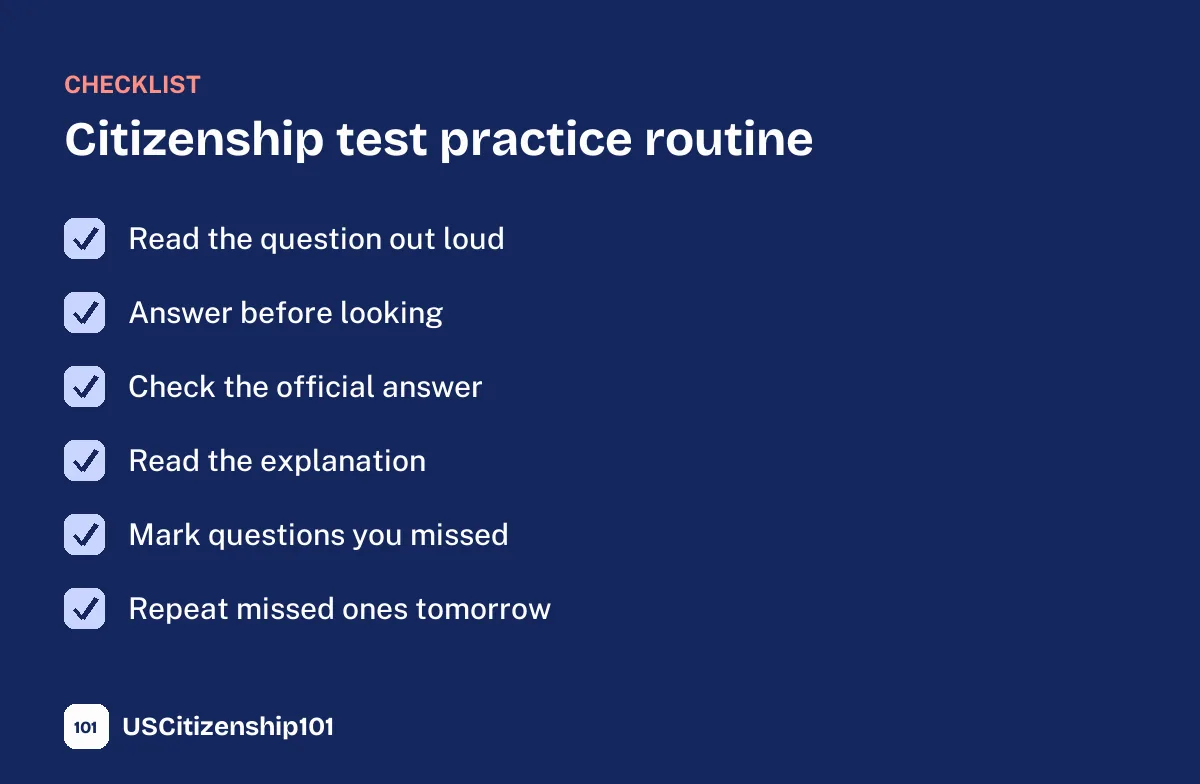
In the final week before your interview, change how you do citizenship test practice. Stop learning new material and focus on performance:
- Every day: one full 20-question mock test in our practice test.
- After each test: study only the questions you missed.
- Every other day: ask a family member to quiz you out loud for ten minutes.
- Two days before: check the names of current officials.
- The night before: a short, relaxed review, then sleep early.
This final week of citizenship test practice builds the confidence that helps you answer calmly in front of an officer.
How did you do?
- 20 to 25 correct: excellent. Move on to full mock tests.
- 12 to 19 correct: you would pass today, but keep studying to be safe.
- Fewer than 12: that is normal at the start. Follow our civics test study plan for four weeks.
Citizenship test practice with a partner: a simple script
Practicing with another person is the closest thing to the real interview. Give your partner this script:
- Sit across from each other at a table, like at the USCIS office.
- Your partner reads a question in a calm, clear voice, only once.
- You answer out loud. If you did not understand, you say, “Could you please repeat the question?”
- Your partner says “correct” or gives the right answer, without long explanations.
- After 20 questions, or when you reach 12 correct, stop and review the misses together.
Doing this kind of citizenship test practice two or three times a week makes the real interview feel familiar and much less stressful.
Using our online citizenship test practice tools
Our free practice test offers four kinds of citizenship test practice: mock tests with the real stopping rules, practice by topic with instant explanations, flashcards that can read questions aloud, and a “review mistakes” mode that only shows questions you missed before. Your progress is saved in your browser, so you can pick up where you left off. It works on phones, tablets, and computers, with no account needed.
Make your citizenship test practice more effective
- Practice out loud. The interview is spoken, so train your voice, not just your eyes.
- Use a partner. Ask someone to read questions to you in random order.
- Space it out. Revisit missed questions after one day, three days, and a week.
- Use mock tests. Our practice test asks 20 random questions and stops at 12 right or 9 wrong, like the real officer.
- Check changing answers. See civics test answers that change for current officials.
Turning practice into confidence
Confidence comes from evidence. Each time you finish a mock test with 12 or more correct answers, write down the date and score. After a week you will have a page of proof that you are ready. Read it the morning of your interview. Many applicants say that this simple habit calmed their nerves more than anything else.
Common mistakes during citizenship test practice
- Only using multiple choice. The real test has no options, so also practice answering from memory.
- Studying the wrong version. If you filed before October 20, 2025, practice the 100 civics questions instead.
- Skipping “name two” questions. Always learn extra answers.
- Practicing only once a week. Short daily citizenship test practice is far more effective.
Frequently asked questions
Should I practice the English test too?
Yes. The interview also includes reading and writing one sentence each. Many words in civics answers appear on the official vocabulary lists, so civics practice helps your English too. Try our English practice page and the citizenship English test guide.
What if I keep forgetting the same answers?
Write those questions on a card and read it several times a day, out loud. Link each answer to a picture or story. Forgetting is normal; repetition fixes it.
Are these the exact questions on the test?
Yes. All 25 come from the official USCIS list for the 2025 test. The officer chooses from the full list of 128.
How many questions should I practice each day?
Five to eight new questions plus a review of earlier ones works well for most people. Consistent daily citizenship test practice beats long weekly sessions.
Is online citizenship test practice enough?
It is a great tool, but combine it with speaking practice with another person, because the interview is a conversation.
Where can I find more citizenship test practice?
Our free practice test has all 128 questions, flashcards, topic practice, and a mistakes review.
Final thoughts
Good citizenship test practice is simple: real questions, answers said out loud, and a little understanding behind each one. Work through these 25 questions again tomorrow, then move on to full mock tests. With steady practice, the real interview will feel like one more session.
Source: USCIS, 128 Civics Questions and Answers (2025 version), available at uscis.gov. Last reviewed September 2026.
Free tools
This article is for general education, not legal advice. Always confirm requirements at uscis.gov.