How to Fill Out Form N-400: Section-by-Section Guide for 2026
A plain-English walkthrough of every section of the citizenship application, the documents to gather first, and the mistakes that cause delays.
On this page
To become a citizen through naturalization, you need to fill out Form N-400, the Application for Naturalization. The form is long, but it is not complicated if you prepare the right information first and take it one section at a time. A careful, honest application is also the best preparation for your interview, because the officer uses your N-400 as the script.
This guide explains how to fill out Form N-400 step by step: what to gather first, how to answer each section, how to file online or on paper, and the mistakes that most often cause delays. It follows the current edition of the form (01/20/25). Always use the edition USCIS lists on its website when you file.
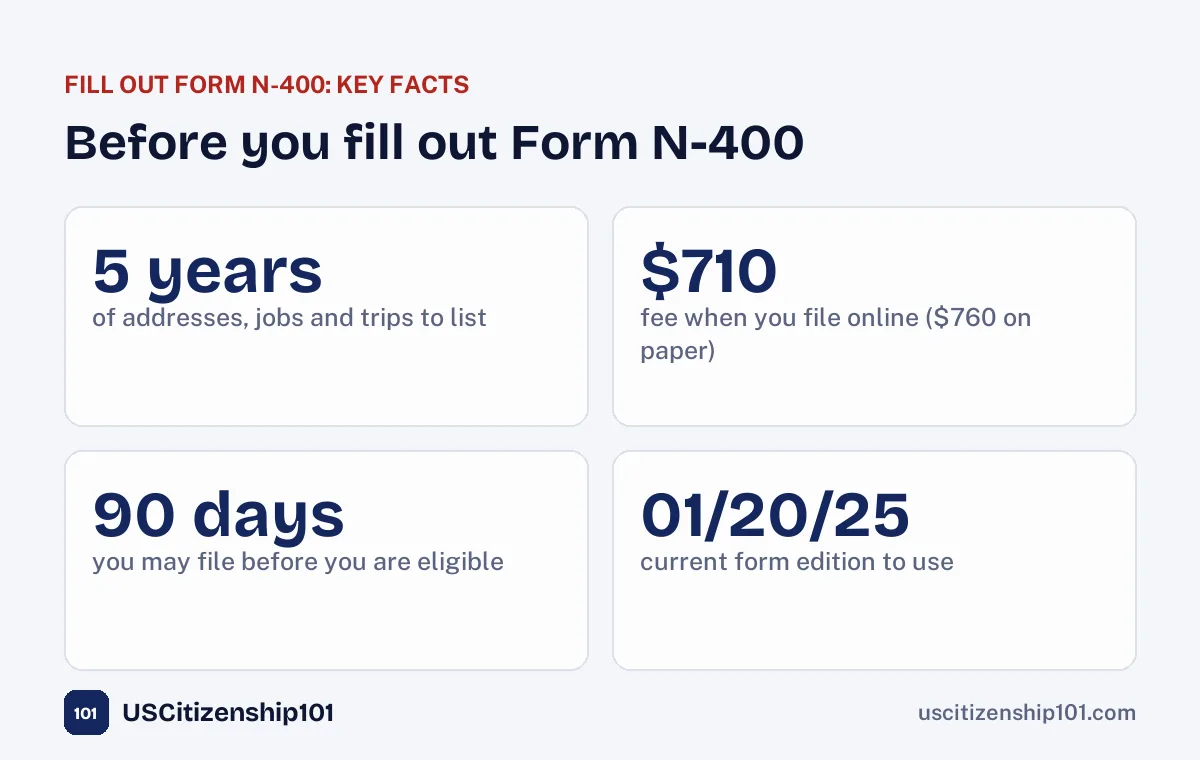
Key points before you fill out Form N-400
- Use the current edition of the form. USCIS rejects outdated editions.
- Gather 5 years of addresses, jobs, and trips before you start (3 years on the marriage path).
- Answer every question. Write “None” or “N/A” where it applies on paper.
- Be completely honest, especially on arrests and travel.
- File online for $710 or on paper for $760.
Step 1: Confirm you are eligible
Before you fill out Form N-400, confirm that you meet the requirements. Most applicants need 5 years as a permanent resident (3 years if married to and living with a U.S. citizen), continuous residence, physical presence for half that time, 3 months in your state or USCIS district, and good moral character. See the full list of citizenship requirements. You may file up to 90 days early; see N-400 early filing.
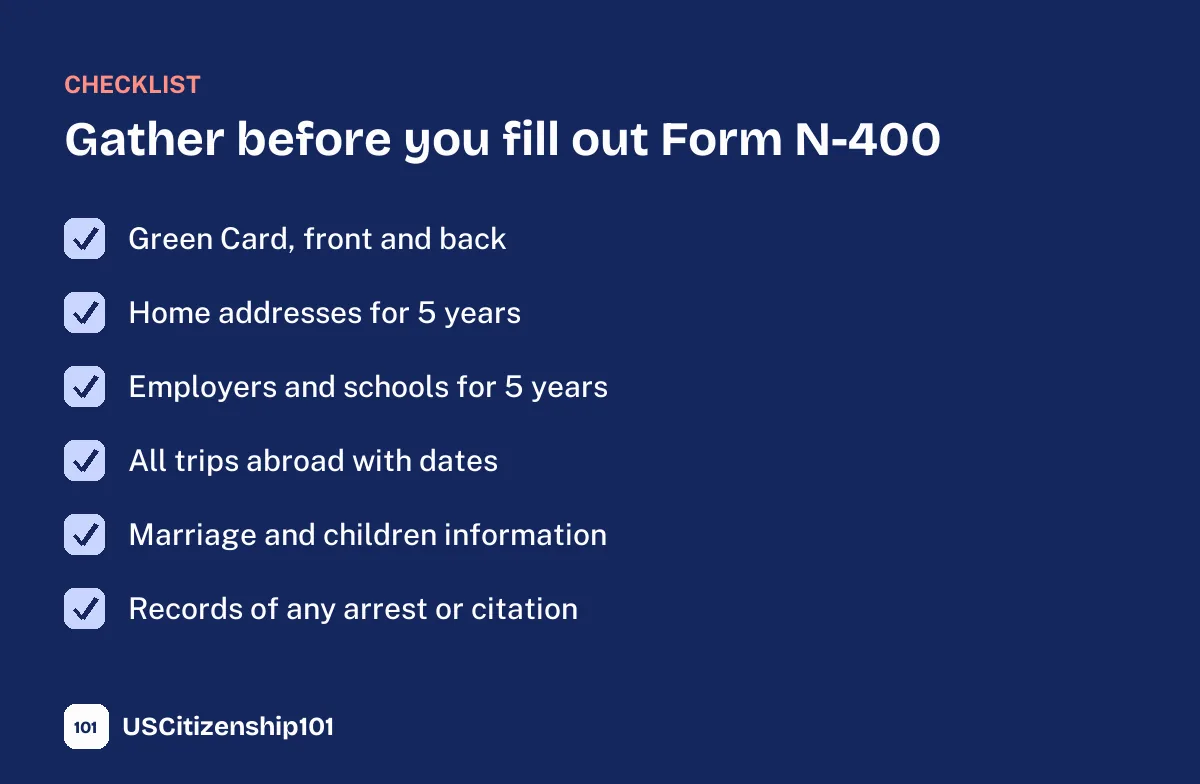
Step 2: Gather your information
- Your Green Card (A-number, “Resident Since” date, category).
- Your Social Security number and USCIS online account number, if you have them.
- Every home address for the last 5 years, with month and year.
- Every employer or school for the last 5 years, with dates.
- Every trip outside the U.S. longer than 24 hours in the last 5 years, with exact dates.
- Current and past marriages: names, dates, places, and your spouse’s citizenship details.
- Your children’s names, birth dates, A-numbers, and addresses.
- Details of any arrest, citation, or charge, with court records.
Having this ready before you fill out Form N-400 saves hours and prevents mistakes.
Step 3: Choose online or paper filing
Filing online through a USCIS account costs $710, checks your answers as you go, and lets you upload documents. Paper filing costs $760 and is required if you request a reduced fee or fee waiver. See the N-400 filing fee guide.
Step 4: Eligibility section
The first section asks how you qualify. Most people select the option for permanent residents of at least 5 years. Choose the 3-year option only if you have been married to and living with the same U.S. citizen spouse for 3 years, and that spouse has been a citizen for all 3 years. Military and other special options have their own rules.
Step 5: Information about you
Enter your current legal name exactly as it appears on your Green Card or legal documents, all other names you have used (including maiden names), your A-number, date of birth, country of birth and nationality, and your date of permanent residence. If you want to legally change your name when you naturalize, this section lets you request it.
Accommodations and disability exceptions
If you need accommodations at the interview, such as a sign language interpreter or wheelchair access, you can request them. If you are filing Form N-648 for a disability exception, indicate it and attach the form. See Form N-648.

Step 6: Biographic information
This section asks for your ethnicity, race, height, weight, eye color, and hair color. USCIS uses it for background checks. Answer as accurately as you can. Use your current height and weight; small changes since your Green Card photo are normal and do not cause problems.
Step 7: Residence history
List every place you have lived for the last 5 years (3 on the marriage path), starting with the current address. Avoid gaps: the end of one address should connect to the start of the next. If you lived abroad for part of the time, include those addresses too.
Step 8: Marital history and children
Give your current marital status and details about your current spouse, such as full name, date of birth, date of marriage, and A-number if they have one, plus their citizenship status and how they became a citizen. List prior marriages for you and your spouse. Then list all your children, including adult children, stepchildren you legally adopted, and children who live abroad or are deceased, following the form’s instructions.
Step 9: Employment and schools
List every employer or school for the last 5 years, starting with the most recent. Include periods of unemployment, self-employment, or retirement, so there are no gaps. Include the employer’s address and your job title, and check the dates against your pay records or tax returns so they match what you tell the officer.
Step 10: Time outside the United States
List every trip outside the U.S. that lasted more than 24 hours during the statutory period, with departure and return dates and the countries visited. This is one of the most important sections, because it affects continuous residence and physical presence. Use passport stamps and travel records to be exact. See the continuous residence requirement.
Step 11: The “have you ever” questions
The additional information section asks dozens of yes-or-no questions about your background: claims to citizenship, voting, taxes, organizations, arrests and crimes, drugs, gambling, support of dependents, immigration violations, military service, Selective Service, and your willingness to take the oath. Read each question slowly.
- Answer truthfully. “Yes” answers are not automatically disqualifying, but hiding information can be.
- Disclose every arrest, citation, or charge, even if dismissed or expunged, and attach records.
- Use the additional information space to explain any “Yes” answer.
- If you are unsure how to answer a question, talk to an immigration attorney before filing.
These questions come back at your interview. Our guide to citizenship interview questions explains them and the words officers may ask you to define.
Step 12: Fee reduction, signature, and filing
If you qualify, complete the fee reduction section and attach proof of income. Then read the certification and sign. Unsigned applications are rejected. If someone helped you fill out Form N-400, the preparer section must be completed; if an interpreter helped, the interpreter section too.
Attach a copy of both sides of your Green Card and any required evidence. On paper, include the fee payment form on top and mail to the address listed on the USCIS website for your state. Online, upload evidence and pay at the end.
How to fill out Form N-400 online
- Create a free USCIS online account at my.uscis.gov with your email address.
- Choose “File a form online” and select Form N-400.
- Answer the questions section by section. You can save and return later.
- Upload a copy of your Green Card and any evidence the system asks for.
- Review the summary page carefully. The system flags missing answers.
- Sign electronically by typing your name, then pay the fee.
- Download and save the receipt notice and a PDF copy of your application.
Many applicants find it easier to fill out Form N-400 online, because the form shows only the questions that apply to you and checks for blanks before you submit.
Evidence to include by situation
| Your situation | Evidence to include |
|---|---|
| Everyone | Copy of both sides of your Green Card |
| Applying through marriage (3-year path) | Proof of your spouse’s citizenship; marriage certificate; proof of divorce for prior marriages; proof of living together |
| Military service | Form N-426 and service records |
| Any arrest, citation, or charge | Certified court dispositions and police records |
| Reduced fee request | IRS tax transcript or other proof of household income |
| Fee waiver | Form I-912 and supporting proof |
| Disability exception | Form N-648 completed by a licensed medical professional |
| Name changed since your Green Card | Marriage certificate, divorce decree, or court order |
Always check the current form instructions, because evidence requirements can change.
How to handle tricky situations
Gaps in addresses or employment
Do not leave unexplained gaps. If you were unemployed, write “unemployed” for that period. If you stayed with relatives, list that address.
You lived abroad part of the time
List foreign addresses and trips accurately. Long periods abroad may affect eligibility, so read about continuous residence before you fill out Form N-400.
You are self-employed
List your business name, or “self-employed,” with your occupation and dates. Bring tax returns to the interview.
Children who live abroad
Include all your children, wherever they live, with their current addresses.
A past immigration problem or denial
Answer the related questions honestly and consider speaking with an immigration attorney before filing, because some issues can affect your permanent residence.
Different spellings of your name
List all versions under other names used, and bring documents that explain the differences.
Review checklist before you submit
- Every question is answered, with no blanks on paper.
- Addresses and jobs connect with no date gaps.
- Every trip is listed with exact dates.
- Your name, A-number, and dates match your Green Card.
- All “Yes” answers have an explanation and evidence.
- The form is signed, and preparer and interpreter sections are complete if used.
- The correct fee and current form edition are used.
- You kept a full copy of everything you sent.
Checking this list after you fill out Form N-400 catches most of the errors that lead to rejections and requests for evidence.
What happens after you fill out Form N-400
- You receive a receipt notice. Keep it; its date decides your civics test version.
- USCIS may schedule a biometrics appointment. See biometrics appointment.
- USCIS reviews your file and runs background checks.
- You receive an interview notice. Prepare with our civics test study plan.
- You attend the interview, take the tests, and receive a decision.
- If approved, you take the Oath of Allegiance.
See the full naturalization timeline for what to expect at each stage.
Using the additional information space
When you fill out Form N-400, some answers need more room than the form provides, such as a long list of trips or an explanation of a “Yes” answer. Use the additional information section (or an extra sheet on paper). For each entry, write the page number, part number, and question number it relates to, then your explanation. Keep explanations short and factual: what happened, when, and the result.
Should you get help to fill out Form N-400?
Many people fill out Form N-400 without help. Consider professional help if you have:
- Any arrest, conviction, or charge, even if old or minor.
- Trips abroad longer than six months.
- Periods when you did not file taxes or owed taxes.
- Questions about how you obtained your Green Card.
- Past removal proceedings or immigration violations.
Licensed immigration attorneys and DOJ-accredited representatives at nonprofit organizations can review your case. Be careful with “notarios” or consultants who are not authorized to give legal advice. Only attorneys and accredited representatives can represent you.
Mailing tips for paper filers
- Check the USCIS website for the correct mailing address for your state; it can change.
- Put the fee payment form on top, then the N-400, then evidence.
- Do not staple; use clips if needed.
- Use a trackable mailing service and keep the tracking number.
- Keep a complete photocopy of everything you mailed.
When your information changes after filing
After you fill out Form N-400, life keeps moving. If you move, update your address with USCIS within 10 days. If you marry, divorce, have a child, change jobs, or travel, you do not need to file a new form, but tell the officer at your interview and bring updated documents. The officer will correct your application during the interview.
Use your copy to prepare for the interview
The copy you keep after you fill out Form N-400 is one of your best study tools. Read it again a week before your interview. The officer will ask about your addresses, work, trips, family, and every “Yes” answer. Being familiar with what you wrote helps you answer quickly and consistently.
A weekend plan to fill out Form N-400
If you like working in blocks, here is a simple plan to fill out Form N-400 over one weekend after you have gathered your records:
- Saturday morning: eligibility, personal information, and biographic details.
- Saturday afternoon: residence history, employment, and schools. Check for gaps.
- Sunday morning: travel history and family information, using your passports.
- Sunday afternoon: the “have you ever” questions, explanations, and fee section.
- Monday evening: a fresh-eyes review with the checklist above, then submit.
Splitting the work this way keeps you focused and makes it easier to fill out Form N-400 accurately, without rushing the most important sections.
Common mistakes when you fill out Form N-400
- Using an outdated edition of the form.
- Leaving questions blank.
- Missing trips or addresses, or leaving gaps in dates.
- Not disclosing arrests or citations.
- Filing more than 90 days early.
- Forgetting to sign or to pay the correct fee.
- Different spellings of your name across documents without explanation.

Frequently asked questions
How long does it take to fill out Form N-400?
With your information gathered, most people need two to four hours. Gathering the information can take longer.
Can someone help me fill out the form?
Yes. A friend, relative, attorney, or accredited representative can help. They must complete the preparer section.
Is it safe to fill out Form N-400 myself?
Many people fill out Form N-400 on their own successfully, especially with a simple history. If you have arrests, long absences, or past immigration issues, get legal advice first.
Can I fill out Form N-400 in another language?
No. The form must be completed in English. Someone may help you as an interpreter or preparer, and they sign the form too.
What if I make a mistake after filing?
You can correct most mistakes at your interview. Bring documents and tell the officer.
Can I save my progress online?
Yes. When you fill out Form N-400 in your USCIS account, your answers are saved as a draft, and you can come back later before submitting.
Should I send original documents?
No. Send copies unless the instructions ask for an original. Bring the originals to your interview.
Where do I find the current edition?
On the official USCIS Form N-400 page. The edition date is at the bottom of each page of the form and instructions.
Do I need to send photos?
Only if you live outside the United States when you file, or if USCIS asks. Check the current instructions.
Final thoughts
When you fill out Form N-400 carefully, you make every later step easier: the background check, the interview, and the decision. Gather your history first, answer every question honestly, check dates for gaps, and file with the correct fee. Then start preparing for your interview with our free civics practice test.
Sources: USCIS, Form N-400 and instructions (edition 01/20/25). Last reviewed September 2026. General information, not legal advice.
Free tools
This article is for general education, not legal advice. Always confirm requirements at uscis.gov.