25 Citizenship Interview Tips to Pass on Your First Try
Practical, proven advice for the weeks before, the morning of, and the moment you sit down with the officer.
On this page
The naturalization interview is the most important day of your citizenship journey, and preparation makes all the difference. These 25 citizenship interview tips come from the most common questions and problems applicants face. They cover the weeks before your interview, the night before, the morning of, the interview itself, and what to do if something does not go as planned.
None of these citizenship interview tips require special resources. They just require starting early and following through. Pick the ones that fit you, and you will walk in calm and ready.
Key points from these citizenship interview tips
- Most people who struggle at the interview studied the wrong material or did not practice out loud.
- Your N-400 is the script for the interview. Reread it.
- Short, honest answers are always best.
- You may ask the officer to repeat a question.
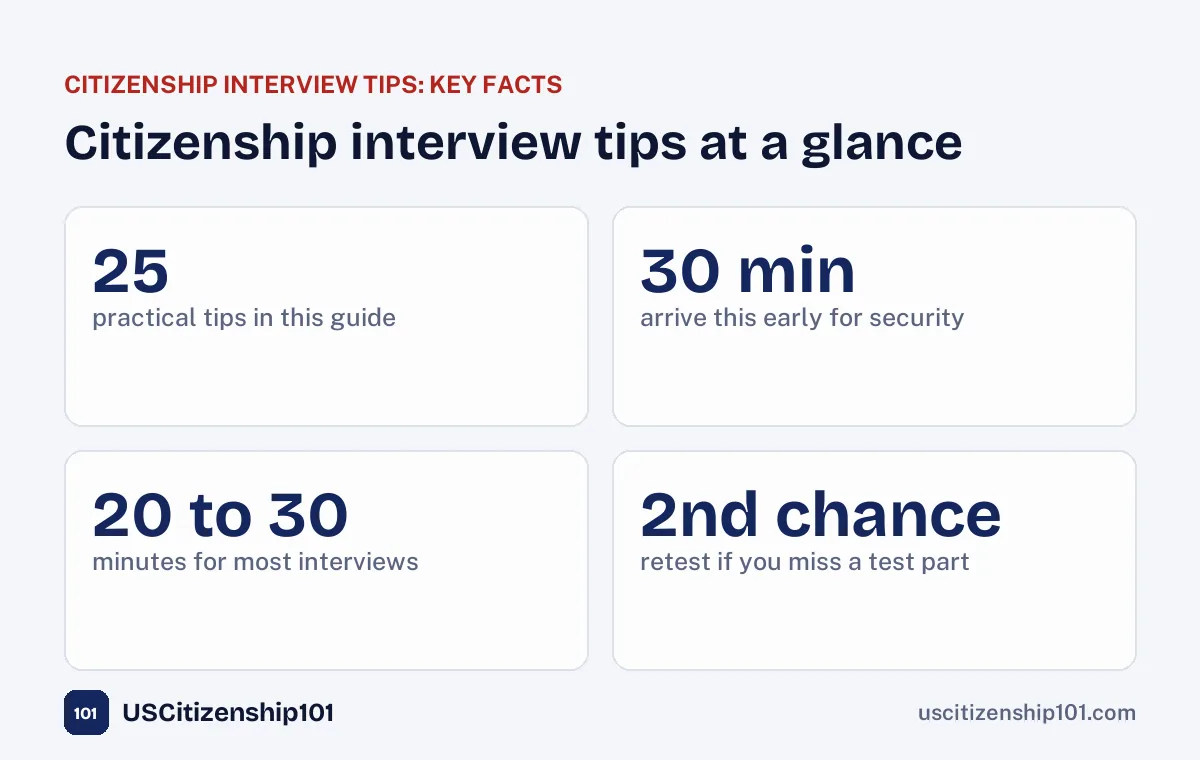
- If you miss a test part, you get a free retest.
Tips for the weeks before your interview
1. Confirm which civics test you will take
Check the received date on your N-400 receipt notice. On or after October 20, 2025 means the 2025 civics test (128 questions, 20 asked, 12 to pass). Earlier means the 2008 test (100 questions, 10 asked, 6 to pass). This is the first of all citizenship interview tips because everything else depends on it.
2. Follow a daily study plan
Twenty to thirty minutes a day for four weeks is enough for most people. Use our civics test study plan.
3. Practice answers out loud
The civics test is oral. Say every answer aloud, ideally to another person. Silent reading does not prepare your voice.
4. Take full mock tests
Our free civics practice test asks 20 random questions and stops at 12 right or 9 wrong, like the officer. When you pass five in a row, you are ready.
5. Master the reading and writing words
The English test sentences come from the official USCIS vocabulary list. Practice reading questions aloud and writing answers by hand.
6. Reread your N-400 carefully
The officer will ask about your addresses, jobs, trips, family, and the “have you ever” questions. Review your copy so your answers match, and note anything that changed.
7. Make a list of your trips abroad
Write every trip with exact dates. Travel questions are common, and having the list ready prevents mistakes.
8. Learn the difficult words
Officers may ask what words like “citation,” “allegiance,” or “habitual drunkard” mean. Our guide to citizenship interview questions includes simple definitions.
9. Check the answers that change
Learn the current President, Vice President, Speaker, and Chief Justice, and your own senators, representative, governor, and state capital. See civics test answers that change.
10. Practice a full mock interview
Ask a friend to play the officer: oath, application questions, reading, writing, and civics. Our mock interview reads the questions aloud for you.

Tips for the night before
11. Pack your documents in one folder
Include your interview notice, Green Card, government photo ID, all passports and travel documents, and every document your notice lists. Add certified court records if you have any arrest or citation history.
12. Plan your route
Check the address, parking, and public transport. Plan to arrive 30 minutes early for security.
13. Review lightly, then sleep
A short review of the questions you find hardest is fine. Cramming late at night is not. Sleep helps memory more than extra study.
14. Prepare your interpreter, if you have one
If you qualify for an age-based exception, confirm your interpreter’s time and remind them to bring ID. See citizenship test exemptions.
Tips for the morning of the interview
15. Eat and hydrate
A light meal and water help concentration. Interviews can run late.
16. Dress neatly
There is no dress code, but business casual shows respect for the occasion and helps you feel confident.
17. Leave electronics simple
Bring your phone but silence it. Avoid large bags that slow security.
Tips for the interview itself
18. Listen to the whole question
Do not start answering before the officer finishes. Key words like “ever” and “since” change the meaning.
19. Ask for a repeat when you need it
“Could you please repeat the question?” or “Could you say it another way?” is always acceptable. It is one of the most useful citizenship interview tips, because guessing causes avoidable mistakes.
20. Keep answers short
Answer what was asked, then stop. Long explanations create confusion.
21. Always tell the truth
Honesty matters more than anything. If the honest answer is “Yes” to a sensitive question, say so and show your records.
22. Correct mistakes immediately
If you realize you said something wrong, tell the officer right away and give the correct information.
23. Read and write slowly
On the English test, accuracy beats speed. Check capital letters and the final period on your written sentence.
24. Remember the margin on the civics test
On the 2025 test you can miss up to eight questions and still pass. One wrong answer is not failure. Take a breath and continue.
Citizenship interview tips for the English test
The English test has three parts, and each needs a slightly different approach.
- Speaking: there is no separate speaking test. The officer judges your English throughout the conversation. Use simple, complete sentences. It is fine to pause and think.
- Reading: you read one of up to three sentences aloud. Look at the whole sentence first, then read it steadily. Do not rush.
- Writing: you write one of up to three sentences from dictation. Listen to the whole sentence, then write. Start with a capital letter and end with a period or question mark.
The best citizenship interview tips for English are simple: learn the official vocabulary words, read practice questions aloud every day, and write practice answers by hand. Our English practice page reads sentences aloud and checks your writing.
Citizenship interview tips for the civics test
- Learn at least one answer for every question, and two or three for questions that ask you to “name two” or “name three.”
- Use short answers. “The Constitution” is perfect; a long explanation is not needed.
- Group similar questions. Study all the questions about Congress together, all the questions about the President together, and so on.
- Link history to a timeline. 1776, 1787, 1803, the Civil War, the world wars, civil rights, September 11.
- Practice without options. Multiple choice is helpful at first, but the real test has none.
These citizenship interview tips for civics work for both the 2025 and 2008 versions.
Citizenship interview tips for special situations
If you have an arrest or citation history
Bring certified court records for every incident, disclose everything honestly, and consider talking to an immigration attorney before the interview. Never hide a record; the officer can see it.
If you took long trips abroad
Bring evidence that you kept ties to the United States during long trips, such as a lease, tax returns, and proof of employment. Read about the continuous residence requirement.
If you applied through marriage
Bring proof that you and your spouse live together and share your lives, such as joint tax transcripts, bank statements, and a lease. See citizenship through marriage.
If you owe taxes or missed Selective Service
Bring an IRS payment plan agreement if you owe taxes, and a Selective Service status letter if you did not register. See good moral character.
If you are 65 or older
If you qualify for 65/20, study the 20 marked questions and bring an interpreter. See the citizenship test for seniors.
What officers are looking for
Understanding the officer’s goals is one of the most calming citizenship interview tips. The officer needs to confirm that:
- You are the person on the application, and your information is true.
- You meet the requirements, such as residence, physical presence, and good moral character.
- You can read, write, and speak basic English, unless you have an exception.
- You know basic U.S. history and government.
- You are willing to take the Oath of Allegiance.
The officer is not trying to trick you. Clear, honest answers make their job easy.
Good answers vs. poor answers
| Question | Good answer | Poor answer |
|---|---|---|
| Where do you live? | “42 Oak Street, Denver, Colorado.” | “Denver” (too vague) or a long story about moving |
| Have you ever been arrested? | “Yes, once in 2019. Here are the court records.” | “No” when the answer is yes |
| Name two national holidays. | “Independence Day and Thanksgiving.” | “Independence Day” (only one) |
| What does “allegiance” mean? | “Loyalty.” | Guessing without asking for a repeat |
One-week countdown
- 7 days before: take a full mock test and list your weak questions.
- 6 days before: reread your N-400 and your trip list.
- 5 days before: practice the “have you ever” questions and word meanings.
- 4 days before: do a full mock interview with a friend.
- 3 days before: check the answers that change and gather documents.
- 2 days before: one more mock test; confirm your route.
- 1 day before: light review, pack your folder, and sleep early.
Following this countdown puts many of these citizenship interview tips into practice without stress.
Citizenship interview tips for staying calm
Nerves are normal, and they can make you forget answers you know well. These citizenship interview tips help:
- Rehearse the setting. Practice sitting across a table from someone who reads questions to you.
- Breathe before answering. One slow breath gives your memory time to work.
- Focus on one question at a time. Do not think about the last question or the next one.
- Remember your preparation. Look at your mock test scores the morning of the interview.
- Smile and be polite. A friendly start makes the conversation more relaxed for both of you.
What happens at the field office, step by step
- Security screening at the building entrance, similar to an airport.
- Check-in with your interview notice.
- Waiting until your name or number is called. This can take a while, so bring patience.
- The oath to tell the truth, in the officer’s office.
- Identity check and review of your documents.
- Application review and the English and civics tests.
- Results on Form N-652.
Knowing the sequence in advance is one of the simplest citizenship interview tips, and it removes a lot of uncertainty.
Interview etiquette
- Greet the officer politely and wait to be invited to sit.
- Keep your phone silent and out of sight.
- Hand documents when asked, not before.
- Speak clearly and look at the officer when answering.
- Thank the officer at the end, whatever the result.
Good manners do not replace preparation, but they help the interview run smoothly. Combine them with the other citizenship interview tips in this guide.
If you are approved
Congratulations. Some offices hold the oath ceremony the same day; others will mail you Form N-445 with a date. Until you take the oath, you are still a permanent resident, so keep your Green Card with you. After the ceremony, apply for a passport. See passport after naturalization.
Citizenship interview tips from people who passed
New citizens often share the same advice after their interviews. Here are the most common lessons, in their own spirit:
- “I practiced answering out loud in the car every day. At the interview, the words came out automatically.”
- “I brought every document, even ones I thought I did not need. The officer asked for my marriage certificate, and I had it.”
- “When I did not understand one question, I asked the officer to repeat it. She said it more slowly, and I answered correctly.”
- “I checked the Speaker of the House the night before. That question came up.”
- “I was nervous, but after the first few questions I relaxed, because I had done so many mock tests.”
Every one of these lessons matches the citizenship interview tips above. Preparation, documents, and practice out loud make the difference.
Citizenship interview tips for your family and helpers
If someone you love has an interview coming up, you can help by quizzing them out loud each evening, playing the officer in a mock interview, helping them gather documents, and driving them to the field office early. Helpers who follow these citizenship interview tips alongside the applicant often make the biggest difference to confidence.
Tips for after the interview
25. Read your N-652 before you leave
The officer gives you Form N-652 with your result. Make sure you understand it. If you need a retest, you will get a free second chance in 60 to 90 days. Read what happens if you fail the citizenship test. If you were approved, prepare for the oath of allegiance ceremony.

Frequently asked questions
What is the single most important of these citizenship interview tips?
Confirm your test version and practice answering out loud. Those two habits prevent most problems.
How early should I start preparing?
Start when you file. Most applicants need four to eight weeks of steady practice. Starting early means you can apply these citizenship interview tips gradually instead of all in the final week.
Can I use these citizenship interview tips if I have a disability?
Yes. You can also request accommodations, such as extra time or an accessible location, through USCIS. If a disability prevents you from learning English or civics, ask a doctor about Form N-648.
What should I do while waiting to be called?
Review a few flashcards, drink some water, and keep your document folder on your lap. Avoid long phone calls, because your name may be called at any time, and staff may not repeat it.
Can I bring my children?
It is best to arrange childcare if possible, so you can focus. Check your field office’s rules.
Do these citizenship interview tips work for the 2008 test too?
Yes. The interview format is the same. Only the civics list and the number of questions differ.
Should I hire a lawyer?
For simple cases, many people prepare on their own using these citizenship interview tips. If you have arrests, long absences, or past immigration problems, a lawyer is worth considering.
What if I am very nervous?
That is normal. Practice mock interviews, arrive early, breathe before answering, and remember that officers see nervous applicants every day.
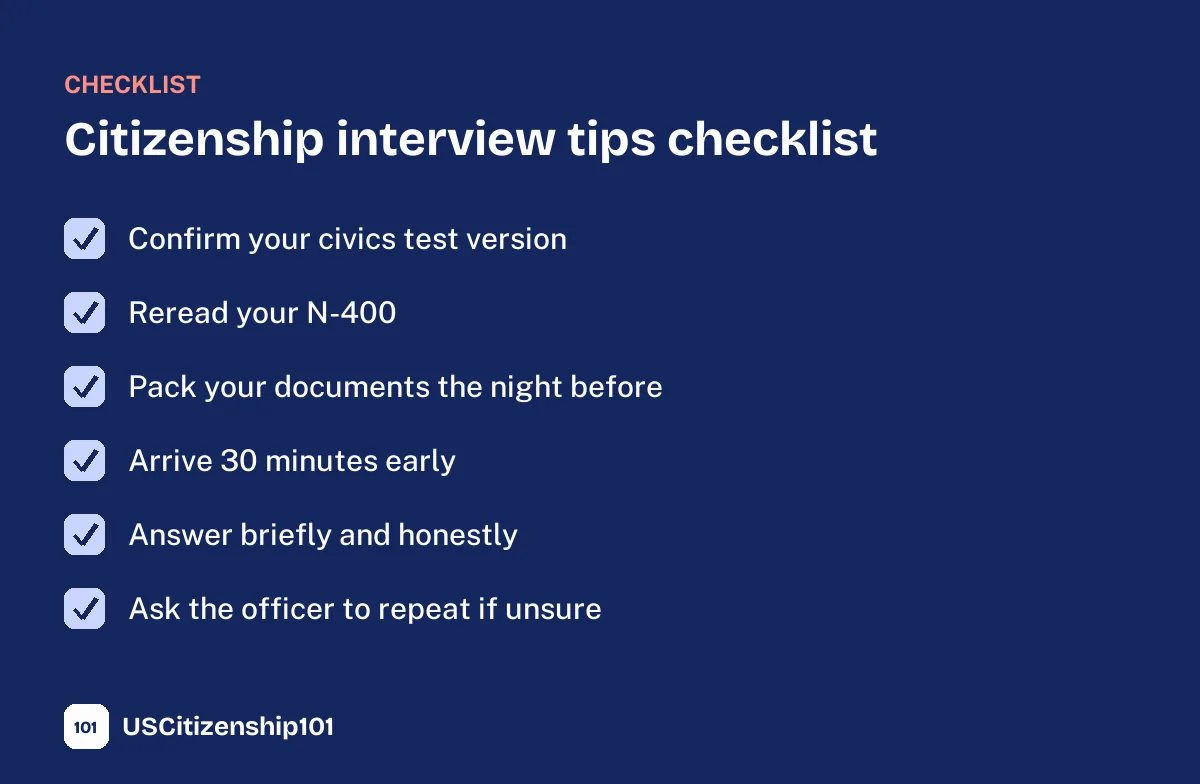
Your citizenship interview tips printable summary
- Know your test version.
- Study daily and practice out loud.
- Pass five mock tests in a row.
- Reread your N-400 and list your trips.
- Pack documents the night before.
- Arrive 30 minutes early.
- Listen fully, answer briefly, tell the truth.
- Ask for repeats when needed.
- Read your N-652 before leaving.
Copy this list onto a card and keep it in your document folder. Read it once in the waiting room before your name is called, then put it away and trust your preparation.
Final thoughts
These citizenship interview tips all point to the same idea: prepare early, practice out loud, bring your documents, and answer honestly. Follow them, and your interview becomes a conversation you have already rehearsed many times.
Sources: USCIS, The Naturalization Interview and Test; USCIS civics and English study materials. Last reviewed September 2026.
Free tools
This article is for general education, not legal advice. Always confirm requirements at uscis.gov.