The Oath of Allegiance Ceremony: What to Expect on the Day You Become a Citizen
What to bring, what to wear, what happens in the room, the full text of the oath explained, and your to-do list after the ceremony.

On this page
The oath of allegiance ceremony is the final step of naturalization and the moment you legally become a citizen of the United States. After months or years of preparation, you raise your right hand, recite the Oath of Allegiance with other new citizens, and receive your Certificate of Naturalization. Until you take the oath, you are not yet a citizen, even if USCIS approved your application.
This guide explains everything about the oath of allegiance ceremony: how you are scheduled, what to bring and wear, what happens in the room, the full text of the oath in plain English, what to check on your certificate, and the important steps to take afterward.
Key points about the oath of allegiance ceremony
- You become a U.S. citizen only after taking the oath at the oath of allegiance ceremony.
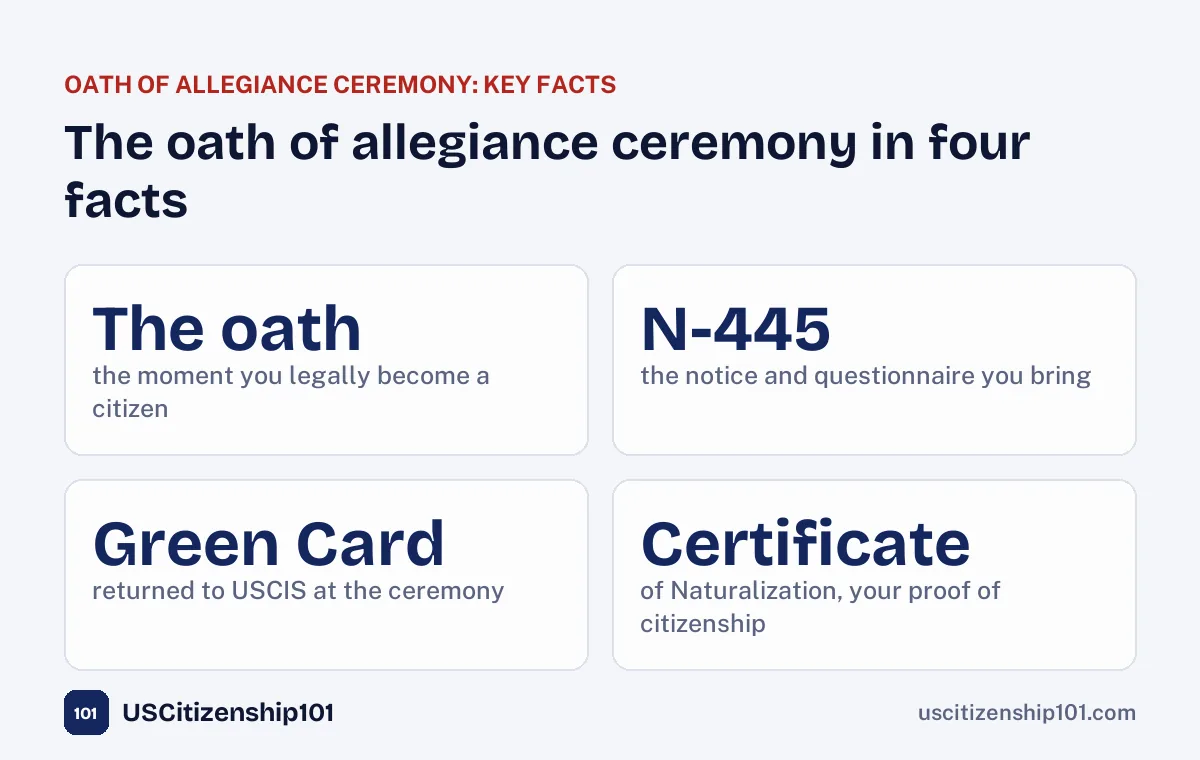
- Some offices hold the ceremony the same day as the interview. Others send Form N-445 with a later date.
- You return your Green Card and receive your Certificate of Naturalization.
- Check your certificate for errors before you leave.
- Afterward, apply for a passport, update Social Security, and register to vote.
How the oath of allegiance ceremony is scheduled
After your interview, if USCIS approves your N-400, you will be scheduled for an oath of allegiance ceremony in one of two ways:
- Same-day oath. Many USCIS field offices can administer the oath on the same day as your interview, sometimes just a few hours later. The officer tells you at the end of your interview.
- Scheduled ceremony. Otherwise, USCIS mails you Form N-445, Notice of Naturalization Oath Ceremony, with the date, time, and place. Ceremonies may be at a USCIS office, a federal courthouse, or a special venue such as a library, park, or historic site.
Administrative vs. judicial ceremonies
USCIS officials run administrative ceremonies. In some districts, federal judges run judicial ceremonies. If you asked to legally change your name on your N-400, your oath must usually happen at a judicial ceremony, because only a court can approve the name change. That can sometimes mean a slightly longer wait.
If you cannot attend
If you cannot attend your oath of allegiance ceremony, follow the instructions on your N-445 to return the notice with a letter explaining why and asking to be rescheduled. Do not simply stay home. Missing ceremonies repeatedly without a good reason can lead to your application being denied.
Form N-445: the questionnaire on the back
The back of Form N-445 has a short questionnaire about the time since your interview. It asks whether, since your interview, you have:
- Married, divorced, or become widowed.
- Traveled outside the United States.
- Claimed to be a U.S. citizen.
- Voted or registered to vote.
- Been arrested, cited, or charged with any crime.
- Joined certain organizations, or done anything else that could affect your good moral character.
Answer honestly and sign it at the ceremony, when a USCIS officer tells you to. If something has changed, an officer may ask you a few questions before the oath of allegiance ceremony begins.
What to bring to the oath of allegiance ceremony
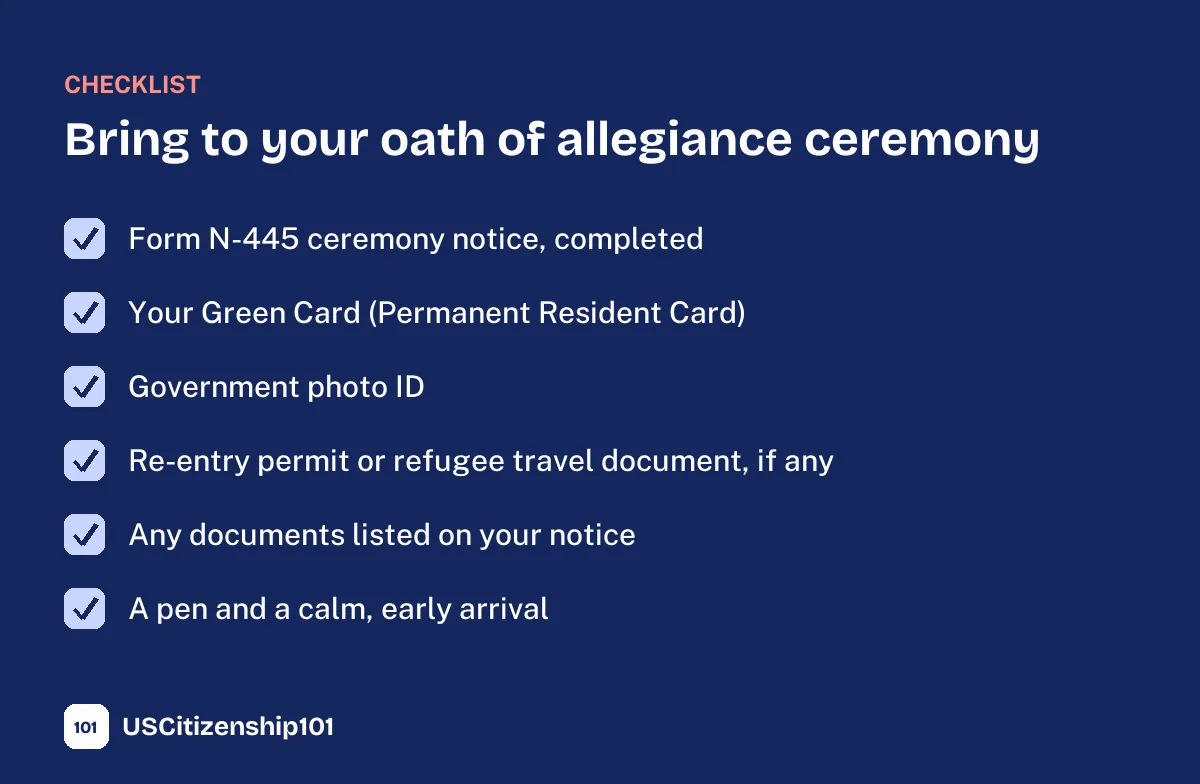
- Your Form N-445, with the questionnaire completed but not signed until instructed.
- Your Permanent Resident Card (Green Card). You will hand it in.
- A government-issued photo ID.
- Any re-entry permit or refugee travel document you have.
- Any other document listed on your notice.
If your Green Card is lost, bring whatever the notice asks, or explain at check-in. Leave large bags at home, because security at federal buildings can be strict.
What to wear
There is no official dress code, but most people dress as they would for a special occasion or a job interview. Business casual is common. Many families dress up and take photos afterward. Avoid shorts, flip-flops, and hats unless worn for religious reasons. Comfortable shoes help, because you may stand in line.
What happens at the oath of allegiance ceremony
- Check-in. You show your notice and ID, return your Green Card, and an officer reviews your N-445 answers.
- Seating. Applicants sit together. Guests usually sit in a separate area.
- Opening. An official welcomes everyone. Many ceremonies include a video message and the reading of the countries represented, which is often a proud and emotional moment.
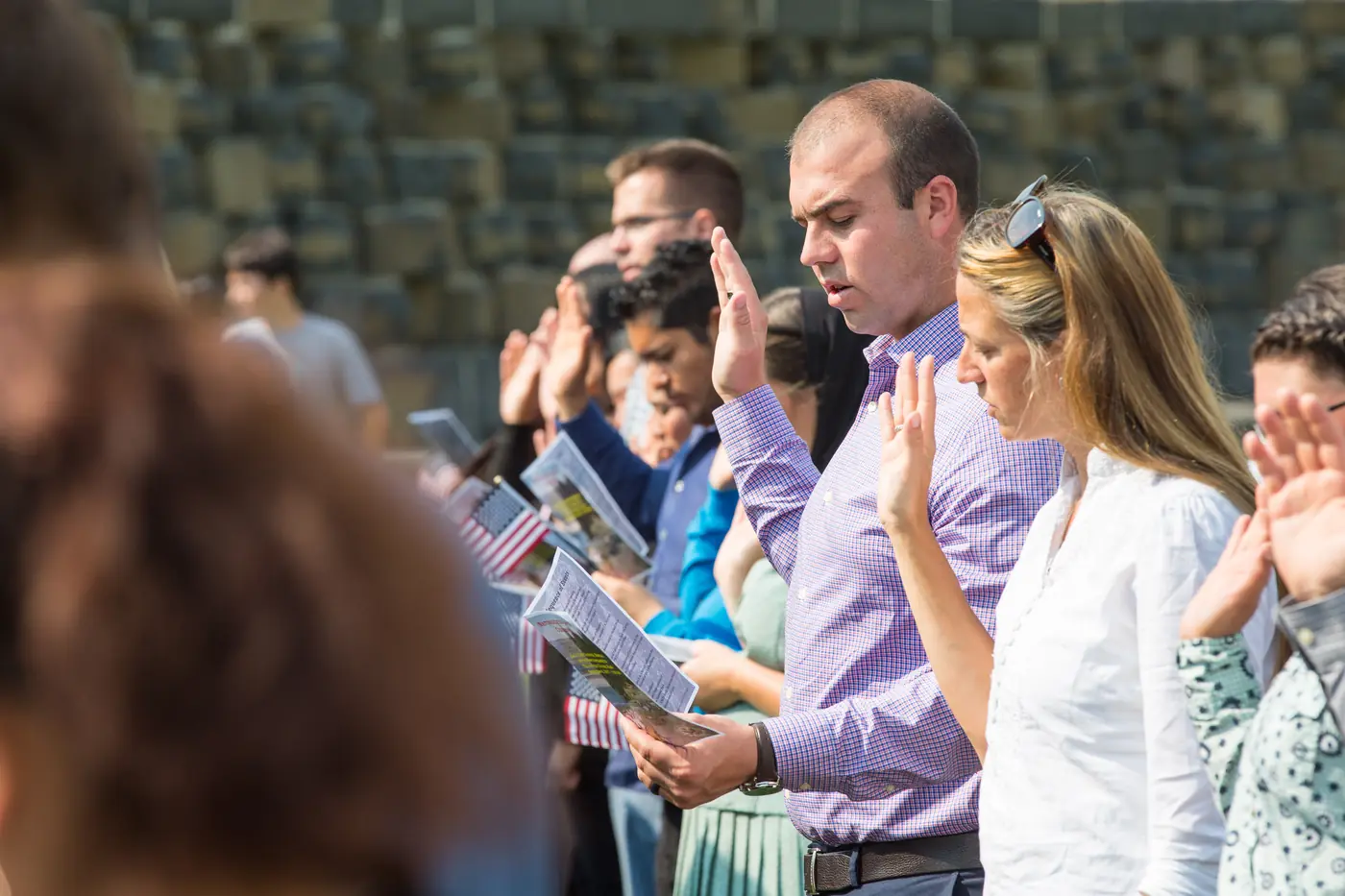
- The oath. Everyone stands, raises their right hand, and repeats the Oath of Allegiance phrase by phrase after the official. At that moment, you become a citizen.
- The Pledge of Allegiance. Many ceremonies lead the new citizens in the Pledge.
- Certificates. Your name is called and you receive your Certificate of Naturalization.
A typical oath of allegiance ceremony lasts one to two hours, including check-in. Larger ceremonies at courthouses or special venues can take longer, because hundreds of people may receive their certificates one by one.
The full Oath of Allegiance, explained
This is the text of the oath, as set out in federal regulations:
“I hereby declare, on oath, that I absolutely and entirely renounce and abjure all allegiance and fidelity to any foreign prince, potentate, state, or sovereignty, of whom or which I have heretofore been a subject or citizen;
that I will support and defend the Constitution and laws of the United States of America against all enemies, foreign and domestic; that I will bear true faith and allegiance to the same;
that I will bear arms on behalf of the United States when required by the law; that I will perform noncombatant service in the Armed Forces of the United States when required by the law; that I will perform work of national importance under civilian direction when required by the law;
and that I take this obligation freely, without any mental reservation or purpose of evasion; so help me God.”
What each part means
- “Renounce and abjure all allegiance…”: you give up loyalty to any other country or ruler.
- “Support and defend the Constitution and laws”: you promise to protect the Constitution and obey U.S. law.
- “Bear true faith and allegiance”: you promise to be loyal to the United States.
- “Bear arms… when required by the law”: you agree to serve in the military if the law requires it.
- “Noncombatant service”: you agree to serve in a non-fighting military role if required.
- “Work of national importance under civilian direction”: you agree to do important civilian work for the country if required.
- “Freely, without any mental reservation”: you take the oath honestly and willingly.
These promises also appear on the 2025 civics test, which asks you to name two promises new citizens make. Read more in rights and responsibilities of U.S. citizens.
The modified oath
If religious training or belief prevents you from promising to bear arms or perform noncombatant service, you may request a modified oath without those phrases. You may also replace “on oath” with “and solemnly affirm” and omit “so help me God.” You can request these modifications on your N-400 or before the ceremony.
Check your Certificate of Naturalization
Before you leave the oath of allegiance ceremony, review your certificate carefully. Check your name, date of birth, country of former nationality, and photo. If anything is wrong because of a USCIS error, tell an officer immediately, before you leave. Fixing it on the spot is much easier than correcting it later with Form N-565.
Your certificate is valuable. Do not laminate it, and do not make photocopies except where the law allows, such as for a passport application. Store it in a safe place.
What to do after the oath of allegiance ceremony
- Apply for a U.S. passport. Use your original certificate. See passport after naturalization.
- Update Social Security. Visit or contact the Social Security Administration so your records show you are a citizen. Waiting about 10 days after the ceremony lets your records reach their system.
- Register to vote. Many ceremonies have registration tables outside the room.
- Help your children. Children under 18 with Green Cards who live with you may now be citizens. Look into Form N-600 or a passport for them.
- Update other records such as your employer’s forms and any state benefits.
- Celebrate. You earned it.

10 easy tips for your oath of allegiance ceremony
- Read your N-445 the day it arrives. Note the date, time, address, and any special instructions.
- Complete the questionnaire in advance, but sign it only when an officer tells you to.
- Put your Green Card with your notice the night before, so you do not forget it.
- Plan your route and parking, and arrive at least 30 to 45 minutes early.
- Check the guest rules for your location, and tell your family how many people can come.
- Dress comfortably but smartly, and wear shoes you can stand in.
- Leave extra items at home, especially large bags, to get through security quickly.
- Charge your phone for photos, but silence it during the oath of allegiance ceremony itself.
- Check your certificate for errors before you leave the building.
- Keep your certificate flat and safe on the way home, and plan your passport application for the following days.
Common problems and how to solve them
- You lost your Green Card. Bring your notice and ID, and explain at check-in. The officer will tell you what to do.
- Something changed since your interview. Mark it honestly on the N-445. Minor changes such as a short trip are usually fine, but serious issues like an arrest may delay your oath of allegiance ceremony.
- You are sick on the day. Return the notice with a letter asking to reschedule, as the instructions explain. Do not attend if you are contagious.
- Your certificate has a typo. Tell an officer before you leave. If you notice later, you may need Form N-565 to correct it.
- You are running late. Call or go anyway and explain. Some offices can still admit you or reschedule you for a later oath of allegiance ceremony.
A short history of the oath
The United States has required new citizens to take an oath since the first naturalization law in 1790. Early oaths simply asked people to support the Constitution. Over time, Congress added the promise to give up loyalty to other countries and to serve the nation when required. The modern wording was standardized in the twentieth century, and today the text is set in federal regulations based on the Immigration and Nationality Act. When you stand at your oath of allegiance ceremony, you are repeating words that millions of immigrants before you have spoken.
Special oath of allegiance ceremonies
Some ceremonies are held on meaningful dates or in memorable places. USCIS holds many special events around Independence Day (July 4) and during Constitution Day and Citizenship Day (September 17), when the country celebrates both the signing of the Constitution and new citizens. Ceremonies also take place at national parks, historic homes, sports stadiums, libraries, and museums. You usually cannot choose a special ceremony, but if you are offered one, it can make the day even more memorable for your family.
Oath waivers for people with disabilities
In rare cases, an applicant has a physical or developmental disability or mental impairment so serious that they cannot understand or communicate an understanding of the oath. The law allows USCIS to waive the oath requirement in these cases, usually with medical evidence and often with a legal guardian or close family member involved. If this may apply to your relative, raise it with USCIS early in the process, and consider speaking with an immigration attorney.
Example timeline to the oath of allegiance ceremony
- Interview day: the officer approves the application and says the office will schedule a ceremony.
- About two to six weeks later: Form N-445 arrives by mail and appears in the online account.
- Ceremony day: check-in, oath, certificate, and photos with family.
- The following weeks: passport application, Social Security update, and voter registration.
Timing varies widely by office. Some applicants take the oath the same afternoon as their interview.
How new citizens describe the day
Many people describe the oath of allegiance ceremony as one of the most emotional days of their lives. Hearing the names of dozens of countries read aloud, and seeing people from all of them stand together, reminds everyone in the room how many journeys led to the same moment. Bring tissues, bring your family if you can, and take time afterward to celebrate. You have earned it.
Preparing your family for the day
An oath of allegiance ceremony is a family milestone. A little planning helps everyone enjoy it:
- Share the address, arrival time, and guest rules with everyone who is coming.
- Explain to children that the ceremony has quiet moments, especially during the oath itself.
- Choose one person to hold bags, coats, and phones so you can move quickly through check-in.
- Agree on a meeting place outside the building in case you are separated.
- Plan a simple celebration afterward, such as a family meal.
Some new citizens bring a small flag or wear red, white, and blue. Others bring an item from their country of birth to honor where they came from. Both are welcome, and many people do both.
Can guests attend?
Usually yes. Most oath of allegiance ceremony events welcome family and friends, though space can be limited, especially at USCIS offices. Some ceremonies have limits on the number of guests. Check your notice or the field office’s instructions. Photos are generally allowed during parts of the ceremony, and many offices have a photo spot with a flag.
Frequently asked questions
When do I officially become a citizen?
At the moment you take the Oath of Allegiance, not at the interview and not when you receive the certificate.
Can I travel between the interview and the oath of allegiance ceremony?
You can, as a permanent resident with your Green Card, but you must report the travel on Form N-445, and you must be present for the ceremony. Plan trips carefully.
Can I bring a religious book to hold during the oath?
Generally yes. Many people take the oath with a hand raised and nothing else, but personal items such as a religious text are usually fine. Follow the officer’s instructions.
What if my name changed after the interview?
Report it on the N-445 questionnaire and bring legal proof. A USCIS officer will advise you.
Do children attend the oath of allegiance ceremony?
Children who became citizens automatically through a parent do not take the oath. Children may attend as guests.
Is there a fee for the oath of allegiance ceremony?
No. The ceremony and your certificate are covered by the N-400 filing fee you already paid.
How long after the interview is the ceremony?
Your oath of allegiance ceremony can be the same day or several weeks later, depending on the field office and ceremony schedules.
Final thoughts
The oath of allegiance ceremony is a day many new citizens remember for the rest of their lives. Bring your notice and Green Card, arrive early, check your certificate before you leave, and take a moment to enjoy it. Then turn to your first tasks as a citizen: your passport, your Social Security record, and your voter registration.
Sources: USCIS, Naturalization Oath of Allegiance; 8 CFR 337.1; USCIS Form N-445. Last reviewed September 2026.
Free tools
This article is for general education, not legal advice. Always confirm requirements at uscis.gov.