128 Civics Questions and Answers for the 2025 Citizenship Test
Every official question and answer for the 2025 civics test, grouped by topic, with memory tips and the 65/20 questions marked.
On this page
The 128 civics questions are the official study list for the 2025 version of the U.S. naturalization civics test. If USCIS received your Form N-400 on or after October 20, 2025, the officer at your interview will ask you up to 20 of these 128 civics questions, and you need 12 correct answers to pass. This page lists every question with its accepted answers, grouped by topic, so you can study in a logical order.
Below the list you will also find memory tips for each section, the questions whose answers change, and a simple plan to learn all 128 civics questions in about a month. Questions marked (65/20) are the 20 questions for applicants who are 65 or older with 20 years as a permanent resident.
Key points about the 128 civics questions
- The 128 civics questions apply to N-400 applications received on or after October 20, 2025.
- The officer asks up to 20 and you need 12 correct. The test stops at 12 right or 9 wrong.
- The test is oral: the officer asks, and you answer out loud.
- For questions with many answers, you only need one, unless the question asks for two or three.
- Applicants 65+ with 20 years of residence study only the 20 marked questions.
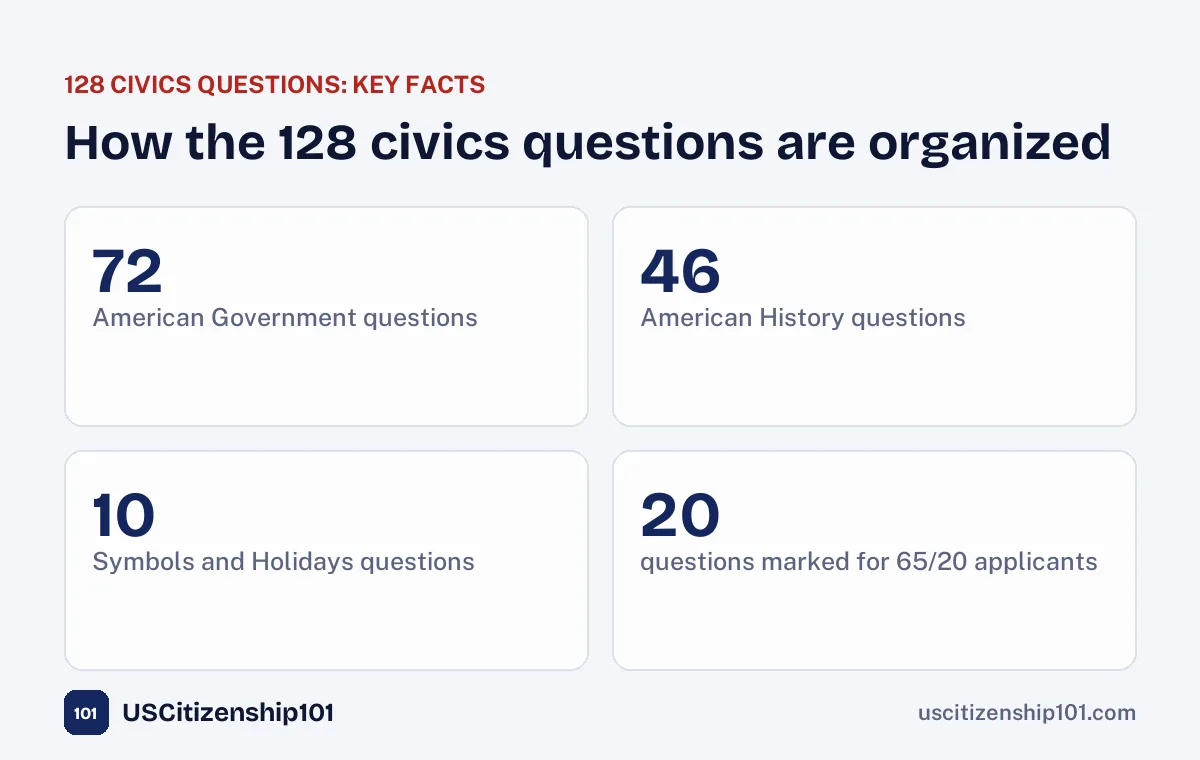
How to use this list of 128 civics questions
Do not try to read all 128 civics questions from top to bottom every day. Instead, pick one section, learn it for a few days, and then move to the next. Each section heading below tells you the topic, and the numbers match the official USCIS list, so you can compare with the government PDF at any time.
For each question, learn at least one answer well. For questions that ask you to “name two” or “name three,” learn one or two extra answers in case you forget one on the day. If you prefer to practice interactively, our free civics practice test uses the same 128 civics questions with flashcards, topic practice, and 20-question mock tests.
The complete list of 128 civics questions and answers
Answers are copied from the official USCIS list. Words in parentheses are optional. Where a question has more than two accepted answers, we show the first two and note that others are also accepted. The official PDF of the 128 civics questions lists every accepted answer.
128 civics questions: American Government, Principles of American Government
- What is the form of government of the United States? Republic; Constitution-based federal republic; and other answers
- What is the supreme law of the land? (65/20) (U.S.) Constitution
- Name one thing the U.S. Constitution does. Forms the government; Defines powers of government; and other answers
- The U.S. Constitution starts with the words “We the People.” What does “We the People” mean? Self-government; Popular sovereignty; and other answers
- How are changes made to the U.S. Constitution? Amendments; The amendment process
- What does the Bill of Rights protect? (The basic) rights of Americans; (The basic) rights of people living in the United States
- How many amendments does the U.S. Constitution have? (65/20) Twenty-seven (27)
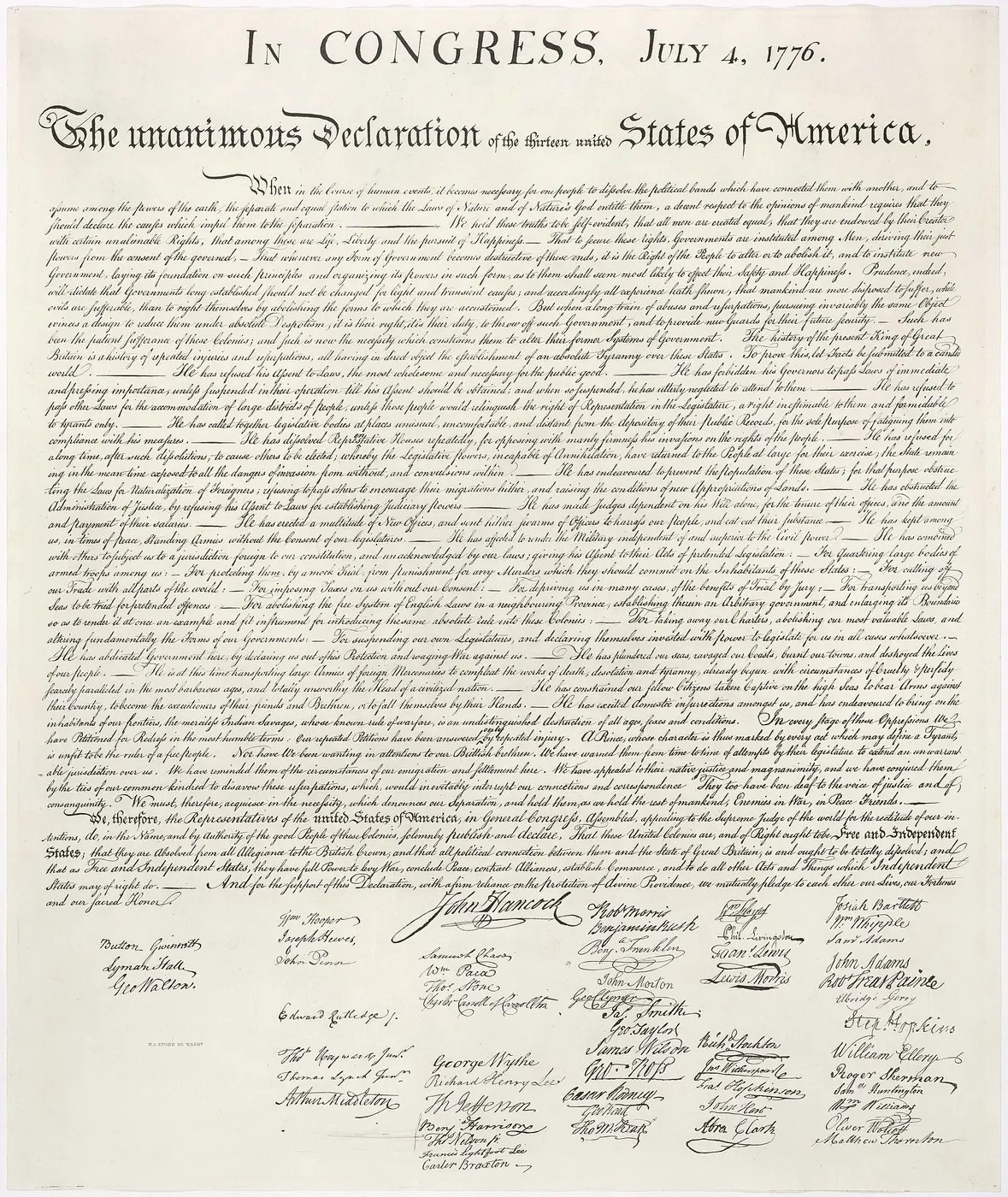
- Why is the Declaration of Independence important? It says America is free from British control.; It says all people are created equal.; and other answers
- What founding document said the American colonies were free from Britain? Declaration of Independence
- Name two important ideas from the Declaration of Independence and the U.S. Constitution. Equality; Liberty; and other answers
- The words “Life, Liberty, and the pursuit of Happiness” are in what founding document? Declaration of Independence
- What is the economic system of the United States? (65/20) Capitalism; Free market economy
- What is the rule of law? Everyone must follow the law.; Leaders must obey the law.; and other answers
- Many documents influenced the U.S. Constitution. Name one. Declaration of Independence; Articles of Confederation; and other answers
- There are three branches of government. Why? So one part does not become too powerful; Checks and balances; and other answers
128 civics questions: American Government, System of Government
- Name the three branches of government. Legislative, executive, and judicial; Congress, president, and the courts
- The President of the United States is in charge of which branch of government? Executive branch
- What part of the federal government writes laws? (U.S.) Congress; (U.S. or national) legislature; and other answers
- What are the two parts of the U.S. Congress? Senate and House (of Representatives)
- Name one power of the U.S. Congress. (65/20) Writes laws; Declares war; and other answers
- How many U.S. senators are there? One hundred (100)
- How long is a term for a U.S. senator? Six (6) years
- Who is one of your state’s U.S. senators now? Answers will vary. [District of Columbia residents and residents of U.S. territories should answer that D.C. (or the territory where the applicant lives) has no U.S. senators.]
- How many voting members are in the House of Representatives? Four hundred thirty-five (435)
- How long is a term for a member of the House of Representatives? Two (2) years
- Why do U.S. representatives serve shorter terms than U.S. senators? To more closely follow public opinion
- How many senators does each state have? Two (2)
- Why does each state have two senators? Equal representation (for small states); The Great Compromise (Connecticut Compromise)
- Name your U.S. representative. Answers will vary. [Residents of territories with nonvoting Delegates or Resident Commissioners may provide the name of that Delegate or Commissioner. Also acceptable is any statement that the territory has no (voting) representatives in Congress.]
- What is the name of the Speaker of the House of Representatives now? (65/20) Mike Johnson (check uscis.gov/citizenship/testupdates before your interview)
- Who does a U.S. senator represent? Citizens of their state; People of their state
- Who elects U.S. senators? Citizens from their state
- Who does a member of the House of Representatives represent? Citizens in their (congressional) district; Citizens in their district; and other answers
- Who elects members of the House of Representatives? Citizens from their (congressional) district
- Some states have more representatives than other states. Why? (Because of) the state’s population; (Because) they have more people; and other answers
- The President of the United States is elected for how many years? (65/20) Four (4) years
- The President of the United States can serve only two terms. Why? (Because of) the 22nd Amendment; To keep the president from becoming too powerful
- What is the name of the President of the United States now? (65/20) Donald J. Trump (check uscis.gov/citizenship/testupdates before your interview)
- What is the name of the Vice President of the United States now? (65/20) JD Vance (check uscis.gov/citizenship/testupdates before your interview)
- If the president can no longer serve, who becomes president? The Vice President (of the United States)
- Name one power of the president. Signs bills into law; Vetoes bills; and other answers
- Who is Commander in Chief of the U.S. military? The President (of the United States)
- Who signs bills to become laws? The President (of the United States)
- Who vetoes bills? (65/20) The President (of the United States)
- Who appoints federal judges? The President (of the United States)
- The executive branch has many parts. Name one. President (of the United States); Cabinet; and other answers
- What does the President’s Cabinet do? Advises the President (of the United States)
- What are two Cabinet-level positions? Attorney General; Secretary of Agriculture; and other answers
- Why is the Electoral College important? It decides who is elected president.; It provides a compromise between the popular election of the president and congressional selection.
- What is one part of the judicial branch? Supreme Court; Federal Courts
- What does the judicial branch do? Reviews laws; Explains laws; and other answers
- What is the highest court in the United States? (65/20) Supreme Court
- How many seats are on the Supreme Court? Nine (9)
- How many Supreme Court justices are usually needed to decide a case? Five (5)
- How long do Supreme Court justices serve? (For) life; Lifetime appointment; and other answers
- Supreme Court justices serve for life. Why? To be independent (of politics); To limit outside (political) influence
- Who is the Chief Justice of the United States now? John G. Roberts, Jr. (check uscis.gov/citizenship/testupdates before your interview)
- Name one power that is only for the federal government. Print paper money; Mint coins; and other answers
- Name one power that is only for the states. Provide schooling and education; Provide protection (police); and other answers
- What is the purpose of the 10th Amendment? (It states that the) powers not given to the federal government belong to the states or to the people.
- Who is the governor of your state now? (65/20) Answers will vary. [District of Columbia residents should answer that D.C. does not have a governor.]
- What is the capital of your state? Answers will vary. [District of Columbia residents should answer that D.C. is not a state and does not have a capital. Residents of U.S. territories should name the capital of the territory.]
128 civics questions: American Government, Rights and Responsibilities
- There are four amendments to the U.S. Constitution about who can vote. Describe one of them. Citizens eighteen (18) and older (can vote).; You don’t have to pay (a poll tax) to vote.; and other answers
- Who can vote in federal elections, run for federal office, and serve on a jury in the United States? Citizens; Citizens of the United States; and other answers
- What are three rights of everyone living in the United States? Freedom of expression; Freedom of speech; and other answers
- What do we show loyalty to when we say the Pledge of Allegiance? (65/20) The United States; The flag
- Name two promises that new citizens make in the Oath of Allegiance. Give up loyalty to other countries; Defend the (U.S.) Constitution; and other answers
- How can people become United States citizens? Be born in the United States, under the conditions set by the 14th Amendment; Naturalize; and other answers
- What are two examples of civic participation in the United States? Vote; Run for office; and other answers
- What is one way Americans can serve their country? Vote; Pay taxes; and other answers
- Why is it important to pay federal taxes? Required by law; All people pay to fund the federal government; and other answers
- It is important for all men age 18 through 25 to register for the Selective Service. Name one reason why. Required by law; Civic duty; and other answers
128 civics questions: American History, Colonial Period and Independence
- The colonists came to America for many reasons. Name one. Freedom; Political liberty; and other answers
- Who lived in America before the Europeans arrived? (65/20) American Indians; Native Americans
- What group of people was taken and sold as slaves? Africans; People from Africa
- What war did the Americans fight to win independence from Britain? American Revolution; The (American) Revolutionary War; and other answers
- Name one reason why the Americans declared independence from Britain. High taxes; Taxation without representation; and other answers
- Who wrote the Declaration of Independence? (65/20) (Thomas) Jefferson
- When was the Declaration of Independence adopted? July 4, 1776
- The American Revolution had many important events. Name one. (Battle of) Bunker Hill; Declaration of Independence; and other answers
- There were 13 original states. Name five. New Hampshire; Massachusetts; and other answers
- What founding document was written in 1787? (U.S.) Constitution
- The Federalist Papers supported the passage of the U.S. Constitution. Name one of the writers. (James) Madison; (Alexander) Hamilton; and other answers
- Why were the Federalist Papers important? They helped people understand the (U.S.) Constitution.; They supported passing the (U.S.) Constitution.
- Benjamin Franklin is famous for many things. Name one. Founded the first free public libraries; First Postmaster General of the United States; and other answers
- George Washington is famous for many things. Name one. (65/20) “Father of Our Country”; First president of the United States; and other answers
- Thomas Jefferson is famous for many things. Name one. Writer of the Declaration of Independence; Third president of the United States; and other answers
- James Madison is famous for many things. Name one. “Father of the Constitution”; Fourth president of the United States; and other answers
- Alexander Hamilton is famous for many things. Name one. First Secretary of the Treasury; One of the writers of the Federalist Papers; and other answers
128 civics questions: American History, 1800s
- What territory did the United States buy from France in 1803? Louisiana Territory; Louisiana
- Name one war fought by the United States in the 1800s. War of 1812; Mexican-American War; and other answers
- Name the U.S. war between the North and the South. The Civil War
- The Civil War had many important events. Name one. (Battle of) Fort Sumter; Emancipation Proclamation; and other answers
- Abraham Lincoln is famous for many things. Name one. (65/20) Freed the slaves (Emancipation Proclamation); Saved (or preserved) the Union; and other answers
- What did the Emancipation Proclamation do? Freed the slaves; Freed slaves in the Confederacy; and other answers
- What U.S. war ended slavery? The Civil War
- What amendment says all persons born or naturalized in the United States, and subject to the jurisdiction thereof, are U.S. citizens? 14th Amendment
- When did all men get the right to vote? After the Civil War; During Reconstruction; and other answers
- Name one leader of the women’s rights movement in the 1800s. Susan B. Anthony; Elizabeth Cady Stanton; and other answers
128 civics questions: American History, Recent American History and Other Important Historical Information
- Name one war fought by the United States in the 1900s. World War I; World War II; and other answers
- Why did the United States enter World War I? Because Germany attacked U.S. (civilian) ships; To support the Allied Powers (England, France, Italy, and Russia); and other answers
- When did all women get the right to vote? 1920; After World War I; and other answers
- What was the Great Depression? Longest economic recession in modern history
- When did the Great Depression start? The Great Crash (1929); Stock market crash of 1929
- Who was president during the Great Depression and World War II? (Franklin) Roosevelt
- Why did the United States enter World War II? (Bombing of) Pearl Harbor; Japanese attacked Pearl Harbor; and other answers
- Dwight Eisenhower is famous for many things. Name one. General during World War II; President at the end of (during) the Korean War; and other answers
- Who was the United States’ main rival during the Cold War? Soviet Union; USSR; and other answers
- During the Cold War, what was one main concern of the United States? Communism; Nuclear war
- Why did the United States enter the Korean War? To stop the spread of communism
- Why did the United States enter the Vietnam War? To stop the spread of communism
- What did the civil rights movement do? Fought to end racial discrimination
- Martin Luther King, Jr. is famous for many things. Name one. (65/20) Fought for civil rights; Worked for equality for all Americans; and other answers
- Why did the United States enter the Persian Gulf War? To force the Iraqi military from Kuwait
- What major event happened on September 11, 2001 in the United States? (65/20) Terrorists attacked the United States; Terrorists took over two planes and crashed them into the World Trade Center in New York City; and other answers
- Name one U.S. military conflict after the September 11, 2001 attacks. (Global) War on Terror; War in Afghanistan; and other answers
- Name one American Indian tribe in the United States. Apache; Blackfeet; and other answers
- Name one example of an American innovation. Light bulb; Automobile (cars, internal combustion engine); and other answers
128 civics questions: Symbols and Holidays, Symbols
- What is the capital of the United States? Washington, D.C.
- Where is the Statue of Liberty? New York (Harbor); Liberty Island [Also acceptable are New Jersey, near New York City, and on the Hudson (River).]
- Why does the flag have 13 stripes? (65/20) (Because there were) 13 original colonies; (Because the stripes) represent the original colonies
- Why does the flag have 50 stars? (Because there is) one star for each state; (Because) each star represents a state; and other answers
- What is the name of the national anthem? The Star-Spangled Banner
- The Nation’s first motto was “E Pluribus Unum.” What does that mean? Out of many, one; We all become one
128 civics questions: Symbols and Holidays, Holidays
- What is Independence Day? A holiday to celebrate U.S. independence (from Britain); The country’s birthday
- Name three national U.S. holidays. (65/20) New Year’s Day; Martin Luther King, Jr. Day; and other answers
- What is Memorial Day? A holiday to honor soldiers who died in military service
- What is Veterans Day? A holiday to honor people in the (U.S.) military; A holiday to honor people who have served (in the U.S. military)
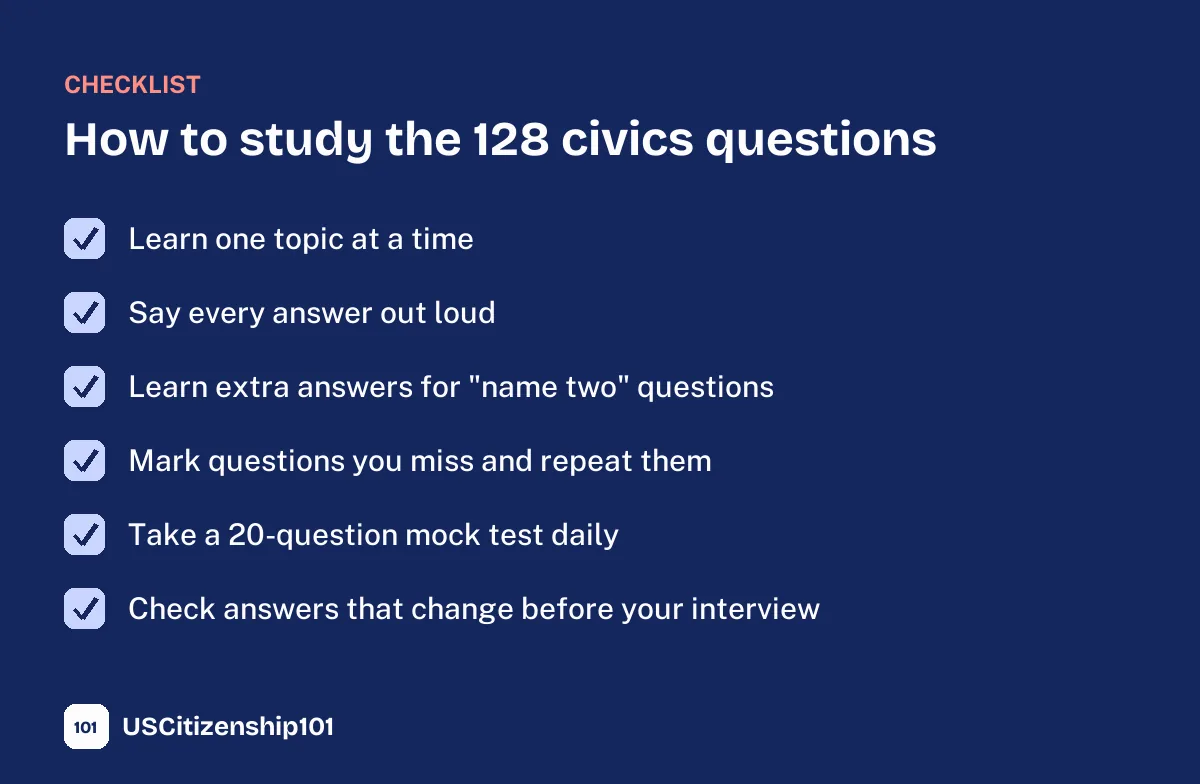
Memory tips for each section
Principles of American Government
These questions are about ideas more than facts. Link them together as a story: the Declaration of Independence said America was free and that people have rights, the Constitution created the government, and the Bill of Rights protected those rights. When you understand the story, many of the 128 civics questions in this section answer themselves.
System of Government
This is the biggest section. Draw three boxes on paper for Congress, the President, and the courts. Write each fact from the list in the correct box: who makes laws, who signs them, who explains them, how long each person serves. Our guide to the three branches of government explains this section in detail.
Rights and Responsibilities
This short part of the 128 civics questions is very practical. Group these into “rights everyone has” (like freedom of speech) and “things only citizens do” (like voting in federal elections and serving on a jury). This split makes the section easy to remember.
American History
Use a timeline. Put the colonial period, the Revolution, the Constitution, the 1800s, the Civil War, the world wars, the civil rights movement, and September 11 in order. Every history question in the 128 civics questions fits somewhere on that line. Our American history questions guide tells the story in order.
Symbols and Holidays
These are the quickest points among the 128 civics questions. Learn them in the first week to build confidence, then move on to the harder sections.
Why USCIS created the 128 civics questions
The 128 civics questions replaced the 100-question list for new applicants to give a broader view of American government and history. The new list adds more questions about founding documents, the powers of each branch, citizen participation, and events from the colonial era to recent history. Because the officer now asks up to 20 of the 128 civics questions instead of 10, a strong result depends on steady study across every topic rather than luck.
Answers that change
A few of the 128 civics questions depend on who is in office or where you live, including the President, Vice President, Speaker of the House, Chief Justice, your senators, your representative, your governor, and your state capital. We list current answers in our guide to civics test answers that change. Always check uscis.gov/citizenship/testupdates the week of your interview.
A four-week plan for the 128 civics questions
- Week 1: Principles of American Government, Rights and Responsibilities, and Symbols and Holidays.
- Week 2: System of Government, questions about Congress and the President.
- Week 3: The rest of System of Government, and American History.
- Week 4: One 20-question mock test every day, plus review of your mistakes.
By the end of week four you will have practiced all 128 civics questions several times. For a detailed daily version, see our civics test study plan.
Frequently asked questions
Do I need to memorize all 128 civics questions?
Yes, you should study all 128 civics questions unless you qualify for 65/20. The officer can choose any of the 128 civics questions, so you should be ready for all of them.
Is there a printable version of the 128 civics questions?
Yes. Our practice test page has a print button that prints all 128 civics questions, and you can also print this page from your browser.
Do I have to use the exact words?
No. Officers accept answers that clearly mean the same thing. Learning the official wording is still the safest approach.
What if I filed before October 20, 2025?
Then you take the 2008 test with 100 questions. Use our list of the 100 civics questions instead.
How long does it take to learn the 128 civics questions?
Most people need four to eight weeks of regular practice to learn the 128 civics questions well. Read more in our full guide to the 2025 civics test.
Source: USCIS, 128 Civics Questions and Answers (2025 version), form M-1778, available at uscis.gov. Current officials checked September 2026.
Free tools
This article is for general education, not legal advice. Always confirm requirements at uscis.gov.