The 2025 Civics Test: What Changed and How to Pass the 128-Question Exam
The new naturalization test has 128 questions, and the officer asks 20. Here is who takes it, what changed, and a step-by-step plan to pass.
On this page
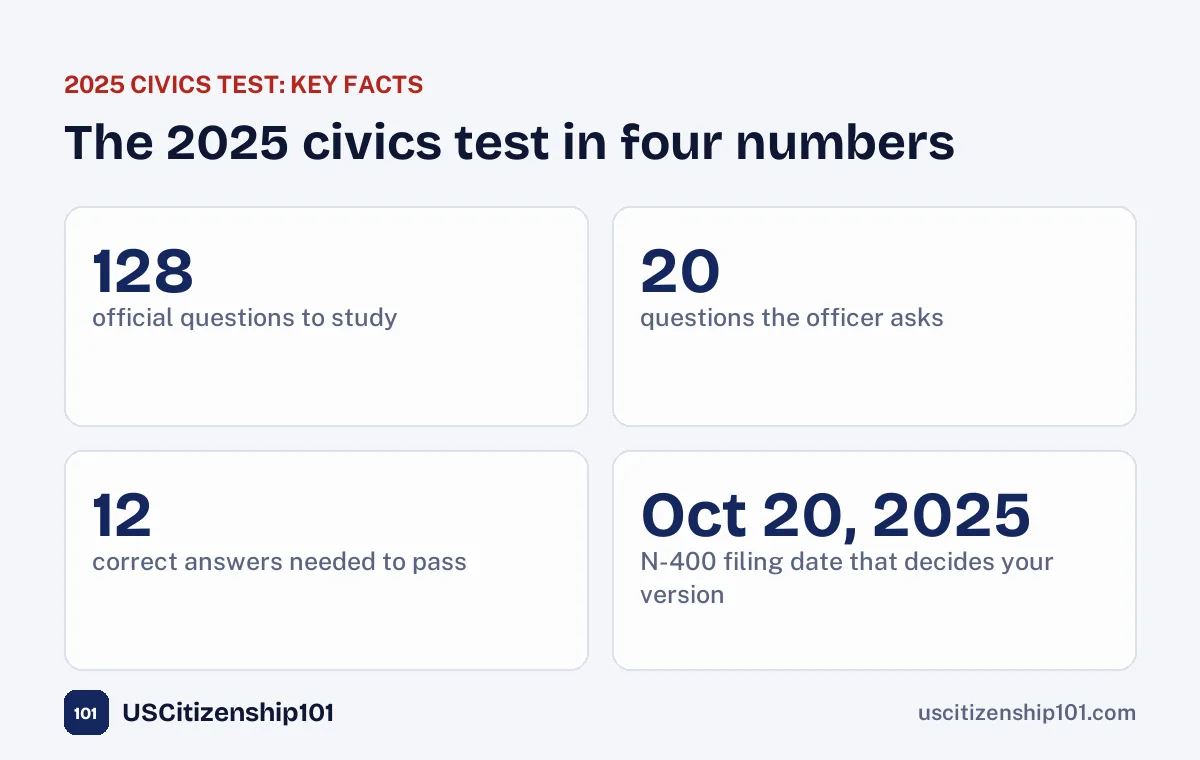
The 2025 civics test is the version of the U.S. naturalization civics exam that USCIS uses for most people applying for citizenship today. If you filed Form N-400 on or after October 20, 2025, this is the test you will take at your interview. It has more questions than the old test, the officer asks more of them, and you need more correct answers to pass.
This guide explains everything in plain English: who takes the 2025 civics test, how it works on interview day, how it compares with the 2008 version, which topics it covers, and a simple seven-step plan to pass it the first time.
Key points about the 2025 civics test
- The 2025 civics test applies to N-400 applications filed on or after October 20, 2025.
- You study 128 questions. The officer asks up to 20.
- You pass with 12 correct answers. The officer stops once you reach 12 correct or 9 incorrect.
- The test is oral. You hear the question and answer out loud.
- Applicants 65 or older with 20 years as a permanent resident study only 20 questions.
Who takes the 2025 civics test?
Your version of the test depends on one date: the day USCIS received your Form N-400, Application for Naturalization. This date is printed on your receipt notice (Form I-797C) as the “received date.”
- Received on or after October 20, 2025: you take the 2025 civics test.
- Received before October 20, 2025: you take the 2008 civics test, even if your interview happens later.
Your interview date does not change your version. Someone who filed in September 2025 and is interviewed in 2026 still takes the 2008 test. Someone who filed in November 2025 takes the 2025 civics test. If you are not sure, look at your receipt notice or your USCIS online account before you start studying, so you do not waste time on the wrong list.
USCIS also uses the same version for a retest. If you take the 2025 civics test at your first interview and do not pass, your second attempt is also the 2025 civics test.
How the 2025 civics test works on interview day
There is no separate test center and no computer. The civics test happens during your naturalization interview at a USCIS field office, usually after the officer reviews your application and gives you the English reading and writing test.
The officer reads the questions
The officer asks each question out loud. You answer out loud in English, unless you qualify for an exception that lets you use an interpreter. The officer does not show you a list of answers. That is why the 2025 civics test is sometimes called “open answer”: you need to know the answer yourself, not recognize it.
Up to 20 questions, 12 to pass
The officer chooses questions from the official list of 128. You need 12 correct answers to pass. The officer stops as soon as the result is clear:
- When you answer 12 questions correctly, you pass and the test ends, even if fewer than 20 questions were asked.
- When you answer 9 questions incorrectly, you cannot reach 12 anymore, so the test ends and that attempt is not a pass.
In practice, many well-prepared applicants answer 12 or 13 questions and are done. The officer will usually tell you right away that you passed.
What counts as a correct answer
USCIS publishes accepted answers for every question. Some questions have one answer (“What is the supreme law of the land?” The Constitution). Others have many, and you only need to give one (“Name one power of the U.S. Congress.”). A few ask for two or three items, and you must give that many.
You do not need to repeat the official wording exactly. Officers accept answers that clearly mean the same thing. However, the safest approach is to learn the official answers, because they are short and easy to remember.
What changed from the 2008 test
The easiest way to understand the 2025 civics test is to compare it with the 2008 test that most applicants used before.
| 2008 test | 2025 civics test | |
|---|---|---|
| Questions to study | 100 | 128 |
| Questions asked | Up to 10 | Up to 20 |
| Correct answers to pass | 6 | 12 |
| Test ends early at | 6 correct or 5 wrong | 12 correct or 9 wrong |
| 65/20 question set | 20 questions, 10 asked, 6 to pass | 20 questions, 10 asked, 6 to pass |
| Applies to N-400s received | Before October 20, 2025 | On or after October 20, 2025 |
The passing percentage is the same, 60 percent. What changes is the amount of material and the number of questions you face. Because the officer asks twice as many questions, a lucky set of easy questions matters less. You need broad knowledge across all topics.
Many questions from the 2008 list are still on the 2025 civics test, sometimes with slightly different wording. The new list adds more questions about the founding documents, the Constitution’s principles, the powers of each branch, and American history from the colonial period to recent events.
If this feels familiar, you may remember that USCIS briefly used a similar 128-question test from December 2020 to April 2021. That version was withdrawn. The 2025 civics test is a new version with its own list, so study from the current official questions, not old 2020 materials.
Topics on the 2025 civics test
The 128 questions are grouped into three main sections. Knowing the structure helps you plan your study time.
American Government (72 questions)
This is the largest section of the 2025 civics test, with more than half of all questions. It has three parts:
- Principles of American Government (15 questions): the Constitution, “We the People,” the Bill of Rights, the Declaration of Independence, and ideas like the rule of law and self-government.
- System of Government (47 questions): the three branches, Congress, the President, the Supreme Court, federal and state powers, and elections.
- Rights and Responsibilities (10 questions): voting, the Oath of Allegiance, and duties of citizens.
Our guide to the three branches of government covers many of these questions in detail.
American History (46 questions)
- Colonial Period and Independence (17 questions): the colonies, the American Revolution, the founders, and the Constitutional Convention.
- 1800s (10 questions): the Louisiana Purchase, the Civil War, Abraham Lincoln, and the end of slavery.
- Recent American History (19 questions): the world wars, the Great Depression, the civil rights movement, the Cold War, and September 11, 2001.
For a story-style review of these events, read American history questions for the citizenship test.
Symbols and Holidays (10 questions)
The shortest section covers the flag, the national anthem, the Statue of Liberty, and national holidays. These are some of the easiest points on the 2025 civics test, so learn them early.
Questions whose answers change
A few questions on the 2025 civics test depend on who holds office on the day of your interview:
- The name of the President of the United States
- The name of the Vice President
- The name of the Speaker of the House of Representatives
- The name of the Chief Justice of the United States
Others depend on where you live, such as one of your state’s U.S. senators, your U.S. representative, your governor, and your state capital. We keep the current national answers and links to look up your state’s answers in our guide to civics test answers that change. USCIS lists official updates at uscis.gov/citizenship/testupdates.
The 65/20 option on the 2025 civics test
If you are 65 or older and have been a lawful permanent resident for 20 years or more when you file, you qualify for special consideration. Instead of all 128 questions, you study only the 20 questions marked with an asterisk on the official list. The officer asks 10 of them and you need 6 correct. You may also take the test in your own language with an interpreter.
You can see all 20 of those questions on our study guides page, and practice them alone by checking “Only the 65/20 questions” in the practice test. Other age-based options, such as 50/20 and 55/15, are explained in our guide to citizenship test exemptions.
7 easy steps to pass the 2025 civics test
You do not need to be a history expert. You need a plan and regular practice. Here is a simple method that works for busy adults.
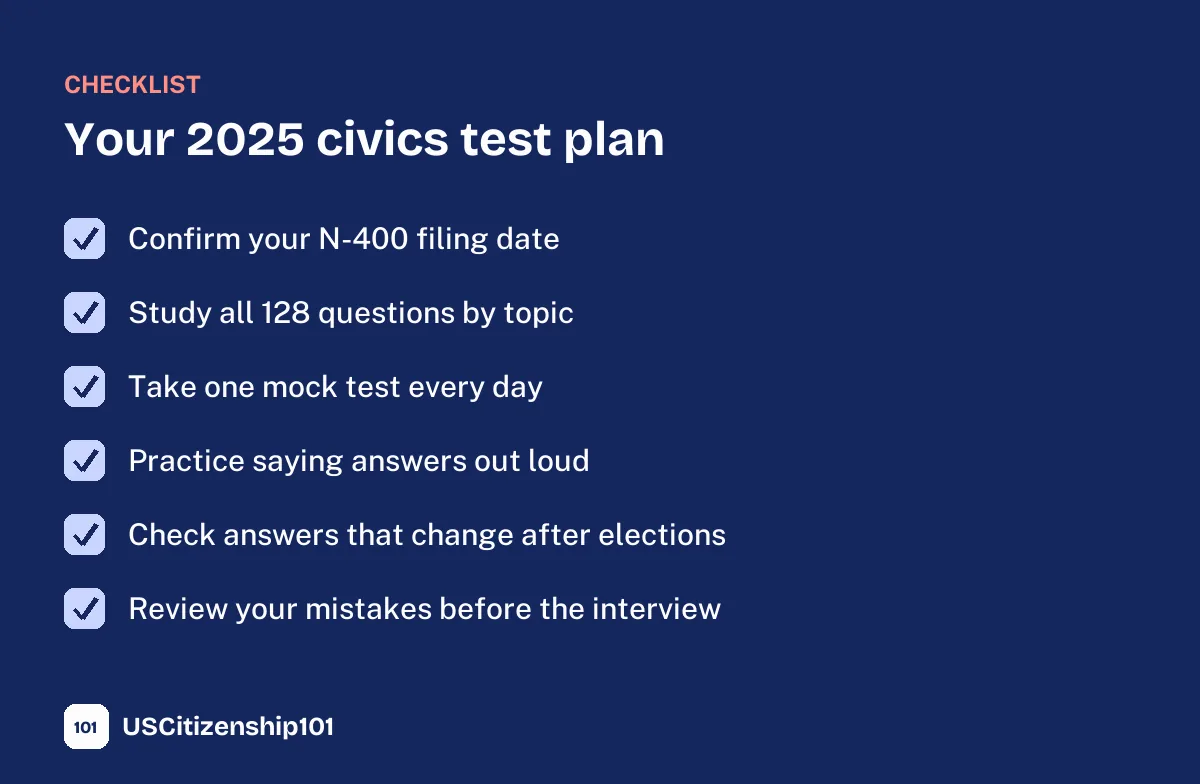
Step 1: Confirm your version
Check the received date on your N-400 receipt notice. If it is October 20, 2025 or later, study for the 2025 civics test. Studying the right list saves weeks of effort.
Step 2: Get the official list
Use only the official 128 questions and answers. You can read them all on our practice test page or download the official PDF from USCIS. Avoid old books and videos that still teach the 100-question list if you filed after the change.
Step 3: Study by topic, not in order
Group similar questions together. Learn all the questions about Congress in one session, then all the questions about the President. Your brain remembers connected facts better than a random list.
Step 4: Learn a little every day
Aim for 20 to 30 minutes a day rather than three hours on the weekend. Daily practice builds long-term memory. Many people learn five to eight new questions a day and review older ones.
Step 5: Say every answer out loud
The 2025 civics test is spoken, so practice speaking. Read the question, cover the answer, and say it. Our flashcards can read questions to you in an American English voice so you get used to hearing them.
Step 6: Take full mock tests
Once you have studied every topic, take a mock test every day. Our free civics practice test asks 20 random questions and stops at 12 correct or 9 wrong, exactly like the officer. When you pass five mock tests in a row, you are ready.
Step 7: Review your mistakes
Your mistakes show you exactly what to study. Use “Review mistakes” mode to practice only the questions you missed. Repeat until you get each one right twice.
A four-week study schedule
If your interview is about a month away, this schedule covers every topic on the 2025 civics test with time for review.
| Week | Focus | Daily goal |
|---|---|---|
| 1 | Principles of American Government, Rights and Responsibilities | 6 new questions, review yesterday’s |
| 2 | System of Government (Congress, President, courts, states) | 8 new questions, one short quiz |
| 3 | American History and Symbols and Holidays | 8 new questions, one short quiz |
| 4 | Full review | One 20-question mock test and your mistakes |
For a day-by-day version, see our civics test study plan.
Sample questions from the 2025 civics test
Here are ten real questions from the official list, with one accepted answer for each. Try to answer before you read the answer, and say it out loud.
- What is the form of government of the United States? A republic (also accepted: a constitution-based federal republic, or a representative democracy).
- What does the Bill of Rights protect? The basic rights of Americans.
- How many amendments does the U.S. Constitution have? Twenty-seven (27).
- Why is the Declaration of Independence important? It says America is free from British control (other answers are accepted too).
- Name one power of the U.S. Congress. Writes laws, declares war, or makes the federal budget.
- How long is a term for a U.S. senator? Six (6) years.
- Who can vote in federal elections, run for federal office, and serve on a jury in the United States? Citizens (U.S. citizens).
- What territory did the United States buy from France in 1803? The Louisiana Territory.
- Martin Luther King, Jr. is famous for many things. Name one. He fought for civil rights.
- Why does the flag have 50 stars? Because there is one star for each state.
If you knew most of these, you already have a strong start on the 2025 civics test. If not, that is normal at the beginning. Every question becomes easy with repetition.
Common mistakes to avoid
- Studying the wrong version. This is the most common and most costly mistake. Always check your filing date first.
- Memorizing only multiple choice. Recognizing an answer is easier than recalling it. Practice answering without options.
- Ignoring the “name two” and “name three” questions. Giving only one item on a question that asks for two is a wrong answer.
- Forgetting current officials. Check names the week of your interview.
- Answering too fast. If you did not understand the question, politely ask the officer to repeat it. This is allowed.
We cover more of these in citizenship test mistakes and how to avoid them.
What the English test looks like with the 2025 civics test
The civics test is only one part of the naturalization test. You also show that you can read, write, and speak basic English. For reading, you read one of up to three sentences out loud correctly. For writing, you write one of up to three sentences correctly. Your speaking is judged during the whole interview.
The reading and writing sentences use words from the official USCIS vocabulary lists, many of which also appear in civics answers. Studying the 2025 civics test helps your English test too. Practice both on our English practice page.
What happens if you do not pass
If you do not reach 12 correct answers, you are not denied on the spot. USCIS gives you a second chance, usually 60 to 90 days later, and you only retake the part you missed. If you passed English but not civics, you only take the 2025 civics test again. Read the details in what happens if you fail the citizenship test.
Frequently asked questions
Is the 2025 civics test harder than the 2008 test?
It covers more material and asks more questions, so it takes more preparation. The pass rate required is the same 60 percent. With a steady study plan, most applicants find it very manageable.
Can I choose which version I take?
No. Your N-400 received date decides your version. You cannot switch versions.
Are the 2025 civics test questions multiple choice?
No. The officer asks questions out loud and you answer out loud. Multiple choice practice is useful for learning, but you should also practice answering without options.
How long should I study for the 2025 civics test?
Most people need four to eight weeks of regular practice. If English is new for you, give yourself more time and focus on saying answers out loud.
Where can I practice the 2025 civics test for free?
Right here. Our free practice test includes all 128 questions, mock tests with the real pass rules, flashcards, and a mistakes review, with no account needed.
Final thoughts
The 2025 civics test asks more of you than the old version, but it is built to be passed. Every question and answer is public, the pass mark is 60 percent, and you get a second chance if you need it. Confirm your version, study a little every day, say your answers out loud, and take mock tests until passing feels routine. When you walk into your interview, you will already know what to expect.
Sources: USCIS, Study for the Test; USCIS, 128 Civics Questions and Answers (2025 version), form M-1778. Last reviewed September 2026.
Free tools
This article is for general education, not legal advice. Always confirm requirements at uscis.gov.