20 Common Citizenship Test Mistakes and How to Avoid Them
The errors that trip up applicants most often, from studying the wrong list to forgetting documents, and simple ways to avoid every one.
On this page
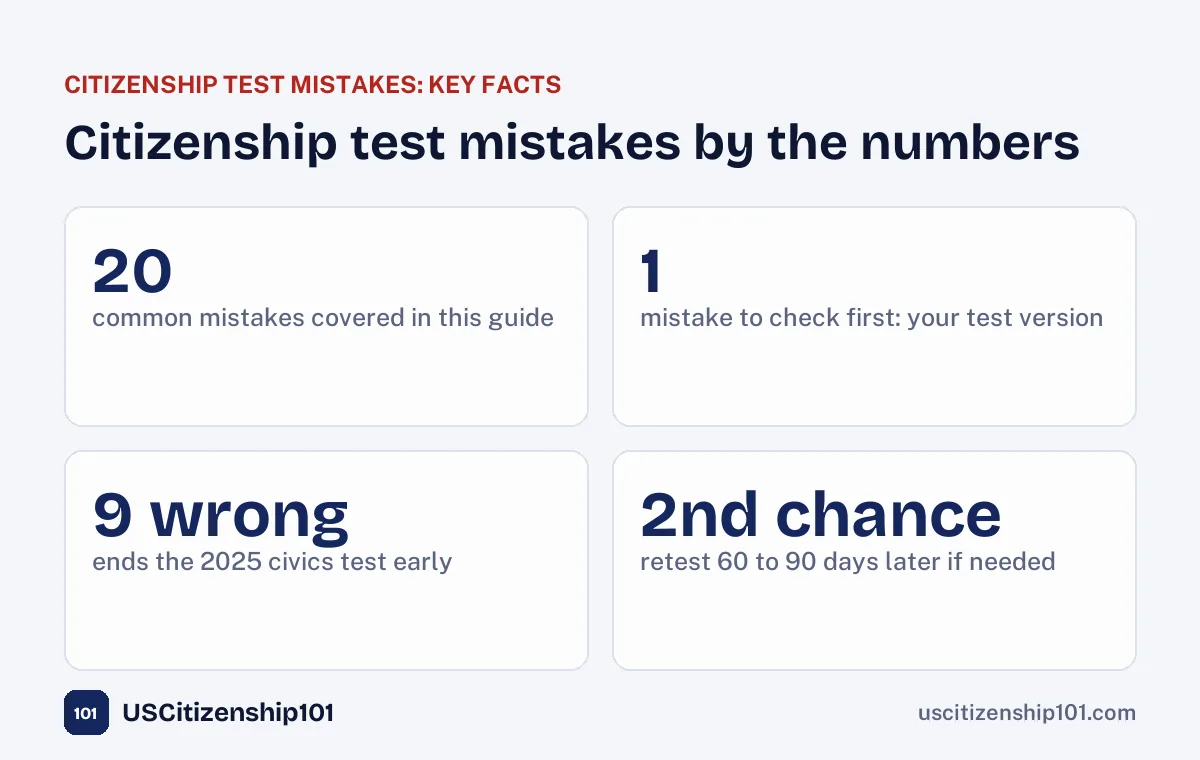
Most applicants who struggle at the naturalization interview do not lack knowledge. They make a handful of predictable citizenship test mistakes: studying the wrong list, forgetting that a question asks for two answers, giving an outdated name, or freezing under pressure. The good news is that every one of these citizenship test mistakes is easy to avoid once you know about it.
This guide lists the 20 most common citizenship test mistakes we see, grouped into study mistakes, civics answer mistakes, English test mistakes, and interview-day mistakes, with a simple fix for each.
Key points about citizenship test mistakes
- The most costly of all citizenship test mistakes is studying the wrong version of the civics test.
- Questions that say “name two” or “name three” need that many answers.
- Names of officials change; check them the week of your interview.
- Practice out loud, because the test is oral.
- If you do make mistakes and fail, you get a free retest.
Study mistakes
1. Studying the wrong version of the test
This is the number one of all citizenship test mistakes. If USCIS received your N-400 on or after October 20, 2025, you take the 2025 civics test with 128 questions. If it was received earlier, you take the 2008 test with 100 questions. Check the received date on your receipt notice before you study anything. Your interview date does not matter.
2. Using outdated study materials
Old books, apps, and videos may teach the wrong list or list former officials. Use the official USCIS questions, such as our lists of the 128 civics questions and 100 civics questions, which are updated when answers change.
3. Cramming at the last minute
Cramming feels productive but fades quickly. Twenty to thirty minutes a day for four weeks works much better. Our civics test study plan lays it out day by day.
4. Only practicing multiple choice
Recognizing an answer among options is much easier than recalling it. The officer does not give options. Practice covering the answer and saying it from memory.
5. Studying silently
The civics test and much of the interview are spoken. Reading silently does not train your mouth or your confidence. Say every answer aloud, ideally to another person.
6. Ignoring your weak topics
It is natural to practice what you already know. Track the questions you miss and practice those most. Our practice test has a “review mistakes” mode for exactly this purpose.
Civics answer mistakes
7. Giving one answer when the question asks for two or three
“Name two national U.S. holidays” needs two. “Name three” needs three. Giving fewer is one of the most frustrating citizenship test mistakes, because you knew the material. Learn one extra answer for each of these questions in case you forget one.
8. Giving an outdated official’s name
The President, Vice President, Speaker of the House, and Chief Justice can change. Check civics test answers that change and the USCIS updates page the week of your interview.
9. Naming a senator or representative from the wrong place
These answers depend on where you live now. If you moved, learn the officials for your new address. Your representative depends on your district, so look it up by ZIP code or street address.
10. Confusing similar answers
Classic mix-ups include the Declaration of Independence (1776) and the Constitution (1787), the Senate (six-year terms) and the House (two-year terms), and the state capital and the largest city. Study these pairs side by side.
11. Mixing up the 1800s and 1900s wars
The world wars were in the 1900s; the Civil War and the War of 1812 were in the 1800s. Draw a simple timeline to keep them apart.
12. Talking too much
Long answers create more chances to say something wrong. Short, clear answers are best. “The Constitution” is better than a paragraph about it.

English test mistakes
13. Forgetting capital letters and punctuation in writing
Start each written sentence with a capital letter, capitalize names like “Washington” and “Congress,” and end with a period or question mark. Small spelling errors may be accepted if the meaning is clear, but missing words usually are not.
14. Not learning the vocabulary lists
The reading and writing sentences come from the official USCIS vocabulary lists. Learning those words, including how to spell them, removes most of the risk. See the USCIS vocabulary list.
15. Reading too fast
When reading the sentence aloud, speed does not help. Read clearly and at a steady pace. Pronunciation matters more than accent.
Interview-day mistakes
16. Not asking the officer to repeat
If you did not understand a question, you can ask the officer to repeat it or say it another way. Guessing is one of the most avoidable citizenship test mistakes.
17. Forgetting documents
Bring your interview notice, Green Card, ID, passports, and anything your notice lists. Missing documents can delay your case even if you pass the test. Prepare a folder the night before and check it against your notice, item by item, so nothing is left at home.
18. Giving answers that do not match your N-400
The officer compares your spoken answers with your application. Review your N-400 copy before the interview so your dates, addresses, and trips are fresh in your mind. If something changed or was wrong, tell the officer honestly.
19. Arriving late or stressed
Arrive 30 minutes early to allow for security lines. Eat beforehand and bring water. A calm start helps your memory. Check traffic or transit schedules the night before, and plan a backup route in case of delays, so a late train does not become one of your citizenship test mistakes.
20. Giving up after one mistake
On the 2025 test you can miss up to 8 questions and still pass. On the 2008 test you can miss up to 4. One wrong answer is not failure. Take a breath and focus on the next question.
Application mistakes that affect your interview
Some of the most serious citizenship test mistakes actually happen months earlier, on Form N-400. The officer uses your application as the script for the interview, so errors there come back to you on test day.
Leaving out trips abroad
List every trip outside the United States longer than 24 hours in the period the form asks about, with dates. Officers can see travel records, and missing trips raise questions about honesty and continuous residence. Read our guide to the continuous residence requirement.
Not disclosing arrests or citations
You must list every arrest, citation, or charge, even if it was dismissed, expunged, or happened long ago. Bring certified court records. Failing to disclose can be treated as a lack of good moral character, which is far worse than the original issue. See good moral character.
Filing too early
You may file up to 90 days before you meet the residence requirement, but not earlier. Filing too early means a denial and a lost fee. Our guide to N-400 early filing shows how to count.
Inconsistent names and dates
Use the same spelling of your name and the same dates everywhere. If your documents disagree, bring proof that explains why, such as a marriage certificate.
Mistakes with test exemptions
Applicants who qualify for the 50/20, 55/15, or 65/20 exceptions make their own set of citizenship test mistakes:
- Filing a few weeks before qualifying. Age and years are counted on the filing date, not the interview date.
- Forgetting to bring an interpreter. USCIS does not provide one for naturalization interviews.
- Studying the full list under 65/20. Focus first on the 20 marked questions.
- Assuming civics is waived by age. It is never waived by age alone. Only an approved medical exception on Form N-648 can waive it.
Our guide to citizenship test exemptions covers each rule in detail.
Mistakes before a retest
If you need a second attempt, avoid these citizenship test mistakes:
- Studying everything again. Focus on the part you missed, shown on Form N-652.
- Waiting until the last week. You have 60 to 90 days, so start the day after your first interview.
- Missing the retest appointment. If you cannot attend, contact USCIS to reschedule before the date.
- Moving without updating your address. You could miss the new notice.
A simple self-check before your interview
One week before your interview, answer these questions honestly. Each “no” points to one of the citizenship test mistakes above.
- Have I confirmed my test version from my receipt notice?
- Have I passed at least five full mock tests in a row?
- Can I give two or three answers for every “name two” or “name three” question?
- Do I know the current President, Vice President, Speaker, and Chief Justice?
- Do I know one of my senators, my representative, my governor, and my state capital?
- Can I read and write the practice sentences with correct capitals and punctuation?
- Have I reviewed my N-400 so my answers match it?
- Have I gathered every document my interview notice lists?
- Do I know how to get to the office and how long security takes?
- Am I comfortable asking the officer to repeat a question?
Real-world scenarios
These short scenarios show how small citizenship test mistakes play out, and how easily they could be avoided.
- The wrong list: an applicant who filed in November 2025 studied an old 100-question book. At the interview, several questions were unfamiliar. A two-minute check of the receipt notice would have prevented it.
- The missing holiday: asked to name two national holidays, an applicant said “Independence Day” and then froze. Learning a third, like Thanksgiving, would have given a backup.
- The old Speaker: an applicant studied from notes written a year earlier and named a former Speaker of the House. Checking the USCIS updates page the week before would have caught it.
- The rushed reading: nervous, an applicant read the English sentence too quickly and skipped a word. Slowing down and pointing to each word fixes this.
Each of these applicants passed at their retest after correcting the specific mistake, which shows how fixable these problems are.
How nerves cause citizenship test mistakes, and how to stay calm
Many citizenship test mistakes are not knowledge problems at all. Stress narrows attention, speeds up speech, and makes familiar answers disappear for a moment. Knowing this helps you plan for it:
- Rehearse the setting. Practice with someone sitting across a table and reading questions, so the real interview feels familiar.
- Use a breathing pause. Before each answer, take one slow breath. Two seconds of silence is normal and gives your memory time to work.
- Keep answers short. Short answers reduce the chance of adding something wrong when nervous.
- Remember the margin. You can miss several questions and still pass. One mistake is not the end.
- Sleep and eat well. A tired brain makes more citizenship test mistakes than a rested one.
Citizenship test mistakes on the 2008 version
Applicants taking the 2008 test face a shorter test, only 10 questions with 6 needed to pass, so each wrong answer matters more. Five wrong answers end the test. Common citizenship test mistakes on the 2008 version include forgetting the political party of the President, forgetting how many justices are on the Supreme Court, and naming the wrong ocean or river in the geography questions. Study the 2008 list carefully, including its Integrated Civics section on geography, symbols, and holidays.
Mistakes helpers and family members make
Family members want to help, but they can accidentally cause citizenship test mistakes too. Helpers sometimes quiz from outdated lists, accept almost-correct answers to be kind, or give too many hints. The best help is strict and friendly: use the official list, ask each question once, and only accept an answer that matches an official answer in meaning. That kind of practice makes the real interview easier.
How to find your own citizenship test mistakes before the interview
The best way to avoid citizenship test mistakes is to make them in practice, not at the interview. Take full mock tests in our free civics practice test. It asks 20 random questions on the 2025 version and stops at 12 correct or 9 wrong, just like the officer. After each test, review the questions you missed and note the type of mistake: did you not know it, confuse it, or give too few answers? Patterns will appear quickly, and fixing them takes only days.
Quick reference: mistake and fix
| Mistake | Quick fix |
|---|---|
| Wrong test version | Check the received date on your N-400 receipt notice |
| Outdated study book or app | Use the official USCIS list |
| Too few answers for “name two” | Learn one extra answer as a backup |
| Old official’s name | Check the USCIS updates page the week before |
| Wrong state officials after moving | Look up officials for your new address |
| Declaration vs. Constitution | 1776 declared freedom; 1787 created the government |
| Missing capital letter or period | Check the first letter and last mark of every sentence |
| Did not understand the question | Ask the officer to repeat it |
| N-400 answers do not match | Review your copy of the application before the interview |
| Freezing under pressure | Practice out loud with a partner and breathe before answering |
Print this table or save it on your phone, and read it during your final week of study. It covers most of the citizenship test mistakes that cost applicants points.
What if you still fail?
Even with good preparation, some people have a bad day. If you fail the English or civics part, you get a free retest 60 to 90 days later and only retake the part you missed. Read what happens if you fail the citizenship test for the full process.

Frequently asked questions
What is the most common reason people fail?
In our experience, studying the wrong version and nerves are the biggest causes. Both are fixable with preparation.
Can I correct an answer after I give it?
Yes. If you realize immediately that you made a mistake, politely tell the officer and give the correct answer.
Do officers accept answers in different words?
Yes, if the meaning is clearly the same as an official answer.
Can a mistake on the English test be fixed on the same day?
Yes, within the test itself. You get up to three sentences for reading and up to three for writing, and you only need one correct in each. If you miss the first sentence, stay calm and focus on the next.
Will the officer tell me which answers were wrong?
Often the officer simply moves on. You will receive your overall result on Form N-652 at the end of the interview.
Do accents cause citizenship test mistakes?
Not usually. Officers are used to many accents. Speak clearly and at a steady pace.
Final thoughts
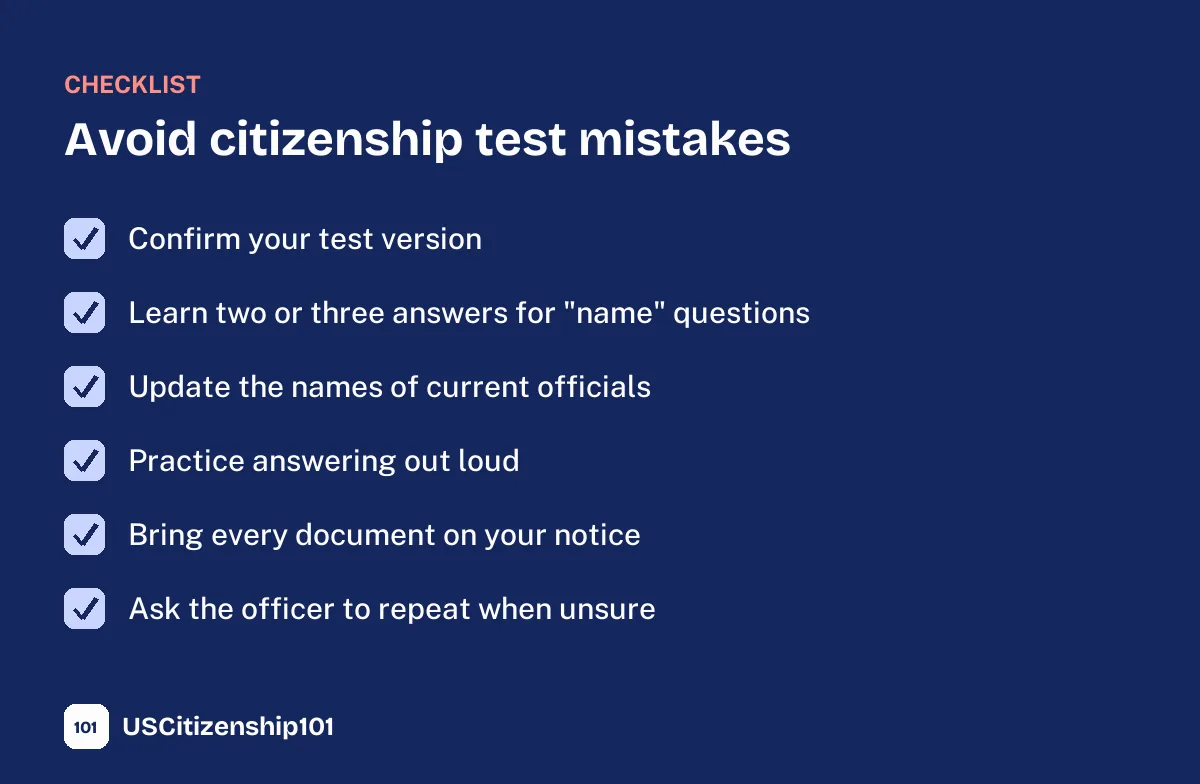
Citizenship test mistakes are common, but they are also predictable. Check your version, learn extra answers for multi-part questions, update the names of officials, practice out loud, and bring your documents. Avoid these 20 citizenship test mistakes, and you give yourself the best possible chance to pass the first time.
Sources: USCIS, Study for the Test; USCIS civics questions and answers (2025 and 2008 versions); USCIS vocabulary lists. Last reviewed September 2026.
Free tools
This article is for general education, not legal advice. Always confirm requirements at uscis.gov.