N-400 Early Filing: How to Apply for Citizenship 90 Days Early
You can file Form N-400 up to 90 days before you meet the residence requirement. Here is how to calculate your exact date and avoid costly mistakes.
On this page
Early filing lets many applicants submit Form N-400 up to 90 days before they reach the continuous residence requirement for U.S. citizenship. If you are on the 5-year path, you can file about three months before your fifth anniversary as a permanent resident. On the 3-year marriage path, you can file about three months before your third anniversary. Early filing can shorten your wait for citizenship, but filing even one day too early leads to a denial and a lost fee.
This guide explains exactly how early filing works, which requirements it applies to and which it does not, how to calculate your earliest date, examples, and the mistakes to avoid.
Key points about early filing
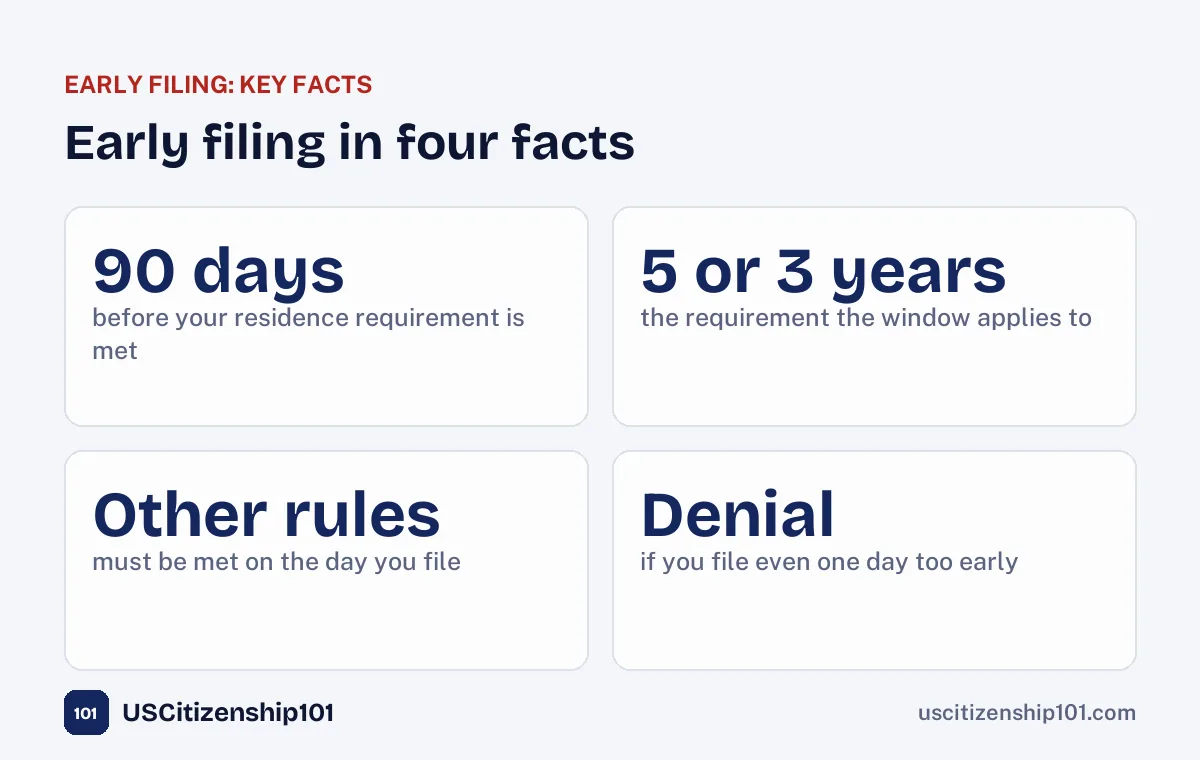
- Early filing allows you to file up to 90 calendar days before you meet the continuous residence requirement.
- It applies to the 5-year and 3-year residence paths.
- Other requirements, such as age 18 and 3 months in your state, must be met on the day you file.
- Physical presence is counted from the filing date backward.
- Filing too early means denial and no refund.
What the 90-day rule says
USCIS allows you to file Form N-400 up to 90 calendar days before you complete your continuous residence requirement, if your eligibility is based on being a permanent resident for 5 years, or 3 years as the spouse of a U.S. citizen. The rule exists because the naturalization process takes time, so you will have met the full residence requirement well before your interview and oath.
How to calculate your early filing date
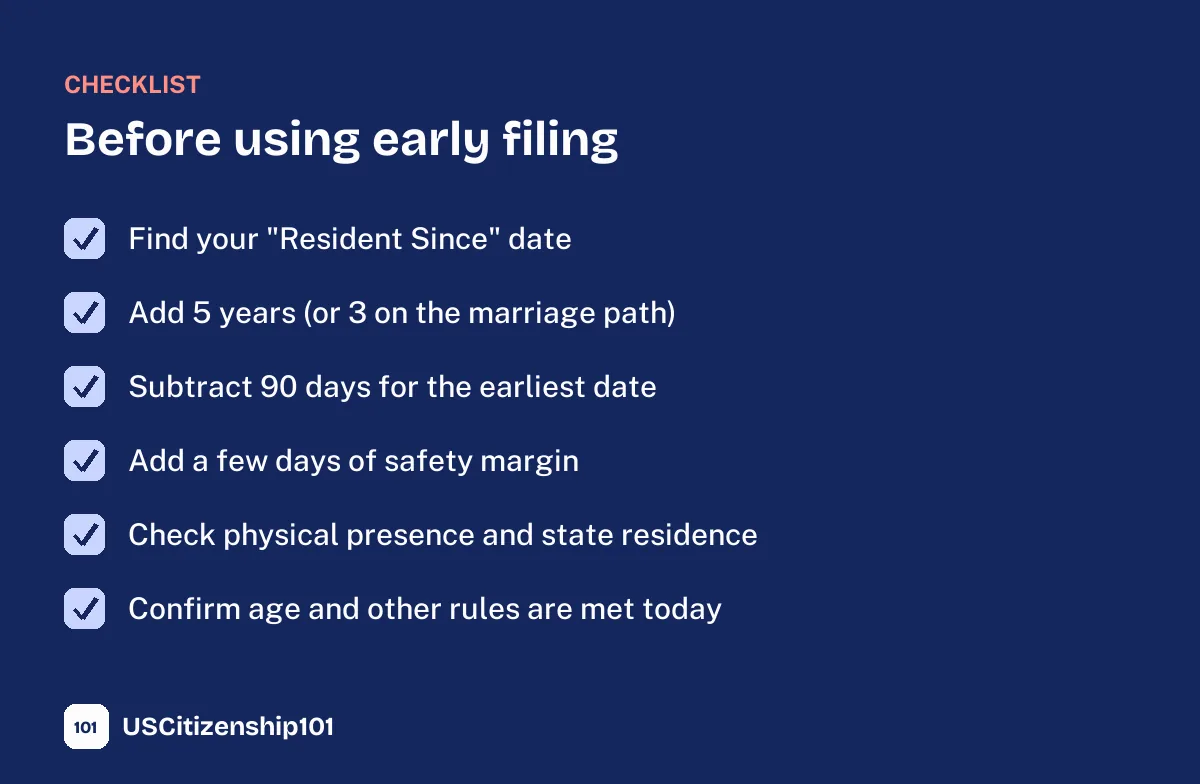
- Find your “Resident Since” date on the front of your Green Card.
- Add 5 years (or 3 years on the marriage path). This is the date you complete continuous residence.
- Subtract 90 days. This is the earliest date USCIS will accept.
- Add a safety margin of a few days, especially if you file by mail.
USCIS offers an early filing calculator on its website. It is a good idea to use it to confirm your date.
Example on the 5-year path
Your Green Card says Resident Since: June 15, 2021. Five years later is June 15, 2026. Ninety days before that is March 17, 2026. That is your earliest early filing date. Filing on March 20, 2026 gives a small safety margin.
Example on the 3-year path
You became a resident on September 1, 2023, through marriage to a U.S. citizen, and you have lived together since. Three years later is September 1, 2026. Ninety days earlier is June 3, 2026. You can file on or after that date, as long as your spouse has been a citizen for 3 years by the time you would reach the requirement and you remain married and living together.

Early filing dates at a glance
This table shows the earliest early filing date on the 5-year path for sample Green Card dates. It was calculated by adding 5 years and subtracting 90 calendar days. Use it to understand the pattern, then calculate your own date or use the USCIS calculator.
| Resident Since | 5 years reached | Earliest early filing date |
|---|---|---|
| January 10, 2021 | January 10, 2026 | October 12, 2025 |
| March 1, 2021 | March 1, 2026 | December 1, 2025 |
| May 20, 2021 | May 20, 2026 | February 19, 2026 |
| July 4, 2021 | July 4, 2026 | April 5, 2026 |
| September 15, 2021 | September 15, 2026 | June 17, 2026 |
| November 30, 2021 | November 30, 2026 | September 1, 2026 |
| February 14, 2022 | February 14, 2027 | November 16, 2026 |
| April 1, 2022 | April 1, 2027 | January 1, 2027 |
| June 30, 2022 | June 30, 2027 | April 1, 2027 |
| August 15, 2022 | August 15, 2027 | May 17, 2027 |
| October 1, 2022 | October 1, 2027 | July 3, 2027 |
| December 20, 2022 | December 20, 2027 | September 21, 2027 |
Early filing and physical presence
Physical presence is counted differently. You need at least 30 months (913 days) inside the United States during the 5 years before your filing date, or 18 months (548 days) on the 3-year path. Because you are filing up to 90 days early, the period you count is the 5 years ending on your actual filing date. List every trip, total your days abroad, and make sure the remaining days meet the minimum on the day you submit. If you travelled a lot, early filing may need to wait until your days add up.
Early filing after a long trip
If a trip of a year or more broke your continuous residence, your residence period restarts after you return. On the 5-year path, many applicants in that situation can use early filing 4 years and 1 day after returning, because the new 5-year period minus 90 days falls at that point. On the 3-year path, it is 2 years and 1 day. Confirm your specific situation carefully, because long absences can raise other questions about your Green Card.

Timing for online and paper applications
For early filing, what counts is the date USCIS receives your application. Online applications are received the moment you submit, so you can file on your exact earliest date. Paper applications are received when they arrive at the USCIS lockbox, which can be several days after mailing. If you mail your N-400, send it so it arrives on or after your earliest date, not before. A package that arrives one day early can be rejected or denied.
Conditional residents
If you have a two-year conditional Green Card, your conditional period counts toward your residence. You can use early filing on the normal schedule, even if your Form I-751 to remove conditions is still pending. USCIS often decides both applications together at your interview, so bring evidence that supports both.
What to do in the 90 days before your date
- Gather your addresses, jobs, and trips for the full period.
- Order certified court records if you have any arrests or citations.
- Request IRS tax transcripts.
- Create your USCIS online account if you plan to file online.
- Start studying civics and English with our civics test study plan.
- Check whether you qualify for a reduced fee. See the N-400 filing fee guide.
Using the weeks before early filing to prepare means your application will be complete and you will be ready if your interview comes quickly.
Three scenarios
The careful filer
Beatriz’s earliest early filing date is April 10. She files online on April 12 with a complete application. Her case moves forward normally.
The rushed filer
Karim counted “three months” instead of 90 days and filed on a date that was two days too early. USCIS denied his application and kept the fee. He had to refile.
The traveller
Sofia reached her early filing date, but a long trip last year left her short of 30 months of physical presence. She waited two more months until her days added up, then filed successfully.
What early filing does not change
Early filing only applies to the continuous residence period. Other requirements must be met on the day you file:
- Age: you must be at least 18 when you file.
- State or district residence: you must have lived in your state or USCIS district for 3 months on the filing date.
- Physical presence: you must have been physically present in the United States for at least half of the period before filing (30 months on the 5-year path, 18 months on the 3-year path).
- Age-based test exemptions: the 50/20, 55/15, and 65/20 exceptions are measured on the filing date, and the 90-day window does not apply to them.
Common mistakes with early filing
- Counting 3 months instead of 90 days. Months vary in length. Always count 90 calendar days.
- Using the wrong date. Use the “Resident Since” date, not the card’s issue date or your arrival date.
- Forgetting about breaks. If a long trip broke your residence, your clock may have restarted. See the continuous residence requirement.
- Mail timing. USCIS counts the date it receives your application, not the date you mailed it.
- Assuming age exemptions apply early. They do not.
Full eligibility checklist for your filing date
On the day USCIS receives your application, confirm each of these:
- You are at least 18 years old.
- You are within 90 days of completing 5 years as a permanent resident (or 3 years on the marriage path).
- Your continuous residence has not been broken by a trip of a year or more, or by a longer trip you cannot explain.
- You have been physically present in the United States for at least half the period.
- You have lived in your state or USCIS district for at least 3 months.
- You can show good moral character for the period.
- On the marriage path, you are married to and living with your U.S. citizen spouse, who has been a citizen for 3 years.
Read the full list of citizenship requirements for details on each one.
Documents to prepare
- A copy of both sides of your Green Card.
- A list of every address, employer, and trip for the statutory period.
- Marriage and divorce records, and your spouse’s proof of citizenship on the marriage path.
- Certified court records for any arrest, citation, or charge.
- Proof of income if you request a reduced fee.
- Form I-912 if you request a fee waiver.
What happens after you file
After USCIS receives your application, you will get a receipt notice. Keep it, because its received date also decides your civics test version. Next comes a possible biometrics appointment, then background checks, an interview notice, the interview with English and civics tests, a decision, and finally the Oath of Allegiance. The full journey is described in our naturalization timeline. By the time your interview arrives, you will have passed your fifth (or third) anniversary as a permanent resident.
Tips for filing online
- Create your USCIS account a few days before your date so you can explore the form.
- Fill in the form as a draft, then submit on your earliest date.
- Upload clear scans of your documents in PDF or JPG format.
- Save the confirmation and receipt number immediately after paying.
Getting help
If your dates are complicated because of long trips, a conditional Green Card, or a change in marital status, consider asking a licensed immigration attorney or DOJ-accredited representative to confirm your date before you file. A short consultation can prevent a costly denial.
Why filing as soon as possible helps
Naturalization can take several months or more after you file, depending on your field office. Every week you wait to submit adds a week to the end of the process. Filing on your earliest allowed date means:
- You may be able to vote in an upcoming election sooner.
- You can apply for a U.S. passport sooner, which helps with international travel.
- Your children under 18 with Green Cards may become citizens sooner.
- You can sponsor relatives as a citizen sooner.
- You avoid having to renew your Green Card if it is close to expiring.
At the same time, it is never worth rushing an incomplete application. A complete, accurate application filed a week later is far better than an incomplete one filed on the first possible day, because errors lead to requests for evidence, delays, or denial.
Your Green Card expiration and citizenship
Many people apply for citizenship around the time their ten-year Green Card is due for renewal. If your card will expire while your N-400 is pending, you should still renew it with Form I-90, or check current USCIS guidance on whether your N-400 receipt notice extends your proof of status. Do not let your card expire without a plan, especially if you need to travel or show proof of status to an employer.
Filing on the marriage path: extra care
On the 3-year path, three separate dates must line up: your Green Card date, your marriage and cohabitation, and your spouse’s citizenship. The 90-day window applies to your residence period, but you must still be married to and living with your citizen spouse when you file and through your oath. If your spouse became a citizen recently, count 3 years from their naturalization date as well. See citizenship through marriage.
How to count 90 calendar days by hand
If you prefer to check the date yourself, count backward from your anniversary date one month at a time, using the actual number of days in each month. For example, from June 15 back to May 15 is 31 days, from May 15 back to April 15 is 30 days, and from April 15 back to March 15 is 31 days, which totals 92 days. Because that is two days more than 90, the earliest date is March 17. A calendar app or the USCIS calculator makes this easy, but it helps to understand why “three months” is not always the same as 90 days.
Keep a record
Write your key dates on a single page and keep it with your immigration documents: your Green Card date, your five-year (or three-year) date, your earliest filing date, the date you actually filed, and your receipt number. This record is useful if you ever need to confirm your filing date with USCIS or explain your timing to an attorney.
Should you file early?
For most people, yes. If your application is complete and your dates are clear, filing as early as allowed starts your case sooner and can move your oath date forward by up to three months. Consider waiting, however, if you are close to qualifying for an age-based exception, if you need time to gather court records, or if you are about to take a long trip.
Frequently asked questions
Does early filing speed up processing?
It does not make USCIS process your case faster, but it starts your case earlier, so the whole process can finish up to three months sooner than if you waited for your anniversary.
What happens if I file too early?
USCIS will deny the application, and the fee is not refunded. You can refile once you are eligible, but you will pay the fee again, so it is worth double-checking your date before you submit.
Is there a USCIS early filing calculator?
Yes. USCIS offers an early filing calculator on its website. Enter your Green Card date and path, and it shows your earliest date.
Does early filing change my civics test version?
Your test version depends on the date USCIS receives your N-400. Applications received on or after October 20, 2025 take the 2025 civics test.
Can I use early filing on the military path?
Military naturalization has its own rules, often without a residence period at all. Check the specific requirements with USCIS or the legal assistance office on your base.
Final thoughts
Early filing is a simple, useful rule when you calculate your date carefully. Use your Green Card date, count 90 calendar days, check your other requirements, and add a small safety margin. Then start preparing for the interview while your case moves forward.
Sources: USCIS, Apply for Citizenship and the USCIS early filing calculator; USCIS Form N-400 instructions. Last reviewed September 2026.
Free tools
This article is for general education, not legal advice. Always confirm requirements at uscis.gov.