How to Register to Vote After Naturalization (2026 Guide)
You can vote in the very next election once you are registered. Here is when to register, how to do it, and how to meet the deadline for November 3, 2026.
On this page
Voting is the one right you gain only by becoming a U.S. citizen, and you can use it in the very next election. To register to vote after naturalization, you wait until you have taken the Oath of Allegiance, then sign up with your state or local election office online, by mail, in person, or at your ceremony. Once your registration is accepted, you can vote in federal, state, and local elections like any other citizen.
This guide explains exactly when and how to register to vote after naturalization, what you need, how registration at the ceremony works, and how to meet the deadline for the November 3, 2026 general election. It also covers the most common mistakes new citizens make, and how to avoid them.
Key points about registering to vote after naturalization
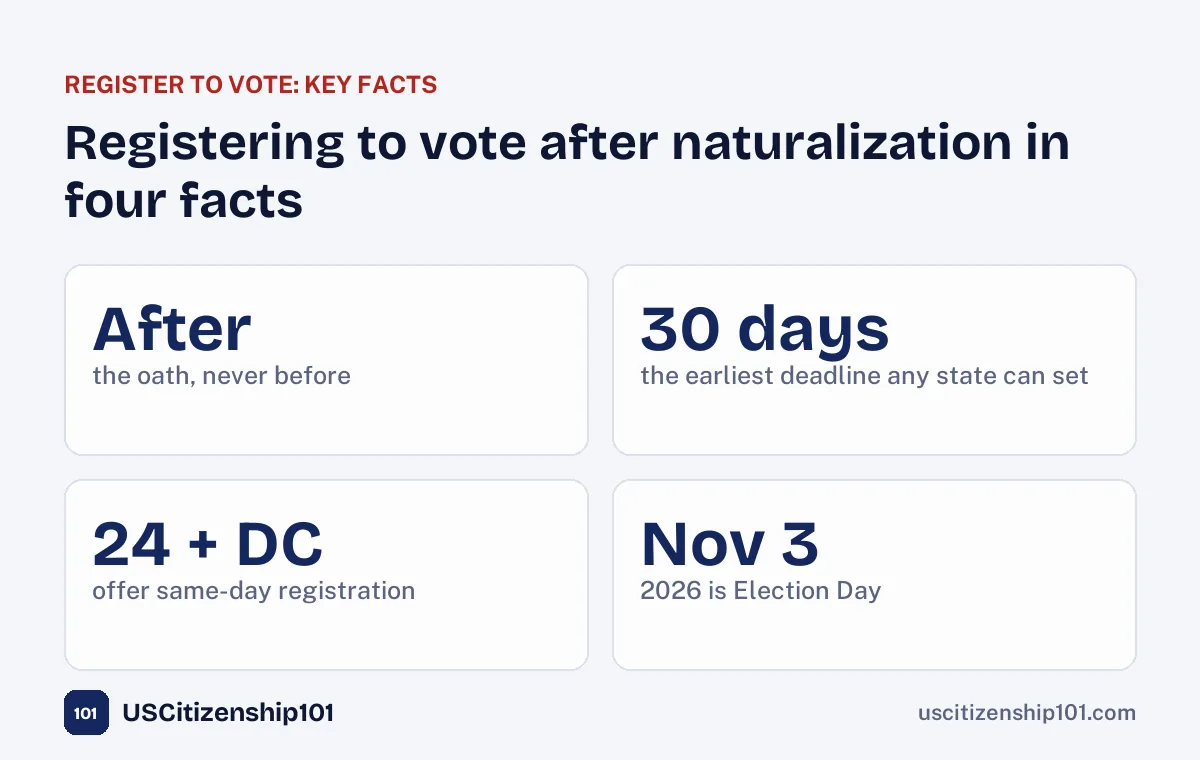
- You can register to vote only after you take the Oath of Allegiance. Registering or voting before the oath can cost you your citizenship case.
- Each state runs its own registration. vote.gov links to your state’s official rules and forms.
- Most people can register to vote online, by mail, or in person. Many ceremonies also offer registration right after the oath.
- Deadlines range from 30 days before Election Day to Election Day itself. Check yours now if you want to vote on November 3, 2026.
- North Dakota has no voter registration. Voters there show ID with their address at the polls.
Can you vote right after you become a citizen?
Yes. There is no waiting period. The moment you take the Oath of Allegiance, you are a U.S. citizen with the same right to vote as someone born here. What you need next is registration, because in almost every state you cannot vote until you are on the voter rolls. If you register to vote after naturalization before your state’s deadline, you can vote in the next election, even if your ceremony was only days earlier.
Your right to vote does not depend on how long you have been a citizen, what language you speak, or whether you passed the English test with an exemption. The only requirements are those every voter must meet: U.S. citizenship, being at least 18 by Election Day, living in the state, and meeting the state’s other rules.
Step 1: Wait until after the oath
This step protects everything you worked for. Voter registration forms ask whether you are a U.S. citizen. Until you take the oath, the honest answer is no, even if your interview is approved and your ceremony is scheduled. Checking “yes” early can count as a false claim to U.S. citizenship, and registering or voting before the oath can lead USCIS to deny your application for lack of good moral character. In serious cases it can also lead to removal from the United States.
If someone offers you a registration form at the DMV or in a store before your ceremony, say no and wait. You can register to vote after naturalization the same day you take the oath.
Step 2: Look up your state’s rules
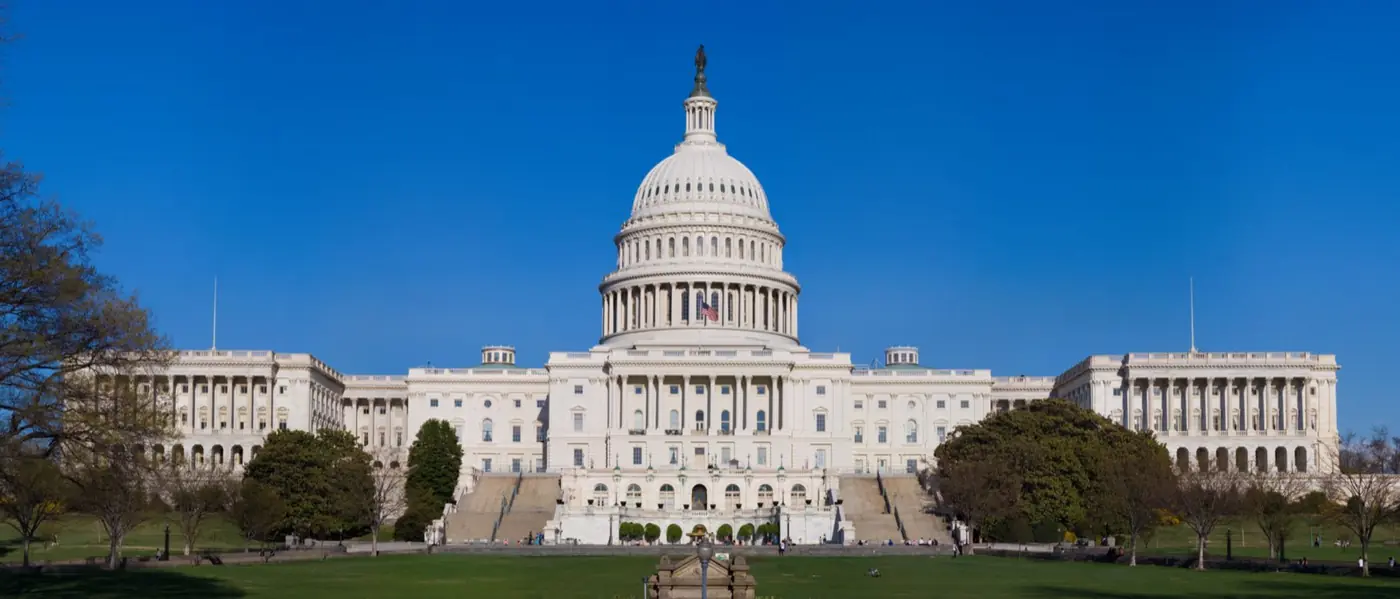
The federal government does not keep a voter list. Each state does, and each sets its own deadlines, ID rules, and methods. The easiest starting point is vote.gov, the official federal site that sends you to your state’s registration page. You can also contact your county or city election office directly.
Look for three things: your registration deadline, whether you can register to vote online, and what number or document your state asks for.
Step 3: Choose how to register to vote
- Online: most states have online registration. It is usually fastest if you have a state driver’s license or ID.
- By mail: use your state’s form or the National Mail Voter Registration Form, which works in most states and is available in Spanish and several other languages.
- In person: at your local election office, and in many states at the DMV and some public assistance offices.
- At your ceremony: many naturalization ceremonies offer registration right after the oath (see below).
Step 4: Fill out the form carefully
Use your full legal name exactly as it appears on your Certificate of Naturalization. If you changed your name at the ceremony, use the new name. Most forms ask for your driver’s license or state ID number, or the last four digits of your Social Security number if you do not have one. You will also give your home address, date of birth, and, in some states, a party choice. Choosing a party is usually optional, though in some states it decides which primary elections you can vote in.
Answer the citizenship question “yes” only after your oath, and sign the form yourself. Signing a registration form is a statement under penalty of perjury, so read each question before you answer.
Step 5: Confirm your registration
After you register to vote after naturalization, check that it went through. Most states have an online tool to look up your registration status, and many mail you a voter card or notice. The same tools usually show your polling place and sample ballot. If you do not appear on the rolls a few weeks after registering, and well before the deadline, call your election office.
Registering at your naturalization ceremony
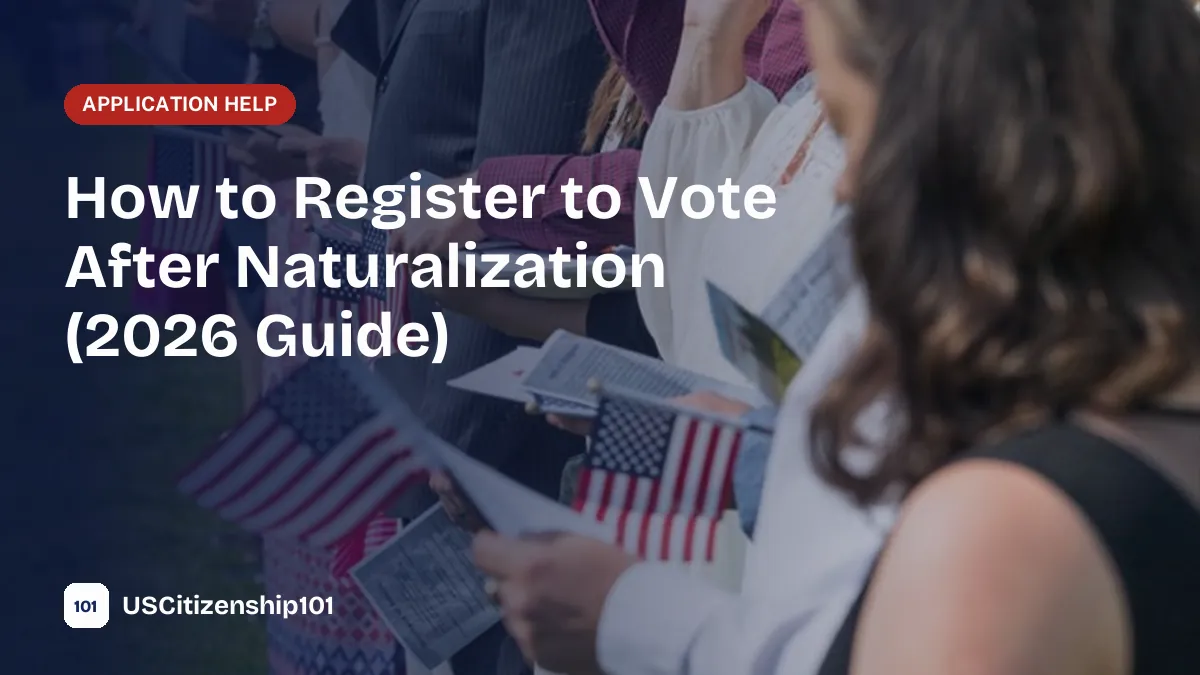
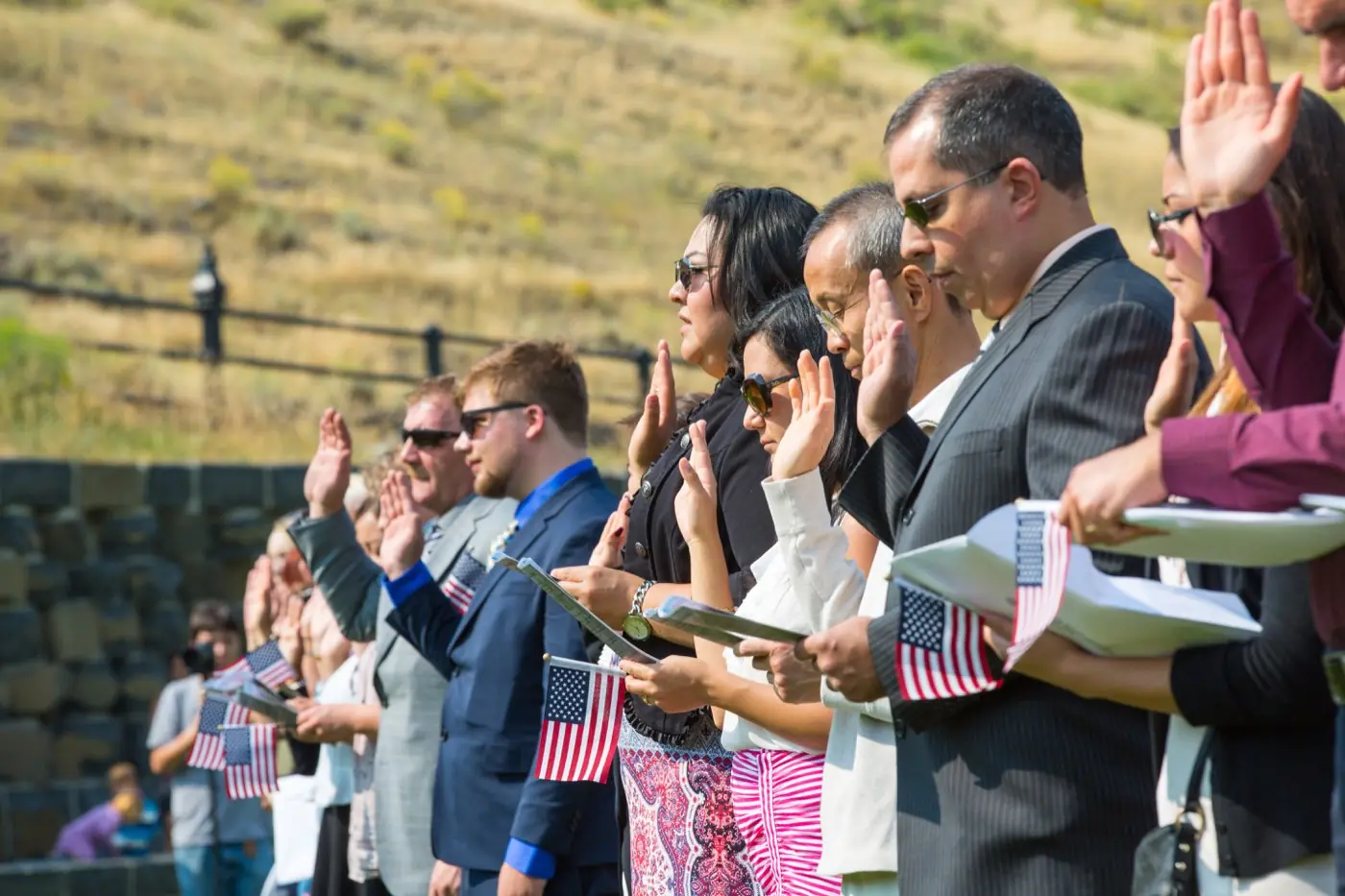
USCIS policy is that every new citizen should have the chance to register to vote at the end of an administrative naturalization ceremony, once they are citizens. USCIS first invites state or local election officials to do this. When election officials are not available, nonprofit, nonpartisan organizations approved by USCIS may hand out and collect forms. If neither is present, USCIS staff give you a registration application to fill out and send in yourself.
This guidance changed in 2025 and was restored on August 31, 2026, after a federal court decision, so what you see can vary by office. Judicial ceremonies held in a courtroom follow the court’s own practice. Either way, registration happens only after the oath, never before it.
If you register to vote at the ceremony, ask whether the form will be submitted for you or whether you must mail it. If you must mail it, do so the same week. See our guide to the oath of allegiance ceremony to know what else to expect that day.
Registration deadlines for the November 3, 2026 election
Federal law lets states set their registration deadline no earlier than 30 days before a federal election. For November 3, 2026, that means the earliest deadlines fall in early October. Some states have different deadlines for online, mail, and in-person registration, so read your state’s page closely.
According to the National Conference of State Legislatures, as of March 2026 these 24 states and the District of Columbia offer same-day registration, where you can register and vote at the same time: California, Colorado, Connecticut, District of Columbia, Hawaii, Idaho, Illinois, Iowa, Maine, Maryland, Massachusetts, Michigan, Minnesota, Montana, Nevada, New Hampshire, New Mexico, New York, North Carolina, Utah, Vermont, Virginia, Washington, Wisconsin, and Wyoming. Details vary, and you must prove where you live, usually with a driver’s license, state ID, or a document such as a utility bill. Rules can change, so confirm with your state before you rely on it.
If your oath comes after the deadline
If your ceremony is scheduled after your state’s regular deadline, check three things right away: whether your state offers same-day registration, whether it has a special rule for people who became citizens after the deadline, and what documents you would need. Your county election office can answer all three. If none of these options applies, register to vote after naturalization anyway, so you are ready for the next election.
Proof of citizenship rules
Most states verify citizenship through the statement you sign and their own records. A few states require documentary proof of citizenship when you register, and in 2026 Congress and the courts are still debating national rules on this. For you, the practical answer is simple: your Certificate of Naturalization or U.S. passport is proof of citizenship.
Keep your original certificate safe at home. If your state asks for proof, follow its instructions exactly, and ask whether a copy or the certificate number is accepted before you send the original anywhere. Getting a passport after naturalization also gives you an easier document to carry.
Voting for the first time
- Know your options: depending on your state, you may vote on Election Day at your polling place, vote early in person, or vote by mail.
- Check ID rules: some states ask for photo ID at the polls, others accept other documents, and some ask for none. First-time voters who registered by mail may need to show ID.
- Language help: many counties provide ballots and materials in Spanish and other languages. If you need help reading the ballot, federal law lets you bring a person of your choice, other than your employer or union representative.
- Study the ballot: look up your sample ballot before you go. Local races and ballot measures can be long.
- If there is a problem: if your name is missing at the polls, ask for a provisional ballot.
A timeline to register to vote before November 3, 2026
If you take the oath this fall and want to vote in the midterm elections, use this timeline as a guide. Your state’s own dates always come first.
- Before your ceremony: look up your state’s deadline and registration methods on vote.gov. Do not fill out or sign anything yet.
- Ceremony day: register to vote at the ceremony if it is offered, or online that evening.
- Within a week: if you were given a paper form to mail, mail it. If you registered online, save the confirmation.
- Two to three weeks later: use your state’s lookup tool to confirm you are registered and find your polling place.
- October: decide whether you will vote early, by mail, or on Election Day, and request a mail ballot if you want one.
- November 3, 2026: vote, with any ID your state requires.
Registering at the DMV
Under the National Voter Registration Act, often called the “motor voter” law, most states let you register to vote when you apply for or renew a driver’s license or state ID. Some states do this automatically unless you opt out. This is convenient, but timing matters for new citizens. The DMV may still have you on file as a noncitizen if your records were created before your oath.
If you go to the DMV after your ceremony, tell the clerk you are now a U.S. citizen and ask how to update your record. Bring your naturalization certificate or U.S. passport if they ask for proof. If you went to the DMV before your oath and were offered registration, the right answer was no. If you think a DMV transaction before your oath may have registered you by mistake, speak with an immigration attorney.
If you live abroad or serve in the military
U.S. citizens who live outside the country, and members of the military and their families, can register to vote and request an absentee ballot through the Federal Post Card Application. The Federal Voting Assistance Program at FVAP.gov explains how it works for each state. You generally vote in the state where you last lived before moving abroad. If you naturalized through military service, FVAP and your unit’s voting assistance officer can help you register to vote.
Students and people who move often
If you are a student, you can usually choose to register to vote either at your school address or at your family’s home address, but not both. Pick one and vote only there. If you move often, update your registration each time you move, because your polling place and ballot depend on your address. Many states let you update your address online in a few minutes.
How to register to vote with a new name
Many people change their name at the naturalization ceremony. If you did, register to vote under the new name printed on your certificate. Update your Social Security record and your driver’s license as soon as you can, because some states check your registration against those records. If the names do not match, your registration may be delayed or flagged. Updating Social Security first often makes the other updates easier.
Keeping your registration current
Once you register to vote, you generally stay registered as long as you keep voting and your address stays the same. States clean their lists, and if you do not vote for several elections and do not answer a mailed notice, you may be removed. Check your status before each major election, especially if you have moved, changed your name, or not voted in a while.
Common mistakes to avoid
- Registering before the oath, even by accident at the DMV.
- Using a name that does not match your naturalization certificate.
- Waiting too long and missing the deadline.
- Assuming the ceremony form was submitted when you were supposed to mail it.
- Forgetting to update your registration after you move.
- Mailing your original naturalization certificate when a copy or number was enough.
Why registering matters
On the civics test, you learned that voting in a federal election is one of the responsibilities only for U.S. citizens. Now you can act on it. Your vote helps choose your representatives in Congress, your governor, your school board, and local measures that affect your daily life. Registering can also put you on the list for jury duty in many places, which is another duty of citizenship. Read more in our guide to the rights and responsibilities of citizens.
Frequently asked questions
How soon after naturalization can I register to vote?
Right after you take the Oath of Allegiance. Many new citizens register to vote after naturalization the same day, at the ceremony or online.
Can I vote if I became a citizen a week before the election?
Yes, if you can still register to vote in time. In states with same-day registration, you can register and vote on the same day. In other states, check whether you are still within the deadline or whether a special rule applies.
Do I need my naturalization certificate to register to vote?
Usually not. Most states ask for a driver’s license, state ID, or Social Security number. A few states require proof of citizenship, and your certificate or U.S. passport counts.
Can I register to vote if I do not speak much English?
Yes. English is not a requirement to vote. Many states and counties offer forms and ballots in Spanish and other languages, and the national mail form is available in several languages.
What if I registered by mistake before my oath?
Talk to an immigration attorney before you do anything else, and do not vote. How it is handled depends on the facts, so get legal advice specific to your case.
Do I have to choose a political party?
Usually not. You can register without a party. In some states, your party choice decides which primary elections you can vote in.
Do I have to register to vote again if I move?
Yes, update your registration whenever you move, including within the same city. Moving to another state always requires a new registration.
Final thoughts
Becoming a citizen gives you a voice in how the country is run, and registering is the step that lets you use it. Wait until your oath, look up your state’s rules on vote.gov, register to vote after naturalization online, by mail, in person, or at your ceremony, and confirm that you are on the rolls. Do it now, and you can vote on November 3, 2026.
Sources: USCIS Policy Manual, Volume 12, Part J, Chapter 5; USAGov, Register to vote; NCSL, Same-Day Voter Registration; NCSL, Voter Registration Deadlines. Last reviewed September 2026.
Free tools
This article is for general education, not legal advice. Always confirm requirements at uscis.gov.