How to Get a U.S. Passport After Naturalization
Your first U.S. passport, step by step: which form to use, what happens to your naturalization certificate, and how to plan travel after your ceremony.
On this page
Getting a passport after naturalization is one of the first things most new citizens do, and for good reason. You surrender your Green Card at the oath ceremony, so until you have a U.S. passport, you have no convenient travel document. A U.S. passport also becomes your main everyday proof of citizenship, which is easier to carry than your naturalization certificate.
This guide explains how to get your first passport after naturalization: the form to use, the documents and photo you need, where to apply, fees, processing times, and how to plan international travel in the weeks after your ceremony.
Key points about getting a passport after naturalization
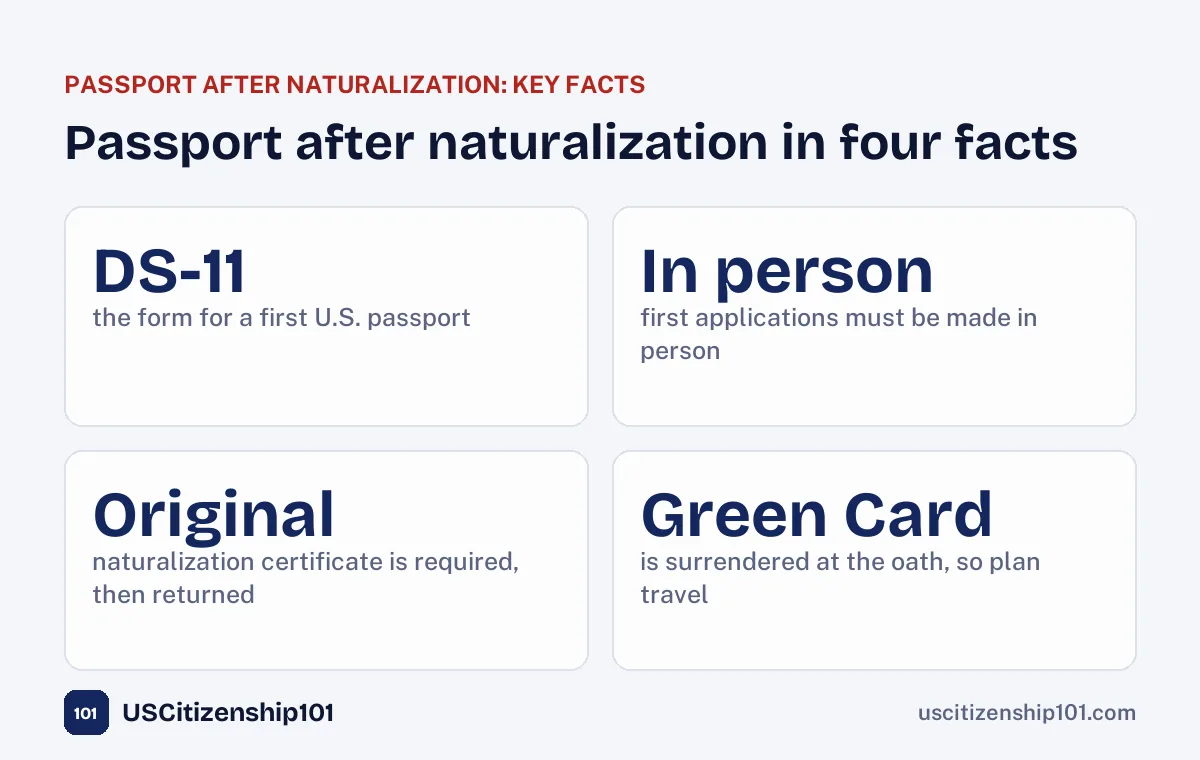
- First-time applicants use Form DS-11 and must apply in person.
- You submit your original Certificate of Naturalization; it is returned to you, usually separately.
- Bring a photocopy of the certificate and your photo ID.
- After the oath, you cannot travel on your Green Card, and you must use a U.S. passport to reenter the United States.
- Check fees and processing times at travel.state.gov.
Step 1: Wait for your ceremony and certificate
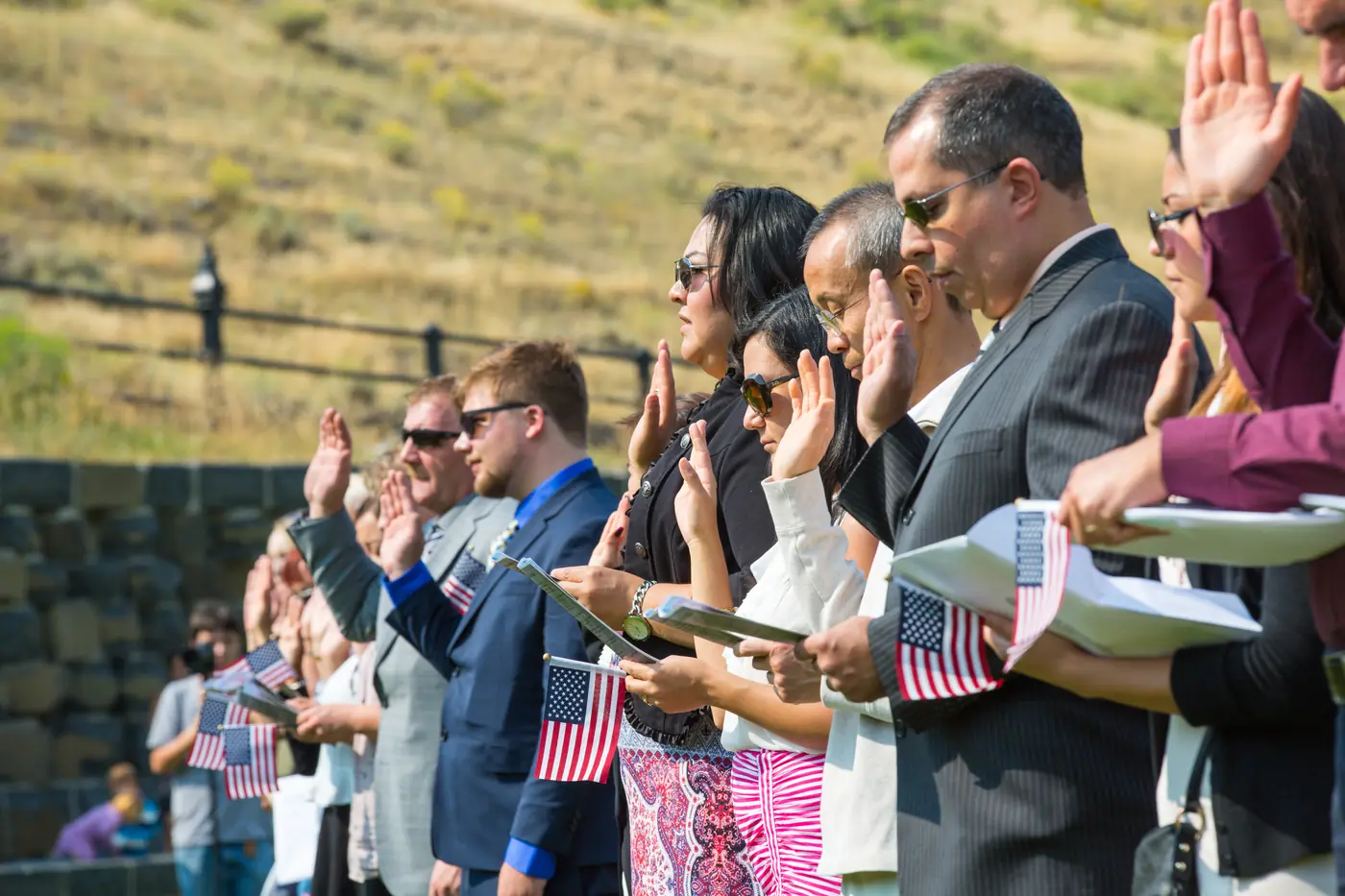
You become a citizen at the Oath of Allegiance, and you receive your Certificate of Naturalization there. Check it for errors before you leave the ceremony. A mistake in your name or date of birth can cause problems with your passport after naturalization. See our guide to the oath of allegiance ceremony.
Step 2: Fill out Form DS-11
Form DS-11, Application for a U.S. Passport, is the form every first-time adult applicant uses. It is available on the State Department website, where you can complete it online and print it. Do not sign it until the acceptance agent asks you to. Use your name exactly as it appears on your naturalization certificate.
Step 3: Gather your documents
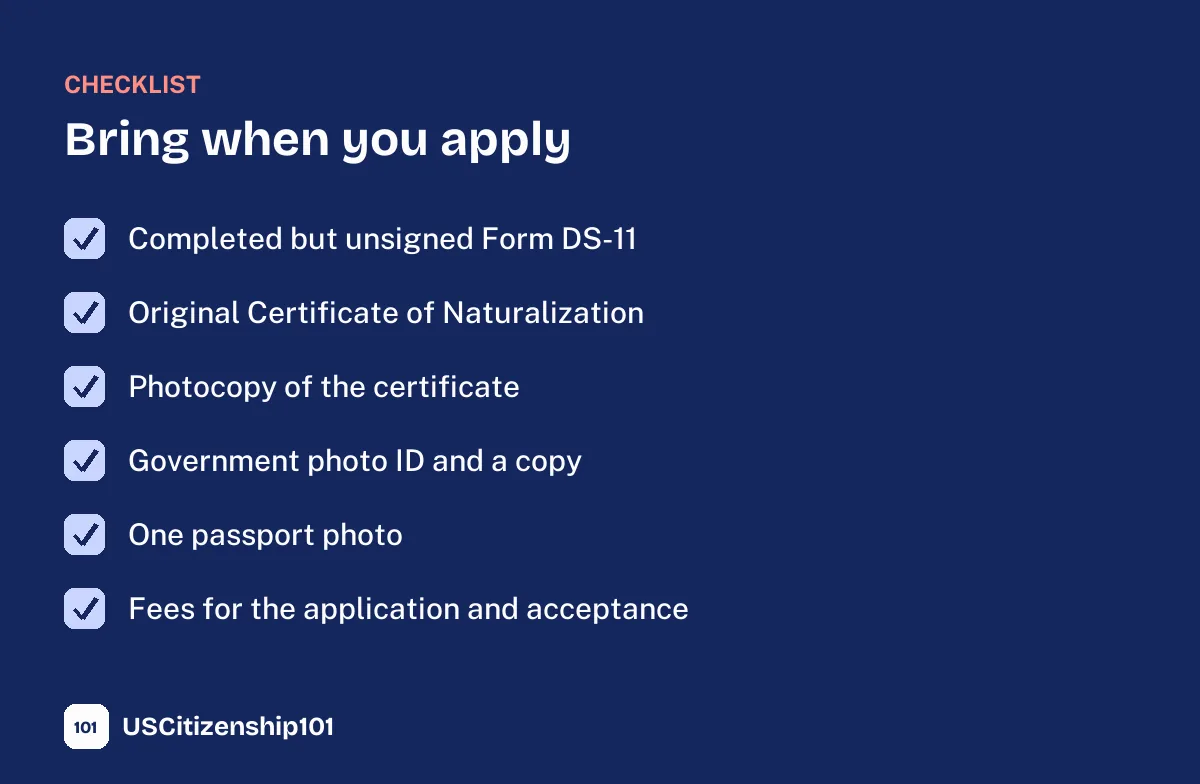
- Proof of citizenship: your original Certificate of Naturalization, plus a photocopy of the front and back on standard white paper.
- Photo ID: a driver’s license or state ID, plus a photocopy.
- Passport photo: one color photo taken within the last six months, meeting State Department rules (white background, no glasses).
- Fees: two separate payments, one for the application and one for the acceptance facility.
Step 4: Apply in person
First-time applicants must apply in person at a passport acceptance facility, such as many post offices, county clerk offices, and public libraries. Many require an appointment. Some naturalization ceremonies have passport acceptance staff on site, which can save a trip; check your ceremony notice or ask the office.
Step 5: Pay the fees
A first adult passport book has an application fee paid to the Department of State and a separate acceptance fee paid to the facility. You can also apply for a passport card, a cheaper wallet-sized document valid for land and sea travel to Canada, Mexico, the Caribbean, and Bermuda. Expedited service costs more. Fees change, so check current amounts at travel.state.gov before you go.
Step 6: Track your application
You can check the status of your passport after naturalization online on the State Department website. Your naturalization certificate is returned by mail, often in a separate envelope from your new passport. Do not worry if they arrive on different days.
Step 7: Sign and protect your passport
Check that your name, date of birth, and photo are correct when your passport arrives, then sign your new passport right away. Keep your naturalization certificate in a safe place at home and carry your passport when you travel.
Why you need a passport after naturalization
Your Certificate of Naturalization proves you are a citizen, but it is a large, valuable document you should not carry around. A passport after naturalization solves several problems at once:
- It is the only document that lets you fly internationally and reenter the United States as a citizen.
- It proves citizenship for jobs, benefits, and voter registration.
- It lets you get help from U.S. embassies and consulates abroad.
- It protects your certificate, which can stay safely at home.
For these reasons, applying for a passport after naturalization is usually the first task on every new citizen’s list.
Where to apply
You can find passport acceptance facilities near you using the State Department’s online locator. Common locations include post offices, county clerk or court offices, and some public libraries. Some locations offer evening or weekend hours. If you live near a passport agency and have proof of urgent international travel, you may be able to get an appointment there. Applying for a passport after naturalization at a ceremony, if offered, is often the most convenient choice.
Expedited and urgent options
- Expedited service: pay an extra fee for faster processing.
- Faster delivery: pay for overnight return shipping.
- Urgent travel: with travel planned within a short window, you may request an in-person appointment at a passport agency.
- Life-or-death emergencies: the State Department offers emergency appointments for serious illness, injury, or death of an immediate family member abroad, with documentation.
If you know you will travel soon after your ceremony, plan for an expedited passport after naturalization from the start.
What the acceptance agent checks
At your appointment, the acceptance agent reviews your DS-11, checks your original naturalization certificate and photo ID, confirms your photo meets requirements, and watches you sign the form under oath. They then seal your application and documents in an envelope for the State Department. Bring everything in one folder so the appointment goes quickly.
If you live abroad
Most people naturalize while living in the United States. If you move abroad soon after, you can apply for a passport after naturalization at a U.S. embassy or consulate, following that post’s instructions. Bring your original certificate and ID, and expect processing to take longer than in the United States.
Your passport checklist
- Certificate checked for errors at the ceremony.
- DS-11 completed, not signed.
- Original certificate and a photocopy.
- Photo ID and a photocopy.
- Compliant passport photo.
- Fees, paid as the facility instructs.
- Appointment booked, if required.
Traveling before your passport arrives
After your oath, you no longer have a Green Card to travel on, and you are not allowed to enter the United States as a foreign national once you are a citizen. If you already have a trip booked, the safest options are to request an expedited passport after naturalization or, if the trip is urgent and close, to request an urgent appointment at a passport agency with proof of travel. Do not leave the United States expecting to return on your old foreign passport. If you are a dual citizen, you may use your other passport to enter that country, but you still need your U.S. passport to return.
Real-life examples
Planning ahead
Olga knew her oath date a month in advance. She filled out her DS-11 online beforehand, applied for a passport after naturalization at the ceremony’s on-site table, and received her passport within the routine processing time, well before her summer trip.
An urgent family trip
Ravi’s father became seriously ill abroad a week after Ravi’s ceremony. With a letter from the hospital and his flight booking, Ravi obtained an emergency appointment at a passport agency and received his passport after naturalization in time to travel.
A family application
After naturalizing, Linh applied for her own passport and her two children’s passports on the same day, bringing her certificate, their birth certificates, Green Cards, and photos. The children’s passports became their first proof of citizenship.
Protecting your documents
Keep your Certificate of Naturalization at home in a safe or fireproof folder, and carry your passport only when you travel or need to prove citizenship. Make a digital copy of both, stored securely. If your passport is lost or stolen, report it to the State Department right away and apply for a replacement. If your certificate is lost, you can request a replacement from USCIS with Form N-565, but replacing it takes time and costs a fee, which is another reason to rely on your passport after naturalization for everyday proof.
Using your passport after naturalization at work and for benefits
Your passport after naturalization is one of the easiest documents to show an employer for employment verification, because a U.S. passport proves both identity and permission to work. It can also be used to prove citizenship when you register to vote, apply for certain government benefits, or update your record with the Social Security Administration. If an employer previously recorded your Green Card, they may ask for updated information after you naturalize. A U.S. passport or passport card is the simplest document to provide.
A note on fees and scams
Only apply for your passport after naturalization through official channels: a passport acceptance facility, a passport agency, a U.S. embassy or consulate, or the State Department’s official website. Some private companies offer “passport services” for extra fees. They cannot make the government process your application faster than official expedited service. Be especially careful with websites that look official but are not. Official government sites end in .gov.
Your first trip as a U.S. citizen
Your first trip abroad with your passport after naturalization is a special moment. A few tips make it smooth:
- Check the entry rules for your destination. Some countries require visas or electronic travel authorizations for U.S. citizens.
- Enroll in the State Department’s Smart Traveler Enrollment Program (STEP) to receive safety updates and help in emergencies.
- Make sure your passport is valid for at least six months beyond your trip, as many countries require.
- At U.S. border control on your return, use the lines for U.S. citizens.
- If you are a dual national, carry both passports when visiting your other country.
Many new citizens say the first time they walked through the “U.S. citizens” line felt like the real end of their journey.
Passport book vs. passport card
| Passport book | Passport card | |
|---|---|---|
| International air travel | Yes | No |
| Land and sea travel to Canada, Mexico, Caribbean, Bermuda | Yes | Yes |
| Proof of citizenship | Yes | Yes |
| Size | Booklet | Wallet card |
| Cost | Higher | Lower |
Many new citizens apply for both at once when they get their first passport after naturalization, because the card is a convenient everyday proof of citizenship.
Photo requirements
- Color photo, 2 by 2 inches, taken within the last six months.
- Plain white or off-white background.
- Neutral expression, both eyes open, facing the camera.
- No glasses. Head coverings only for religious or medical reasons, with a signed statement if required.
- No filters or edits.
Many pharmacies, post offices, and acceptance facilities take compliant photos. A rejected photo is one of the most common reasons for delay.
If your name changed
If you legally changed your name at your naturalization ceremony, your certificate shows your new name, and your passport after naturalization will use it. If your name changed after the ceremony, for example through marriage, bring the legal name change document, such as a marriage certificate or court order.
Passports for your children
Children under 18 with Green Cards who live with you often become citizens automatically when you naturalize. You can apply for their passports as proof of citizenship. For a child’s first passport, you generally need:
- Form DS-11, completed for the child.
- Your Certificate of Naturalization, showing you are a citizen.
- The child’s birth certificate and Green Card.
- Proof of your relationship and, if parents are separated, custody documents.
- For children under 16, both parents usually must appear, or provide a notarized consent form.
- A photo of the child.
A child’s passport is often the fastest and cheapest proof of their new citizenship. You can also file Form N-600 for a Certificate of Citizenship that never expires.
Other records to update
- Social Security: update your record so it shows you are a citizen, which helps with work verification and benefits.
- Voter registration: register to vote in your state.
- Driver’s license: some states let you update your status or get a REAL ID with your passport.
- Employer: you may give your employer updated documents if requested.
Common mistakes
- Booking travel too soon after the ceremony, before the passport arrives.
- Signing the DS-11 at home instead of in front of the acceptance agent.
- Bringing only a photocopy of the certificate. The original is required.
- A non-compliant photo.
- Combining both fees into one payment. They are usually separate.
- Using the wrong form. Renewal form DS-82 is not for first passports.
Example timeline
- Ceremony day: take the oath, receive the certificate, and check it.
- That week: complete Form DS-11 online and book an appointment.
- Appointment: submit the application, original certificate, photo, and fees.
- Weeks later: receive the passport and, separately, the certificate.
Renewing later
Adult passports are generally valid for 10 years. When yours is due, you can usually renew by mail or online with Form DS-82, without sending your naturalization certificate again. Your first passport after naturalization is the only one that requires the certificate and an in-person visit, in most cases.
Planning travel after your ceremony
Once you take the oath, your Green Card is gone, and U.S. law requires citizens to use a U.S. passport to enter and leave the United States. Avoid booking international trips until your passport arrives, or apply for expedited service if you must travel soon. For true emergencies, such as a family death abroad, the State Department offers urgent appointments at passport agencies with proof of travel.
Frequently asked questions
Can I apply for a passport at my oath ceremony?
At some ceremonies, yes. Ask the USCIS office or check your notice. If it is offered, bring your completed DS-11, photo, ID, and fee payments to the ceremony.
Will I get my naturalization certificate back?
Yes. It is returned by mail, usually separately from your passport after naturalization. Keep an eye on your mailbox for both envelopes.
How long does it take to get a passport after naturalization?
Routine processing usually takes several weeks, and expedited service is faster. Check current times on the State Department website.
Is there a deadline to get a passport after naturalization?
No. You can apply any time, but it is wise to apply soon, especially if you plan to travel.
Can I apply by mail for my first passport?
No. First-time adult applicants must apply in person with Form DS-11. Mail renewals with Form DS-82 are only for people who already had a U.S. passport.
Do I need an appointment?
Many acceptance facilities require one. Check online or call ahead.
Can I use my foreign passport to travel?
You must use your U.S. passport to enter and leave the U.S. You may use a foreign passport to enter another country if you are also its citizen. See dual citizenship.
Final thoughts
Getting a passport after naturalization takes one visit and a few weeks of waiting, and it opens the door to travel as a U.S. citizen for the rest of your life. Prepare your DS-11, bring your original certificate and ID, and apply soon after your ceremony so you are ready to travel as a U.S. citizen.
Sources: U.S. Department of State, Apply in Person; Form DS-11 instructions. Last reviewed September 2026.
Free tools
This article is for general education, not legal advice. Always confirm requirements at uscis.gov.