Form N-600: How Children Get a Certificate of Citizenship
Many children become citizens automatically when a parent naturalizes. Here is how Form N-600 proves it, who should file, and when a passport is enough.
On this page
Form N-600, Application for Certificate of Citizenship, is how a person who is already a U.S. citizen, usually through a parent, gets official proof of that citizenship. It is most often used for children who became citizens automatically when a parent naturalized. The certificate it produces is permanent proof that never expires.
This guide explains which children become citizens automatically, who should file Form N-600, the documents you need, fees, the U.S. passport alternative, and tips for a smooth application.
Key points about Form N-600
- Form N-600 proves citizenship; it does not grant it.
- Many children become citizens automatically when a parent naturalizes, under INA 320.
- The child must be under 18, a permanent resident, and in the legal and physical custody of a U.S. citizen parent, living in the U.S.
- A U.S. passport is another way to prove citizenship, often faster and cheaper.
- Adults who acquired or derived citizenship as children can also file.
Automatic citizenship for children
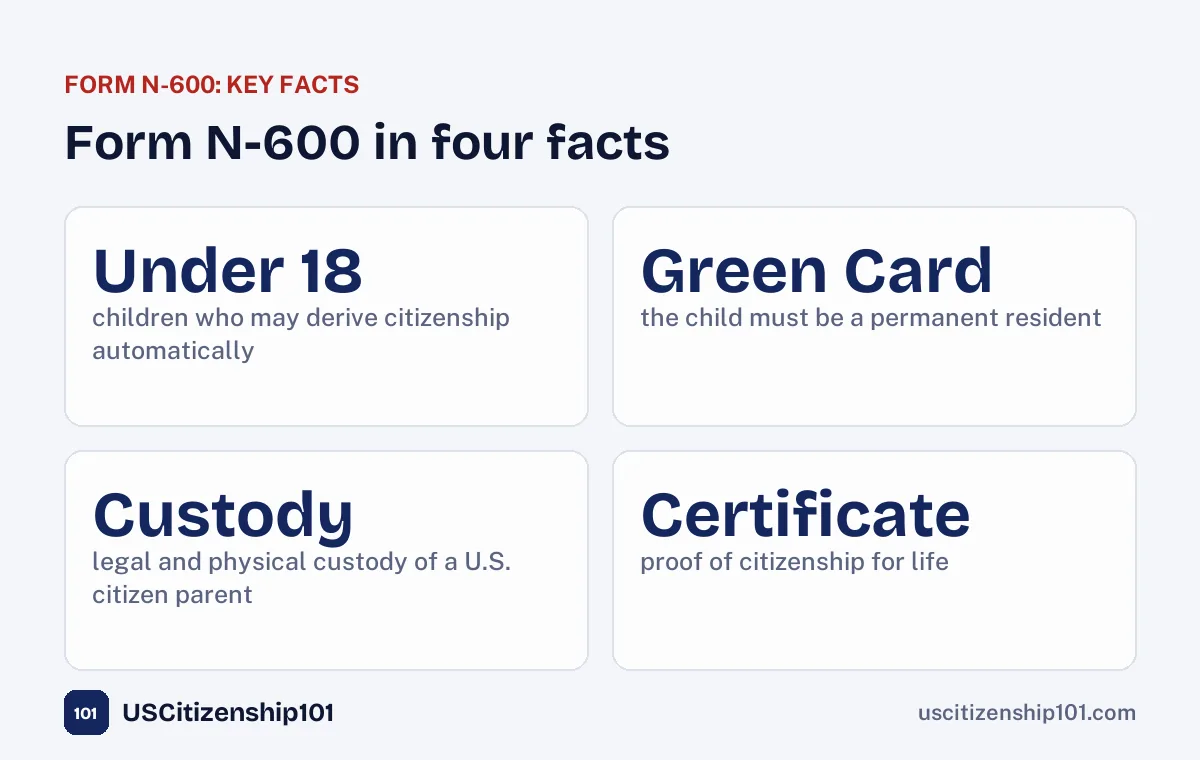
Under section 320 of the Immigration and Nationality Act, added by the Child Citizenship Act of 2000, a child born abroad automatically becomes a U.S. citizen when all these conditions are met at the same time, on or after February 27, 2001:
- At least one parent is a U.S. citizen, by birth or naturalization.
- The child is under 18.
- The child is a lawful permanent resident.
- The child lives in the United States in the legal and physical custody of the U.S. citizen parent.
This is one of the most valuable benefits of naturalization for families. For example, if you naturalize while your 12-year-old with a Green Card lives with you, your child becomes a citizen the day you take the oath. No test, interview, or ceremony is needed for the child. Form N-600 simply documents it.
Citizenship at birth abroad
Some children born outside the United States are citizens from birth because a parent was a U.S. citizen who met certain residence or physical presence requirements before the birth. These rules depend on the birth date and the parents’ situation. Such children can also use Form N-600 to get a certificate, or a Consular Report of Birth Abroad and passport.

Who should file Form N-600
- Children who derived citizenship automatically through a naturalized parent.
- Children born abroad who acquired citizenship at birth through a U.S. citizen parent.
- Adults who became citizens as children but never obtained proof.
- Adopted children who meet the requirements (some adopted children receive a certificate automatically after entering on certain immigrant visas).
A parent or legal guardian files for a child under 18. Adults file for themselves. There is no deadline: a person who derived citizenship as a child can file at any age, even decades later, as long as they can prove the facts.
Documents you need
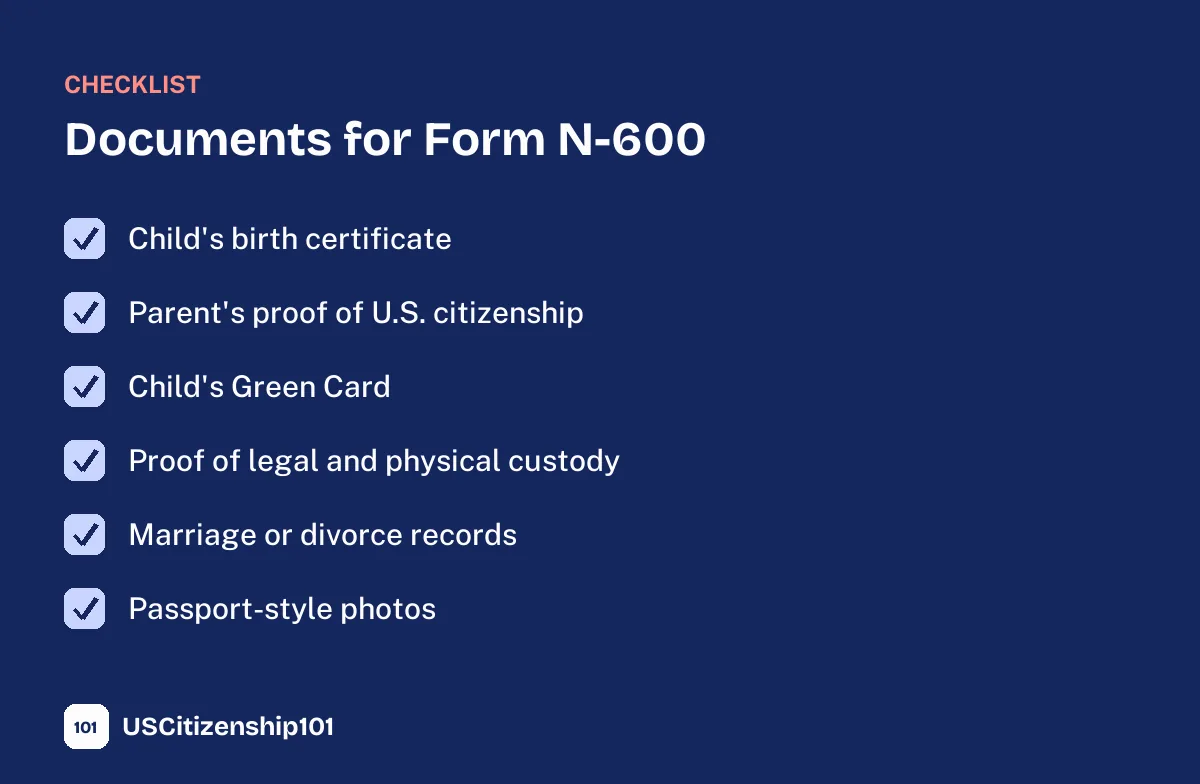
- The child’s birth certificate, with a certified English translation if needed.
- Proof of the parent’s U.S. citizenship: Certificate of Naturalization, U.S. birth certificate, or U.S. passport.
- The child’s Green Card.
- Proof of legal and physical custody, such as a divorce decree or custody order, if parents are separated.
- Parents’ marriage certificate and any divorce records.
- Adoption decree, if applicable.
- Passport-style photos, as the instructions require.
Fees
Form N-600 has a significant filing fee, and there are fee exemptions for some military-related applicants. At the time of writing, the fee set in the 2024 USCIS fee rule is $1,385 on paper or $1,335 online. Confirm the current amount in the USCIS Fee Schedule (Form G-1055) before filing.
The U.S. passport alternative
A U.S. passport is also full proof of citizenship. Many families apply for a child’s passport with the parent’s naturalization certificate, the child’s birth certificate, Green Card, and custody documents. Passports cost much less than Form N-600, but they expire and must be renewed. A Certificate of Citizenship never expires. Some families get both. See passport after naturalization.
Filing and what happens next
- File Form N-600 online or by mail with the fee and evidence.
- Receive a receipt notice.
- USCIS may request more evidence or schedule an interview.
- If approved, the child may take an oath (if 14 or older, in some cases) and receives the Certificate of Citizenship.
Examples: which children qualify
Example 1: A teenager with a Green Card
Elena naturalizes when her son Diego is 15. Diego has a Green Card and lives with Elena in Texas. Diego becomes a U.S. citizen automatically on the day of Elena’s oath. Elena can file Form N-600 for his certificate or apply for his passport.
Example 2: A child who turned 18 first
Samir naturalizes two months after his daughter turns 18. Because she was no longer under 18, she did not derive citizenship. She can apply for naturalization herself when eligible.
Example 3: A child without a Green Card
Kim naturalizes while her son is in the United States on a student visa. Because he is not a permanent resident, he does not derive citizenship yet. If he later becomes a permanent resident while still under 18 and living with Kim, he can derive citizenship at that point.
Example 4: Divorced parents
Mateo’s parents are divorced. His father naturalized, but a court gave his mother, who is not a citizen, sole legal custody, and Mateo lives with her. Mateo does not meet the custody requirement through his father at this time.
Example 5: An adult who never got proof
Aisha became a citizen automatically in 2010, at age 12, when her mother naturalized. She never received a certificate. Now 28, she files Form N-600 herself to get proof.
Legal and physical custody explained
“Legal custody” generally means the parent has the legal right to make decisions for the child. When parents are married and living together, both usually have legal custody. When parents are divorced or separated, a court order or the law of the state or country usually decides who has legal custody. “Physical custody” means the child actually lives with that parent. For automatic citizenship, the child must be in both the legal and physical custody of the U.S. citizen parent. Bring custody orders and proof of where the child lives when you file Form N-600.
Children who turned 18 before February 27, 2001
The Child Citizenship Act applies to children who were under 18 on or after February 27, 2001. People who were already 18 or older on that date are judged under the older rules that were in force when they were children. Those rules were stricter, often requiring both parents to naturalize, or the custodial parent after a separation. If this applies to you, get legal advice before filing Form N-600.
Step by step: filing Form N-600 online
- Create a USCIS online account in the child’s name, or your own if you are the adult applicant.
- Select Form N-600 and answer the questions about the child, the parents, and the basis for citizenship.
- Upload clear copies of each document listed above.
- Pay the fee, or request a fee exemption if you qualify.
- Save the receipt notice.
- Respond to any Request for Evidence.
- Attend an interview if scheduled. Many cases are approved without one.
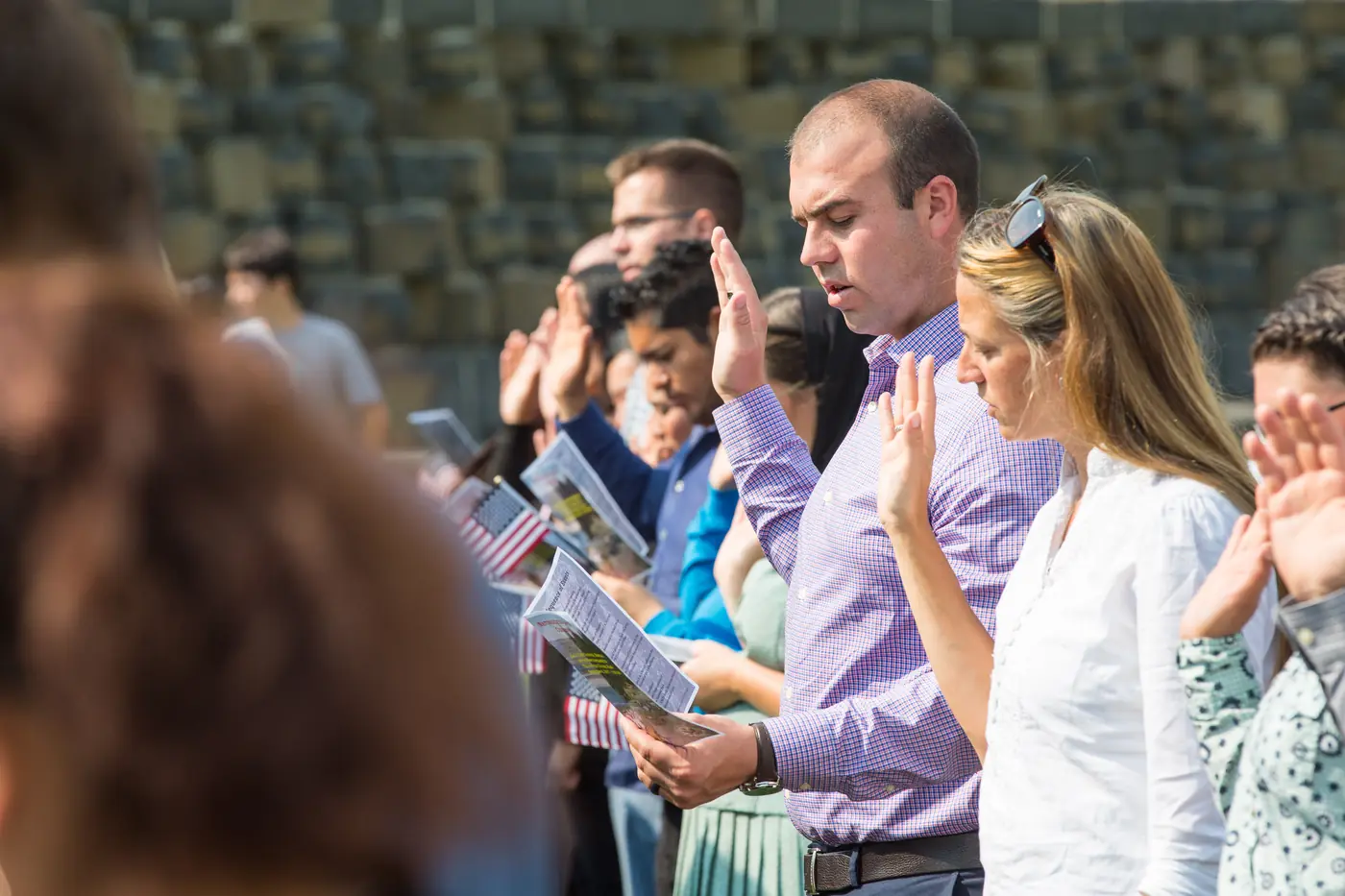
- Receive the Certificate of Citizenship, sometimes at a short ceremony.
Form N-600K for children living abroad
Children who live outside the United States do not derive citizenship automatically under INA 320, because they do not reside in the U.S. with the citizen parent. Some of them can apply for citizenship through Form N-600K, Application for Citizenship and Issuance of Certificate Under Section 322. It requires a U.S. citizen parent (or grandparent) who meets certain physical presence rules, and the child must usually travel to the United States temporarily for an interview and oath. This is a separate process from Form N-600.
Common mistakes
- Assuming a child needs to naturalize: many children already became citizens automatically.
- Missing custody proof: separated parents must show custody.
- Forgetting translations: foreign documents need certified English translations.
- Waiting too long: proof is easier to gather while the family records are current.
- Confusing the forms: children abroad may need N-600K, not N-600.
Why proof matters
Your child may already be a citizen, but without proof, schools, employers, universities, and government agencies may not know it. A Certificate of Citizenship or a passport lets your child apply for financial aid, federal jobs, and voting registration, and travel freely. Filing Form N-600 early avoids problems later, especially if original family documents become harder to find over time.
Adopted children
Adopted children can derive citizenship under the same rules if the adoption is full and final and meets U.S. immigration law requirements, and the child is under 18, a permanent resident, and living in the U.S. in the custody of the citizen parent. Children who enter the United States on certain immigrant visas after a completed foreign adoption (commonly IR-3 or IH-3 visas) usually become citizens on arrival, and USCIS generally mails their Certificate of Citizenship automatically, without Form N-600. Children adopted after arriving, or who entered on other visas, may need to file.
Stepchildren
A stepchild does not derive citizenship through a stepparent simply because of the marriage. The stepparent would generally need to legally adopt the child, and the adoption would need to meet immigration law requirements, before the child could derive citizenship through them.
Certificate of Citizenship vs. U.S. passport
| Certificate of Citizenship | U.S. passport | |
|---|---|---|
| Issued by | USCIS | Department of State |
| Proves citizenship | Yes | Yes |
| Allows international travel | No | Yes |
| Expires | Never | Yes (5 years for children under 16) |
| Relative cost | Higher | Lower |
| Processing | Months | Usually weeks |
Many families get a passport first for convenience, then file Form N-600 later for permanent proof. Either document is accepted as evidence of citizenship by employers and government agencies.
Timeline and interview
Processing times for Form N-600 vary by office and can take several months or longer. Check current estimates on the USCIS processing times page. USCIS may approve a clear case without an interview. If an interview is scheduled, the parent usually attends with the child and brings original documents. Children 14 and older may be asked to take an oath before receiving the certificate in some cases.
Protecting the certificate
The certificate is one of the most important documents your child will ever own. Keep the Certificate of Citizenship in a safe, dry place. Do not laminate it. Make copies only when allowed by law, for example for a passport application. If it is lost, stolen, or damaged, or contains a USCIS error, you can request a replacement with Form N-565.
Preparing a strong application
- Use the current edition of the form and the latest instructions.
- Answer every question about both parents, including dates and places of birth, marriage, and citizenship.
- Include a clear timeline showing the date the child got a Green Card, the date the parent naturalized, and the child’s age on each date.
- Show where the child has lived, with school or medical records if helpful.
- Include certified translations for every foreign-language document.
- Keep a full copy of everything you submit.
A clear timeline is especially helpful, because USCIS must confirm that all the conditions were true at the same time before the child’s 18th birthday.
Questions USCIS may ask
- When did the child become a permanent resident?
- When did the parent become a citizen?
- Where has the child lived since then, and with whom?
- Are the parents married, separated, or divorced? Who has custody?
- Has the child ever lived outside the United States for long periods?
If you are not sure your child derived citizenship
Make a timeline with three dates: the child’s Green Card date, the parent’s oath date, and the child’s 18th birthday. If the child had a Green Card and lived with the citizen parent before turning 18, and the parent became a citizen before that birthday, the child likely derived citizenship on the latest of those dates. Custody questions and older cases are more complex. When in doubt, consult an immigration attorney before filing Form N-600, because a careful review can confirm the right path.
Families with several children
Each child needs their own Form N-600 and fee, and each child’s eligibility is checked separately. Children who were over 18 when you naturalized will need to naturalize on their own, while their younger siblings may already be citizens. Plan a family timeline so every child gets the right proof or applies at the right time.
What your child can do as a citizen
Once your child is a citizen, with or without a certificate yet, they have the same rights as any U.S. citizen of their age. When they turn 18, they can register to vote, and they can apply for federal jobs and financial aid that require citizenship. They do not need to renew a Green Card, and they cannot lose their status because of long trips abroad. Having proof, through Form N-600 or a passport, makes all of this straightforward.
It is also a good moment to talk with your child about what citizenship means. Many families look at the civics questions together, visit a local government building, or talk about why the family came to the United States. Our free civics practice test can be a fun family activity, even though children who derive citizenship do not have to take it.
Other situations where Form N-600 helps
- A young adult applying for a federal job or security clearance who needs official proof.
- A person whose passport was lost and who wants a document that never expires.
- Someone who needs to prove citizenship for a government benefit.
- A person born abroad to U.S. citizen parents who never received a Consular Report of Birth Abroad.
Frequently asked questions
Does my child need to take the citizenship test?
No. Children who derive citizenship do not take the English or civics test, and they do not attend a naturalization interview like adults do.
What if my child turned 18 before I naturalized?
Then the child did not derive citizenship through you and must apply for naturalization on their own when eligible, usually after 5 years as a permanent resident. See how to become a US citizen.
Can I file Form N-600 at the same time as my own N-400?
No. Your child derives citizenship only after you take the oath. File Form N-600 afterward.
Does my child need to be present for the interview?
If an interview is scheduled, USCIS usually asks the child to attend with the parent. Follow the interview notice.
Is Form N-600 required?
No. It is optional proof, but having proof is important for school, work, and travel. At minimum, most families get a U.S. passport for the child.
Final thoughts
Naturalizing is a milestone for the whole family. When you naturalize, check whether your children became citizens with you, using the three dates: Green Card, your oath, and their 18th birthday. If they did, Form N-600 or a passport gives them the proof they need for life.
Sources: USCIS Form N-600 and instructions; INA sections 301, 309 and 320; USCIS Fee Schedule G-1055. Last reviewed September 2026. General information, not legal advice.
Free tools
This article is for general education, not legal advice. Always confirm requirements at uscis.gov.