How to Become a US Citizen in 2026: The Complete Step-by-Step Guide
From checking eligibility to taking the Oath of Allegiance, here is every step of naturalization explained in plain English.
On this page
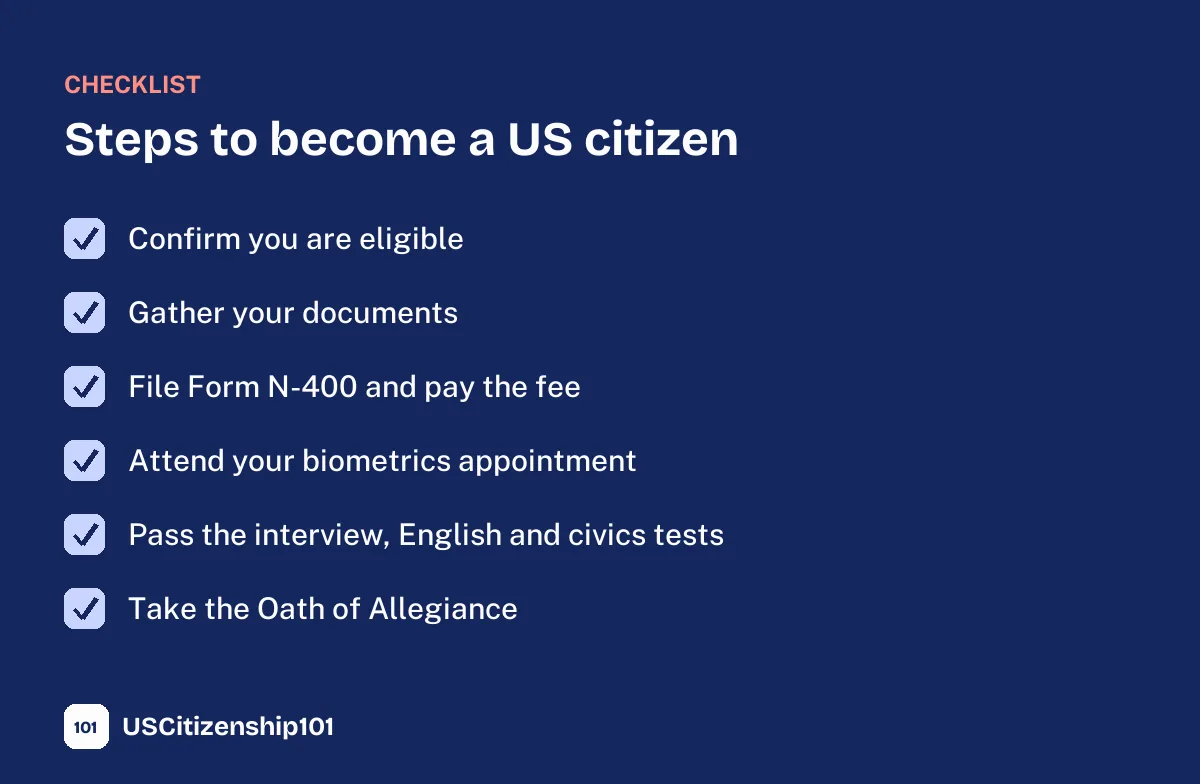
If you want to become a US citizen, the most common path is naturalization: the legal process that lets a lawful permanent resident (a Green Card holder) apply for citizenship after meeting certain requirements. Millions of people have done it, and the process is well defined. You file an application, give your fingerprints, attend an interview, pass an English and civics test, and take an oath.
This guide walks you through every step to become a US citizen through naturalization, explains who qualifies, what it costs, how long it takes, and how to avoid the mistakes that slow people down. Everything is written in plain English, and every step links to a deeper guide if you want more detail.
Key points: how to become a US citizen
- Most people become a US citizen through naturalization by filing Form N-400.
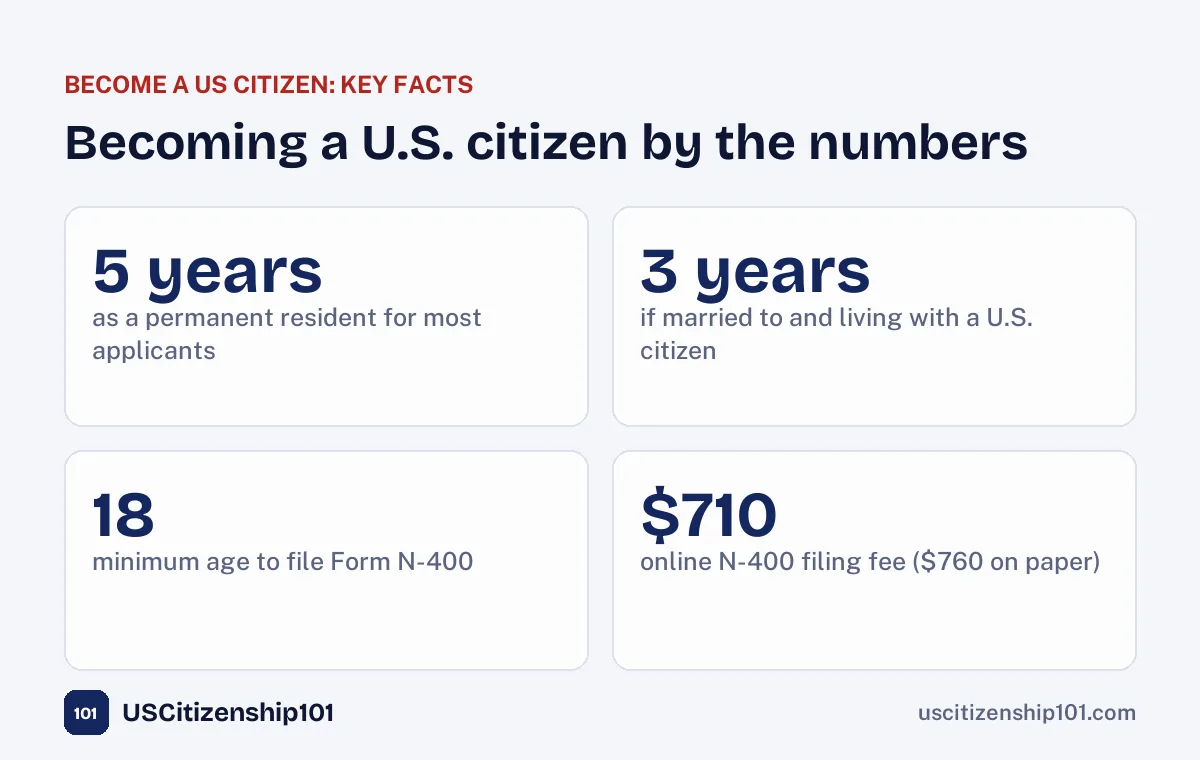
- You usually need 5 years as a permanent resident, or 3 years if married to and living with a U.S. citizen.
- You must be at least 18, show good moral character, and pass an English and civics test.
- The filing fee is $710 online or $760 on paper, with reduced fees and waivers for some applicants.
- The journey ends at the Oath of Allegiance ceremony, where you officially become a citizen.
Ways to become a US citizen
There are four main ways a person can become a US citizen or already be one:
- Birth in the United States. Under the 14th Amendment, most people born on U.S. soil are citizens at birth.
- Birth abroad to a U.S. citizen parent. Some children born outside the country are citizens at birth if a parent meets certain residence rules.
- Derivation through a parent. A child with a Green Card can automatically become a US citizen when a parent naturalizes, if the child is under 18 and lives in that parent’s legal and physical custody. Our guide to Form N-600 explains how to get proof.
- Naturalization. Adults who are permanent residents apply using Form N-400. This is what most people mean when they ask how to become a US citizen, and it is the focus of this guide.
Step 1: Check that you are eligible
Before you spend money on the application, confirm that you meet the requirements. To become a US citizen through naturalization on the standard 5-year path, you must:
- Be at least 18 years old when you file.
- Have been a lawful permanent resident for at least 5 years (3 years if married to a U.S. citizen and living together, and your spouse has been a citizen for those 3 years).
- Have continuous residence in the United States for that period, without long trips that break it.
- Have been physically present in the United States for at least half of that time (30 months on the 5-year path, 18 months on the 3-year path).
- Have lived for at least 3 months in the state or USCIS district where you apply.
- Show good moral character.
- Be able to read, write, and speak basic English, unless you qualify for an exception.
- Know basic U.S. history and government (the civics test).
- Support the principles of the U.S. Constitution and be willing to take the Oath of Allegiance.
Each requirement has its own guide on this site: continuous residence, good moral character, and the full list of citizenship requirements. Members of the U.S. military and some spouses have special, faster rules.
Use the early filing window
You do not have to wait until the exact day you reach 5 years (or 3 years). USCIS lets you file up to 90 days early. That can help you become a US citizen a few months sooner. Our guide to N-400 early filing shows how to calculate the date.
Step 2: Gather your documents
Form N-400 asks for five years of history (or three, on the marriage path). Collect this information before you start:
- Your Green Card (front and back copy).
- Every home address for the last 5 years, with dates.
- Every employer or school for the last 5 years, with dates.
- Every trip outside the United States longer than 24 hours, with dates.
- Information about your current and past marriages, and your children.
- Records of any arrest, citation, or court case, even if the case was dismissed.
- Proof of income if you are asking for a reduced fee or fee waiver.
If you are applying on the 3-year marriage path, include proof that your spouse has been a U.S. citizen for the last 3 years, such as a birth certificate, naturalization certificate, or passport. See citizenship through marriage for the full list.
Step 3: File Form N-400 and pay the fee
Form N-400, Application for Naturalization, is the application to become a US citizen. You can file it online through a USCIS account or on paper by mail.
| Filing option | Fee | Notes |
|---|---|---|
| Online | $710 | Fastest to submit, easy to track, upload documents directly. |
| Paper | $760 | Required if you request a reduced fee or fee waiver. |
| Reduced fee | $380 | Household income between 150% and 400% of the Federal Poverty Guidelines. |
| Fee waiver | $0 | File Form I-912 with proof of eligibility. |
Fees change from time to time, so confirm on uscis.gov/n-400 before filing. Our N-400 filing fee guide explains every option, and our step-by-step walkthrough shows how to fill out Form N-400 without common errors.
After USCIS receives your application, you get a receipt notice (Form I-797C). Keep it safe. Its received date also decides which version of the civics test you take.
Step 4: Attend your biometrics appointment
USCIS usually schedules a biometrics appointment at an Application Support Center a few weeks after filing. There, staff take your fingerprints, photo, and signature for a background check. It takes about 15 to 30 minutes. In some cases USCIS reuses fingerprints from an earlier application and skips this step. Read what to bring in our guide to the biometrics appointment.

Step 5: Prepare for the interview and tests
The interview is the most important step to become a US citizen, and it is also the one you can prepare for the most. Start studying as soon as you file. You will need to pass two tests during the interview.
The English test
You read one of up to three sentences out loud, write one of up to three sentences, and show you can speak and understand basic English during the conversation. Practice on our English practice page or read the full guide to the citizenship English test.
The civics test
If USCIS received your N-400 on or after October 20, 2025, you take the 2025 civics test: the officer asks up to 20 of 128 questions and you need 12 correct. If you filed earlier, you take the 2008 test with 10 questions from a list of 100 and need 6 correct. Our free civics practice test covers both versions.
Exceptions for older applicants
If you are 50 or older with 20 years as a permanent resident, or 55 or older with 15 years, you can skip the English test and take civics in your language. At 65 with 20 years, you also study a shorter list. See citizenship test exemptions.
Step 6: Attend the naturalization interview
A USCIS officer interviews you at a local field office. You take an oath to tell the truth, the officer reviews your N-400 answers, and you take the English and civics tests. Most interviews last 20 to 30 minutes.
Bring your interview notice, Green Card, ID, passports, and any documents the notice lists. Answer honestly and ask the officer to repeat anything you do not understand. For a full walkthrough, read what to expect at the USCIS citizenship interview and practice with our mock interview.
Step 7: Receive a decision
At the end of the interview, the officer gives you Form N-652 with one of these results:
- Granted: you passed and USCIS approves your application.
- Continued: USCIS needs more documents, or you need to retake part of the test.
- Denied: USCIS decides you are not eligible. You can request a review with Form N-336.
If you did not pass the English or civics test, you get a second chance 60 to 90 days later. Read what happens if you fail the citizenship test.
Step 8: Take the Oath of Allegiance
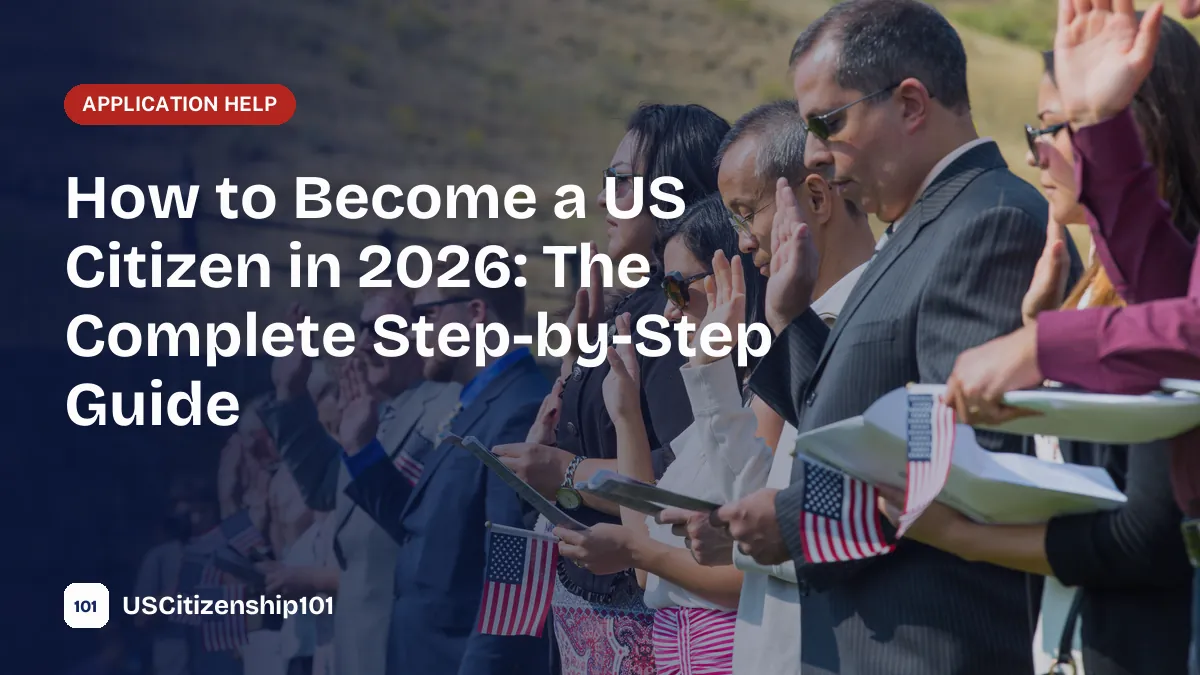
You legally become a US citizen when you take the Oath of Allegiance at a naturalization ceremony. Some field offices hold the ceremony the same day as the interview. Others schedule it a few weeks later and mail you Form N-445, a notice of the ceremony with a short questionnaire about the time since your interview.
At the ceremony you return your Green Card, recite the oath, and receive your Certificate of Naturalization. Our guide to the oath of allegiance ceremony explains what to wear, what to bring, and what happens.
Step 9: Get your U.S. passport
Your naturalization certificate proves you are a citizen, but a U.S. passport is easier to carry and is needed for international travel. Apply as soon as you can, using your original certificate. See how in our guide to getting a passport after naturalization.
Step 10: Update your records and vote
After you become a US citizen, update your records with the Social Security Administration so your citizenship status is correct for work and benefits. Then register to vote. Voting in federal elections is one of the most important rights you gain. Many ceremonies have voter registration tables right outside the room.
Special paths to become a US citizen
The steps above describe the standard route. Some people can become a US citizen under different rules that shorten or change the requirements.
Members of the U.S. military
Service members who served honorably for at least one year during peacetime may apply without the usual residence period, and those who served during designated periods of hostilities may apply even without a Green Card. The N-400 fee is waived for military applicants. Military bases often have USCIS points of contact to help service members become a US citizen while serving.
Spouses of U.S. citizens
If you have been married to and living with a U.S. citizen for 3 years, and your spouse has been a citizen for those 3 years, you can apply after 3 years as a permanent resident instead of 5. Spouses of citizens who work abroad for certain U.S. employers may qualify under a special provision without a residence period at all.
Children of U.S. citizens
Children under 18 with a Green Card who live with a U.S. citizen parent often become a US citizen automatically, without any test or ceremony. They can then apply for a passport or a Certificate of Citizenship as proof.
Planning the cost to become a US citizen
The government fee is only part of the budget. Plan for these costs so there are no surprises on the way to become a US citizen:
- Filing fee: $710 online or $760 on paper, unless you qualify for $380 or a waiver.
- Documents: certified court records, translations of foreign documents, and copies. IRS tax transcripts are free.
- Travel: transport to your biometrics appointment, interview, and ceremony, plus time off work.
- Legal help: optional, but worth it if your case is complex. Nonprofits may help for free.
- Passport: a separate State Department application with its own fees after the ceremony.
Studying does not need to cost anything. The official USCIS materials are free, and so is every practice tool on this site.
What if you have a criminal record?
A past arrest or conviction does not always stop you from being able to become a US citizen, but it must be handled carefully. Some serious crimes are permanent bars, while others only matter if they happened during the period USCIS reviews. Always disclose every arrest, citation, and charge on your N-400, even if it was dismissed or expunged, and bring certified court records to the interview. Talk to a licensed immigration attorney before filing, because in rare cases an application can put your Green Card at risk.
How long does it take to become a US citizen?
The time from filing to the oath depends mostly on your USCIS field office. Some offices finish in a few months, others take a year or more. You can check current estimates at USCIS processing times. Our naturalization timeline guide explains each stage and what can cause delays.
Common mistakes that delay citizenship
- Filing too early. Filing more than 90 days before you qualify leads to a denial and a lost fee.
- Forgetting trips abroad. List every trip, even short ones. Officers compare your answers with travel records.
- Leaving out arrests or citations. Not disclosing a record, even a dismissed one, can be treated as a lack of honesty.
- Studying the wrong civics test. Check your N-400 received date.
- Missing appointments. Keep your address updated with USCIS so you receive every notice.
These and other pitfalls are covered in our article on citizenship test mistakes.

Do you need a lawyer to become a US citizen?
Many people complete the process on their own, especially if their history is simple. Consider talking to a licensed immigration attorney or a DOJ-accredited representative if you have any arrest or criminal record, long trips outside the country, past immigration problems, tax issues, or questions about your Green Card itself. Nonprofit organizations often provide free or low-cost help. You can search for accredited organizations through the Department of Justice.
Benefits once you become a US citizen
- The right to vote in federal elections and run for most public offices.
- A U.S. passport and help from U.S. embassies abroad.
- Protection from losing your status or being deported for most reasons.
- The ability to petition for more family members, often faster.
- Eligibility for federal jobs that require citizenship.
- Citizenship for your children under 18 with Green Cards, in many cases automatically.
Citizenship also comes with responsibilities, like serving on a jury when called and supporting the Constitution. Read more in rights and responsibilities of U.S. citizens.
Frequently asked questions
How much does it cost to become a US citizen?
The N-400 filing fee is $710 online or $760 on paper. Some applicants pay $380 or nothing with a fee waiver. Studying can be free: every tool on this site costs nothing.
Can I become a US citizen without speaking English?
Yes, in some cases. Applicants who qualify for the 50/20, 55/15, or 65/20 exceptions, or who have a qualifying medical disability documented on Form N-648, can be exempt from the English test.
Can I keep my other citizenship?
The United States allows dual citizenship, but your other country may not. Read our guide to dual citizenship before you apply.
What is the fastest way to become a US citizen?
For most people, file online as soon as you are eligible (up to 90 days early), respond quickly to every USCIS request, and prepare well so you pass the interview the first time.
Is there an age limit?
You must be at least 18 to file Form N-400. There is no upper age limit, and older applicants may qualify for easier test options.
Final thoughts
The path to become a US citizen is long, but each step is clear and manageable. Check your eligibility carefully, file a complete and honest application, study a little every day, and walk into your interview prepared. When you raise your right hand at the ceremony, all the effort will be worth it.
Sources: USCIS, 10 Steps to Naturalization; USCIS Form N-400 and instructions; USCIS Policy Manual, Volume 12. Last reviewed September 2026. General information, not legal advice.
Free tools
This article is for general education, not legal advice. Always confirm requirements at uscis.gov.