The USCIS Biometrics Appointment for Citizenship: What to Expect
What to bring, what happens at the Application Support Center, how long it takes, how to reschedule, and what comes after your fingerprints.
On this page
A few weeks after you file Form N-400, USCIS may schedule a biometrics appointment at an Application Support Center (ASC). At the biometrics appointment, staff take your fingerprints, photograph, and signature. USCIS uses them for FBI background checks and to produce your Certificate of Naturalization. It is quick, simple, and one of the first signs that your case is moving.
This guide explains what happens at your biometrics appointment, what to bring, how long it takes, how to reschedule, when USCIS may reuse your fingerprints, and what comes next.
Key points about the biometrics appointment
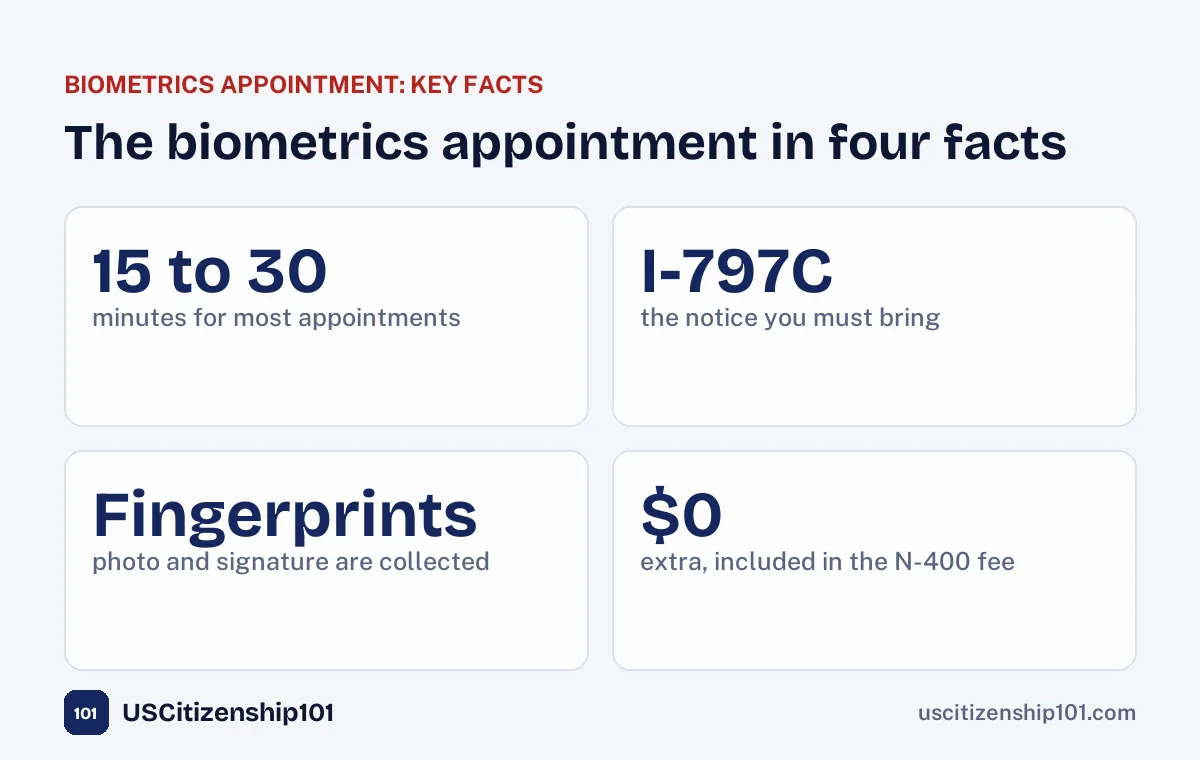
- USCIS sends a notice (Form I-797C) with the date, time, and ASC address.
- The biometrics appointment usually takes 15 to 30 minutes, plus waiting.
- Bring the notice and photo ID, usually your Green Card.
- There is no extra fee; it is included in the N-400 fee.
- USCIS may reuse earlier biometrics and skip the appointment.
When you get the notice
Timing varies by case and location. USCIS usually mails the biometrics appointment notice a few weeks after it receives your N-400, and it also appears in your online account. The notice lists the Application Support Center, date, and time. Read it carefully, and mark the date on your calendar.
What to bring
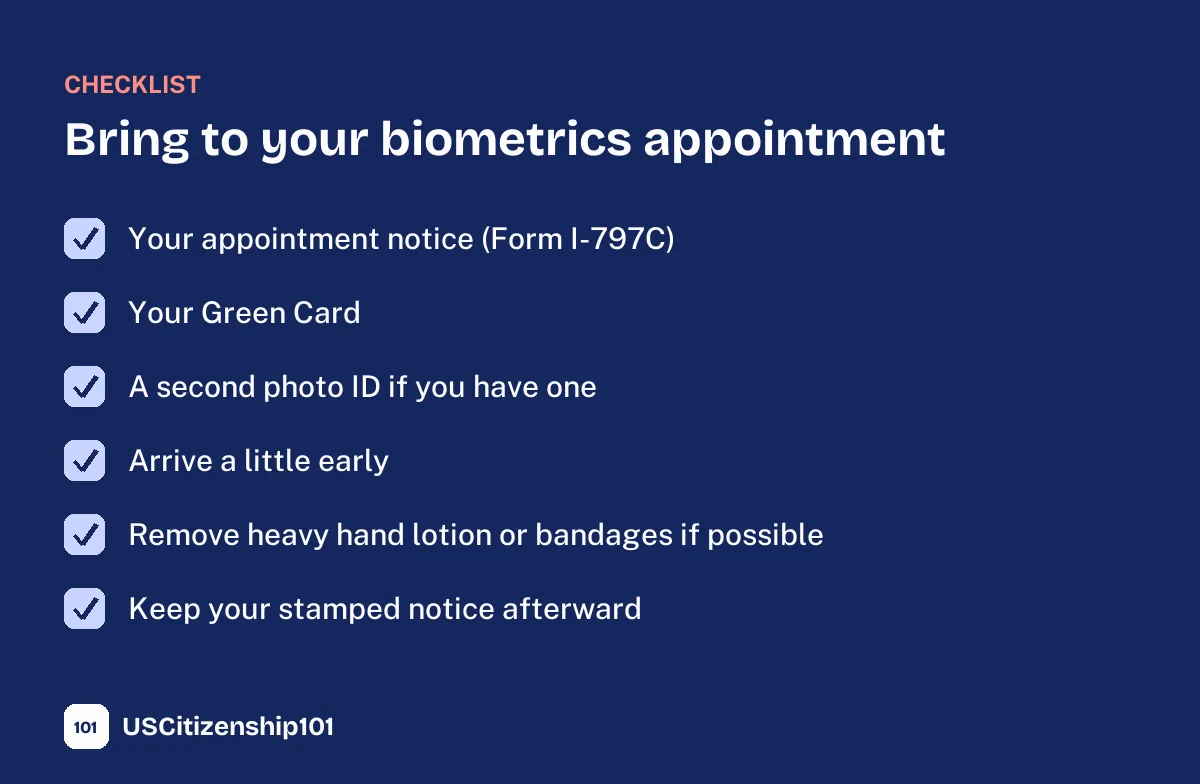
- The appointment notice (Form I-797C).
- Your Permanent Resident Card (Green Card).
- A second photo ID, such as a driver’s license or passport, if you have one.
Without the notice and valid ID, the ASC may not be able to serve you, and you would need to come back another day. Put both items in one envelope the night before.
What happens at the Application Support Center
- Security and check-in: staff check your notice and ID.
- Waiting: you wait until your name or number is called.
- Fingerprints: your fingerprints are taken electronically; no ink.
- Photo: a digital photo is taken.
- Signature: you sign on an electronic pad.
- Stamp: staff stamp your notice to show you attended.
The process is the same for everyone and does not include any questions about your application or the civics test. Staff are there only to collect your information accurately, so you can relax and follow their instructions.

How to reschedule
If you cannot attend your biometrics appointment, request a new date before the scheduled appointment through your USCIS online account or the USCIS Contact Center. USCIS generally expects good cause, such as illness, a family emergency, or a conflict you cannot change. Rescheduling can delay your case, so only do it when necessary. Missing the appointment without rescheduling can lead to your application being denied as abandoned.
Reused biometrics
Many long-time permanent residents gave fingerprints when they applied for their Green Card or renewed it. If you gave biometrics for an earlier application, USCIS may reuse them for your N-400. In that case, you might not receive an appointment notice at all, or you might receive a notice explaining that your biometrics will be reused. This is normal and can save time.
Why USCIS needs biometrics
Naturalization requires a full background check. Your fingerprints are sent to the FBI to check criminal history records, and your name is checked against other government databases. The photo and signature captured at your biometrics appointment are also used on your Certificate of Naturalization. Without this step, USCIS cannot complete your case, which is why attending your biometrics appointment is required.
8 easy tips for your biometrics appointment
- Check the address. Application Support Centers are separate from USCIS field offices. Go to the location on your notice.
- Arrive a little early, but not too early; some centers only admit people close to their appointment time.
- Bring your notice and Green Card. These are the essentials.
- Leave extra items at home. Security may not allow large bags or certain items.
- Care for your hands. Avoid heavy lotion on the day, and remove bandages if possible, so fingerprints scan well.
- Dress simply. You will be photographed; religious head coverings are fine.
- Keep your stamped notice. It proves you attended your biometrics appointment.
- Start studying. Use the waiting time before your interview to prepare.
Special situations
Disabilities and accommodations
If you need an accommodation, such as wheelchair access or assistance, request it through USCIS before your biometrics appointment. In some cases, USCIS can arrange for biometrics to be collected at home for people who are homebound.
Lost notice or Green Card
If you lost your notice, you may be able to download it from your online account or ask the USCIS Contact Center for help. If your Green Card is lost, bring other government photo ID and be ready to explain.
Missing fingers or fingerprint issues
Staff are trained to handle missing fingers, injuries, and faint fingerprints. Tell them about any condition. USCIS may request additional steps if prints cannot be read.
Common problems and solutions
- You never received a notice: check your online account and make sure USCIS has your current address. Contact USCIS if you expected one.
- You missed the appointment: contact USCIS immediately to explain and request a new date.
- Your fingerprints were rejected later: USCIS may send a new appointment notice. Attend it promptly.
- The center is far away: you may ask to reschedule at a different center, but this is not always possible.
An example morning
Yusuf’s biometrics appointment is at 9:00 a.m. He arrives at 8:45 with his notice and Green Card. A security officer checks his bag, and a staff member checks his notice at the front desk and gives him a number. After a 20-minute wait, he is called to a station. A technician scans his fingers on a glass screen, takes his photo, and asks him to sign on an electronic pad. The technician stamps his notice, and Yusuf is out of the building by 9:35. That is a typical biometrics appointment.
Biometrics appointment vs. interview
| Biometrics appointment | Interview | |
|---|---|---|
| Location | Application Support Center | USCIS field office |
| Timing | A few weeks after filing | Months after filing |
| What happens | Fingerprints, photo, signature | Oath, N-400 review, English and civics tests |
| Questions about your case | No | Yes |
| Length | 15 to 30 minutes | 20 to 30 minutes |
If you move after filing
Update your address with USCIS within 10 days of moving. If you move before your biometrics appointment, USCIS may reschedule you at a center closer to your new home. If you move to a different USCIS district, your case may also be transferred to a new field office for the interview, which can affect timing.
Background checks after biometrics
After your biometrics appointment, the FBI runs fingerprint checks, and USCIS runs name checks. Most results come back quickly, but some take longer, especially for common names or when records need manual review. There is nothing you need to do during this time unless USCIS sends you a request. Delays at this stage are one reason processing times vary.
Biometrics for other applications
If you have other applications pending, such as a Green Card renewal (Form I-90) or a petition to remove conditions (Form I-751), USCIS may schedule biometrics for them separately or reuse the same biometrics. Attend each appointment you are scheduled for, and keep each stamped notice.

Use the time after your biometrics appointment
The weeks or months after your biometrics appointment are the perfect time to prepare for your interview. Here is a simple plan:
- Weeks 1 to 3: learn the civics questions by topic, a few each day. See the list of 128 civics questions.
- Weeks 4 to 5: practice reading and writing sentences from the USCIS vocabulary list.
- Week 6 onward: take full mock tests in our free practice test and rehearse your N-400 answers.
Keep good records
Keep your stamped biometrics appointment notice with your receipt notice and a copy of your N-400. If there is ever a question about whether you attended, the stamp is your proof. Scan it and save a digital copy too.
How the fingerprint scan works
Modern Application Support Centers use electronic scanners, not ink. A technician will guide each finger onto a glass plate, first individually and then in groups, and may roll each finger gently from side to side. The scan takes a few minutes. If a print is unclear, the technician will simply repeat it. Relax your hand and let the technician position your fingers; pressing too hard can make prints less clear.
What happens to your information
Your fingerprints and photo are used to confirm your identity and to run the background checks required for naturalization. They become part of your immigration record. USCIS uses your photo and signature to produce your Certificate of Naturalization. The information is protected by federal privacy laws and handled by government agencies involved in the background check process.
Tips for older applicants
Older applicants sometimes have faint fingerprints, which is common and nothing to worry about. Tell the technician if you have arthritis or trouble with your hands; they can help position your fingers gently. Bring a family member if you need help getting to the center, and ask about seating if you cannot stand for long.
If you are sick on the day
If you are too ill to attend, or have a contagious illness, request to reschedule through your online account or the USCIS Contact Center as early as possible, ideally before the appointment. Explain the reason. Many applicants are able to reschedule for illness without any problem.
Getting there
- Look up the center’s address and hours ahead of time, and check whether there is parking or a nearby transit stop.
- Allow extra time for traffic, parking, and security.
- Some centers are in office buildings or shopping areas, so look carefully for signs.
- Bring change or a card for parking meters if needed.
Myths about biometrics
- “They will ask about my case.” No. Staff only collect fingerprints, a photo, and a signature.
- “Old tickets will show up and cause a denial on the spot.” No decision is made at the center. Your record is reviewed later by an officer, which is why you should disclose everything on your N-400.
- “I must pay at the center.” No. The cost is included in your filing fee.
- “If I am not scheduled, something is wrong.” USCIS may simply be reusing your earlier biometrics.
Where the biometrics appointment fits in the process
- Filing: you submit Form N-400 and receive a receipt notice.
- Biometrics: fingerprints, photo, and signature at an Application Support Center.
- Background checks: FBI and other checks run in the background.
- Interview notice: USCIS schedules you at your field office.
- Interview: application review, English test, and civics test.
- Decision and oath: approval and the Oath of Allegiance.
Biometrics is step two of six. Once it is done, most of the remaining waiting is for USCIS, and most of your remaining work is preparing for the interview. Read what to expect at the USCIS citizenship interview to get ready.
What to do if you have an arrest record
If you have ever been arrested or cited, your fingerprints will likely show it. That is not a reason to skip or fear your appointment. What matters is that you disclosed it on your N-400 and bring certified court records to your interview. If you have not yet talked to an attorney about a criminal record, do so before your interview. Our guide to good moral character explains how USCIS reviews records.
A quick checklist for the night before
- Appointment notice printed or saved and ready.
- Green Card and a second photo ID in your wallet.
- Route, parking, and travel time planned.
- Hands free of heavy lotion or bandages if possible.
- Comfortable clothes and a phone charged for waiting time.
Biometrics for applicants living far from a center
Application Support Centers are located in many cities, but some applicants live hours away. USCIS normally assigns the center closest to your address. If travel is very difficult, you can ask to be scheduled at a different center, although USCIS may not always be able to change it. Plan the trip as you would for any important appointment: leave early, check the weather and road conditions, and bring snacks and water. If you rely on public transport, check schedules in advance so you arrive on time for your biometrics appointment.
Staying informed after your appointment
After your biometrics appointment, check your USCIS online account regularly and keep an eye on your mail. Sign up for text or email notifications if available. The next notice you receive will usually be your interview appointment, although USCIS could also send a request for more evidence. Respond to any request quickly and completely, so your case keeps moving toward the interview and oath.
What comes next
After your biometrics appointment, USCIS runs FBI fingerprint and name checks and reviews your file. This stage can take a while, and your online status may not change. The next step is usually the interview notice. Use the time to study with our civics test study plan and read the naturalization timeline.
Frequently asked questions
Can I bring my children?
You may, but centers can be busy and waits can be long. If possible, arrange childcare so the visit is quick and easy.
Is the biometrics appointment the same as a Green Card appointment?
The process is similar, but this appointment is specifically for your naturalization case. Attend every notice you receive, even if you gave fingerprints before.
Can I go early or on a different day?
Some ASCs accept early walk-ins at their discretion, but you should plan to attend your scheduled time. If you want to try an earlier visit, call or check with the center first, and bring your notice either way.
What if my fingerprints are hard to read?
This happens more often than people expect. Some people have faint fingerprints because of age or work, for example construction, cleaning, or farm work. USCIS may ask you to return or use other checks. Moisturizing your hands in the days before, but not on the day, may help.
Can someone go with me?
A family member or caregiver can usually accompany you, especially if you need help, but they may need to wait in the lobby.
Will I be asked civics questions at biometrics?
No. The biometrics appointment only collects fingerprints, a photo, and a signature. The tests happen at the interview.
How long after biometrics is the interview?
It varies by field office, from a few weeks to many months. Check USCIS processing times for your office.
Do I need to dress up?
No. Wear something comfortable. You will be photographed, so avoid hats unless worn for religious reasons. Simple clothing without large logos or distracting patterns is best for the photo, and remove sunglasses before your picture.
Final thoughts
Your biometrics appointment is a short, simple step, but it is an important one. Bring your notice and ID, arrive on time, and keep your stamped notice. Then focus on preparing for the interview, where your English and civics knowledge will be tested and your application reviewed.
Sources: USCIS, Preparing for Your Biometric Services Appointment. Last reviewed September 2026.
Free tools
This article is for general education, not legal advice. Always confirm requirements at uscis.gov.