USCIS Vocabulary List: Every Reading and Writing Word for the English Test
Every word on the official reading and writing lists, grouped by category, with practice sentences and a simple plan to master them.
On this page
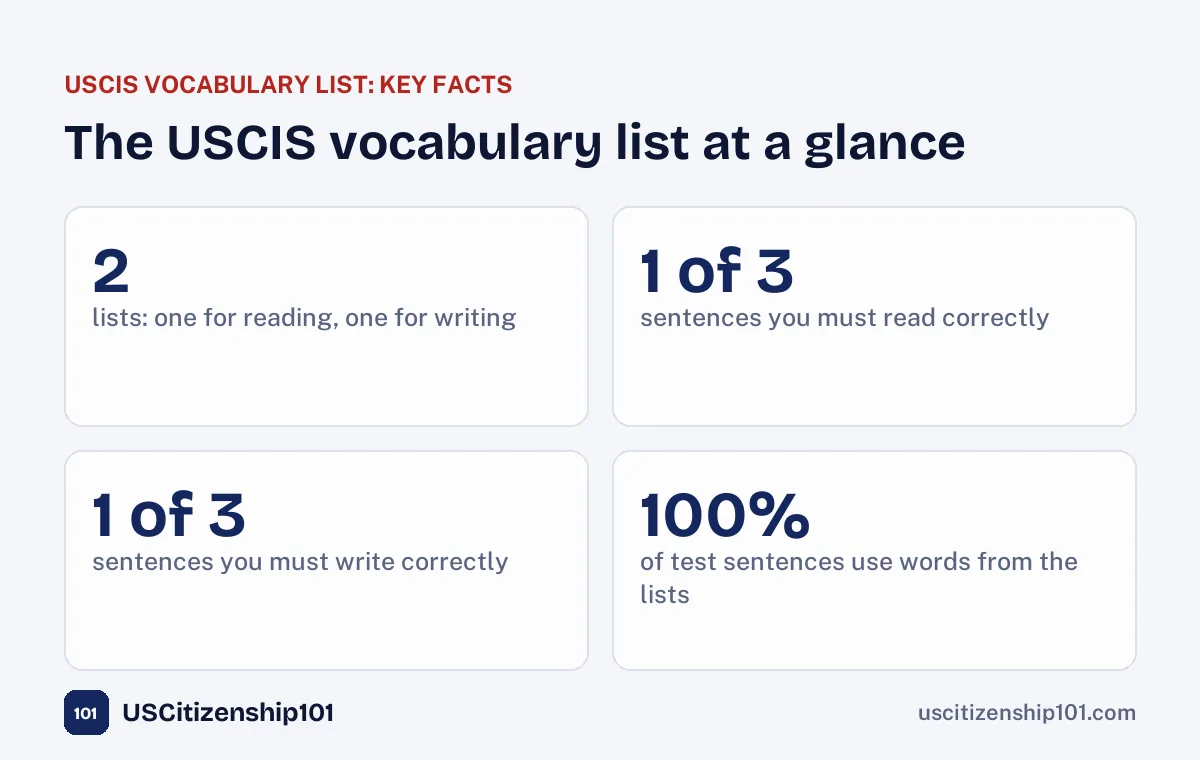
The USCIS vocabulary list is the set of English words used to build the reading and writing sentences on the U.S. citizenship test. There are two lists: one for reading and one for writing. Every sentence the officer asks you to read or write is made from these words. That means if you know the USCIS vocabulary list well, the English test becomes very predictable.
This guide gives you every word on both lists, grouped by category, explains how the reading and writing tests work, and shows you practice sentences and study methods that help you master the USCIS vocabulary list quickly.
Key points about the USCIS vocabulary list
- There is a reading USCIS vocabulary list and a writing USCIS vocabulary list.
- For reading, you must read 1 of up to 3 sentences correctly out loud.
- For writing, you must write 1 of up to 3 sentences correctly as the officer reads it.
- The words are grouped by topic: people, civics, places, holidays, question words, verbs, and other words.
- Many words also appear in civics answers, so studying both together saves time.
How the English test uses the USCIS vocabulary list
Reading test
The officer shows you a sentence, often on a tablet, and asks you to read it out loud. The sentence is usually a question, like “Who was the first President?” You pass if you read one of up to three sentences in a way the officer understands, without long pauses or skipping content words. Small pronunciation differences are fine.
Writing test
The officer reads a sentence out loud and you write it. The sentence is usually a statement, like “Washington was the first President.” You pass if you write one of up to three sentences so that the meaning is clear. Small spelling mistakes may be accepted, but missing or wrong words that change the meaning are not.
Notice the connection: reading sentences are often questions, and writing sentences are often the answers. Studying them together is the fastest way to learn the USCIS vocabulary list.
The reading USCIS vocabulary list
People
Abraham Lincoln, George Washington
Civics
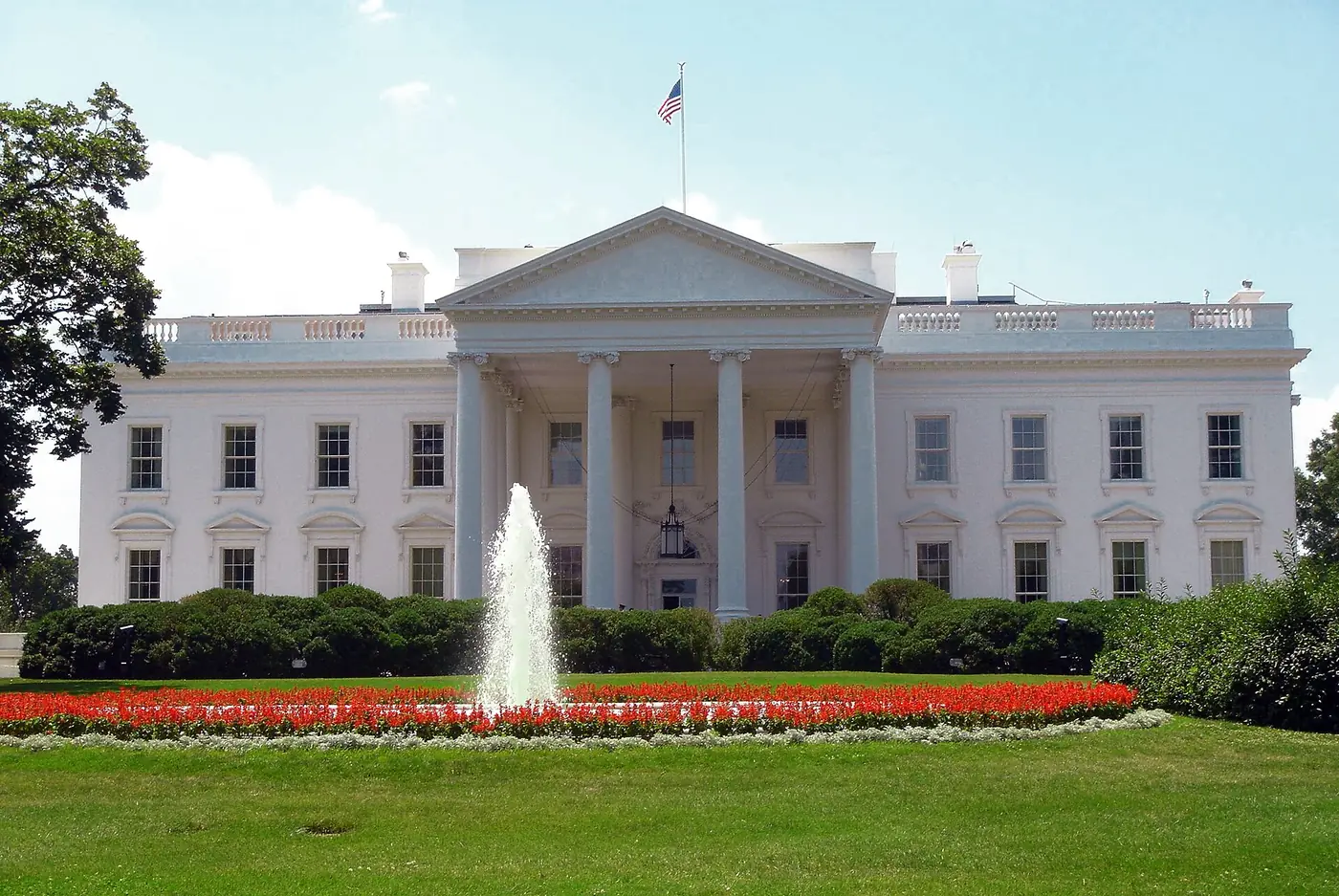
American flag, Bill of Rights, capital, citizen, city, Congress, country, Father of Our Country, government, President, right, Senators, state/states, White House
Places
America, United States, U.S.
Holidays
Presidents’ Day, Memorial Day, Flag Day, Independence Day, Labor Day, Columbus Day, Thanksgiving
Question words
How, What, When, Where, Who, Why
Verbs
can, come, do/does, elects, have/has, is/are/was/be, lives/lived, meet, name, pay, vote, want
Other (function words)
a, for, here, in, of, on, the, to, we
Other (content words)
colors, dollar bill, first, largest, many, most, north, one, people, second, south
The writing USCIS vocabulary list
People
Adams, Lincoln, Washington
Civics
American Indians, capital, citizens, Civil War, Congress, Father of Our Country, flag, free, freedom of speech, President, right, Senators, state/states, White House
Places
Alaska, California, Canada, Delaware, Mexico, New York City, United States, Washington, Washington, D.C.
Months
February, May, June, July, September, October, November
Holidays
Presidents’ Day, Memorial Day, Flag Day, Independence Day, Labor Day, Columbus Day, Thanksgiving
Verbs
can, come, elect, have/has, is/was/be, lives/lived, meets, pay, vote, want
Other (function words)
and, during, for, here, in, of, on, the, to, we
Other (content words)
blue, dollar bill, fifty/50, first, largest, most, north, one, one hundred/100, people, red, second, south, taxes, white
USCIS publishes the official USCIS vocabulary list on its website. Check uscis.gov for the latest version before your interview.
Practice sentences
These sentences are written in the same style as the test and use only words from the USCIS vocabulary list. Read the questions out loud, then write the answers from dictation.
| Read this question | Write this answer |
|---|---|
| Who was the first President? | Washington was the first President. |
| What is the capital of the United States? | Washington, D.C. is the capital of the United States. |
| Who lives in the White House? | The President lives in the White House. |
| What country is north of the United States? | Canada is north of the United States. |
| What country is south of the United States? | Mexico is south of the United States. |
| When is Independence Day? | Independence Day is in July. |
| When is Memorial Day? | Memorial Day is in May. |
| When is Thanksgiving? | Thanksgiving is in November. |
| What is the largest state? | Alaska is the largest state. |
| Who can vote? | Citizens can vote. |
| What are the colors of the flag? | The flag is red, white, and blue. |
| How many Senators does Congress have? | Congress has one hundred Senators. |
| Why do people come to America? | People come to America to be free. |
| Who was Lincoln? | Lincoln was President during the Civil War. |
| What do we pay to the government? | We pay taxes. |
Practice these with audio on our English practice page, which reads sentences aloud and checks your writing word by word.
What the key words mean
Knowing what each word means helps you read and write it naturally. Here are short notes on the most important words from the USCIS vocabulary list.
People
- George Washington / Washington: the first President and the “Father of Our Country.” His face is on the one dollar bill.
- Abraham Lincoln / Lincoln: the President during the Civil War, who worked to end slavery.
- Adams: John Adams, the second President.
- American Indians: the people who lived in America before Europeans arrived.
Civics words
- Bill of Rights: the first ten amendments to the Constitution.
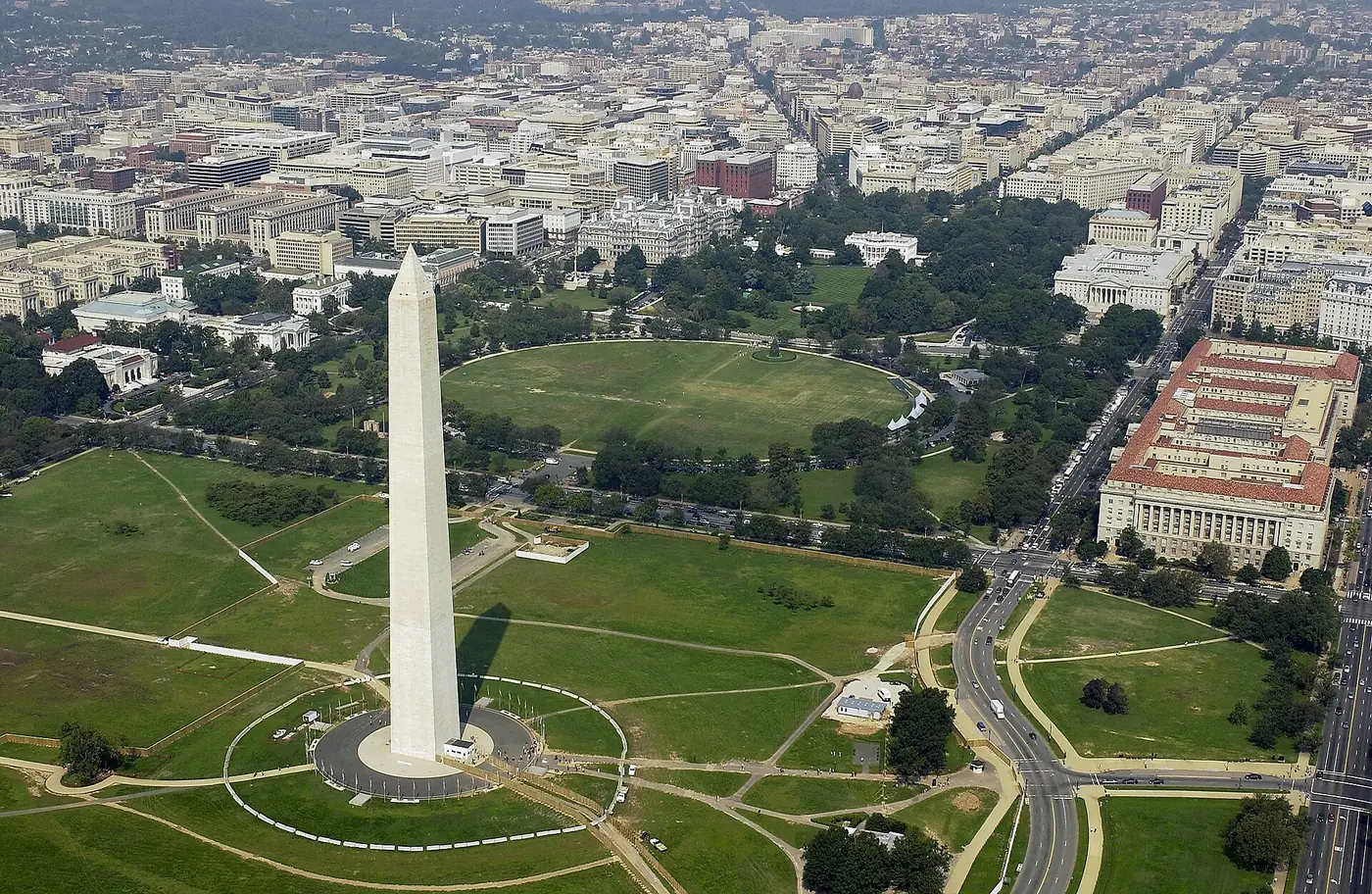
- capital: the city where a government is located. Washington, D.C. is the capital of the United States.
- citizen / citizens: a person who is a member of the country, with full rights such as voting.
- Congress: the part of government that makes laws. It meets in Washington, D.C.
- Senators: members of the Senate. There are one hundred.
- President: the leader of the executive branch, who lives in the White House.
- Civil War: the war between the North and the South from 1861 to 1865.
- freedom of speech: the right to say what you think, protected by the First Amendment.
- free: having liberty. Many people come to America to be free.
- right: something the law guarantees, such as the right to vote.
Places
- Alaska: the largest state by area.
- California: the state with the most people.
- Delaware: the first state to approve the Constitution.
- New York City: the first capital of the United States.
- Canada / Mexico: the countries north and south of the United States.
Holidays and months
- Presidents’ Day: in February.
- Memorial Day: in May, honoring those who died in military service.
- Flag Day: in June.
- Independence Day: July 4.
- Labor Day: in September, honoring workers.
- Columbus Day: in October.
- Thanksgiving: in November.
Notice how the holidays and months on the writing list match. That is not an accident: many writing sentences are about when a holiday happens, such as “Labor Day is in September.”
A three-week plan for the USCIS vocabulary list
- Week 1: reading words. Read every word aloud daily and read five practice questions.
- Week 2: writing words. Spell ten words a day from memory and write five practice answers by hand.
- Week 3: full practice. Have someone dictate three sentences a day, and read three questions aloud. Check capitals and punctuation every time.
Fifteen minutes a day is enough to master the USCIS vocabulary list in three weeks, especially if you are also studying civics.
Pronunciation tips for the reading test
- Say “Senators” with the stress on the first syllable: SEN-a-tors.
- Say “Delaware” as DEL-a-ware and “February” as FEB-roo-air-ee.
- Pronounce the “th” in “the,” “Thanksgiving,” and “north” by placing your tongue lightly between your teeth.
- Read “U.S.” as the two letters, “you ess.”
- Read “D.C.” as “dee see.”
- Keep a steady pace. Pausing briefly is fine; long silences are what cause problems.
Simple grammar in test sentences
The sentences on the English test use very simple grammar. Most follow a few patterns:
- Who / What / When / Where questions: “Who lives in the White House?”
- “is” statements: “Alaska is the largest state.”
- “was” for the past: “Washington was the first President.”
- “can” for ability or rights: “Citizens can vote.”
- “in” with months: “Thanksgiving is in November.”
If you learn these five patterns along with the USCIS vocabulary list, you can understand and write almost any sentence the officer gives you.
More practice sentences
Here are more sentences built only from words on the USCIS vocabulary list. Read the first column aloud and write the second from dictation.
| Read | Write |
|---|---|
| What is the capital of the United States? | Washington, D.C. is the capital of the United States. |
| Who is the Father of Our Country? | Washington is the Father of Our Country. |
| When is Labor Day? | Labor Day is in September. |
| When is Columbus Day? | Columbus Day is in October. |
| When is Presidents’ Day? | Presidents’ Day is in February. |
| When is Flag Day? | Flag Day is in June. |
| Where does Congress meet? | Congress meets in Washington, D.C. |
| Who was the second President? | Adams was the second President. |
| What state has the most people? | California has the most people. |
| What was the first state? | Delaware was the first state. |
| Who lived here first? | American Indians lived here first. |
| What is one right in the Bill of Rights? | Freedom of speech is a right. |
| How many states are in the United States? | The United States has fifty states. |
| Who elects Congress? | The people elect Congress. |
| What was the first capital? | New York City was the first capital. |
How the officer scores your writing
The officer is checking whether you can communicate the meaning of the sentence in writing. You will usually pass if:
- All the important words are present, even if one has a small spelling error.
- The sentence can be read and understood.
- Numbers can be written as words or digits, such as “fifty” or “50.”
You will usually not pass if you leave out an important word, add words that change the meaning, write an abbreviation for a word that should be written in full, or write something the officer cannot read. Neat handwriting and the words from the USCIS vocabulary list are your best protection.
If you are new to writing in English
Some applicants speak English well but rarely write it. If that is you, start with copying: write each practice sentence by looking at it, five times. Then move to writing it from memory, and finally from dictation. Practice the letters that are easy to confuse, such as “b” and “d,” or “n” and “u.” Keep your letters large and clear. Many adult education centers and libraries offer free citizenship classes that include writing practice with the USCIS vocabulary list.
Flashcards for the USCIS vocabulary list
Make two sets of index cards. For the reading set, write each word or phrase on one side and practice saying it. For the writing set, write the word on the back and have someone say it aloud while you write it, then flip to check. Carry a few cards with you and review them during short breaks. Small, frequent sessions work best for spelling.
How to study the USCIS vocabulary list
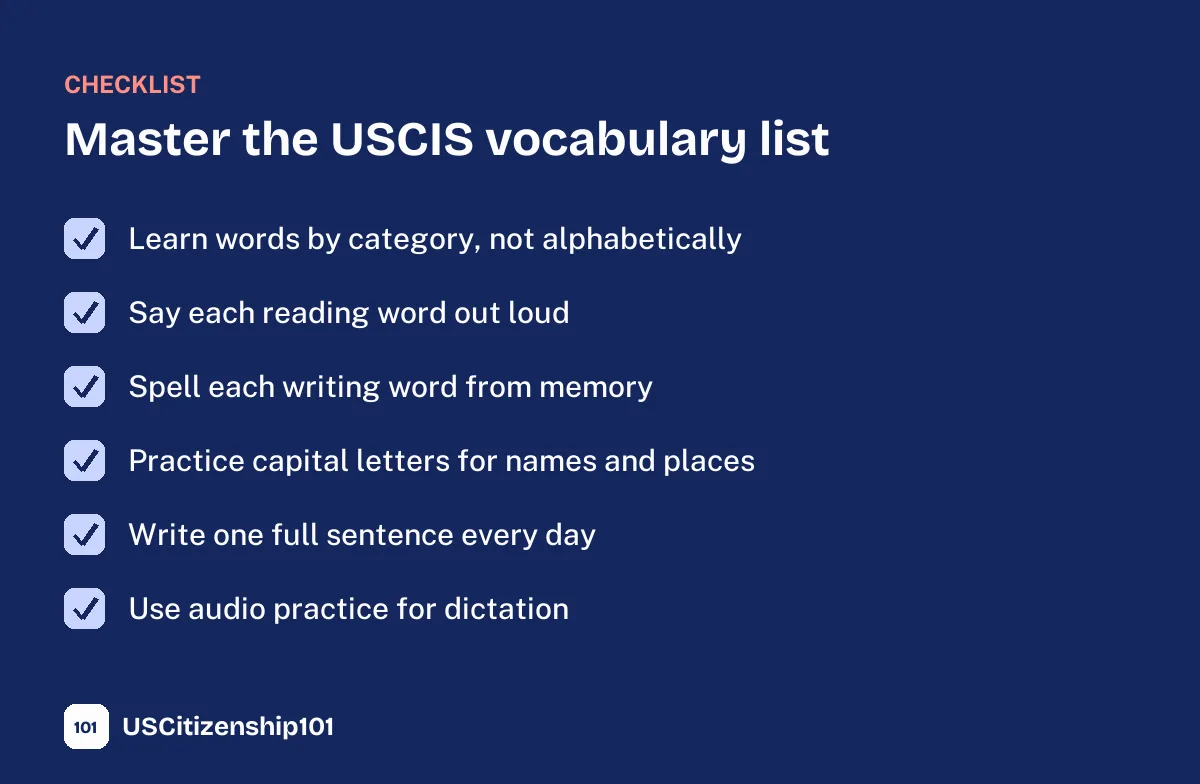
Learn by category
Study one group at a time: people, then places, then holidays and months. Categories are easier to remember than an alphabetical list.
Say it, then spell it
For each reading word, say it out loud three times. For each writing word, spell it from memory, then check. Pay extra attention to tricky spellings like “Delaware,” “February,” “Thanksgiving,” and “Senators.”
Capital letters matter
Names of people, places, holidays, and months start with capital letters: Washington, Canada, Memorial Day, November. So does the first word of every sentence. Missing capitals is one of the most common writing mistakes.
Write one sentence a day by hand
The real writing test is done by hand, often on a signature pad or paper. Writing by hand every day builds speed and accuracy.
Link words to civics answers
Many words on the USCIS vocabulary list are also civics answers: George Washington, the White House, Congress, the Civil War, Independence Day. When you study civics, you are also studying English.
What to do on test day
- Reading: look at the whole sentence before you start, then read it at a steady pace. If you make a mistake, calmly reread the word.
- Writing: listen to the full sentence before you write. If you did not hear it clearly, ask the officer to repeat it.
- Check your work: after writing, look at the first letter and the last punctuation mark, and make sure no small words are missing.
- Stay calm: you have up to three chances for each part, and you only need one correct sentence.
Common mistakes on the reading and writing test
- Skipping small words like “the,” “of,” or “in” when writing.
- Writing “presidents day” without capital letters.
- Misspelling “February” (it has an “r” after the “b”).
- Forgetting the period at the end of a written sentence.
- Reading too fast and dropping a word.
- Confusing “north” and “south,” or “Canada” and “Mexico.”
For more, see our full guide to the citizenship English test and citizenship test mistakes.
Frequently asked questions
Do I need to know every word on the USCIS vocabulary list?
Yes, because any sentence may use any of the words. The lists are short, so this is very achievable in a few weeks.
Will the sentences be exactly like the practice sentences?
Not exactly, but they use the same words and a similar style.
Is the USCIS vocabulary list the same for the 2025 and 2008 civics tests?
The English reading and writing tests use the official vocabulary lists regardless of which civics version you take. Always check uscis.gov for the latest lists.
How long does it take to learn the USCIS vocabulary list?
Most learners need two to four weeks with 15 minutes of daily practice. If you already read English well, one week of focused practice on spelling and capital letters may be enough.
Are numbers written as words or digits?
Either is usually accepted for numbers on the USCIS vocabulary list, such as “fifty” or “50” and “one hundred” or “100.” Practice both ways.
Where can I hear the words pronounced?
Our English practice page reads sentences aloud in American English. USCIS also offers free audio study materials on its website.
Can I skip the English test?
Yes, if you qualify for the 50/20, 55/15, or 65/20 exceptions, or a medical exception. See citizenship test exemptions.
Study the vocabulary with civics at the same time
The fastest way to prepare for the whole interview is to combine your English and civics study. When you learn the civics answer “George Washington was the first President,” you are also learning words from the USCIS vocabulary list. When you practice writing “Congress meets in Washington, D.C.,” you are also reviewing a civics fact. Try our civics test study plan and add ten minutes of reading and writing to each session.
Final thoughts
The USCIS vocabulary list is one of the best-kept secrets of the citizenship test: it tells you exactly which words can appear. Learn the words by category, practice reading questions out loud, and write the matching answers by hand every day. In a few weeks, the English test will feel easy.
Sources: USCIS, Reading Vocabulary for the Naturalization Test and Writing Vocabulary for the Naturalization Test, available at uscis.gov. Last reviewed September 2026.
Free tools
This article is for general education, not legal advice. Always confirm requirements at uscis.gov.