What to Bring to Your Citizenship Interview: Complete Checklist
Your interview notice, Green Card, ID, and passports, plus the extra papers some applicants need. A complete checklist so nothing is missing on the day.
On this page
Your citizenship interview is the most important day of the naturalization process, and one of the easiest ways to make it go smoothly is to arrive with the right papers. Having your citizenship interview documents ready shows the officer you are organized, answers questions before they are asked, and can save you from a delay or a second trip. The good news is that most people need only a short list of documents.
This guide gives you a complete checklist: what every applicant must bring, the extra citizenship interview documents some people need depending on their history, how to organize them, and what to do if something is missing. Your interview notice always comes first, so read it carefully and use this guide to prepare everything it asks for.
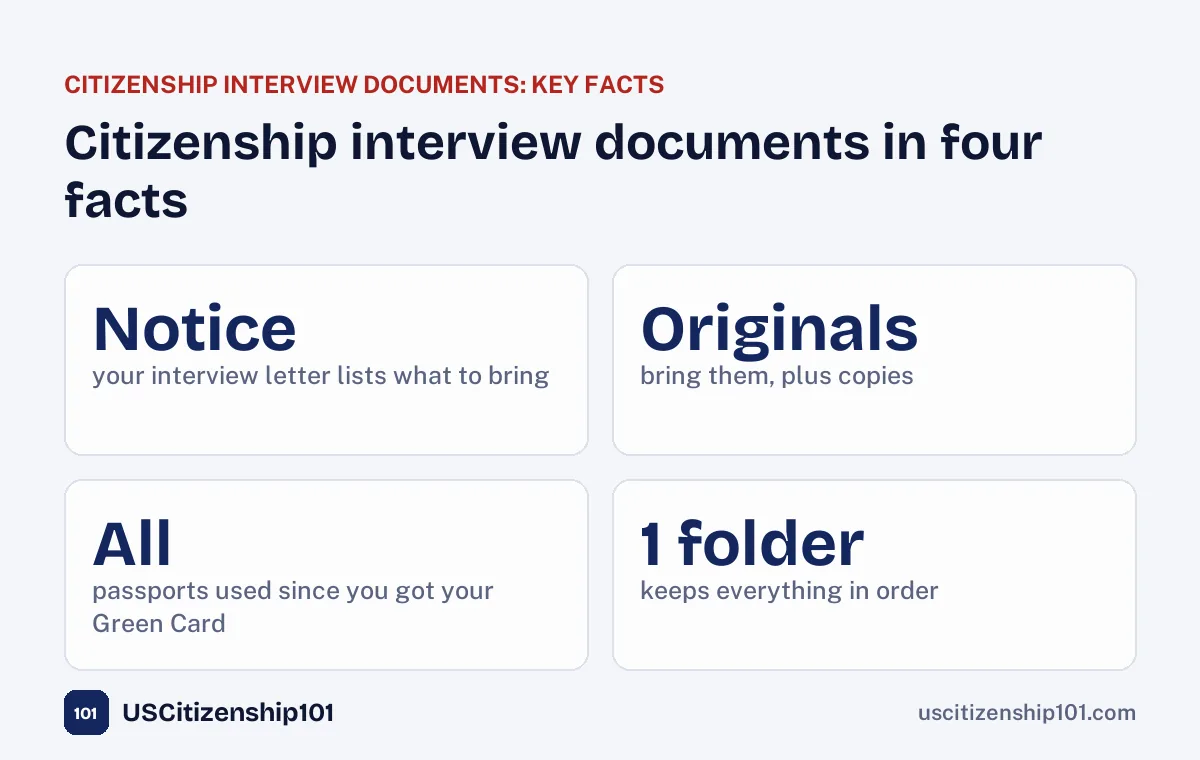
Key points about citizenship interview documents
- Your interview notice lists what to bring. Read it first and follow it exactly.
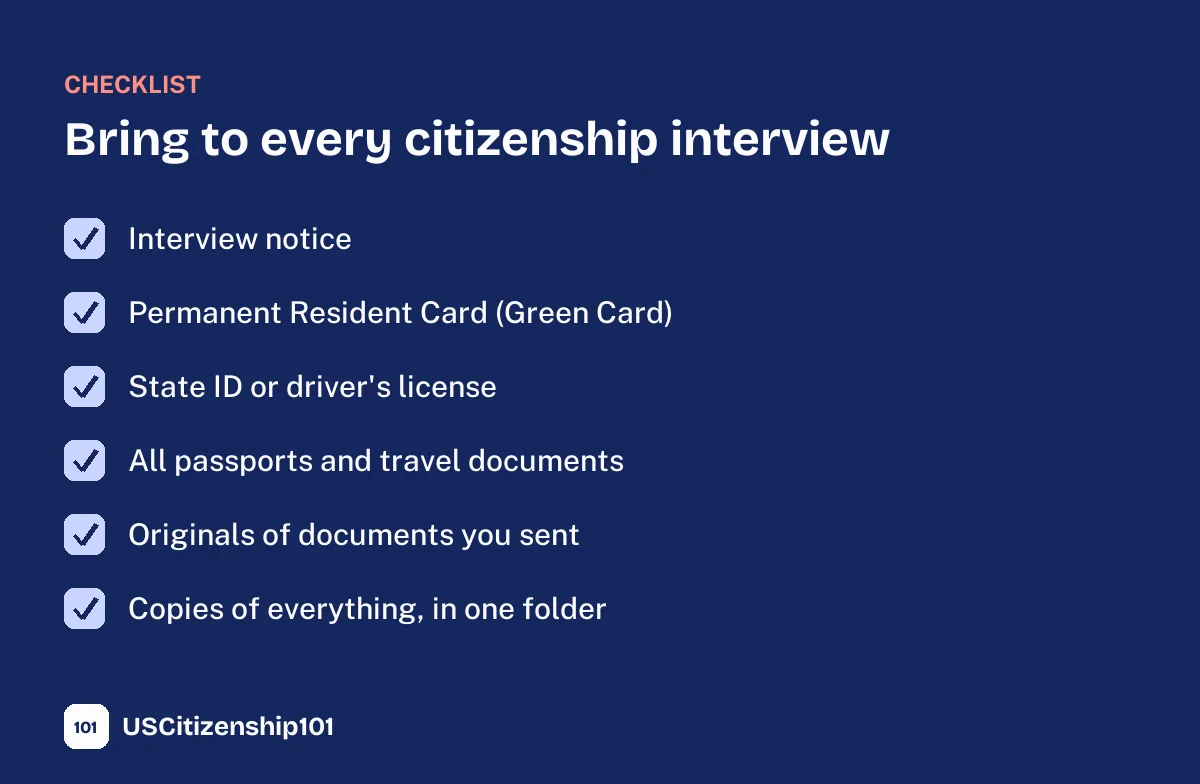
- Every applicant brings the notice, Green Card, a photo ID, and all passports and travel documents used since becoming a permanent resident.
- Bring the originals of documents you sent with your N-400 as copies, plus a copy of each.
- Some applicants need extra documents: marriage records, tax transcripts, court records, name change papers, or proof of support.
- Put your citizenship interview documents in one folder, in order, and bring it on the day.
Start with your interview notice
A few weeks before your interview, USCIS sends an interview notice by mail and posts it in your online account. It gives the date, time, and field office address, and it lists the citizenship interview documents you must bring. Requirements can depend on your case, so the notice is the final word. If this checklist and your notice ever differ, follow the notice.
Bring the notice itself with your other citizenship interview documents. Security staff and the reception desk use it to check you in.
Citizenship interview documents every applicant brings
- Your interview notice.
- Your Permanent Resident Card (Green Card). If it is lost or expired, bring your Form I-90 receipt notice and any other proof of status you have.
- A government-issued photo ID, such as a state driver’s license or ID card.
- All passports and travel documents you have used since you became a permanent resident, including expired ones. These show your trips outside the United States.
- Originals of the documents you sent with your N-400 as copies, such as a marriage certificate or court records.
These are the citizenship interview documents the officer is most likely to ask for. The officer compares them with your N-400 answers, checks your identity, and confirms your trips abroad.
Citizenship interview documents at a glance
| Document | Who needs it | Original or copy |
|---|---|---|
| Interview notice | Everyone | Original |
| Green Card | Everyone | Original |
| Driver’s license or state ID | Everyone | Original |
| Passports and travel documents | Everyone who has them | Originals, including expired |
| Marriage certificate and spouse’s proof of citizenship | Marriage-based applicants | Original plus copy |
| Divorce decrees or death certificates | Anyone married before | Original plus copy |
| IRS tax transcripts | Marriage-based cases, long trips, tax issues | Printed transcript |
| Court and arrest records | Anyone ever arrested, cited, or charged | Original or court-certified copy |
| Name change document | Anyone whose name changed | Original plus copy |
| Proof of child support | Parents of children who live elsewhere | Copies of records |
| Form N-648 | Disability exception applicants | Copy |
Use this table as a quick check, then read the sections below for the details that apply to you.
Extra citizenship interview documents for your situation
USCIS Form M-477, the Document Checklist, lists additional documents for specific situations. Read each section below and bring what applies to you.
If you applied based on marriage to a U.S. citizen
- Proof your spouse has been a U.S. citizen for the required time: birth certificate, Certificate of Naturalization or Citizenship, U.S. passport, or Form FS-240.
- Your current marriage certificate.
- Proof that all prior marriages of you and your spouse ended: divorce decrees, annulments, or death certificates.
- Documents showing your life together, such as joint tax returns or IRS tax transcripts for the last three years, a lease or mortgage, bank statements, and your children’s birth certificates.
See our guide to citizenship through marriage.
If you were married before
Bring proof that every earlier marriage ended, such as divorce decrees, annulment papers, or death certificates.
If your name changed
Bring the document that legally changed your name if it differs from the name on your Green Card, such as a marriage certificate, divorce decree, or court order.

If you took long trips abroad
If any trip lasted six months or more since you became a permanent resident, bring evidence that you kept your life in the United States: IRS tax transcripts for the last five years (three if you applied through marriage), rent or mortgage records, pay stubs, and similar proof. Read our guide to the continuous residence requirement.
If you have tax problems
If you did not file a tax return you were required to file, bring your correspondence with the IRS. If you owe taxes, bring a signed payment agreement with the IRS or your state and proof of your payment status. IRS tax transcripts are free at irs.gov and are a good idea for most applicants.
If you have children you do not live with
Bring any court or government order for support, plus proof that you paid, such as cancelled checks, receipts, a court or agency printout of child support payments, wage garnishment records, or a letter from the child’s parent or guardian.
If you were ever arrested, cited, or convicted
- If no charges were filed: an original official statement from the arresting agency or court confirming it.
- If charges were filed: an original or court-certified copy of the complete arrest record and the final result for each incident.
- If you were convicted or completed a program: the sentencing record and proof you completed your sentence, probation, or program.
- If a record was sealed, expunged, or vacated: the court order, or an official statement that no record exists.
Bring these citizenship interview documents even for old or minor incidents, and even if a record was expunged. Traffic tickets for $500 or more, and any that involved alcohol or drugs, should also be documented. If you have any criminal history, talk to an immigration attorney before your interview. See our guide to good moral character.
If you are asking for a disability exception
Bring a copy of your Form N-648, Medical Certification for Disability Exceptions, and any updated medical records. See our Form N-648 guide.
If you did not register for Selective Service
Men who were required to register between ages 18 and 26 and did not should bring a Status Information Letter from the Selective Service System, along with any explanation.
If you serve or served in the military
Bring your military records and Form N-426, Request for Certification of Military or Naval Service, if you applied based on military service and it is requested.
How to organize your citizenship interview documents
- Use one folder with dividers or labeled envelopes.
- Put the core documents first: notice, Green Card, ID, passports.
- Group the rest by topic: marriage, taxes, travel, court records.
- Keep a copy of each original behind it, in case the officer wants to keep a copy.
- Add a copy of your N-400 so you can review your answers while you wait.
- Write a one-page list of everything in the folder, and check it off the night before.
Other things to bring besides your documents
- A pen with black ink, in case you need to sign or correct something.
- Your N-400 copy and notes of your trips abroad with exact dates.
- An interpreter, only if you qualify for an English exemption because of age and years as a permanent resident, or a disability exception. Everyone else takes the interview in English.
- Your attorney or accredited representative, if you have one who filed Form G-28.
- Reading glasses or hearing aids, if you use them, for the reading and writing tests.
Citizenship interview documents for older applicants
If you qualify for an English exemption because of your age and years as a permanent resident, your citizenship interview documents are the same as everyone else’s, but you may bring an interpreter. The interpreter must be fluent in English and your language, and should not be your attorney. Some offices ask the interpreter to sign a form, so the interpreter should bring a photo ID. Older applicants may also take a simplified civics test. Read our guide to the citizenship test for seniors.
Keep your citizenship interview documents safe afterward
After the interview, keep your folder together. If your case is continued, you may need the same citizenship interview documents again, and if you are approved, you will want your records in one place when you apply for a U.S. passport. Store originals in a safe, dry place at home, and keep scanned copies on your phone or computer.
What not to bring
Federal buildings have security screening. Leave weapons, pocket knives, pepper spray, and large bags at home. Do not bring family members or friends who are not part of your case unless your notice allows it, because many offices do not let them wait inside. Phones must usually be silenced and put away during the interview. Do not bring study sheets into the interview room.
Where to get missing citizenship interview documents
- IRS tax transcripts: free and fast with the Get Transcript tool at irs.gov, or by mail with Form 4506-T.
- Court and arrest records: from the clerk of the court that handled the case, or the police department or sheriff for arrest reports. Ask for certified copies and the final disposition.
- Marriage, divorce, and death records: from the vital records office or county clerk in the place where the event happened.
- Selective Service status letter: from the Selective Service System, through its website.
- Replacement passport from your home country: from your country’s consulate, if you lost one you used for travel. If you cannot get it, write down your trips with dates and bring any proof, such as airline records.
Records from courts and vital records offices can take weeks, so request them as soon as your interview notice arrives. If a record does not exist, ask the office for a letter saying so, and bring that letter with your other citizenship interview documents.
Documents for a re-exam or second interview
If you did not pass part of the test at your first interview, USCIS schedules a re-exam, usually within 60 to 90 days. For that appointment, bring your new notice, your Green Card, your ID, and any documents the officer asked for in writing. You only retake the part you did not pass. Bring the same folder with all your citizenship interview documents anyway, in case the officer has a follow-up question.
If your oath could be the same day
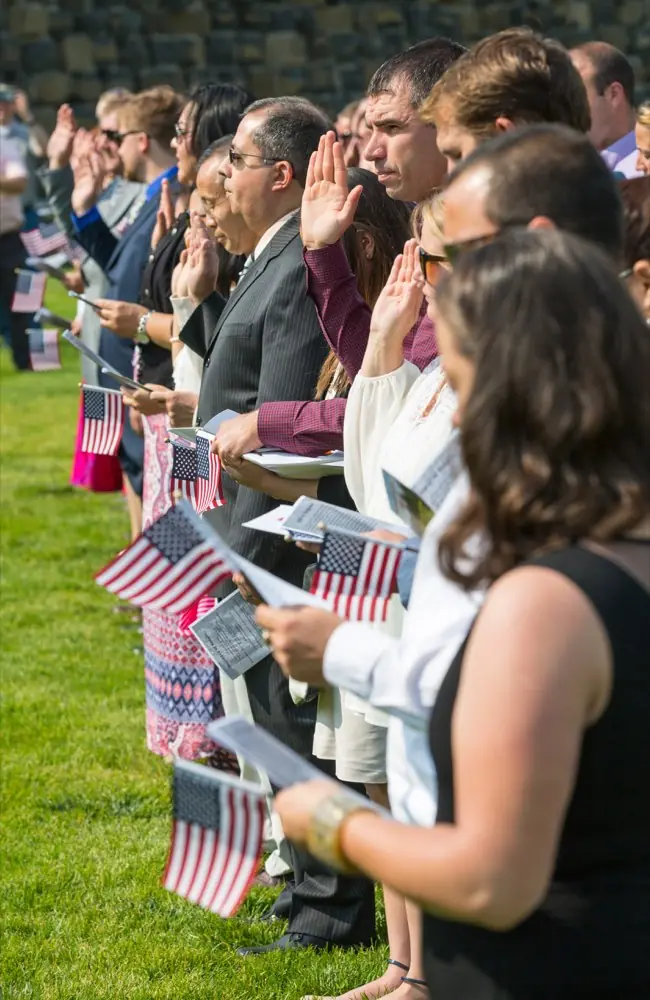
Some field offices hold the oath ceremony on the same day as the interview when the case is approved. If that happens, you will return your Green Card at the ceremony and receive your Certificate of Naturalization. Bring your Green Card even if you think you will not need it, and check your certificate for errors before you leave. See our guide to the oath of allegiance ceremony.
A timeline to prepare your documents
- When the notice arrives: read it, mark the date, and list the citizenship interview documents it asks for.
- Two to three weeks before: request IRS tax transcripts, court records, or any official copies you are missing. Court records can take time.
- One week before: put all your citizenship interview documents in your folder and review your N-400 answers.
- The night before: check off your list, and put the folder next to your keys.
- Interview day: arrive 30 minutes early with your folder, ID, and notice.
If one of your citizenship interview documents is missing
Do not skip the interview because one paper is missing. Bring everything else and explain calmly. The officer may continue your case and give you a request for more documents, often on Form N-14, with a deadline to send them. Answer before the deadline and keep proof that you sent it. Missing an interview without rescheduling is much worse than arriving with one missing document.
If your Green Card is expired or lost
You can still attend your interview. Bring your expired card if you have it, your I-90 receipt notice if you filed to replace it, and your other citizenship interview documents. Your N-400 receipt notice can also extend your Green Card validity for a period, which USCIS explains on the notice itself.
How the officer uses your documents
At the start of the interview, you take an oath to tell the truth and the officer checks your ID. During the interview, the officer reviews your N-400 with you, question by question, and may ask to see citizenship interview documents that support your answers, such as passports for trips or court records for arrests. Answer honestly, hand over what is asked for, and say so if you do not understand a question. You will also take the English and civics tests. Read our citizenship interview tips and practice the citizenship interview questions before the day.
Frequently asked questions
What citizenship interview documents do I need?
Your interview notice, Green Card, a photo ID, all passports and travel documents since you became a permanent resident, and the originals of documents you sent with your N-400. Some people need extra documents for marriage, taxes, travel, arrests, or name changes.
Do I need to bring my birth certificate?
Usually not, unless your notice asks for it or it supports something in your case, such as your children’s birth certificates in a marriage-based case.
Should I bring originals or copies?
Bring both for all your citizenship interview documents. Show the originals and offer the copies. The officer usually returns originals.
Do I need tax transcripts?
They are required in some situations, such as marriage-based cases or long trips abroad, and helpful in many others. They are free from the IRS.
Do I need my Social Security card?
Usually not. Your notice lists what is required. Knowing your Social Security number is helpful, because the N-400 asks for it and the officer may confirm it with you.
Can I bring my children to the interview?
Only if necessary. Check your notice and your field office rules, because many offices limit who can wait inside.
What if I forget a document?
Attend anyway with the citizenship interview documents you have. The officer may give you a list of documents to send later with a deadline.
Final thoughts
Preparing your citizenship interview documents takes an evening, and it removes one of the biggest sources of stress on interview day. Follow your notice, bring the core documents every applicant needs, add the extra papers for your situation, and keep everything in one folder. Then you can focus on what matters most: answering clearly and passing your tests.
Sources: USCIS Form M-477, Document Checklist; USCIS, Form N-400 Instructions. Last reviewed September 2026.
Free tools
This article is for general education, not legal advice. Always confirm requirements at uscis.gov.