Form N-648: Medical Certification for the Citizenship Test Disability Exception
If a disability prevents you from learning English or civics, a doctor can certify it on Form N-648. Here is who qualifies and how to make the form strong.
On this page
Form N-648, Medical Certification for Disability Exceptions, is how applicants with a serious disability ask to be excused from the citizenship test. A licensed doctor or clinical psychologist completes it and explains how your condition prevents you from learning, or showing that you know, English or U.S. history and government. If USCIS accepts it, you skip the English test, the civics test, or both.
This guide covers who qualifies, who can sign the form, what the doctor must write, how to file it with your N-400, what happens at the interview, and the most common reasons a certification is not accepted.
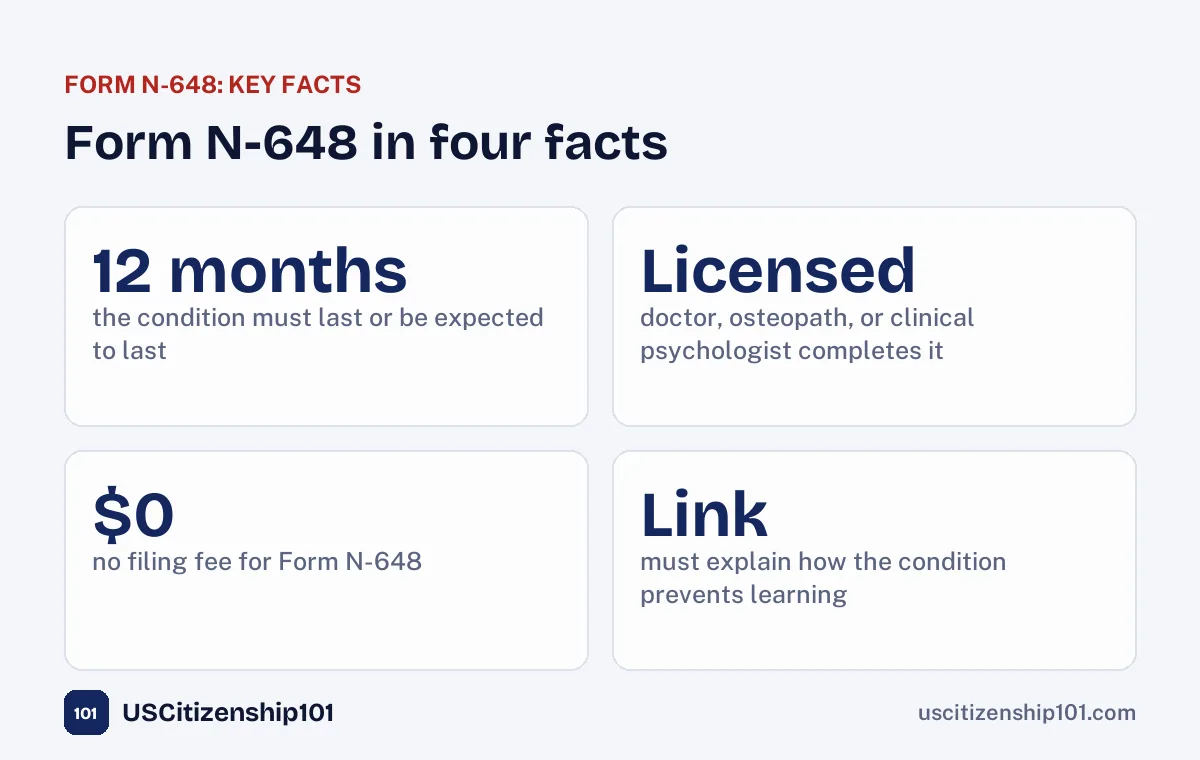
Key points about Form N-648
- Form N-648 requests an exception to the English requirement, the civics requirement, or both.
- A licensed medical doctor, doctor of osteopathy, or clinical psychologist in the United States must complete it.
- The condition must have lasted, or be expected to last, at least 12 months.
- The form must explain how the condition prevents learning or showing knowledge. A diagnosis alone is not enough.
- There is no fee for Form N-648. File it with your N-400 when you can.
Who qualifies for the disability exception
The law excuses applicants who cannot meet the English or civics requirement because of a physical or developmental disability or a mental impairment. USCIS looks for three things:
- A medically determinable condition, diagnosed by a professional.
- A condition that has lasted, or is expected to last, 12 months or more.
- A clear link between the condition and the inability to learn or demonstrate the required knowledge, even with reasonable accommodations.
There is no official list of qualifying conditions, because the decision depends on how the condition affects each person. Certifications often involve dementia and Alzheimer’s disease, intellectual and developmental disabilities, traumatic brain injury, the effects of a stroke, and serious psychiatric conditions that severely affect memory or concentration. Having one of these diagnoses does not guarantee an exception, and people with other conditions may qualify if the impact is severe enough.
Some situations do not qualify: conditions caused by illegal drug use, low literacy or little schooling on its own, and ordinary difficulty learning English as a second language. Those applicants are usually better served by classes, more study time, or the age-based exemptions.
Who can sign Form N-648
- A licensed medical doctor (M.D.).
- A licensed doctor of osteopathy (D.O.).
- A licensed clinical psychologist.
The professional must be licensed in the United States and must examine you before completing the form. Ideally it is someone who treats you and knows your history. A specialist, such as a neurologist or psychiatrist, can often give the most detailed explanation, but a primary care doctor who knows you well can complete it too. Records from doctors in other countries can support the certification but cannot replace it.
What the doctor must explain
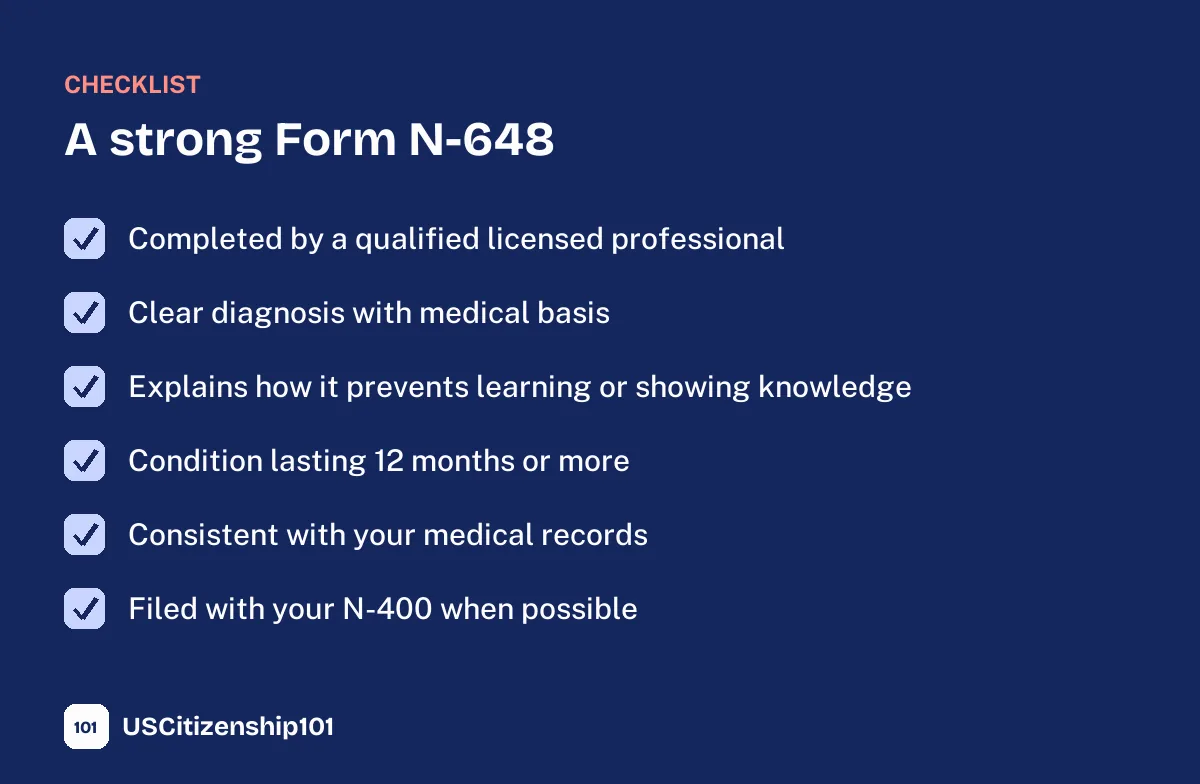
Officers are not medical experts. The certification has to make sense to someone without medical training. A strong Form N-648 includes:
- The diagnosis, with its medical basis and when it began.
- Duration: that it has lasted or will last 12 months or more.
- Functional impact in plain words: how the condition affects memory, attention, reasoning, speech or learning. For example, “cannot retain new information for more than a few minutes.”
- The link to the test: why those effects prevent you from reading and writing an English sentence, or from learning and recalling civics answers.
- Which requirement the exception should cover: English, civics, or both.
- Consistency with your medical records and with how you present at the interview.
Many doctors have never completed this form. Bring the current form and instructions from uscis.gov/n-648, your records and medication list, and a short description of what the test involves: reading and writing one sentence and answering civics questions from memory. The certification must reflect a genuine condition and a real examination. A false certification can lead to denial and serious consequences for both the applicant and the professional.
How to file Form N-648, step by step
- Talk with your doctor about whether your condition prevents you from learning English or civics.
- Have the doctor examine you and complete the form close to the time you file, so it reflects your current condition.
- Mark the disability exception on your N-400 and submit Form N-648 with it when possible, so the officer can review it before the interview. Check the current instructions for any rules about submitting it later.
- Gather supporting records: recent medical records, cognitive or psychological test results, school or special education records for developmental disabilities, hospital or specialist records, and a medication list. They should tell the same story as the form.
- Request accommodations early if you need them: wheelchair access, a caregiver with you, a sign language interpreter, extra time, or in some cases an interview at home or in a care facility.
- Bring copies of everything to the interview.
If your case takes a long time or your condition changes, ask your doctor whether the certification needs an update.
What happens at the interview
You still attend the interview. The officer reviews Form N-648, checks that it is complete and that the explanation makes sense, and compares it with your records and with what they observe. The officer usually tries to speak with you and may ask family members or caregivers about your daily abilities. A caregiver can come with you, and you may bring an interpreter if you do not speak English.
If the officer accepts the certification, you are excused from the covered tests. You must still meet every other requirement, including continuous residence, physical presence and good moral character.
Why certifications are not accepted, and what to do next
- Diagnosis without explanation: the form names a condition but does not say how it prevents learning.
- Missing duration: nothing shows the condition has lasted or will last 12 months.
- Inconsistency: interview answers or medical records contradict the form.
- Wrong provider: the professional is not one of the three license types.
- Incomplete or unclear: blank sections, illegible handwriting, or medical jargon with no plain explanation.
If the officer finds the form insufficient, you will be asked to take the tests. If you do not pass, you get a retest, usually 60 to 90 days later, and you may be able to submit a new or corrected Form N-648 before it. Ask your doctor to address the officer’s specific concerns. See what happens if you fail the citizenship test for the retest rules.
Because of this, it is wise to practice as much as your condition allows, even when you file Form N-648. Our free civics practice test can read questions aloud and lets you go at your own pace.
Four examples
Dementia
Rosa, 74, has moderate Alzheimer’s disease diagnosed three years ago. Her neurologist explains that her memory loss prevents her from learning and recalling new information, even the shorter 65/20 question list. The officer reviews the form with her daughter present and accepts the exception for both English and civics.
Developmental disability
Ahmed, 25, has an intellectual disability documented since childhood. His doctor explains how his cognitive limitations prevent him from learning to read and write English and from retaining civics facts. His school records support the certification.
Stroke
Mei had a stroke two years ago that affected her language abilities. Her physician explains that her aphasia prevents her from reading, writing and learning new verbal information. The exception covers both tests.
A form that was not accepted
Carlos’s form lists “depression” but does not explain how it prevents him from learning. The officer finds it insufficient and gives him the tests. Before his retest, his psychologist submits a new Form N-648 describing specific effects on concentration and memory, with supporting records.
Form N-648 compared with the age exceptions
| Option | What it changes | Who qualifies |
|---|---|---|
| Form N-648 | Excuses English, civics, or both | People with a qualifying disability or impairment |
| 50/20 and 55/15 | Excuses English; civics test in your language | Older applicants with long residence |
| 65/20 | Excuses English; shorter civics list in your language | Age 65+ with 20 years of residence |
| Accommodations | Changes how the test is given | People who can take the test with support |
You can combine options. If an older parent can learn 20 questions with practice, the 65/20 rule may be enough. If they cannot retain new information at all, a medical exception is the better route. See the citizenship test for seniors.
After the exception is accepted
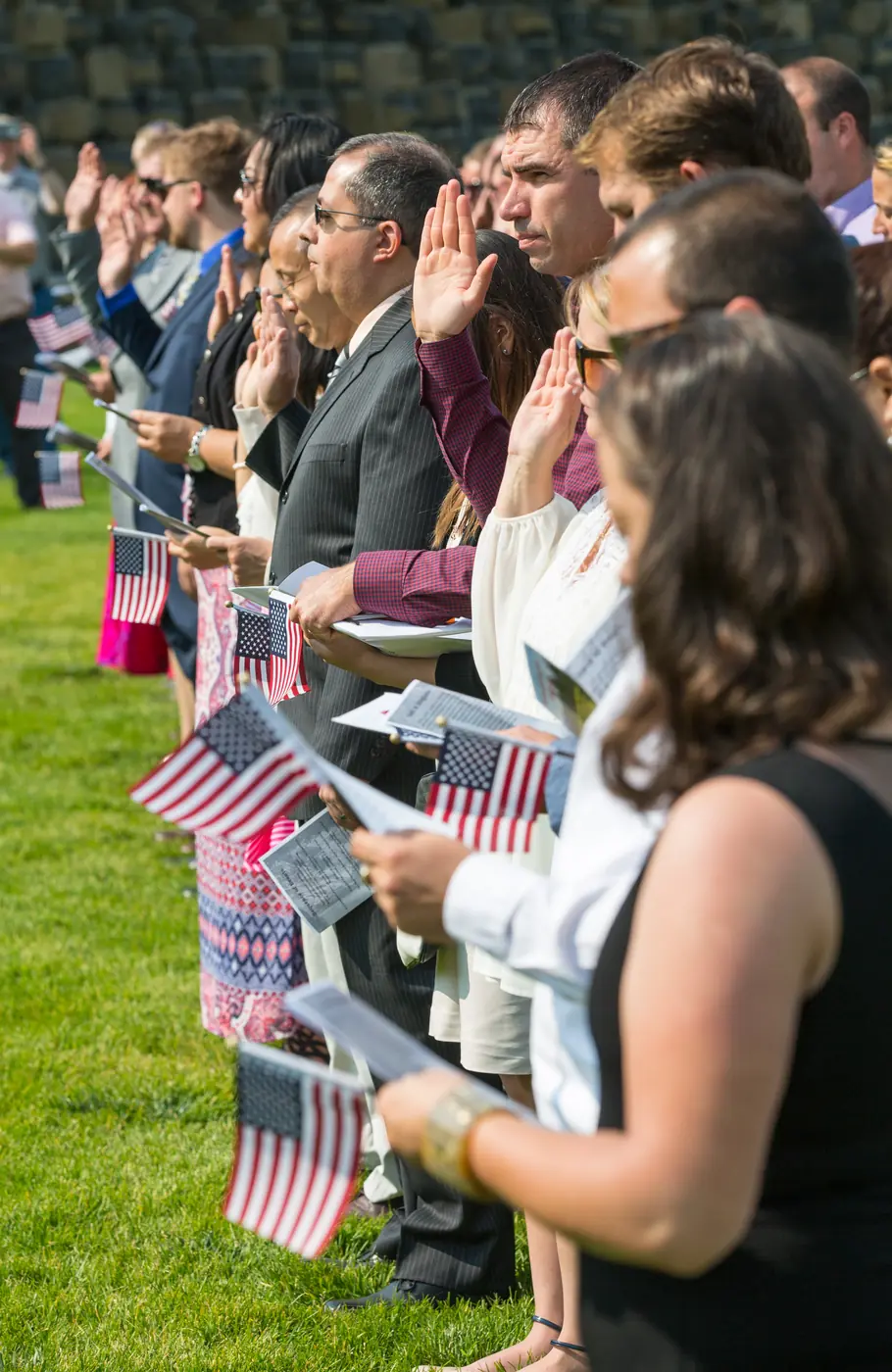
The interview continues with the review of your application. If you are approved, you are scheduled for the oath ceremony. In rare cases where a person cannot understand or communicate an understanding of the oath, USCIS can waive the oath itself. That waiver is separate from Form N-648, so raise it with USCIS early. If your condition gets worse while you wait, update your medical documentation and ask about accommodations.
Checklist before you submit
- The professional is a licensed M.D., D.O. or clinical psychologist in the United States.
- The form is the current edition and every section is complete.
- The diagnosis is clear and supported by records.
- The form states the condition has lasted, or will last, 12 months or more.
- The explanation connects the condition to the specific tests being excused.
- The professional signed and dated the attestation.
- Your N-400 indicates that you are requesting a disability exception.
- You kept copies of the form and all supporting records.
If you have questions about your situation, a legal aid organization or immigration attorney can review the form before you file.
Frequently asked questions
Is there a fee for Form N-648?
No. There is no separate fee, though you pay the normal N-400 fee.
Can my family doctor complete it?
Yes, if they are a licensed M.D. or D.O. in the United States and know your condition.
Can a nurse practitioner complete Form N-648?
Check the current instructions. Licensed medical doctors, doctors of osteopathy and licensed clinical psychologists are the professionals authorized to certify.
Can one Form N-648 cover both tests?
Yes. The professional can certify that the condition prevents you from meeting the English requirement, the civics requirement, or both.
Does Form N-648 excuse the interview?
No. You still attend the interview, where the officer reviews your application and the certification.
How long is the certification valid?
It should reflect a recent examination. If your case takes a long time or your condition changes, ask your doctor whether an update is needed.
Sources: USCIS Form N-648 and instructions; USCIS Policy Manual, Volume 12, Part E. Last reviewed October 2026. General information, not legal or medical advice.
Free tools
This article is for general education, not legal advice. Always confirm requirements at uscis.gov.