The Proposed N-400 Fee Increase: What Could Change and What It Means for You
DHS has proposed raising the citizenship application fee by about 75%. Here are the proposed numbers, what has and has not happened yet, and how fees are applied to your case.
On this page
In June 2026, the Department of Homeland Security proposed a large N-400 fee increase, the fee you pay to apply for U.S. citizenship. If it becomes final, the online fee would go from $710 to $1,280, and the reduced fee and fee waivers for Form N-400 would end.
This guide explains exactly what was proposed, where the rule stands today, which fees apply right now, and what to watch for. It sticks to the published facts. Whether to file now or later depends on your own eligibility and situation.
Key points about the N-400 fee increase
- DHS published a proposed rule on June 23, 2026. It is not final.
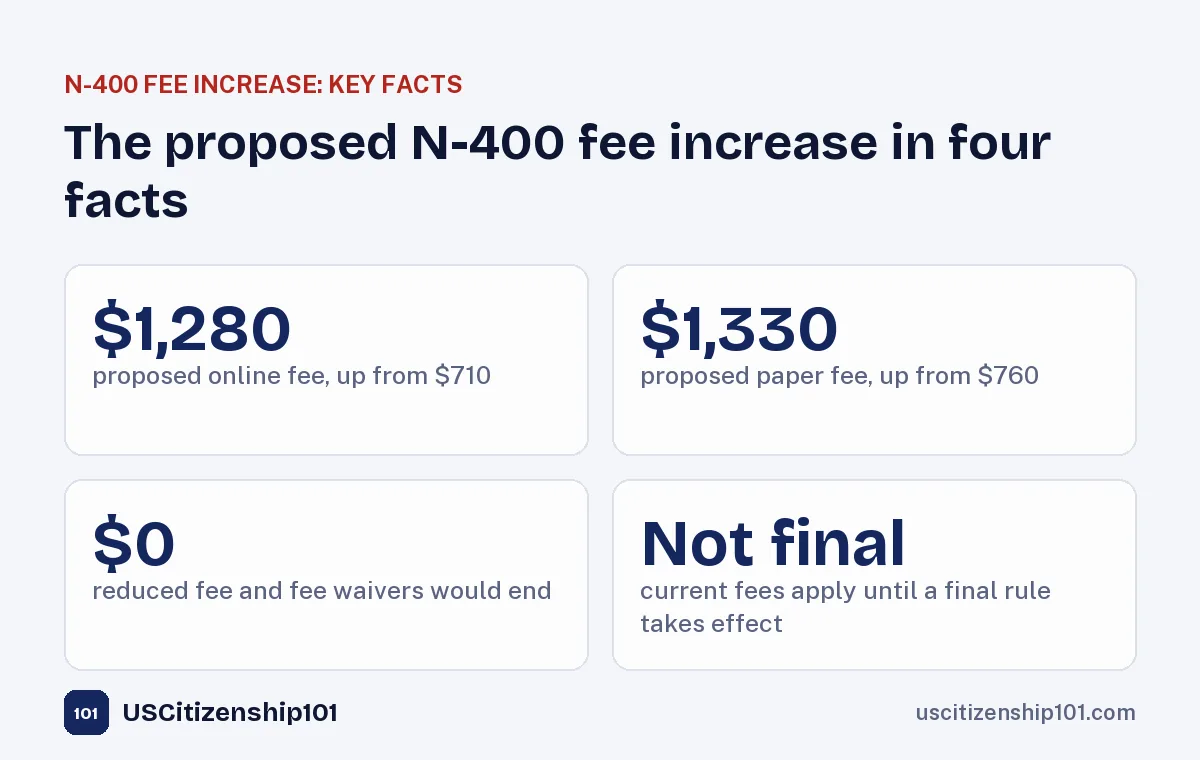
- Proposed fees: $1,280 online (now $710) and $1,330 on paper (now $760).
- The proposal would end the $380 reduced fee and fee waivers for Form N-400.
- Fee exemptions for military applicants would remain.
- The public comment period closed on August 24, 2026. Current fees apply until a final rule takes effect.
Current fees compared with the proposal
| Current fee | Proposed fee | |
|---|---|---|
| Form N-400, filed online | $710 | $1,280 |
| Form N-400, filed on paper | $760 | $1,330 |
| Reduced fee (household income 150% to 400% of poverty guidelines) | $380 | Would end |
| Fee waiver (Form I-912) | Available if you qualify | Would end for N-400 |
| Military applicants applying through service | No fee | No fee |
The proposal also covers Form N-336, the request for a hearing after a denial. Its paper fee would go from $830 to $1,475, and fee waivers for it would end too.
Why DHS proposed the N-400 fee increase
DHS says the current fees do not cover the full cost of processing naturalization applications, and that the reduced fee and waivers shift those costs to other applicants. The proposal sets the fee at what DHS calculates to be the full cost of deciding an N-400. You can read the full reasoning in the Federal Register notice.
Where the rule stands
- June 23, 2026: proposed rule published. A small correction followed on July 8, 2026.
- August 24, 2026: public comment period closed.
- Next: DHS reviews the comments and may publish a final rule. A final rule can keep, change or drop parts of the proposal, and it sets an effective date.
As of October 2026, no final rule has been published. Until one takes effect, the current fees on uscis.gov/n-400 apply. Our N-400 filing fee guide covers how to pay them.

How fees apply to your application
USCIS charges the fee in effect when it receives your application. If a final rule changes the fee, applications received before the effective date pay the old fee, and applications received on or after it pay the new one. An application that arrives with the wrong fee is rejected, so always check the fee page the day you file.
Who would be affected most
- Applicants who use the reduced fee would go from $380 to the full fee, more than three times as much.
- Applicants who qualify for a fee waiver would have to pay the full fee.
- Families where several people apply would see the increase for each person.
- Military applicants applying through service would still pay nothing.
The reduced fee and fee waiver today
These two options are the ones the proposal would remove, so it helps to know how they work now:
- Reduced fee ($380): for applicants whose household income is between 150% and 400% of the Federal Poverty Guidelines. You request it with your N-400 and show your income.
- Fee waiver: requested with Form I-912. You may qualify if you receive a means-tested benefit, if your household income is at or below 150% of the Federal Poverty Guidelines, or if you face financial hardship.
Our N-400 filing fee guide explains the documents each option needs.
What the change would cost, in examples
| Situation | Pays today | Would pay under the proposal |
|---|---|---|
| One person filing online, full fee | $710 | $1,280 |
| One person who qualifies for the reduced fee | $380 | $1,280 |
| One person who qualifies for a fee waiver | $0 | $1,280 |
| A married couple both filing online | $1,420 | $2,560 |
| A service member applying through military service | $0 | $0 |
These examples use the proposed numbers. A final rule could set different amounts.
If you are thinking about applying
Only you can decide when to apply, and it depends first on whether you are eligible. These steps help either way:
- Check your earliest filing date with our N-400 early filing calculator. Filing even one day too early leads to a denial and a lost fee.
- Review the citizenship requirements and gather your documents.
- If you may qualify for the reduced fee or a waiver now, read the current eligibility rules on uscis.gov.
- If your case is complicated, talk to an immigration attorney or a DOJ-accredited representative.
Frequently asked questions
Has the N-400 fee already gone up?
No. As of October 2026 the rule is only proposed. The current fees are $710 online and $760 on paper.
When would a new fee start?
On the effective date set in a final rule, if DHS publishes one. That date has not been announced.
Can I still use a fee waiver or the reduced fee?
Yes, if you qualify, while the current rules are in effect.
Can I still comment on the proposal?
No. The comment period closed on August 24, 2026.
Will you update this page?
Yes. We will update it if DHS publishes a final rule.
Sources: Federal Register, Naturalization Application Fee Adjustments (proposed rule, June 23, 2026); USCIS, Form N-400. Last reviewed October 2026. General information, not legal advice.
Free tools
This article is for general education, not legal advice. Always confirm requirements at uscis.gov.