N-400 Filing Fee in 2026: How Much Citizenship Costs and How to Pay Less
The application costs $710 online or $760 on paper. Here is who can pay $380 or nothing at all, and how to pay correctly the first time.
On this page
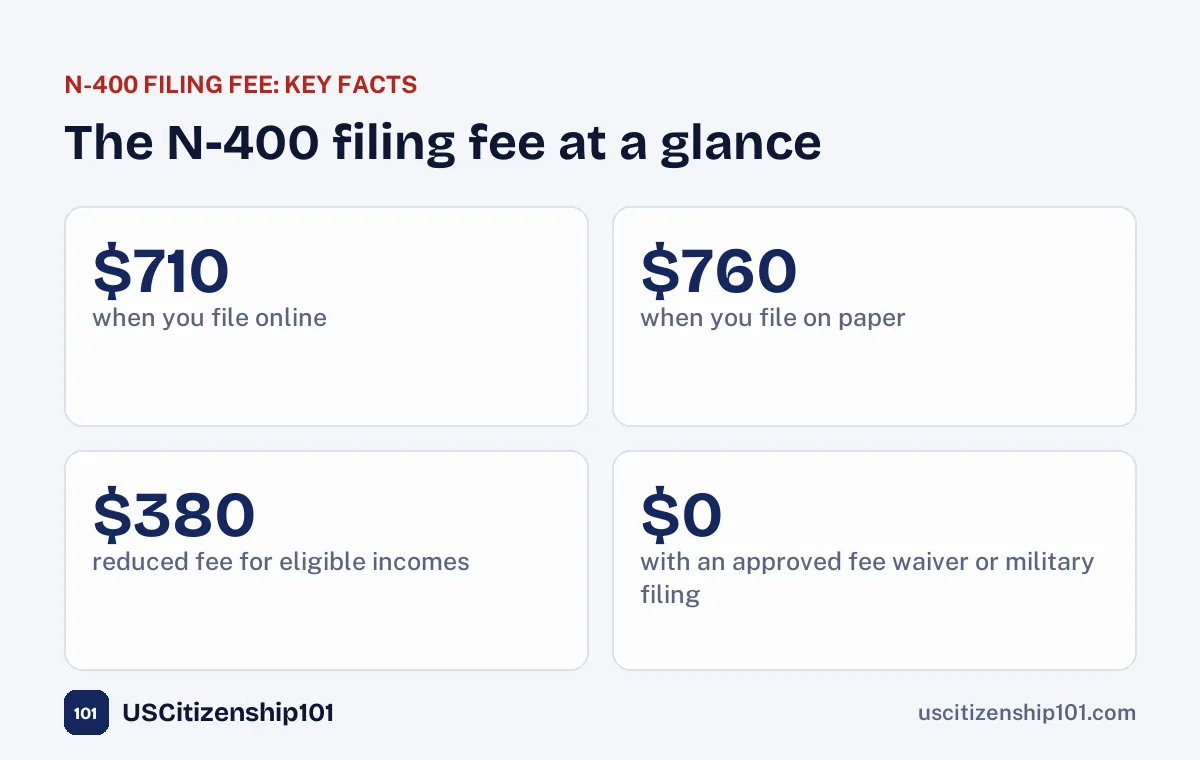
The N-400 filing fee is the government fee you pay when you apply for U.S. citizenship with Form N-400, Application for Naturalization. In 2026 the N-400 filing fee is $710 if you file online and $760 if you file on paper. Some applicants pay a reduced fee of $380, and some pay nothing at all with a fee waiver or through military service.
Paying the right amount in the right way matters. USCIS rejects applications that arrive with the wrong fee or a failed payment, and a rejection can cost you weeks. This guide explains every part of the N-400 filing fee: current amounts, who qualifies for discounts, how to pay, common payment mistakes, and other costs to plan for.
Key points about the N-400 filing fee
- The standard N-400 filing fee is $710 online or $760 on paper.
- A $380 reduced fee is available for household incomes between 150% and 400% of the Federal Poverty Guidelines.
- A full fee waiver is possible with Form I-912 for low-income applicants or people facing financial hardship.
- There is no separate biometrics fee. It is included.
- Reduced fee and fee waiver requests must be filed on paper.
Current N-400 filing fee amounts
| How you file | N-400 filing fee | Who it is for |
|---|---|---|
| Online (USCIS account) | $710 | Most applicants |
| Paper, by mail | $760 | Most applicants |
| Reduced fee (paper only) | $380 | Household income from 150% to 400% of the Federal Poverty Guidelines |
| Fee waiver (paper only) | $0 | Means-tested benefits, income at or below 150% of the guidelines, or financial hardship |
| Military naturalization | $0 | Applicants filing under military service provisions |
USCIS set these amounts in its fee rule that took effect on April 1, 2024. Fees can change again, so always confirm the current N-400 filing fee on uscis.gov/n-400 or the USCIS fee calculator in the same week you file.
Why the online N-400 filing fee is lower
Filing online costs $50 less than filing on paper. USCIS saves time and money on data entry and mail handling, and it passes some of that saving to applicants. Filing online has other benefits too:
- You get your receipt number immediately.
- You can upload evidence and respond to requests for evidence directly.
- You see notices in your account as soon as they are issued.
- The online form checks for missing answers before you submit.
The only people who must file on paper are those asking for the reduced fee or a fee waiver, and a few special cases described in the form instructions. If you are paying the full N-400 filing fee, online filing is usually the better choice.
The reduced N-400 filing fee: $380
If your household income is more than 150% but not more than 400% of the Federal Poverty Guidelines, you can pay half the normal N-400 filing fee. You request the reduced fee on Form N-400 itself, in the fee reduction section, and include documents that prove your household income.
Who counts in your household
Your household generally includes you, your spouse if you live together, and your children or other dependents who live with you. The form instructions explain the rules in detail.
Proof of income
The best proof is an IRS tax transcript for the most recent tax year, which you can download free from the IRS website. If you did not file taxes, other evidence such as pay stubs or benefit letters may be accepted.
Check the current poverty guidelines
The Federal Poverty Guidelines change every year. USCIS publishes the current table in Form I-912P. Multiply the guideline for your household size by 1.5 and by 4 to find the income range for the reduced N-400 filing fee.
The full fee waiver: Form I-912
You can ask USCIS to waive the N-400 filing fee completely by submitting Form I-912, Request for Fee Waiver, with a paper N-400. You may qualify on one of three grounds:
- Means-tested benefit. You, your spouse, or the head of your household currently receives a means-tested benefit such as Medicaid, SNAP, TANF, or SSI.
- Low income. Your household income is at or below 150% of the Federal Poverty Guidelines.
- Financial hardship. A situation such as unemployment, large medical bills, or a recent disaster prevents you from paying.
Include evidence for the ground you choose, such as a benefit letter dated within the last year. If USCIS denies the waiver request, it rejects the N-400 and returns it. You can then refile with the N-400 filing fee or the reduced fee.
Military applicants pay no N-400 filing fee
Current and former members of the U.S. armed forces who apply under the military naturalization provisions do not pay the N-400 filing fee. Military bases often have USCIS contacts who help service members file. If you are a veteran, check whether you qualify under these provisions before paying.

How to pay the N-400 filing fee
If you file online
You pay at the end of the online application with a credit card, debit card, prepaid card, or a U.S. bank account. The payment is processed immediately, and your receipt number appears once it succeeds.
If you file on paper
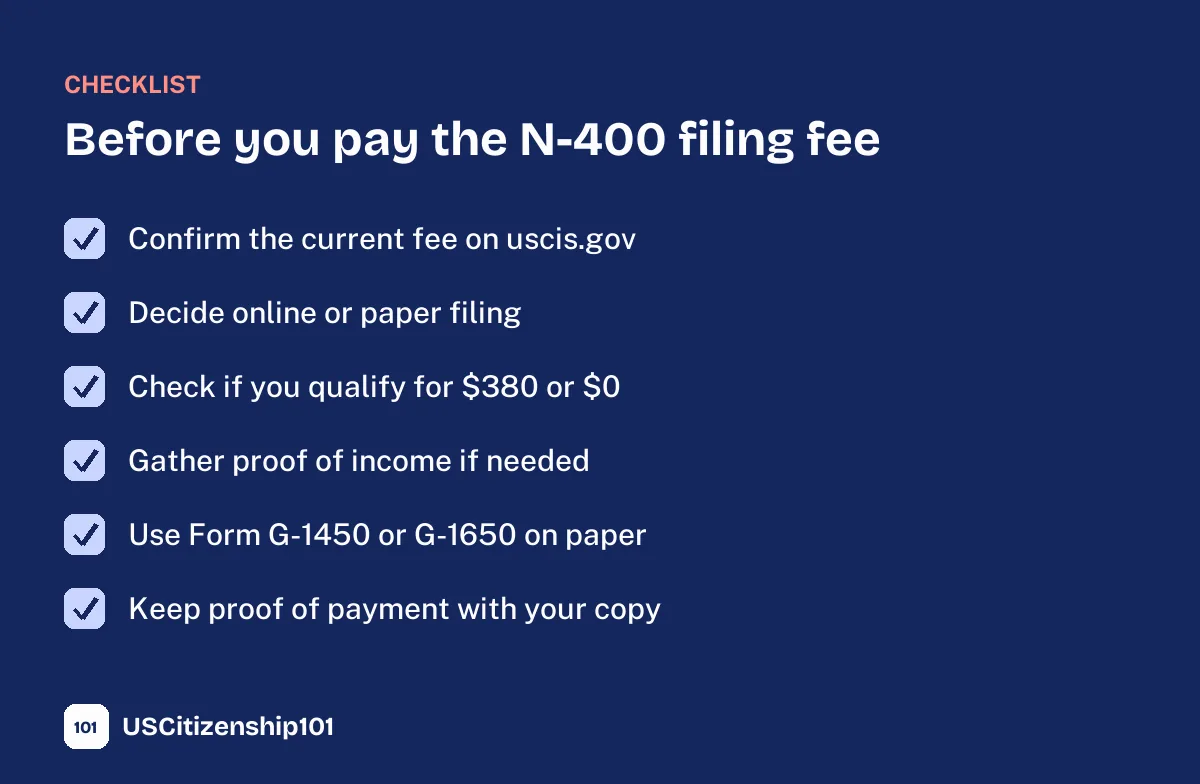
USCIS accepts card payments using Form G-1450, Authorization for Credit Card Transactions, and bank account payments using Form G-1650, Authorization for ACH Transactions. Place the payment form on top of your application package. USCIS has been moving toward electronic payments, so check the “Filing Fee” section of the N-400 page for the currently accepted methods before you mail anything.
Payment tips that prevent rejection
- Pay the exact N-400 filing fee. Do not add an old biometrics fee.
- Sign the G-1450 or G-1650 and make sure the card or account details are correct.
- Make sure the account has enough money when USCIS processes it, which can be days after mailing.
- Use a card that will not expire before USCIS processes the payment.
- Keep a copy of your payment form and check your bank statement for the charge.
What happens if your payment fails
If the N-400 filing fee cannot be charged, USCIS rejects the application and returns it. A rejected application is treated as if it was never filed, so it does not hold your place in line. If you were close to a deadline, such as the 90-day early filing window, a rejection can matter. Double-check the payment before you mail.
If USCIS accepts the application but the payment later bounces, USCIS may deny the application. Keep enough money in the account until you see the charge clear.
What the N-400 filing fee pays for
USCIS is funded mostly by application fees, not by taxes. The N-400 filing fee covers the full cost of processing your case, including:
- Receiving and entering your application and evidence.
- Your biometrics appointment and the FBI name and fingerprint checks.
- Review of your file by a trained immigration officer.
- Your interview, including the English and civics tests.
- A free retest if you need one.
- The naturalization ceremony and your Certificate of Naturalization.
In other words, you pay the N-400 filing fee once, and it covers the entire process from filing to the oath, as long as the application is not denied.
Worked examples of the N-400 filing fee
These examples show how different people end up paying different amounts. The income figures are illustrations only. Always check the current guidelines before you file.
Example 1: Maria files online
Maria earns a salary well above 400% of the poverty guidelines for her household. She files online and pays the standard N-400 filing fee of $710 with a debit card. Her receipt number appears on screen right away.
Example 2: Tuan asks for the reduced fee
Tuan supports a family of four on one income that falls between 150% and 400% of the guidelines. He files on paper, completes the fee reduction section of Form N-400, attaches his IRS tax transcript, and pays $380 using Form G-1450.
Example 3: Amina requests a fee waiver
Amina receives SNAP benefits. She files a paper N-400 with Form I-912 and a copy of her current benefit letter. USCIS approves the waiver, so she pays no N-400 filing fee at all.
Example 4: Carlos is a veteran
Carlos served honorably in the U.S. Army and applies under the military naturalization provisions. He pays no N-400 filing fee.
Help paying the N-400 filing fee
If the N-400 filing fee is a barrier but you do not qualify for a waiver, look for local help. Some cities, states, credit unions, and nonprofit organizations offer citizenship fee assistance, small low-interest loans, or free application clinics. Search your city or state name together with “citizenship fee assistance,” or ask a local immigrant services nonprofit. Libraries and adult education centers often know about these programs too.
Be careful with anyone who asks for large payments to “speed up” your case. Only USCIS decides processing times, and the official N-400 filing fee is the only government charge for the application.

Is the N-400 filing fee refundable?
No. USCIS keeps the N-400 filing fee even if your application is denied or you withdraw it. The only exception is a rare case where USCIS itself made an error, such as charging a fee that was not required. That is why it pays to confirm you are eligible before you file. Our guide to citizenship requirements helps you check.
Other costs to plan for
The N-400 filing fee is the biggest expense, but not the only one. Plan for:
- Documents: certified court records, translations of foreign documents, and copies.
- Photos: two passport-style photos are needed only if you live outside the United States when you file, or if USCIS asks.
- Travel and time off: for your biometrics appointment, interview, and oath ceremony.
- Legal help: optional. Nonprofits and DOJ-accredited representatives often help for free or at low cost.
- A U.S. passport: after you become a citizen, the passport is a separate application with its own State Department fees. See our guide to getting a passport after naturalization.
Studying does not need to cost anything. Every tool on this site is free, including the civics practice test, English practice, and mock interview.
Other USCIS forms and fees you might need
Depending on your situation, you may run into other USCIS forms during or after naturalization. Each has its own fee listed in the USCIS Fee Schedule (Form G-1055), so check the current amount before filing any of them.
- Form I-90, Green Card renewal. If your Green Card will expire while your citizenship case is pending, renew it. Do not let it lapse.
- Form N-336, hearing request. Used to ask for a review if your naturalization application is denied.
- Form N-600, Certificate of Citizenship. Used for children who became citizens automatically through a parent.
- Form N-565, replacement certificate. Used if your Certificate of Naturalization is lost, stolen, damaged, or has an error.
- Form N-470, preserving residence. Used by some people who must work abroad for certain employers.
A simple budget timeline
Spreading costs out makes the process easier to plan. Here is a typical order of expenses:
- Before filing: gather records. Court records and translations are the most common costs here.
- At filing: the application fee, paid once.
- A few weeks later: travel to your biometrics appointment, if USCIS schedules one.
- Months later: travel and time off for the interview.
- After approval: travel to the oath ceremony, then your passport application.
Setting aside a small amount each month from the day you decide to apply means nothing comes as a surprise.
Comparing the N-400 filing fee over time
Before April 2024, applicants paid a $640 application fee plus an $85 biometrics fee, a total of $725 for most people. The current rule combined these into one N-400 filing fee and introduced a lower online price. For most people filing online today, the total cost is slightly lower than before. The reduced fee category was also expanded to more households.
Ways to save on citizenship costs
- File online if you are paying the full N-400 filing fee. You save $50.
- Check the reduced fee carefully. Many working families qualify and do not realize it.
- Get free tax transcripts from the IRS instead of paying for copies.
- Use free legal clinics run by nonprofits, libraries, and community groups, often held near citizenship day in September.
- Prepare well so you pass the first time. A denial means paying the N-400 filing fee again.
- File at the right time. Filing too early leads to denial and a lost fee. Our guide to N-400 early filing shows the exact window.
How the fee fits into the whole process
Paying the N-400 filing fee is step three in the naturalization journey, after checking eligibility and gathering documents. After that come biometrics, the interview, the English and civics tests, and the oath. Read our full guide on how to become a US citizen for the big picture, or our walkthrough on how to fill out Form N-400.
Frequently asked questions
Do I pay again if I fail the citizenship test?
No. You get a free retest 60 to 90 days later. You only pay the N-400 filing fee again if your application is denied and you file a new one. See what happens if you fail the citizenship test.
Is there still a separate biometrics fee?
No. Since April 1, 2024 the biometrics cost is included in the N-400 filing fee.
Can I file online and ask for a fee waiver?
No. Fee waiver and reduced fee requests must be filed on paper with the correct forms and evidence.
Can someone else pay the N-400 filing fee for me?
Yes. A family member or friend can pay with their card or bank account. Make sure their details are entered correctly on the payment form.
Does the N-400 filing fee cover my children?
No. Each applicant files their own N-400 and pays their own fee. Many children under 18 do not need an N-400 at all, because they may become citizens automatically when a parent naturalizes. Read about Form N-600 for proof of their citizenship.
Can I pay the fee in installments?
No. USCIS requires the full amount when you file. If paying at once is hard, look at the reduced fee, a fee waiver, or local assistance programs described above.
What if USCIS raises the fee after I file?
You pay the amount that applies on the day USCIS receives your application. A later fee change does not affect an application that is already accepted.
Does my lawyer’s fee include the government fee?
Not always. Ask your attorney or accredited representative whether their quote includes the USCIS fee or only their own services, and get it in writing.
Final thoughts
The N-400 filing fee is a real expense, but you have options. File online to save $50, check whether you qualify for the $380 reduced fee or a full waiver, and pay carefully so your application is accepted the first time. Then put your energy into preparing for the interview, the part that truly decides your result.
Sources: USCIS Form N-400 page and instructions (edition 01/20/25); USCIS Forms I-912, I-912P, G-1450 and G-1650; USCIS Fee Schedule (G-1055). Figures checked September 26, 2026.
Free tools
This article is for general education, not legal advice. Always confirm requirements at uscis.gov.