U.S. Citizenship Requirements: The Complete Eligibility Checklist
Every requirement for naturalization in one place, with plain-English explanations and links to detailed guides for each rule.
On this page
Before you apply for naturalization, you need to be sure you meet all the citizenship requirements. Filing when you are not eligible leads to denial and a lost fee, so it is worth checking each rule carefully. The good news is that the citizenship requirements are clearly defined in law, and most long-time permanent residents meet them.
This guide lists every one of the general citizenship requirements for adults applying with Form N-400, explains each in plain English, and links to detailed guides. It also covers special paths for spouses of citizens and members of the military.
Key citizenship requirements
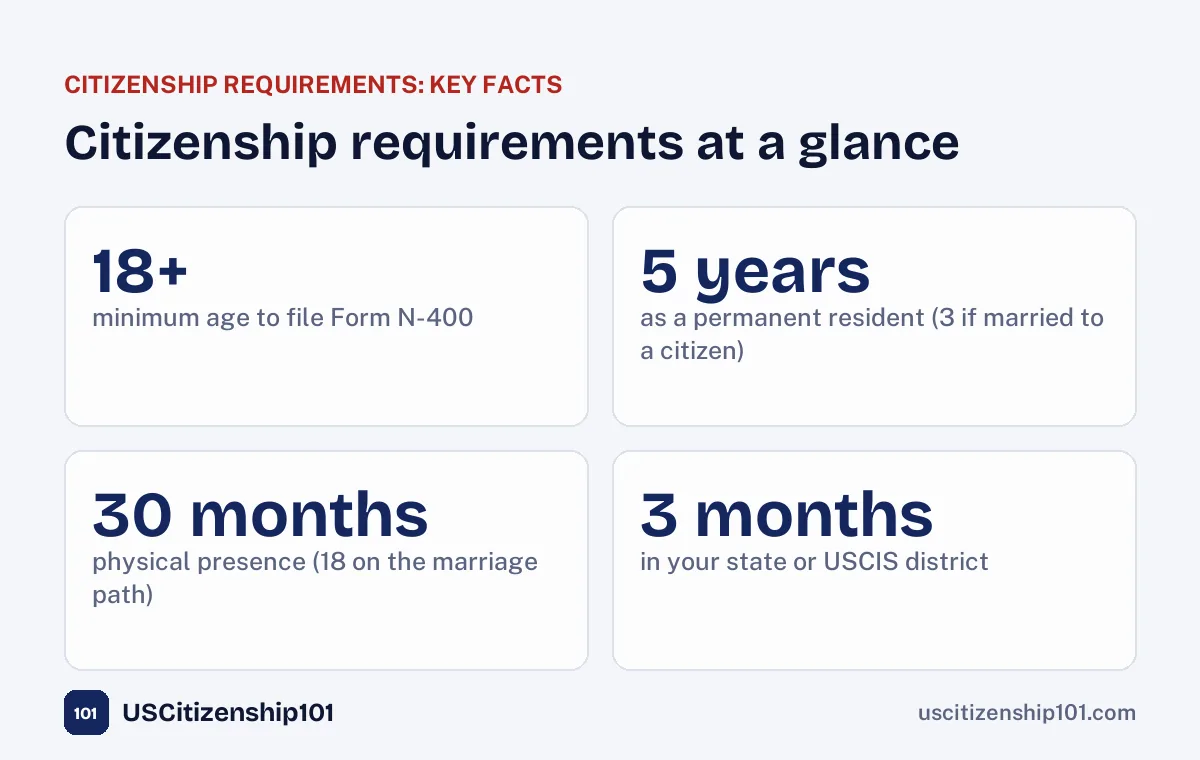
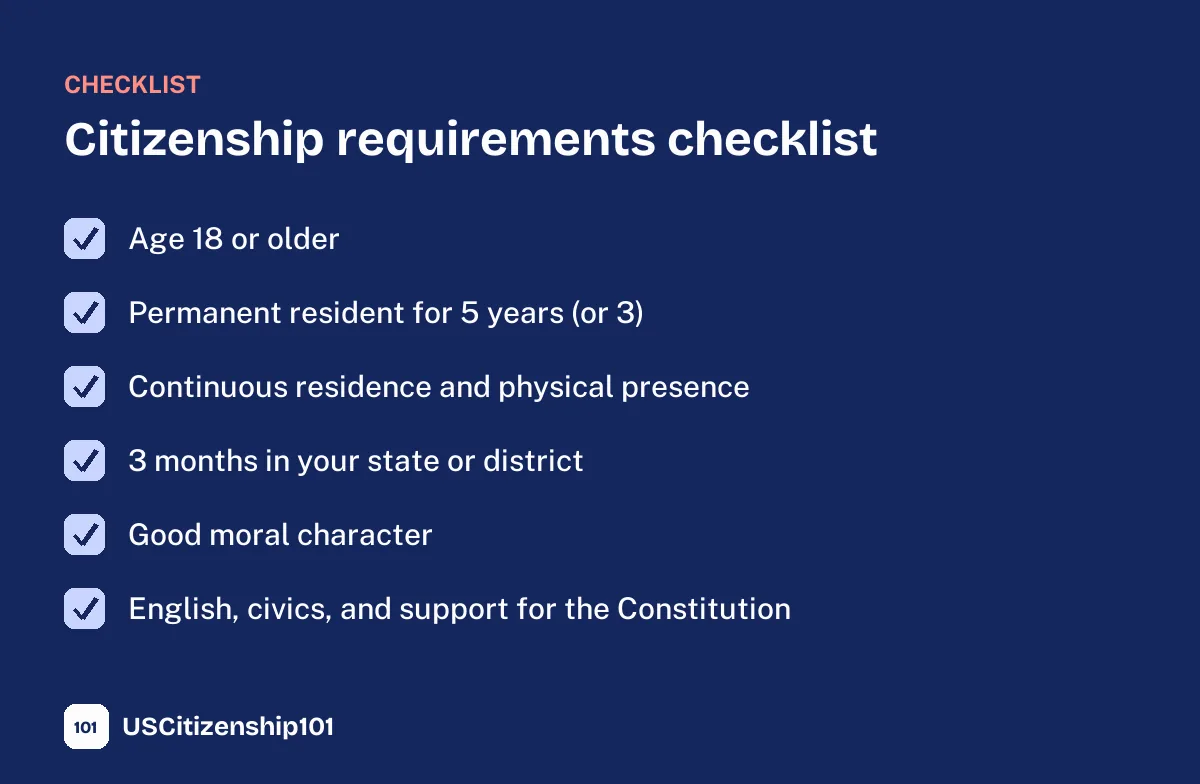
- Be at least 18 years old.
- Be a lawful permanent resident for 5 years (3 years if married to and living with a U.S. citizen).
- Have continuous residence and physical presence for the required time.
- Live in your state or USCIS district for 3 months.
- Show good moral character.
- Pass the English and civics tests, unless exempt, and support the Constitution.
1. Age
You must be at least 18 years old when you file Form N-400. Children under 18 usually do not naturalize on their own; many become citizens automatically through a U.S. citizen parent. See Form N-600.
2. Lawful permanent residence
You must be a lawful permanent resident (Green Card holder), and your status must have been lawfully obtained. Most applicants need 5 years of permanent residence. If you have been married to and living with a U.S. citizen for 3 years, and your spouse has been a citizen for those 3 years, you need only 3 years. See citizenship through marriage.
3. Continuous residence
You must have continuous residence in the United States for the 5 (or 3) years before filing, and continue living here until you naturalize. Trips over 6 months may break continuous residence, and trips of a year or more do. See the continuous residence requirement.
4. Physical presence
You must have been physically present in the United States for at least half the period: 30 months on the 5-year path, 18 months on the 3-year path. This is separate from continuous residence and counts actual days in the country.
5. Time in your state or district
You must have lived for at least 3 months in the state or USCIS district where you apply. Students may sometimes apply where they attend school or where their family lives, and people who move often should count carefully from their most recent move.

6. Good moral character
You must show good moral character during the statutory period and until your oath. Serious crimes, dishonesty in immigration matters, failure to pay taxes or child support, and other conduct can prevent it. See good moral character.
7. English
You must be able to read, write, and speak basic English, unless you qualify for an exception. See the citizenship English test.
8. Civics
You must show knowledge of U.S. history and government by passing the civics test: the 2025 civics test for applications received on or after October 20, 2025, or the 2008 test for earlier ones.
9. Attachment to the Constitution
You must support the principles of the U.S. Constitution and be well disposed to the good order and happiness of the United States. In practice, the officer confirms this through questions on your N-400 about your support for the Constitution and your willingness to take the oath.
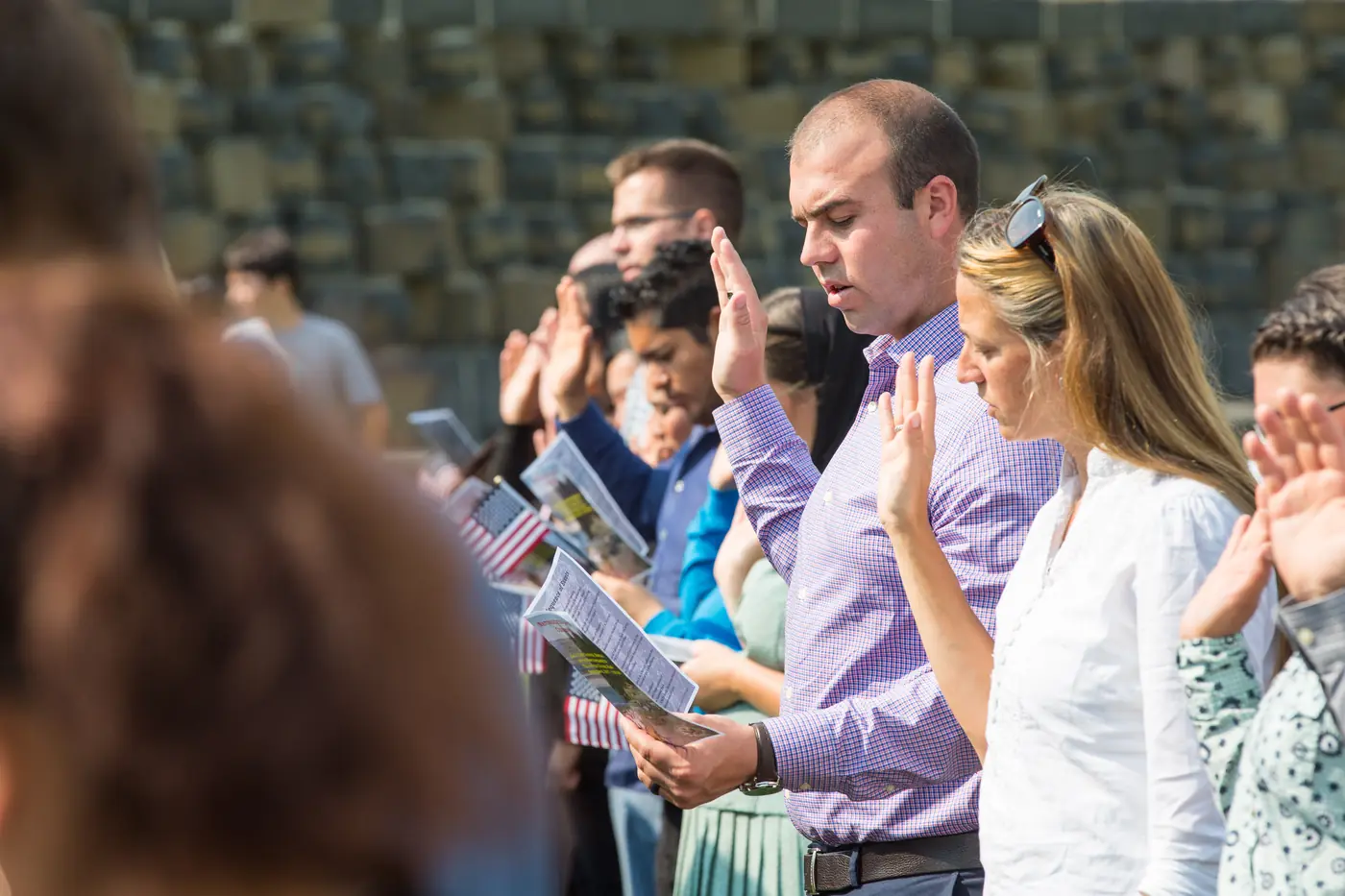
10. The Oath of Allegiance
You must be willing to take the Oath of Allegiance. You become a citizen when you take it. See the oath of allegiance ceremony.
Citizenship requirements for spouses of U.S. citizens
If you are married to a U.S. citizen, the citizenship requirements are the same except for the time periods. You need 3 years as a permanent resident, 3 years married to and living with your citizen spouse (who has been a citizen for those 3 years), 18 months of physical presence, and good moral character for 3 years. Everything else, including the English and civics tests, stays the same.
Citizenship requirements for military members
Members and veterans of the U.S. armed forces have special citizenship requirements. Those who served honorably for at least one year may apply without meeting the usual residence and physical presence periods in certain situations, and those who served during designated periods of hostilities may apply even without a Green Card. There is no N-400 filing fee for military naturalization. Service members still take the English and civics tests.
Citizenship requirements for older applicants
| Age and residence at filing | English test | Civics test |
|---|---|---|
| 50 or older, 20 years as a resident | Exempt | Full test, in your language |
| 55 or older, 15 years as a resident | Exempt | Full test, in your language |
| 65 or older, 20 years as a resident | Exempt | 20-question list, in your language |
All other citizenship requirements still apply. See citizenship test exemptions and the citizenship test for seniors.
Disability exceptions
If a physical or developmental disability or mental impairment prevents you from learning English or civics, a licensed doctor or clinical psychologist can certify it on Form N-648. The other citizenship requirements, such as residence and good moral character, still apply.
Who is not eligible yet
- People who have not had their Green Card for the required time (with the 90-day early filing window).
- People whose continuous residence was broken by a long trip and who have not built a new period.
- People who do not have enough days of physical presence.
- People who moved to a new state less than 3 months ago.
- People with conduct that prevents good moral character during the statutory period.
- People who obtained their Green Card through fraud or error, who should get legal advice before filing.
Quick self-check
- Am I 18 or older?
- Will I have 5 years (or 3 years on the marriage path) as a permanent resident within 90 days?
- Have all my trips been shorter than 6 months, or can I explain longer ones?
- Have I been inside the U.S. for at least half of the period?
- Have I lived in my state for at least 3 months?
- Have I filed taxes, paid child support if required, and registered for Selective Service if required?
- Do I have any arrests or convictions that need legal review?
- Am I ready to learn basic English and civics, or do I qualify for an exception?
If you can answer yes to the eligibility questions and have reviewed any issues, you likely meet the citizenship requirements. Check your exact date with N-400 early filing.
Documents that prove each requirement
| Requirement | Typical proof |
|---|---|
| Age | Birth certificate, passport, Green Card |
| Permanent residence | Green Card with “Resident Since” date |
| Continuous residence | Address history, lease or mortgage, tax transcripts, employment records |
| Physical presence | Passports with stamps, travel list with dates |
| State residence | Lease, utility bills, driver’s license with current address |
| Good moral character | Tax transcripts, court dispositions, child support records, Selective Service proof |
| Marriage path | Marriage certificate, spouse’s citizenship proof, joint documents |
| Exceptions | Form N-648, or age and residence dates for 50/20, 55/15, 65/20 |
You do not send all of these with your application, but you should be ready to show them at your interview. The N-400 instructions list what must be included when you file.
Four example applicants
Sara: ready on the 5-year path
Sara has had her Green Card for 4 years and 10 months, has taken only short trips, lived in Ohio for 6 years, and has no criminal record. She is within the 90-day window, so she meets the citizenship requirements and can file now.
Hiro: married to a citizen
Hiro has been a permanent resident for 3 years and married to his U.S. citizen wife, who was born in the United States, for 4 years. They live together. He meets the citizenship requirements on the 3-year path.
Fatima: a long trip
Fatima has been a resident for 6 years but spent 14 months abroad last year. Her continuous residence was broken, so she must build a new period before she meets the citizenship requirements.
Daniel: a recent move
Daniel qualifies in every way, but he moved from Florida to Texas two months ago. He waits one more month to meet the 3-month state residence rule, then files.
Common misunderstandings about citizenship requirements
- “Five years in the U.S. is enough.” The count starts from your Green Card date, not your arrival date.
- “Any trip under a year is fine.” Trips over 6 months create a presumption that residence was broken, and many short trips can affect physical presence.
- “Marrying a citizen makes me eligible right away.” You still need 3 years of permanent residence and marriage to a citizen.
- “Old tickets do not matter.” You must disclose citations and arrests, even minor ones.
- “Older people do not need to test.” Age exceptions remove the English test, not civics, unless a medical exception applies.
Frequently asked questions
Do I need to speak English to become a citizen?
Usually yes, at a basic level. Some older applicants and people with qualifying disabilities are exempt.
Can I apply if I have a criminal record?
Possibly. It depends on the offense and when it happened. Get legal advice before filing.
Do I need a job to meet the citizenship requirements?
No. There is no employment or income requirement, although you must meet your legal obligations such as filing taxes if required.
Is there an income requirement for citizenship?
No. You do not need a minimum income to naturalize. Low-income applicants may qualify for a reduced fee or fee waiver. See the N-400 filing fee guide.
Do I need to own property?
No. Renters and owners are treated the same.
Where can I check if I meet the citizenship requirements?
Review this checklist, the Form N-400 instructions, and the USCIS Policy Manual. A legal aid organization can also do a free eligibility screening.
Requirements that continue after you file
Some citizenship requirements must stay true not only when you file but all the way to your oath ceremony:
- Residence: you must keep living in the United States until you naturalize.
- Good moral character: any arrest or citation after filing must be reported and can affect your case.
- Marriage path: you must remain married to and living with your citizen spouse.
- Attachment to the Constitution: you must still be willing to take the oath.
Report any changes at your interview, and on Form N-445 before the oath.
From requirements to application: step by step
- Check each requirement using the checklist above.
- Calculate your filing date with the 90-day early filing window.
- Gather your records: addresses, jobs, trips, marriage documents, court records.
- Review any issues with an attorney if needed.
- File Form N-400 online or by mail. See how to fill out Form N-400.
- Prepare for the tests with our free practice test and English practice.
Where the citizenship requirements come from
The citizenship requirements are set by Congress in the Immigration and Nationality Act, mainly in section 316, with special rules in other sections for spouses, military members, and children. USCIS explains how it applies them in its Policy Manual. Some rules, such as the 5-year residence period, date back to the 1790s. Others, like the current civics test, change over time through USCIS policy. When in doubt, the official sources are the Form N-400 instructions and the USCIS Policy Manual.
Free eligibility screenings
Many nonprofit organizations, libraries, and community groups hold free citizenship clinics, especially around Constitution Day and Citizenship Day in September. Trained staff and volunteers review your situation against the citizenship requirements and help you complete the application. If your case is complex, they can refer you to an attorney or DOJ-accredited representative.
Planning your application date
If you are close to meeting the citizenship requirements, plan backward. Mark the date you reach 5 years (or 3), subtract 90 days for your earliest filing date, check that you will meet the 3-month state rule and physical presence on that date, and set aside time in the weeks before to gather documents. Planning ahead means you can file on your first eligible day with a complete application, which is the fastest path to citizenship.
Refugees and asylees
Refugees and asylees who became permanent residents follow the same citizenship requirements as everyone else, with one helpful difference: their “Resident Since” date is usually rolled back. Refugees’ residence usually counts from their date of arrival in the United States, and asylees’ residence is usually rolled back one year from the date their Green Card was approved. This means many refugees and asylees can apply sooner than they expect. Check the date printed on your Green Card.
Conditional permanent residents
If you had a two-year conditional Green Card, the time as a conditional resident counts toward the residence requirement. You must have removed the conditions, or have a pending petition to remove them, when you apply. USCIS often reviews a pending Form I-751 together with the N-400 at the interview.
Families with children
Children under 18 do not need to meet the adult citizenship requirements. If they have Green Cards and live with you, they often become citizens automatically when you naturalize. Children who are already 18 must meet the citizenship requirements themselves and file their own N-400.
If you do not meet a requirement
If you are missing a requirement, the answer is usually to wait. Time fixes most gaps: more years of residence, more days of physical presence, or conduct issues moving outside the statutory period. Some problems, such as unpaid taxes or missing records, can be fixed by taking action before you file. For serious issues, talk to an immigration attorney. Filing before you meet the citizenship requirements only leads to a denial and a lost fee.
What the officer checks at the interview
At your interview, the officer confirms each of the citizenship requirements in turn. They check your identity and Green Card, review your addresses and trips for residence and physical presence, ask the “have you ever” questions for good moral character, test your English through the conversation and the reading and writing sentences, and give the civics test. Finally, they confirm that you are willing to take the Oath of Allegiance. Knowing this structure helps you prepare evidence for each requirement. Read what to expect at the USCIS citizenship interview.
Benefits of meeting the requirements
Once you meet the citizenship requirements and take the oath, you gain the right to vote in federal elections, a U.S. passport, protection from losing your status for long trips, the ability to sponsor more family members, eligibility for federal jobs, and citizenship for many of your children under 18. For many families, these benefits make the effort of meeting every requirement worthwhile.
Final thoughts
The citizenship requirements are clear once you see them together, and most permanent residents who have lived quietly and lawfully in the United States meet them. Check each one, gather your records, and when you are ready, follow our guide on how to become a US citizen.
Sources: USCIS Policy Manual, Volume 12 (Citizenship and Naturalization); INA section 316. Last reviewed September 2026. General information, not legal advice.
Free tools
This article is for general education, not legal advice. Always confirm requirements at uscis.gov.