Citizenship Test Exemptions: The 50/20, 55/15 and 65/20 Rules Explained
Older permanent residents can skip the English test and take civics in their own language. Here is who qualifies and exactly how it works.
On this page
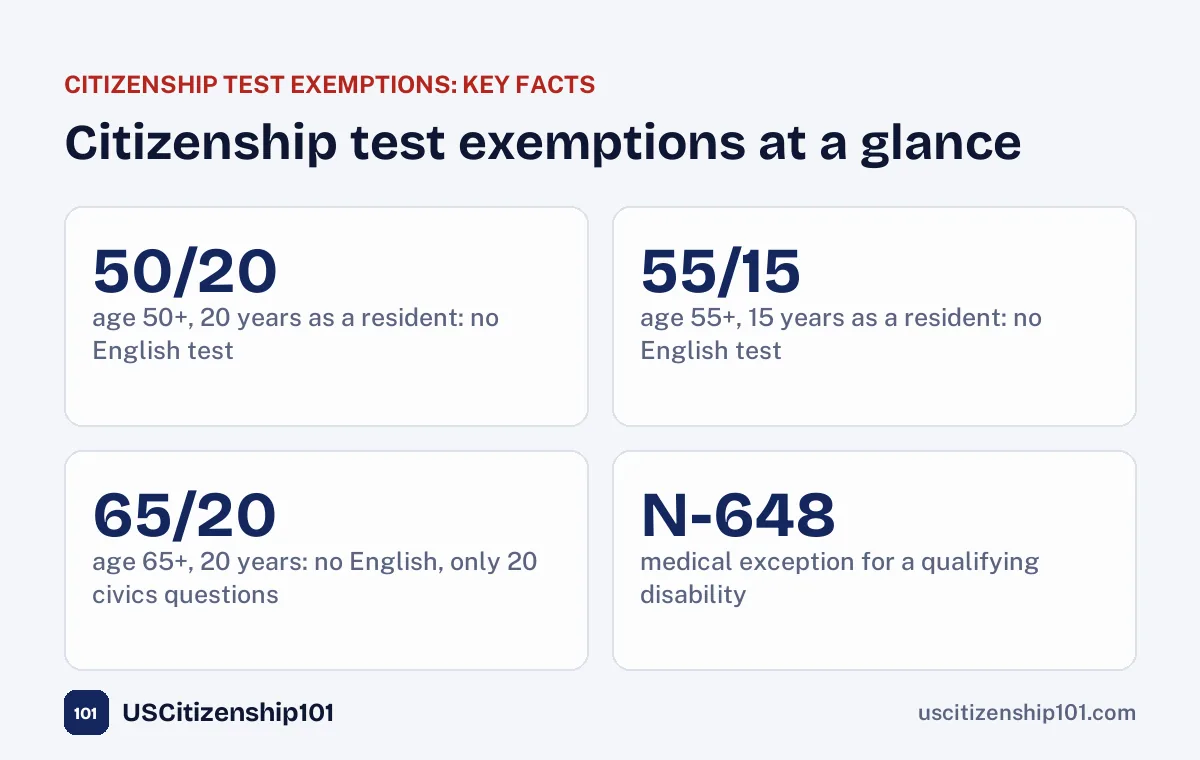
Citizenship test exemptions let some applicants skip the English part of the naturalization test and take the civics test in their own language. They exist because learning a new language later in life is hard, and the law recognizes that long-time permanent residents have already shown their commitment to the United States. There are three age-based exemptions, known as 50/20, 55/15, and 65/20, plus a separate exception for people with a qualifying medical disability.
This guide explains every one of the citizenship test exemptions in plain English: who qualifies, how the years are counted, what the interview looks like, how to bring an interpreter, how the medical exception works, and the mistakes that cause people to miss out.
Key points about citizenship test exemptions
- 50/20: age 50 or older with 20 years as a permanent resident. No English test.
- 55/15: age 55 or older with 15 years as a permanent resident. No English test.
- 65/20: age 65 or older with 20 years. No English test, and only 20 civics questions to study.
- With any of these citizenship test exemptions you still take civics, but you may use an interpreter.
- A disability can qualify you for an exception to English and civics using Form N-648.
The three age-based citizenship test exemptions
| Exemption | Age when you file | Years as a permanent resident | English test | Civics test |
|---|---|---|---|---|
| 50/20 | 50 or older | 20 or more | Not required | Full civics test, in your language |
| 55/15 | 55 or older | 15 or more | Not required | Full civics test, in your language |
| 65/20 | 65 or older | 20 or more | Not required | Shorter test from 20 questions, in your language |
The names are easy to remember: the first number is your age, the second is your years as a Green Card holder. You need both numbers on the day USCIS receives your application.
How the years are counted
Two facts must both be true on the day USCIS receives your Form N-400:
- You have reached the required age.
- You have been a lawful permanent resident for the required number of years, counted from the “Resident Since” date on your Green Card.
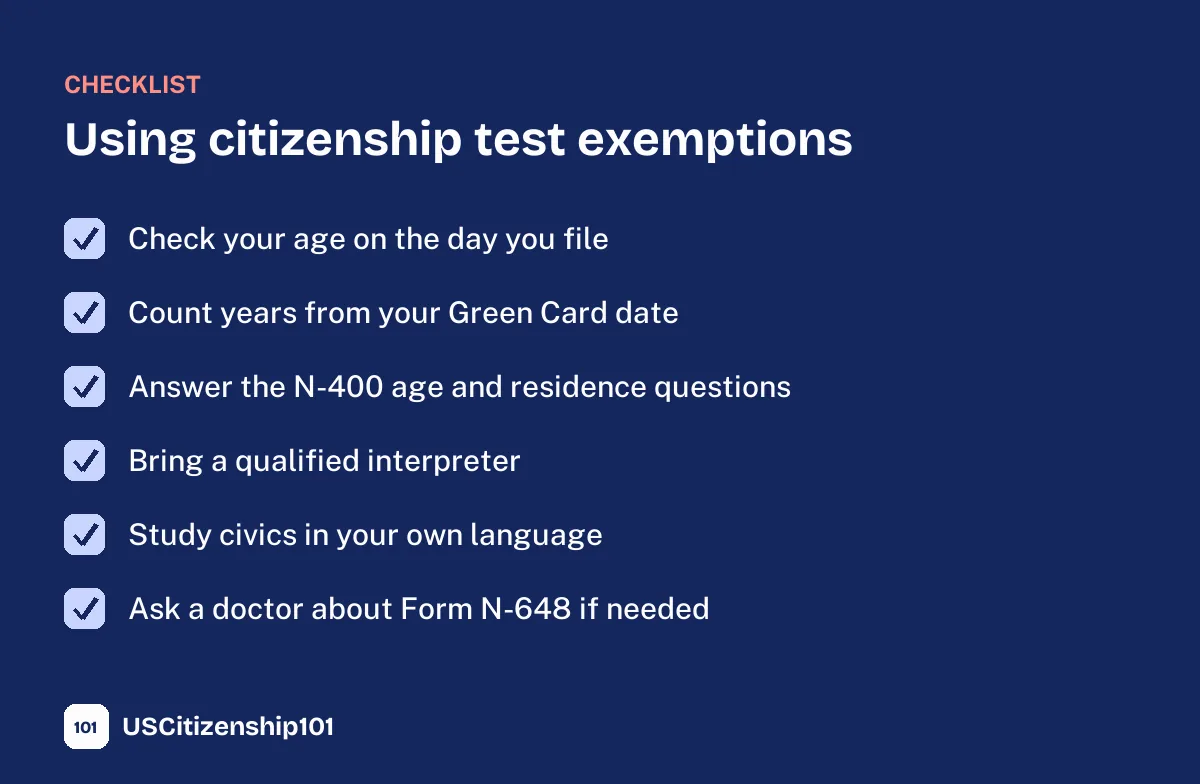
Your age and years are measured at filing, not at the interview. If you file one week before your 55th birthday, you do not get the 55/15 exemption, even if your interview happens a year later. That is one of the most common reasons people lose citizenship test exemptions they could have had. If you are close to a cutoff, wait until you clearly qualify before filing.
Conditional residence counts
If you first received a two-year conditional Green Card, for example through marriage, that conditional period counts toward your years as a permanent resident once the conditions are removed.
Long trips can still matter
Citizenship test exemptions only change the test. They do not change the other requirements for naturalization, such as continuous residence and physical presence. Long trips abroad can still affect your eligibility. Read our guide to the continuous residence requirement before filing.
The 50/20 exemption in detail
If you are at least 50 years old and have been a permanent resident for at least 20 years when you file, you are exempt from the English requirement. That means no reading test, no writing test, and no requirement to speak English during the interview. You still take the civics test, but you may take it in the language of your choice with an interpreter.
With the 50/20 exemption, the civics test itself is the normal version for your filing date. If you filed on or after October 20, 2025, that is the 2025 civics test with up to 20 questions and 12 correct to pass. Before that date, it is the 2008 test with up to 10 questions and 6 to pass.
The 55/15 exemption in detail
The 55/15 exemption works the same way as 50/20, with different numbers: at least 55 years old and at least 15 years as a permanent resident at filing. You skip the English test and may take civics in your language with an interpreter. The civics test is the full version for your filing date.
Many people who came to the United States in their thirties or forties qualify for 55/15 without realizing it. If you are between 55 and 64, check your Green Card date carefully.
The 65/20 special consideration in detail
The 65/20 rule gives the most help of all the citizenship test exemptions. If you are 65 or older and have been a permanent resident for 20 years or more when you file:
- You do not take the English test.
- You study only the 20 questions marked with an asterisk on the official civics list for your test version.
- The officer asks 10 of those 20 questions and you need 6 correct.
- You may take the test in your own language with an interpreter.
You can read all 20 questions for the 2025 test on our study guides page, and practice only those questions by checking “Only the 65/20 questions” in the practice test. Our guide to the citizenship test for seniors has study tips made for older learners.

Bringing an interpreter
If you use one of the age-based citizenship test exemptions, you must bring your own interpreter to the interview. USCIS does not provide one for naturalization interviews. Choose your interpreter carefully:
- The interpreter must be fluent in both English and your language.
- USCIS generally does not allow your attorney or accredited representative to also act as your interpreter.
- The interpreter will be asked to swear or affirm that they will translate completely and accurately.
- Pick someone calm and reliable. A family member can serve, but a neutral person is often better for sensitive questions.
- Your interpreter should attend the whole interview, not just the civics portion.
Practice with your interpreter before the interview. Have them read some civics questions in English and translate your answers back, so you both get used to the rhythm.
The medical disability exception: Form N-648
Separate from the age-based citizenship test exemptions, the law also provides an exception for people with a physical or developmental disability or a mental impairment that prevents them from learning or showing knowledge of English, civics, or both. You request it with Form N-648, Medical Certification for Disability Exceptions.
- A licensed medical doctor, doctor of osteopathy, or licensed clinical psychologist must complete the form.
- The condition must have lasted, or be expected to last, at least 12 months.
- The form must explain how the condition prevents you from meeting the requirement. A diagnosis alone is not enough.
- File it with your N-400 if possible. The officer reviews it at the interview and may ask questions.
If USCIS accepts the N-648, you may be excused from the English test, the civics test, or both. Read the full guide to Form N-648 for details.
Accommodations are different from exemptions
If you do not need a full exception but have a condition that makes the interview harder, you can ask for an accommodation instead. Examples include a sign language interpreter, extra time, a wheelchair-accessible location, or a home visit if you cannot leave home. You request accommodations on the N-400 or through USCIS customer service. Accommodations change how the test is given. Citizenship test exemptions change whether you take part of the test at all.
How to request citizenship test exemptions
For the three age-based options there is no separate form. You answer the N-400 questions about your date of birth and date of permanent residence accurately, and USCIS applies the exemption automatically based on those facts. At the interview, tell the officer that you qualify for 50/20, 55/15, or 65/20 and that you brought an interpreter.
For the medical exception, submit Form N-648 with your N-400, or bring it to the interview if necessary. Filing it early gives the officer time to review it.
What the interview looks like with an exemption
An interview with one of the citizenship test exemptions follows the same structure as any other, with a few differences:
- You and your interpreter are placed under oath.
- The officer reviews your N-400 through the interpreter, asking about your address, travel, family, and background.
- There is no English reading or writing test.
- The officer asks the civics questions in English, and the interpreter translates them. You answer in your language and the interpreter translates back.
- The officer gives you your results on Form N-652.
If you do not pass the civics test, you get a second chance 60 to 90 days later, just like other applicants. See what happens if you fail the citizenship test.
Examples: who qualifies for citizenship test exemptions?
These examples show how the rules work in real life. Each person’s age and Green Card date are measured on the day USCIS receives the application.
Example 1: Rosa, age 52
Rosa has had her Green Card for 22 years. She is over 50 and has more than 20 years as a resident, so she qualifies for the 50/20 exemption. She takes the full civics test in Spanish with an interpreter and does not take the English test.
Example 2: Dev, age 58
Dev became a permanent resident 16 years ago. He is over 55 with more than 15 years, so he qualifies under 55/15. He studies all the civics questions for his version in Hindi and English, and brings his cousin as an interpreter.
Example 3: Mei, age 67
Mei has been a permanent resident for 25 years. She qualifies for 65/20, the most generous of the citizenship test exemptions. She studies only the 20 marked questions, takes the test in Mandarin, and needs 6 correct answers out of 10.
Example 4: Omar, age 54
Omar has had his Green Card for 14 years. He is over 50 but has fewer than 20 years, and he is under 55. He does not qualify for any age-based exemption yet. If he waits one more year, he will have 15 years at age 55 and can use 55/15. He decides to wait.
Refugees and asylees: how your date is counted
If you became a permanent resident through refugee or asylee status, your Green Card date may already be earlier than the day you received the card. Refugees usually have their residence date rolled back to the date they arrived in the United States, and asylees usually have it rolled back one year from the approval of their Green Card. Always use the “Resident Since” date printed on the card, because that is the date USCIS uses when it checks citizenship test exemptions.
What to bring when you use an exemption
- Your interview notice and Green Card.
- A government-issued photo ID and all passports.
- Your interpreter, with their own photo ID.
- Form N-648 and any supporting medical records, if you are requesting the medical exception.
- Any other documents listed on your interview notice.
Arrive early so there is time for you and your interpreter to go through security together.

Citizenship test exemptions vs. fee waivers
People sometimes confuse citizenship test exemptions with fee waivers. They are completely separate. An exemption changes the test you take. A fee waiver changes the amount you pay. You can qualify for both, one, or neither. If money is a concern, read our guide to the N-400 filing fee, which explains the $380 reduced fee and the full waiver.
Planning your filing date around citizenship test exemptions
Because citizenship test exemptions depend on the exact filing date, a little planning can make a big difference. Follow these steps before you submit your application:
- Find your two key dates. Write down your date of birth and the “Resident Since” date on your Green Card.
- Calculate each threshold. Add 50, 55, and 65 years to your birth date, and 15 and 20 years to your residence date.
- Find the earliest date you meet a pair. For example, the day you are both 55 and a resident for 15 years.
- Compare it with your naturalization eligibility date. If you could file now without an exemption, or wait a few months to qualify for one, decide which matters more to you.
- Add a safety margin. File a week or two after the qualifying date, not on the exact day, in case of mail or processing delays.
Remember that the 90-day early filing rule applies to the naturalization residence requirement, not to citizenship test exemptions. You cannot file early and claim an age exemption you have not yet reached.
Common mistakes with citizenship test exemptions
- Filing too early. Missing the age or years by days means taking the English test.
- Using the wrong date. Count from the “Resident Since” date on the Green Card, not the date you entered the country.
- Forgetting the interpreter. Without one, the officer may need to reschedule.
- Studying the full list under 65/20. It is fine to know more, but focus first on the 20 marked questions.
- Assuming civics is waived. Only an approved N-648 can waive civics. Age alone never does.
Study tips for older learners
Citizenship test exemptions make the test easier, but you still need to prepare. These techniques help many older applicants:
- Study in your own language first, then learn the key English words from the questions so you recognize them.
- Use short, daily sessions of 15 to 20 minutes.
- Say answers out loud with your interpreter as practice.
- Write the 20 questions and answers on cards and keep them in a visible place.
- Take our mock test in 65/20 mode until you pass it easily every time.
Frequently asked questions
Do I still need to speak English at the interview?
No, if you qualify for one of the age-based citizenship test exemptions. The whole interview can be conducted through your interpreter.
Is there any age at which civics is waived?
No. No age exemption removes civics completely. 65/20 makes it much shorter. Only an approved N-648 can waive civics.
Which 20 questions do 65/20 applicants study?
The questions marked with an asterisk on the official list for your test version. We list the 2025 set on our study guides page.
Can I use an exemption and still take the English test?
Yes. You can choose to take the tests in English if you prefer. Some applicants do this to show their progress.
Do citizenship test exemptions apply at the retest?
Yes. If you qualified when you filed, the same citizenship test exemptions apply if you need a second civics attempt, and you may bring your interpreter again.
Does my time with a conditional Green Card count?
Yes, once the conditions are removed, the conditional period counts toward your years as a permanent resident.
Final thoughts
Citizenship test exemptions can turn a stressful exam into a manageable conversation. Check your age and your Green Card date carefully before you file, bring a reliable interpreter, and study the civics questions in the language you know best. If a medical condition makes learning difficult, talk to your doctor about Form N-648. With the right plan, citizenship is within reach at any age.
Sources: USCIS, Exceptions and Accommodations; USCIS Policy Manual, Volume 12, Part E; Form N-648 instructions. Last reviewed September 2026. General information, not legal advice.
Free tools
This article is for general education, not legal advice. Always confirm requirements at uscis.gov.