Citizenship Test for Seniors: The 65/20 Questions and Easy Study Tips
If you are 65 or older with 20 years as a permanent resident, you study only 20 questions. Here they are, with study tips made for older learners.
On this page
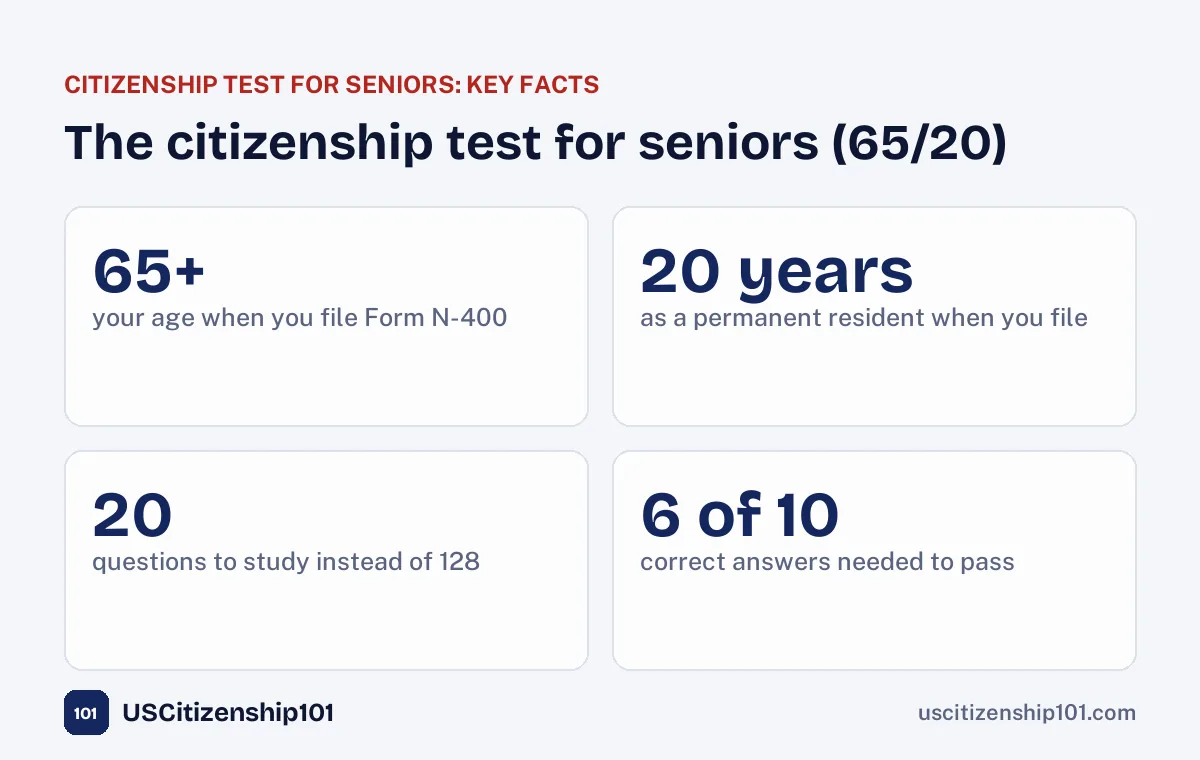
The citizenship test for seniors is a simplified version of the civics test for older applicants who have lived in the United States for a long time. If you are 65 or older and have been a lawful permanent resident for at least 20 years when you file Form N-400, you qualify for what USCIS calls the “65/20 special consideration.” Instead of studying all 128 questions, you study only 20. You can also take the test in your own language with an interpreter, and you skip the English test entirely.
This guide explains exactly how the citizenship test for seniors works, lists all 20 official questions with their answers, and shares study methods that work well for older learners. If you are helping a parent or grandparent prepare, this guide is for you too.
Key points about the citizenship test for seniors
- You qualify if you are 65 or older with 20 years as a permanent resident on the day you file.
- You study only 20 questions marked with an asterisk on the official list.
- The officer asks 10 of those 20. You need 6 correct to pass.
- You may take the civics test in your own language with an interpreter.
- You do not take the English test.
Who qualifies for the citizenship test for seniors
Two conditions must both be true on the day USCIS receives your N-400:
- You are at least 65 years old.
- You have been a lawful permanent resident for at least 20 years, counted from the “Resident Since” date on your Green Card.
Both numbers are measured at filing, not at the interview. If you turn 65 a month after filing, you do not qualify, even if the interview is a year later. If you are close to either threshold, wait until you clearly qualify before you file. It can make the citizenship test for seniors available to you, which is a much easier path.
If you are 50 or older with 20 years, or 55 or older with 15 years, you may still skip the English test, but you study the full civics list. Our guide to citizenship test exemptions compares all the options.
How the citizenship test for seniors works at the interview
- You and your interpreter are placed under oath.
- The officer reviews your N-400 through your interpreter: addresses, travel, family, and background questions.
- There is no English reading or writing test.
- The officer asks up to 10 civics questions from the list of 20. The interpreter translates each question into your language and your answer back into English.
- When you reach 6 correct answers, you pass the civics test.
- The officer gives you the result on Form N-652.
If you do not pass, you get a second chance 60 to 90 days later, and the 65/20 rules still apply. See what happens if you fail the citizenship test.
The 20 questions on the citizenship test for seniors (2025 version)
If USCIS received your N-400 on or after October 20, 2025, these are the 20 questions you study. They are the questions marked with an asterisk on the official 2025 list. Answers come directly from USCIS. You only need one answer unless the question asks for more.
- What is the supreme law of the land? (U.S.) Constitution
- How many amendments does the U.S. Constitution have? Twenty-seven (27)
- What is the economic system of the United States? Capitalism; Free market economy
- Name one power of the U.S. Congress. Writes laws; Declares war; Makes the federal budget
- What is the name of the Speaker of the House of Representatives now? Mike Johnson (check uscis.gov/citizenship/testupdates before your interview)
- The President of the United States is elected for how many years? Four (4) years
- What is the name of the President of the United States now? Donald J. Trump (check uscis.gov/citizenship/testupdates before your interview)
- What is the name of the Vice President of the United States now? JD Vance (check uscis.gov/citizenship/testupdates before your interview)
- Who vetoes bills? The President (of the United States)
- What is the highest court in the United States? Supreme Court
- Who is the governor of your state now? Answers will vary. [District of Columbia residents should answer that D.C. does not have a governor.]
- What do we show loyalty to when we say the Pledge of Allegiance? The United States; The flag
- Who lived in America before the Europeans arrived? American Indians; Native Americans
- Who wrote the Declaration of Independence? (Thomas) Jefferson
- George Washington is famous for many things. Name one. “Father of Our Country”; First president of the United States; General of the Continental Army; and other answers
- Abraham Lincoln is famous for many things. Name one. Freed the slaves (Emancipation Proclamation); Saved (or preserved) the Union; Led the United States during the Civil War; and other answers
- Martin Luther King, Jr. is famous for many things. Name one. Fought for civil rights; Worked for equality for all Americans; Worked to ensure that people would “not be judged by the color of their skin, but by the content of their character”
- What major event happened on September 11, 2001 in the United States? Terrorists attacked the United States; Terrorists took over two planes and crashed them into the World Trade Center in New York City; Terrorists took over a plane and crashed into the Pentagon in Arlington, Virginia; and other answers
- Why does the flag have 13 stripes? (Because there were) 13 original colonies; (Because the stripes) represent the original colonies
- Name three national U.S. holidays. New Year’s Day; Martin Luther King, Jr. Day; Presidents Day (Washington’s Birthday); and other answers
If you filed before October 20, 2025, your citizenship test for seniors uses the 20 marked questions from the 2008 list instead. You can find them marked “(65/20)” in our list of the 100 civics questions, and practice them by choosing the 2008 version in our practice test.
Memory tips for the 20 questions
The 20 questions on the citizenship test for seniors fall into five simple groups. Learning them by group is easier than learning them as a list.
Group 1: The Constitution and the economy
The supreme law of the land is the Constitution, it has 27 amendments, and the economic system is capitalism or a free market economy. Think “one law, 27 changes, free market.”
Group 2: Leaders today
These questions ask for the President, the Vice President, the Speaker of the House, and your governor. Write the four names on one card and read it every day. Check them again before your interview, because they can change. Our guide to civics test answers that change has the current names.
Group 3: How government works
Congress writes laws, the President vetoes bills and is elected for four years, and the Supreme Court is the highest court. Picture three buildings in Washington: the Capitol, the White House, and the Supreme Court.
Group 4: Famous people and events
American Indians lived here before Europeans arrived. Thomas Jefferson wrote the Declaration of Independence. George Washington was the first President. Abraham Lincoln freed the slaves and led the country in the Civil War. Martin Luther King, Jr. fought for civil rights. On September 11, 2001, terrorists attacked the United States.
Group 5: Symbols and holidays
We show loyalty to the United States or the flag in the Pledge of Allegiance. The flag has 13 stripes for the 13 original colonies. For three national holidays, many people choose Independence Day, Thanksgiving, and Christmas.
How other seniors prepare
These examples show common ways older applicants prepare for the citizenship test for seniors. Names are illustrative.
- Ana, 71, studied with her granddaughter every Sunday and kept flashcards in Spanish on her refrigerator. She passed after answering six of seven questions correctly.
- Hoang, 68, listened to the questions read aloud each morning while walking, then practiced answers in Vietnamese with his son, who later served as his interpreter.
- Farida, 76, had memory difficulties. Her doctor completed Form N-648, and her case was reviewed with that medical certification.
How family members can help
Family support makes a big difference on the citizenship test for seniors. You can help by quizzing gently each day, practicing as the interpreter, keeping track of documents and appointment letters, arranging transport to the interview, and reminding your relative that asking the officer to repeat a question is perfectly normal. Stay patient. Confidence grows with every correct answer.
The 2008 version of the citizenship test for seniors
If USCIS received your N-400 before October 20, 2025, your citizenship test for seniors comes from the 2008 list. It also has 20 marked questions, the officer also asks 10, and you also need 6 correct. Many of the topics are the same, such as the supreme law of the land, the President, and national holidays, but the exact questions and wording differ. Check your receipt notice to confirm your version before you start studying, because learning the wrong 20 questions is the most common mistake older applicants make.
Common worries, and why they should not stop you
- “My memory is not what it used to be.” Twenty questions is a small set, and repetition works at any age. If memory loss is medical, Form N-648 exists for exactly that reason.
- “I am nervous talking to officials.” Your interpreter speaks for you, and officers are used to older applicants. You can take your time.
- “I do not read well in any language.” The citizenship test for seniors is oral. You can study by listening and repeating, with no reading required.
- “What if I fail?” You get a free second attempt 60 to 90 days later with the same 65/20 rules.
Bringing an interpreter
USCIS does not provide interpreters for naturalization interviews, so you must bring your own. Choose someone who:
- Speaks both English and your language fluently.
- Is calm, patient, and reliable.
- Is not your attorney or accredited representative, because USCIS generally does not allow them to interpret too.
- Can stay for the whole interview.
The interpreter swears or affirms to translate completely and accurately. Practice with your interpreter before the interview so you are both comfortable with how the questions will be asked.
Study tips for older learners
The citizenship test for seniors is short, but good preparation still matters. These methods work especially well for older adults.
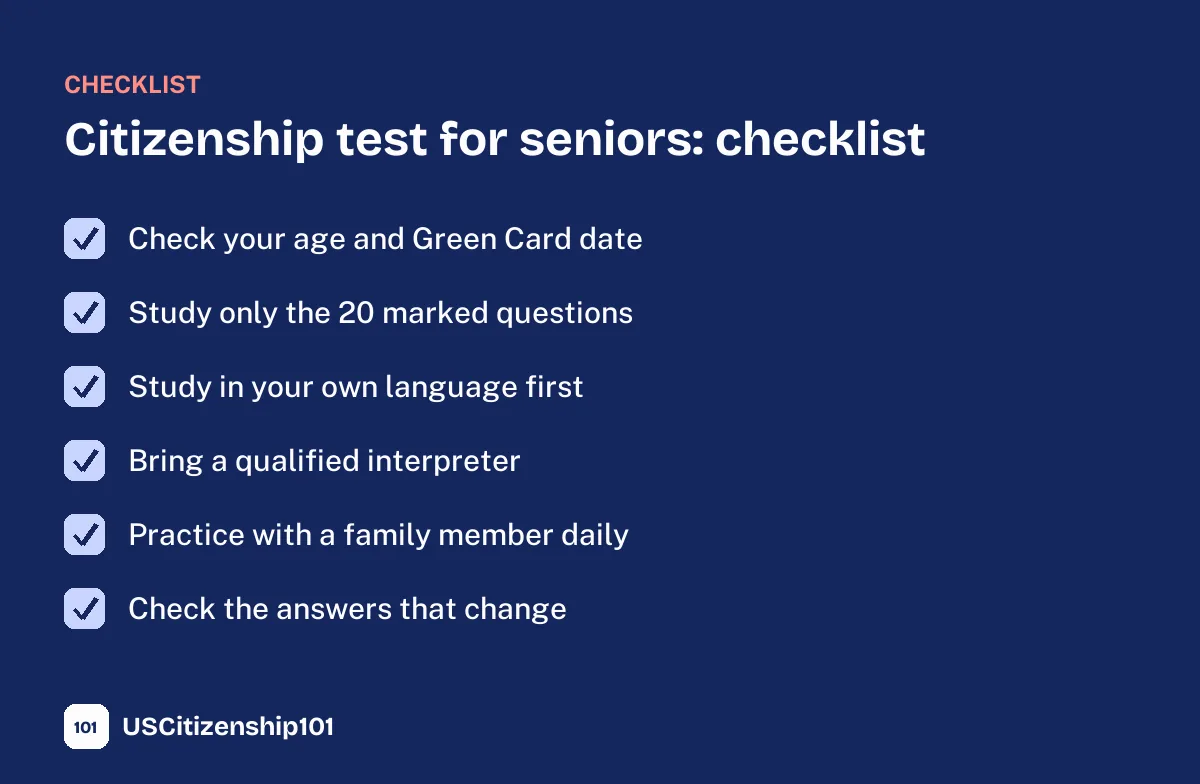
Study in your strongest language
Because you may answer in your own language, learn the meaning of each answer in that language first. Then learn a few key English words from each question, such as “President,” “Constitution,” or “flag,” so you recognize the question even before the interpreter speaks.
Use short sessions
Fifteen minutes in the morning and fifteen in the evening work better than one long session. Memory improves with repetition and rest.
Make large-print cards
Write each question on one side of an index card in large letters and the answer on the other side. Keep the cards by your favorite chair or on the kitchen table.
Connect answers to your life
You have lived in the United States for at least 20 years. Link answers to things you have seen: Independence Day celebrations, elections, or visits to landmarks. Personal memories are powerful memory aids.
Practice with family
Ask a child or grandchild to quiz you for ten minutes each day. It is good practice and a nice way to share your citizenship journey with them.
Use our 65/20 practice mode
Our free civics practice test has an “Only the 65/20 questions” option. It can read questions aloud, show flashcards, and run 10-question mock tests with the real pass rule of 6 correct.
Accommodations for health needs
Many older applicants have health conditions. USCIS offers accommodations such as wheelchair access, extra time, or a sign language interpreter, and in some cases it can arrange an interview at home for applicants who cannot travel. Request accommodations on your N-400 or by contacting USCIS.
If a medical condition, such as dementia or a serious cognitive impairment, prevents you from learning even the shorter citizenship test for seniors, a doctor can complete Form N-648 to request an exception. Read our guide to Form N-648.
Documents to bring
- Your interview notice.
- Your Green Card.
- A government-issued photo ID and all your passports.
- Your interpreter, with their own photo ID.
- Any documents listed on your interview notice.
- Form N-648 and medical records, if you are requesting a medical exception.
A four-week plan for the citizenship test for seniors
- Week 1: Learn questions 1 to 7 on the list above, a few each day.
- Week 2: Learn questions 8 to 14 and review week 1.
- Week 3: Learn questions 15 to 20 and review everything.
- Week 4: One 10-question mock test each day with your interpreter or a family member.
By the end of the month you will have practiced every question on the citizenship test for seniors many times.

Is the citizenship test for seniors worth it?
For many older residents, yes. Citizenship brings the right to vote, a U.S. passport for visiting family abroad, and protection from losing status after long trips. It can also make it easier to sponsor relatives. Because the citizenship test for seniors is so much shorter than the regular test, the main barrier many older residents fear, the exam itself, becomes small. If you have been waiting because the full test felt overwhelming, the citizenship test for seniors may be the right moment to finally apply.
Frequently asked questions
Do I need to speak any English?
No. With the 65/20 exception and the citizenship test for seniors, you may complete the whole interview through your interpreter.
Can I take the regular test instead?
Yes. You may skip the citizenship test for seniors and choose the English test and the regular civics test if you prefer.
What if I am 64 when I file?
Then you do not qualify for the citizenship test for seniors. Consider waiting until after your 65th birthday to file.
Does time with a conditional Green Card count toward 20 years?
Yes, once the conditions were removed, the conditional period counts.
Is the citizenship test for seniors the same in every state?
Yes. It is a federal rule, so the citizenship test for seniors works the same way at every USCIS field office.
Can my interpreter be a family member?
Yes, a family member may interpret if they are fluent in both languages and can translate accurately and neutrally.
Is the fee lower for seniors?
No, there is no senior discount, but many older applicants qualify for the reduced fee or a fee waiver based on income. See our N-400 filing fee guide.
Final thoughts
The citizenship test for seniors recognizes decades of life in the United States. With only 20 questions to learn, an interpreter by your side, and no English test, it is very achievable. Check your dates carefully before filing, practice a little every day with someone you trust, and walk into your interview with confidence.
Sources: USCIS, Exceptions and Accommodations; USCIS 128 Civics Questions and Answers (2025 version); USCIS Policy Manual, Volume 12, Part E. Last reviewed September 2026. General information, not legal advice.
Free tools
This article is for general education, not legal advice. Always confirm requirements at uscis.gov.