Civics Test Study Plan: Pass the Citizenship Test in 4 Weeks
A day-by-day, four-week schedule that covers every civics question in 20 to 30 minutes a day, with built-in review and mock tests.
On this page
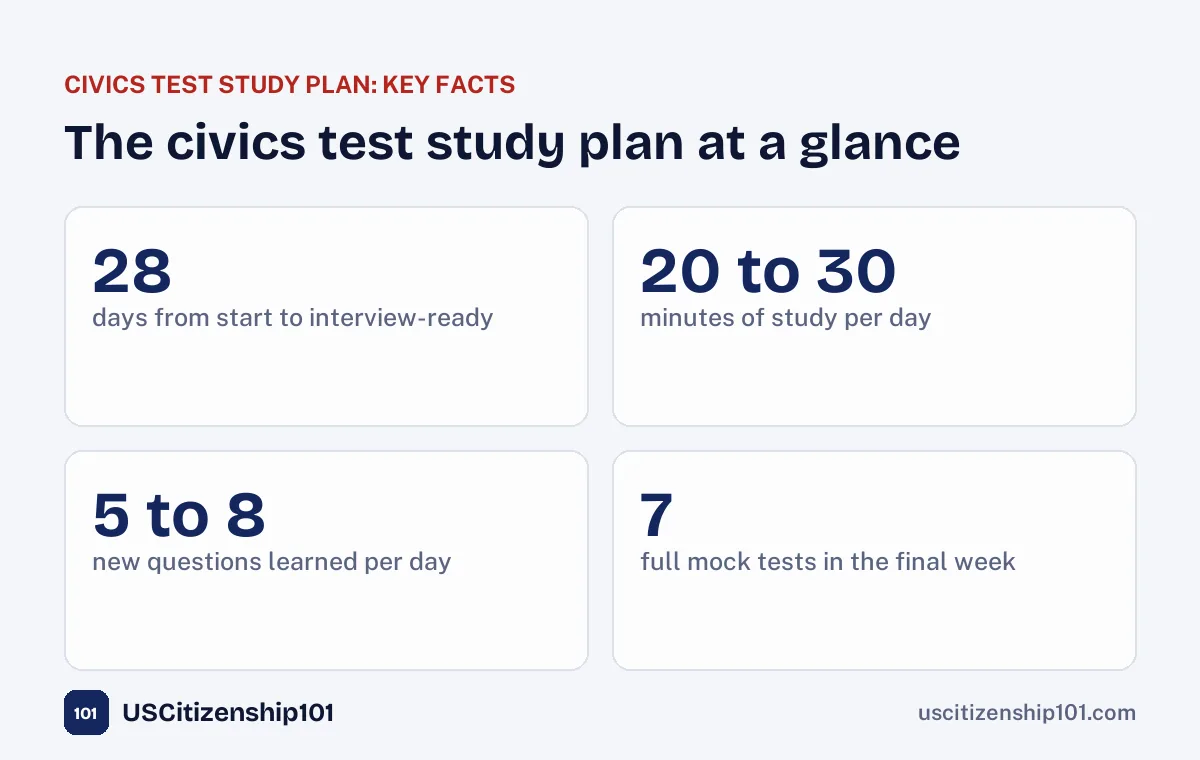
A good civics test study plan turns a long list of questions into small, daily steps. Instead of cramming the night before your interview, you learn a few questions every day, review them regularly, and finish with a week of full mock tests. This civics test study plan covers every question on the 2025 test in 28 days, with 20 to 30 minutes of study a day. It also works for the 2008 test with small changes.
Below you will find the full four-week schedule, what to do in each daily session, how to adjust the plan if you have less time, and the study techniques that make memory stick. Follow it closely, and you will walk into your interview knowing you are ready.
Key points about this civics test study plan
- This civics test study plan takes 28 days and 20 to 30 minutes a day.
- Weeks 1 to 3 teach new questions by topic. Week 4 is for mock tests and review.
- Every session starts with a review of the previous day.
- You practice saying answers out loud, because the real test is oral.
- It covers the 128 questions of the 2025 test, and adapts easily to the 100-question 2008 test.
Before you start: three quick checks
1. Confirm your test version
Look at the received date on your N-400 receipt notice. On or after October 20, 2025 means the 2025 civics test with 128 questions. Before that date means the 2008 test with 100 questions. This civics test study plan is written for 128 questions; the 2008 adjustments are below.
2. Check if you qualify for 65/20
If you are 65 or older with 20 years as a permanent resident, you only need to study 20 questions. A two-week plan is enough. See the citizenship test for seniors.
3. Gather your tools
- The official list of the 128 civics questions (or the 100 civics questions).
- Our free civics practice test for flashcards and mock tests.
- A notebook or index cards.
- A study partner, if possible, to ask you questions out loud.
The daily session: 25 minutes
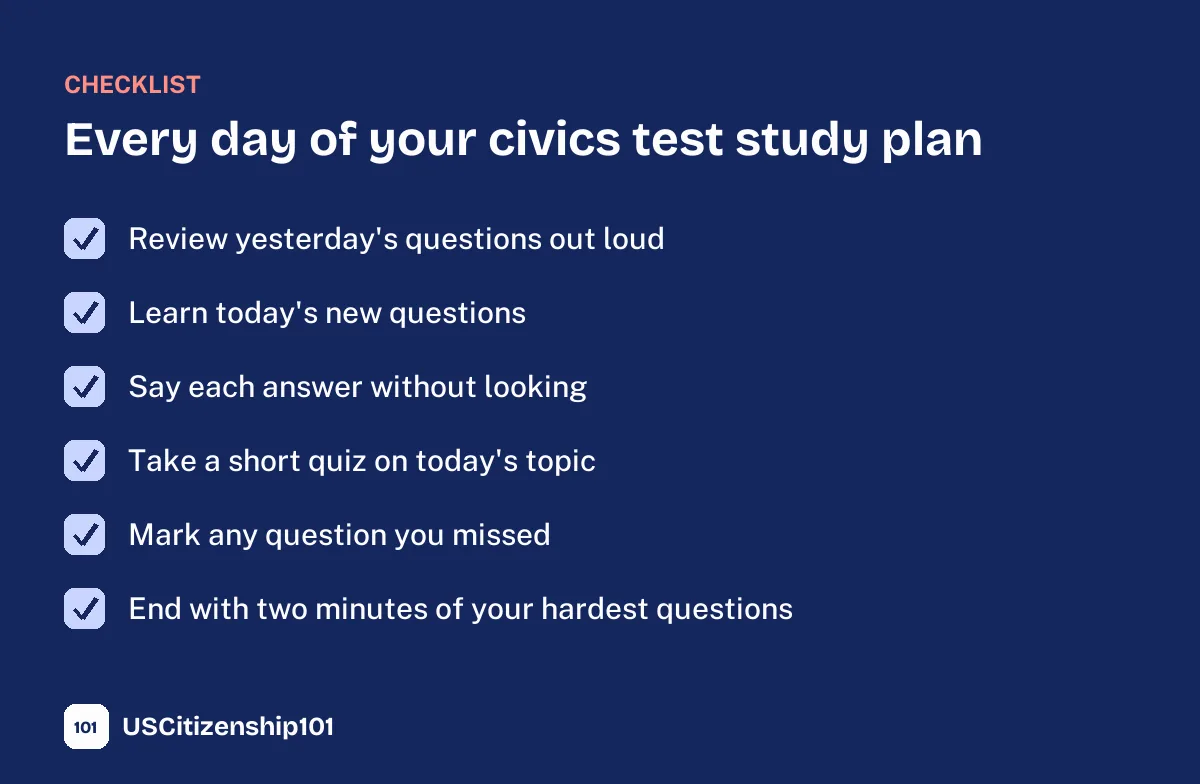
Every day of this civics test study plan follows the same simple routine. Consistency matters more than intensity.
- Review (5 minutes). Answer yesterday’s questions out loud without looking.
- Learn (10 minutes). Read today’s new questions and answers. Say each answer three times.
- Recall (5 minutes). Cover the answers and try to say them from memory.
- Quiz (3 minutes). Use topic practice in the practice test for today’s section.
- Mark (2 minutes). Write down any question you missed. These go into tomorrow’s review.
Week 1: Principles, rights, and symbols
The first week of the civics test study plan starts with ideas and easy wins, to build confidence.
| Day | Topic | Questions (2025 list) |
|---|---|---|
| 1 | The Constitution and “We the People” | 1 to 5 |
| 2 | Bill of Rights, amendments, Declaration of Independence | 6 to 10 |
| 3 | Principles: rule of law, economic system, federalism | 11 to 15 |
| 4 | Rights and responsibilities, part 1 | 63 to 67 |
| 5 | Rights and responsibilities, part 2 | 68 to 72 |
| 6 | Symbols and holidays | 119 to 128 |
| 7 | Review day: all of week 1 | Mixed quiz |
Helpful reading for week 1: the Bill of Rights explained and rights and responsibilities of citizens.
Week 2: How the government works
Week 2 of the civics test study plan covers the largest section, the System of Government. Take it steadily.
| Day | Topic | Questions (2025 list) |
|---|---|---|
| 8 | Branches and separation of powers | 16 to 20 |
| 9 | Congress: Senate and House | 21 to 26 |
| 10 | Congress, continued; elections | 27 to 32 |
| 11 | The President | 33 to 39 |
| 12 | President’s powers and the Cabinet | 40 to 46 |
| 13 | The Cabinet, courts, and the Supreme Court | 47 to 57 |
| 14 | Review day: all of week 2 | Mixed quiz |
Our guide to the three branches of government makes week 2 much easier.
Week 3: Federalism and American history
| Day | Topic | Questions (2025 list) |
|---|---|---|
| 15 | Federal and state powers, your state’s officials | 58 to 62 |
| 16 | Colonial period | 73 to 81 |
| 17 | The Constitution and the founders | 82 to 89 |
| 18 | The 1800s and the Civil War | 90 to 99 |
| 19 | 1900s: wars and the Great Depression | 100 to 108 |
| 20 | Civil rights, the Cold War, and recent history | 109 to 118 |
| 21 | Review day: all of week 3 | Mixed quiz |
For week 3, read American history questions, which tells the story in order.
Week 4: Mock tests and final review
The last week of the civics test study plan is about performance, not new learning.
- Days 22 to 27: Take one full 20-question mock test each day in our practice test. Afterward, study only the questions you missed.
- Day 28: A light review. Check the civics test answers that change, read your “missed” list one last time, and rest.
When you pass five mock tests in a row with 12 or more correct answers, you are ready for your interview.
Day-by-day details
Here is what each study day of the civics test study plan focuses on, with one real question from that day’s range so you know what to expect. Days 7, 14, and 21 are review days, and days 22 to 28 are mock-test days.
- Day 1 (questions 1 to 5): Start with the foundation: the form of government, the supreme law, and what the Constitution does. Sample question: “What is the form of government of the United States?” One accepted answer: Republic.
- Day 2 (questions 6 to 10): Learn what the Bill of Rights protects, how many amendments exist, and why the Declaration of Independence matters. Sample question: “What does the Bill of Rights protect?” One accepted answer: The basic rights of Americans.
- Day 3 (questions 11 to 15): Cover the big ideas: life, liberty and the pursuit of happiness, the economic system, the rule of law, and why power is divided. Sample question: “The words “Life, Liberty, and the pursuit of Happiness” are in what founding document?” One accepted answer: Declaration of Independence.
- Day 4 (questions 63 to 67): Study the voting amendments, who can vote, the rights of everyone, the Pledge, and the promises in the oath. Sample question: “There are four amendments to the U.S. Constitution about who can vote. Describe one of them.” One accepted answer: Citizens eighteen 18 and older can vote..
- Day 5 (questions 68 to 72): Finish rights and responsibilities: how people become citizens, civic participation, serving the country, taxes, and Selective Service. Sample question: “How can people become United States citizens?” One accepted answer: Be born in the United States, under the conditions set by the 14th Amendment.
- Day 6 (questions 119 to 128): Enjoy an easy day with the capital, the Statue of Liberty, the flag, the anthem, and national holidays. Sample question: “What is the capital of the United States?” One accepted answer: Washington, D.C..
- Day 8 (questions 16 to 20): Name the three branches, learn what stops one branch from becoming too powerful, and who makes laws. Sample question: “Name the three branches of government.” One accepted answer: Legislative, executive, and judicial.
- Day 9 (questions 21 to 26): Learn the numbers of Congress: 100 senators, six-year terms, 435 representatives, two-year terms. Sample question: “How many U.S. senators are there?” One accepted answer: One hundred 100.
- Day 10 (questions 27 to 32): Finish Congress: senators per state, the Speaker, who elects members of Congress. Sample question: “How many senators does each state have?” One accepted answer: Two 2.
- Day 11 (questions 33 to 39): Move to the President: term length, the two-term limit, and the names of the current leaders. Sample question: “Who does a member of the House of Representatives represent?” One accepted answer: Citizens in their congressional district.
- Day 12 (questions 40 to 46): Study the line of succession, Commander in Chief, signing and vetoing bills, and parts of the executive branch. Sample question: “If the president can no longer serve, who becomes president?” One accepted answer: The Vice President of the United States.
- Day 13 (questions 47 to 57): Learn the Cabinet and the courts, including the Supreme Court, how many justices decide a case, and why justices serve for life. Sample question: “What does the President’s Cabinet do?” One accepted answer: Advises the President of the United States.
- Day 15 (questions 58 to 62): Compare federal and state powers, then look up your governor and state capital. Sample question: “Name one power that is only for the federal government.” One accepted answer: Print paper money.
- Day 16 (questions 73 to 81): Begin history with the colonists, American Indians, slavery, and the 13 original states. Sample question: “The colonists came to America for many reasons. Name one.” One accepted answer: Freedom.
- Day 17 (questions 82 to 89): Learn the Constitution of 1787 and the founders: Madison, Franklin, Washington, Hamilton, and Jefferson. Sample question: “What founding document was written in 1787?” One accepted answer: U.S. Constitution.
- Day 18 (questions 90 to 99): Cover the 1800s: the Louisiana Purchase, wars, the Civil War, Lincoln, and women’s rights. Sample question: “What territory did the United States buy from France in 1803?” One accepted answer: Louisiana Territory.
- Day 19 (questions 100 to 108): Study the 1900s: the world wars, the Great Depression, and the start of the Cold War. Sample question: “Name one war fought by the United States in the 1900s.” One accepted answer: World War I.
- Day 20 (questions 109 to 118): Finish with the Cold War, civil rights, September 11, and American innovations. Sample question: “During the Cold War, what was one main concern of the United States?” One accepted answer: Communism.
A sample day in the civics test study plan
Here is what day 9 of the civics test study plan looks like in practice. You start by answering the day 8 questions out loud: the three branches, why power is divided, and a power of Congress. Next you learn questions 21 to 26: there are 100 senators, a senator’s term is six years, there are 435 voting members of the House, and a representative’s term is two years. You say each answer three times, cover the page, and recall them. Then you take a short quiz on the System of Government topic in the practice test and write down any misses. The whole session takes about 25 minutes, and tomorrow starts with these same questions as review.
Adapting the civics test study plan for the 2008 test
If you take the 2008 test with 100 questions, use the same structure but compress it to three weeks:
- Week 1: American Government (questions 1 to 57), about eight a day.
- Week 2: American History and Integrated Civics (questions 58 to 100).
- Week 3: One 10-question mock test per day, stopping at 6 correct or 5 wrong, plus review.
If your interview is sooner
If you have only two weeks, double the daily sessions: study for 25 minutes in the morning and 25 minutes in the evening, covering two days of the civics test study plan each day. Keep the final four days for mock tests. If you have only one week, focus first on the Symbols and Holidays and the Principles sections, where many questions are short and easy, then take a mock test every evening.
Study techniques that work
- Active recall. Test yourself instead of rereading. Covering answers and saying them from memory is far more effective.
- Spaced repetition. Review questions after one day, three days, and one week. The daily review in this civics test study plan does this for you.
- Speak, do not just read. The interview is oral. Saying answers aloud trains the skill you will actually use.
- Link facts into stories. “Jefferson wrote the Declaration in 1776; Madison led the Constitution in 1787” is easier than two separate facts.
- Sleep well. Memory consolidates during sleep, so a late-night cram session is less useful than an early night.
For more methods, see how to study for the citizenship test.
Why a civics test study plan beats cramming
Cramming feels productive, but most of what you cram fades within days. A civics test study plan uses short daily sessions and planned reviews, so each answer is repeated several times over weeks. That repetition moves facts into long-term memory, which is exactly what you need when an officer asks a question you studied three weeks earlier. A civics test study plan also reduces stress, because you always know what to do next and can see your progress.
Fit the civics test study plan to your life
- Shift workers: study right after you wake up, whatever time that is. The order of the session matters more than the clock.
- Parents: split the 25 minutes into two parts, such as review during breakfast and new questions after the children are asleep.
- Commuters: use flashcards with audio on the bus or train, and do the out-loud recall at home.
- Busy weekends: if Saturday and Sunday are full, make them your review days and move new material to weekdays.
The best civics test study plan is the one you can follow every day, so adjust the timing freely while keeping the structure.
Staying motivated for four weeks
Motivation dips around the middle of any civics test study plan, often in week two, when the government section feels long. Keep going by crossing off each day on a calendar, telling a friend about your goal, and rewarding yourself at the end of each week. Remember why you started: the right to vote, a U.S. passport, and the security of citizenship for you and your family.
Tracking your progress
Keep a simple log in your notebook: the date, what you studied, and your quiz or mock test score. Seeing your scores rise is motivating, and it shows you which topics need more time. Our practice test also tracks how many questions you have mastered and which ones you need to review.
Frequently asked questions
Is 20 minutes a day really enough?
For most people, yes, when it is every day. This civics test study plan relies on regular short sessions, which beat irregular long ones.
Can I start the civics test study plan before I file?
Yes, and it is a great idea. Starting the civics test study plan early means you will be ready no matter how quickly your interview is scheduled.
What if I miss a day?
Do not skip ahead. Continue the civics test study plan from where you stopped, and use a review day to catch up.
Should I study the English test at the same time?
Yes. Add ten minutes of reading and writing practice a few times a week. Many civics words also appear on the vocabulary lists. See the citizenship English test guide.
Can I study with my spouse or friend?
Absolutely. Quizzing each other out loud is one of the best ways to follow this civics test study plan, and you can each track your own progress.
Final thoughts
A civics test study plan works because it replaces worry with routine. Twenty-five minutes a day, four weeks, and a few mock tests at the end: that is all it takes for most applicants to walk into the interview prepared. Start today with day one, and let each small session add up.
Sources: USCIS, Study for the Test; USCIS 128 Civics Questions and Answers (2025 version). Last reviewed September 2026.
Free tools
This article is for general education, not legal advice. Always confirm requirements at uscis.gov.