The Bill of Rights Explained: All 10 Amendments for the Citizenship Test
The first ten amendments to the Constitution in plain English, with the other amendments and civics test questions you need to know.
On this page
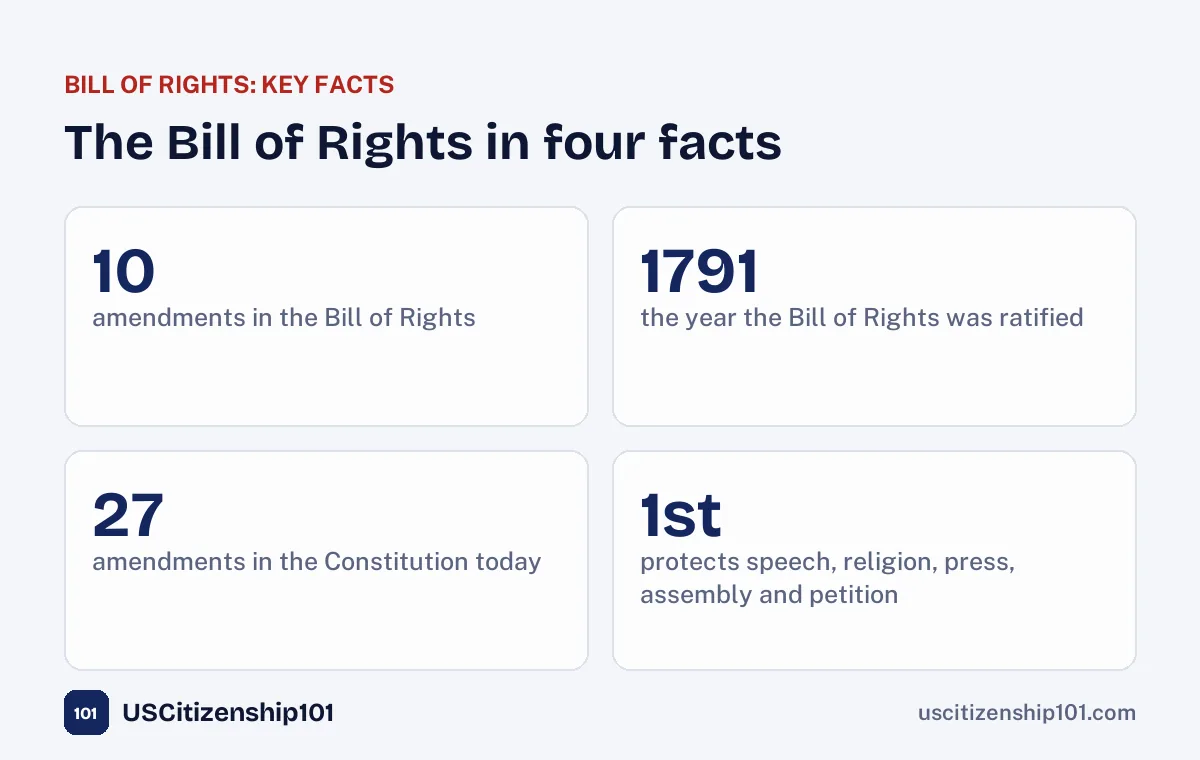
The Bill of Rights is the name for the first ten amendments to the U.S. Constitution. It protects the basic rights of Americans and of everyone living in the United States, such as freedom of speech, freedom of religion, and the right to a fair trial. The Bill of Rights was added to the Constitution in 1791, and it remains one of the most important documents in American history.
Questions about the Bill of Rights and other amendments appear on both versions of the naturalization civics test. This guide explains all ten amendments in plain English, covers the later amendments the test asks about, and shows you exactly how to answer the related questions.
Key points about the Bill of Rights
- The Bill of Rights is the first ten amendments to the Constitution.
- It protects the basic rights of Americans and people living in the United States.
- It was ratified in 1791, largely based on the work of James Madison.
- The Constitution now has 27 amendments in total.
- The First Amendment is the one the civics test asks about most.
Why the Bill of Rights was added
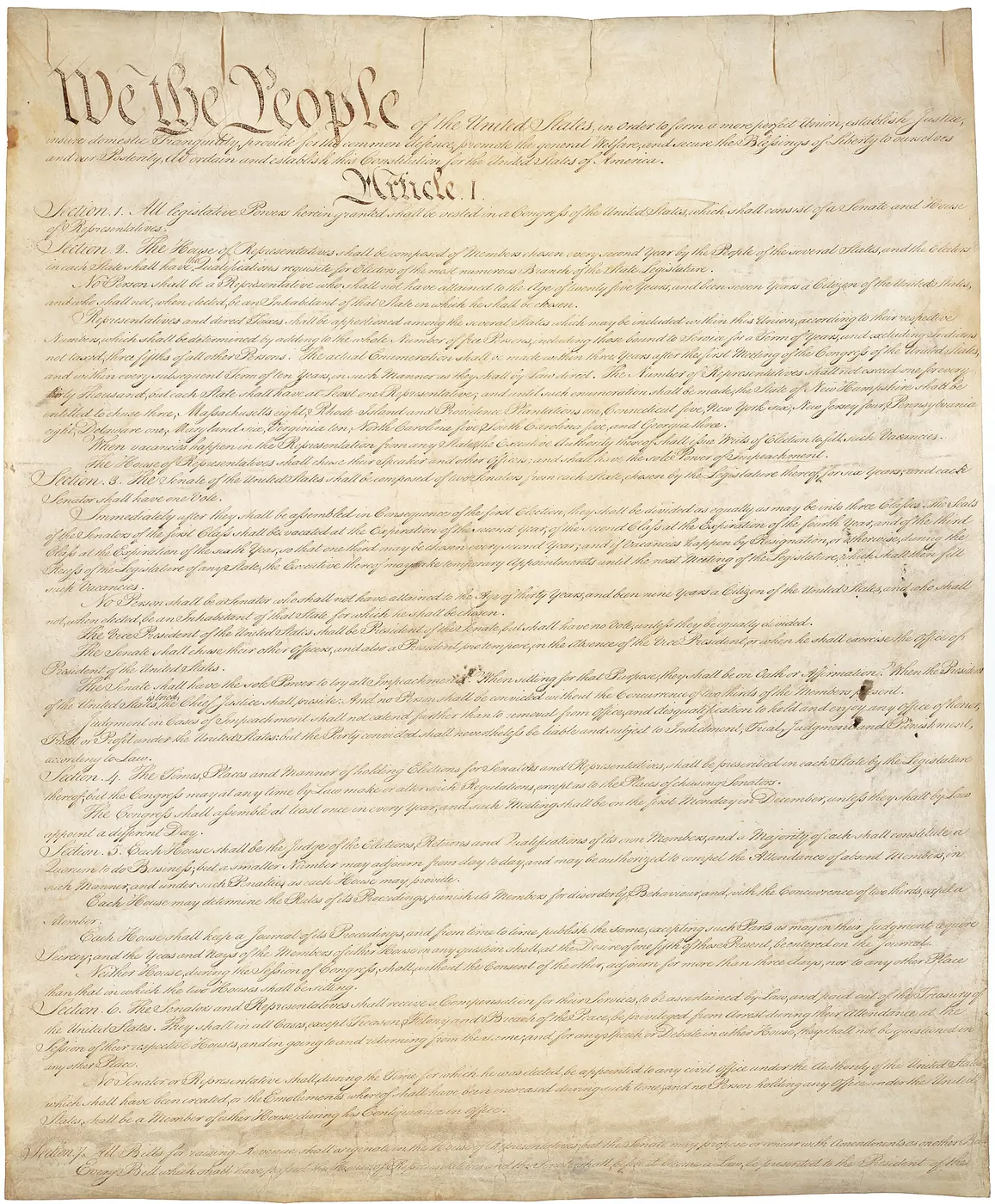
When the Constitution was written in 1787, it created a strong national government but did not list the rights of individuals in detail. Many Americans worried that a powerful government might take away their freedoms, as the British king had done. Some states agreed to approve the Constitution only if a list of rights would be added.
James Madison drafted the amendments, Congress proposed them in 1789, and enough states ratified ten of them by December 15, 1791. Those ten became the Bill of Rights. The idea was simple: the government would have clear limits it could not cross.
All ten amendments in the Bill of Rights
First Amendment: five basic freedoms
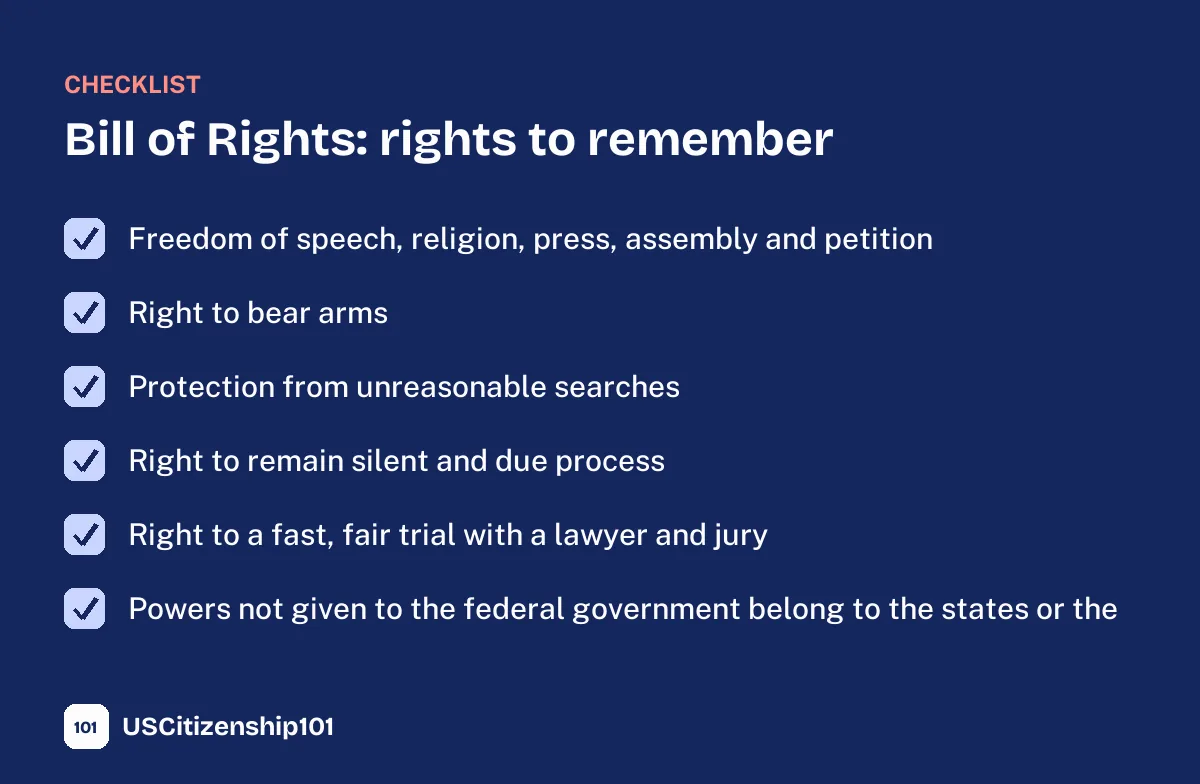
The First Amendment protects freedom of speech, freedom of religion, freedom of the press, freedom of assembly (to gather peacefully), and the freedom to petition the government. It also says the government cannot establish an official religion. On the civics test, any one of these freedoms is an accepted answer when asked for a right or freedom from the First Amendment. This is the most-tested part of the Bill of Rights.
Second Amendment: the right to bear arms
The Second Amendment protects the right of the people to keep and bear arms. The civics test accepts “the right to bear arms” as one of the rights of everyone living in the United States on some versions of the question.
Third Amendment: no forced housing of soldiers
The government cannot force people to let soldiers live in their homes during peacetime. This responded directly to British practices before the Revolution, which the history section also mentions.
Fourth Amendment: protection from unreasonable searches
The government generally needs a warrant, based on probable cause, to search your home or take your property. This protects your privacy.
Fifth Amendment: rights of people accused of crimes
You cannot be forced to testify against yourself (the right to remain silent), you cannot be tried twice for the same crime, and the government cannot take your life, liberty, or property without due process of law. It also requires fair payment if the government takes private property for public use.
Sixth Amendment: the right to a fair trial
People accused of crimes have the right to a speedy and public trial, an impartial jury, a lawyer, to know the charges against them, and to question witnesses.
Seventh Amendment: jury trials in civil cases
In many civil lawsuits in federal court, people have the right to a trial by jury.
Eighth Amendment: no cruel and unusual punishment
The government cannot demand excessive bail or fines, or use cruel and unusual punishment.
Ninth Amendment: other rights are kept by the people
Listing some rights in the Constitution does not mean people have no other rights.
Tenth Amendment: powers of the states and the people
Powers not given to the federal government by the Constitution, and not forbidden to the states, belong to the states or to the people. The 2025 test asks about the purpose of the 10th Amendment, and this is the answer.
Other amendments on the civics test
The Bill of Rights covers only the first ten amendments, but the civics test also asks about later ones. There are 27 amendments in total. These are the most important for the test:
- 13th Amendment (1865): ended slavery.
- 14th Amendment (1868): gave citizenship to people born in the United States (with conditions) and guaranteed equal protection of the laws.
- 15th Amendment (1870): said citizens cannot be denied the vote because of race.
- 16th Amendment (1913): allowed the federal income tax.
- 19th Amendment (1920): gave women the right to vote.
- 22nd Amendment (1951): limited the President to two terms.
- 24th Amendment (1964): banned poll taxes in federal elections.
- 26th Amendment (1971): lowered the voting age to 18.
The 2025 test asks about the four amendments on who can vote. Accepted answers include: citizens 18 and older can vote, you do not have to pay a poll tax to vote, any citizen can vote (women and men can vote), and a male citizen of any race can vote.
How amendments are made
Changing the Constitution is hard on purpose. An amendment must be proposed by two-thirds of both houses of Congress (or by a national convention called by two-thirds of the states), then ratified by three-fourths of the states. That is why there have been only 27 amendments in more than 230 years, including the ten in the Bill of Rights. On the civics test, the answer to “How are changes made to the U.S. Constitution?” is simply “amendments” or “the amendment process.”
Famous court cases about the Bill of Rights
The Supreme Court decides what the Bill of Rights means in real situations. You do not need these cases for the civics test, but they help the amendments make sense.
- Mapp v. Ohio (1961): evidence taken in an illegal search generally cannot be used in state criminal trials. This applies the Fourth Amendment.
- Gideon v. Wainwright (1963): states must provide a lawyer to people accused of serious crimes who cannot afford one. This applies the Sixth Amendment.
- Miranda v. Arizona (1966): police must tell people in custody about their right to remain silent and to have a lawyer. This is based on the Fifth Amendment, and it is why police say “You have the right to remain silent.”
- Tinker v. Des Moines (1969): students do not lose their freedom of speech at school. This applies the First Amendment.
How the Bill of Rights came to protect people from state governments
At first, the Bill of Rights limited only the federal government. States could, in theory, restrict rights that Congress could not. After the Civil War, the 14th Amendment required states to give every person due process and equal protection of the laws. Over the 1900s, the Supreme Court ruled that most rights in the Bill of Rights also apply to state and local governments through the 14th Amendment. Today, a city police department must respect your Fourth Amendment rights just as a federal agency must.
Are rights in the Bill of Rights unlimited?
No right is absolute. Freedom of speech, for example, does not protect true threats, fraud, or speech that directly incites violence. Courts balance individual rights against other important interests, such as public safety. What the Bill of Rights guarantees is that the government must have a strong, lawful reason before it limits a protected right, and that courts can review those limits.
Bill of Rights timeline
- 1787: The Constitution is written without a detailed list of rights.
- 1789: James Madison proposes amendments in the first Congress.
- 1791: Ten amendments are ratified and become the Bill of Rights.
- 1868: The 14th Amendment begins the process of applying rights to the states.
- 1941: President Franklin Roosevelt declares December 15 as Bill of Rights Day.
Official civics test questions related to the Bill of Rights
These are the official 2025 questions from the Principles of American Government and the Rights and Responsibilities sections, where most Bill of Rights and amendment questions appear. Answers are from USCIS.
- What is the form of government of the United States? Republic; Constitution-based federal republic; and other answers
- What is the supreme law of the land? (U.S.) Constitution
- Name one thing the U.S. Constitution does. Forms the government; Defines powers of government; and other answers
- The U.S. Constitution starts with the words “We the People.” What does “We the People” mean? Self-government; Popular sovereignty; and other answers
- How are changes made to the U.S. Constitution? Amendments; The amendment process
- What does the Bill of Rights protect? (The basic) rights of Americans; (The basic) rights of people living in the United States
- How many amendments does the U.S. Constitution have? Twenty-seven (27)
- Why is the Declaration of Independence important? It says America is free from British control.; It says all people are created equal.; and other answers
- What founding document said the American colonies were free from Britain? Declaration of Independence
- Name two important ideas from the Declaration of Independence and the U.S. Constitution. Equality; Liberty; and other answers
- The words “Life, Liberty, and the pursuit of Happiness” are in what founding document? Declaration of Independence
- What is the economic system of the United States? Capitalism; Free market economy
- What is the rule of law? Everyone must follow the law.; Leaders must obey the law.; and other answers
- Many documents influenced the U.S. Constitution. Name one. Declaration of Independence; Articles of Confederation; and other answers
- There are three branches of government. Why? So one part does not become too powerful; Checks and balances; and other answers
- There are four amendments to the U.S. Constitution about who can vote. Describe one of them. Citizens eighteen (18) and older (can vote).; You don’t have to pay (a poll tax) to vote.; and other answers
- Who can vote in federal elections, run for federal office, and serve on a jury in the United States? Citizens; Citizens of the United States; and other answers
- What are three rights of everyone living in the United States? Freedom of expression; Freedom of speech; and other answers
- What do we show loyalty to when we say the Pledge of Allegiance? The United States; The flag
- Name two promises that new citizens make in the Oath of Allegiance. Give up loyalty to other countries; Defend the (U.S.) Constitution; and other answers
- How can people become United States citizens? Be born in the United States, under the conditions set by the 14th Amendment; Naturalize; and other answers
- What are two examples of civic participation in the United States? Vote; Run for office; and other answers
- What is one way Americans can serve their country? Vote; Pay taxes; and other answers
- Why is it important to pay federal taxes? Required by law; All people pay to fund the federal government; and other answers
- It is important for all men age 18 through 25 to register for the Selective Service. Name one reason why. Required by law; Civic duty; and other answers
Quick self-check quiz
Cover the answers and try these. Say each answer out loud, just as you would at your interview.
- What is the Bill of Rights? The first ten amendments to the Constitution.
- Name one freedom from the First Amendment. Speech, religion, press, assembly, or petition.
- How many amendments does the Constitution have? Twenty-seven (27).
- Which amendment gave women the right to vote? The 19th Amendment.
- What is the purpose of the 10th Amendment? Powers not given to the federal government belong to the states or to the people.
- What does the Bill of Rights protect? The basic rights of Americans.
- How are changes made to the Constitution? Through amendments.
- Who can vote in federal elections? Citizens.
If you answered at least six correctly, you already know this topic well. For the rest, reread the sections above, then try again tomorrow. Short, repeated practice is the fastest way to lock in Bill of Rights answers for good.
Memory tricks for the Bill of Rights
- “RAPPS” for the First Amendment: Religion, Assembly, Press, Petition, Speech.
- Count on your hands: ten fingers, ten amendments in the Bill of Rights.
- Group them: 1 and 2 are freedoms, 3 and 4 protect your home and privacy, 5 to 8 protect people accused of crimes, 9 and 10 protect people and states.
- Voting amendments in order: race (15th), women (19th), no poll tax (24th), age 18 (26th).
Rights for everyone, not only citizens
One question on the 2025 test asks you to name three rights of everyone living in the United States. This is a good place to use what you learned above. Accepted answers include freedom of expression, freedom of speech, freedom of assembly, freedom to petition the government, freedom of religion, and the right to bear arms. Pick three you remember easily and practice saying them together, such as “freedom of speech, freedom of religion, and freedom of assembly.” Because this question asks for three, stopping at two would be marked wrong, so rehearse all three until they come out as one sentence.
The Bill of Rights and new citizens
Most rights in the Bill of Rights protect everyone in the United States, not only citizens. Permanent residents already enjoy freedom of speech, freedom of religion, and the right to a fair trial. Becoming a citizen adds rights such as voting in federal elections and running for federal office. When you take the Oath of Allegiance, you promise to support and defend the Constitution, including the Bill of Rights. Read more in our guide to rights and responsibilities of U.S. citizens.
Frequently asked questions
What does the Bill of Rights protect?
The basic rights of Americans, and of people living in the United States. This is the exact accepted answer on the 2025 test.
How many amendments does the Constitution have?
Twenty-seven (27). Ten of them form the Bill of Rights.
Who wrote the Bill of Rights?
James Madison drafted it, building on ideas from state constitutions and the Virginia Declaration of Rights.
Where can I see the original Bill of Rights?
At the National Archives in Washington, D.C., alongside the Declaration of Independence and the Constitution.
Is the Bill of Rights on the English test?
“Bill of Rights” is on the official reading vocabulary list, so you may need to read a sentence containing it. Practice on our English practice page.
Final thoughts
The Bill of Rights is short, but it shapes daily life in the United States and appears throughout the civics test. Learn the five freedoms of the First Amendment, the main idea of each of the other nine, and the key later amendments about voting and citizenship. Then practice the questions with our free civics practice test and the full list of 128 civics questions.
Sources: National Archives, The Bill of Rights: A Transcription; U.S. Constitution; USCIS 128 Civics Questions and Answers (2025 version). Last reviewed September 2026.
Free tools
This article is for general education, not legal advice. Always confirm requirements at uscis.gov.