Rights and Responsibilities of U.S. Citizens: What Changes When You Naturalize
What you gain, and what you promise, when you become a citizen, plus every civics test question on this topic.

On this page
The rights and responsibilities of U.S. citizens are a core topic on the naturalization civics test and a central idea of American democracy. When you become a citizen, you gain new rights, like voting in federal elections and running for office. You also take on responsibilities, like serving on a jury when called and supporting the Constitution.
This guide explains the rights and responsibilities that come with citizenship, compares them with those of permanent residents, walks through the promises in the Oath of Allegiance, and lists every official civics test question on the topic with accepted answers.
Key points about rights and responsibilities
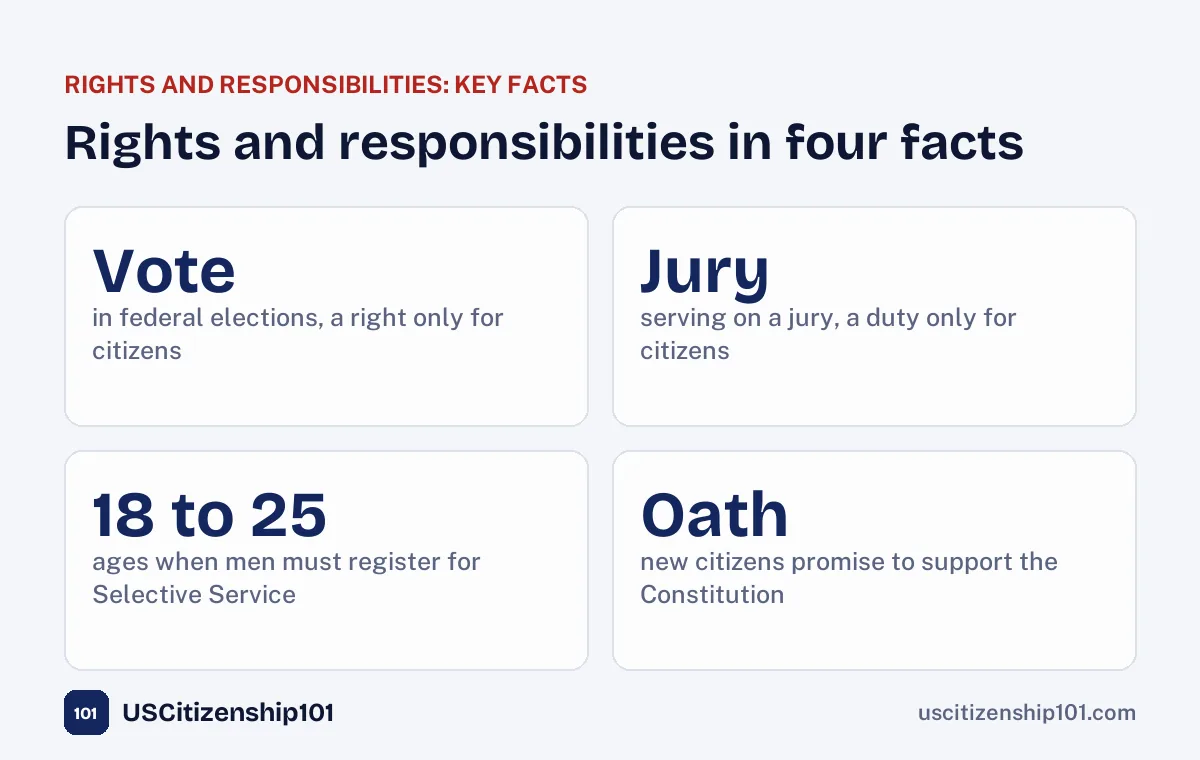
- Only citizens can vote in federal elections, run for federal office, and serve on a jury.
- Everyone living in the United States has basic rights like freedom of speech and freedom of religion.
- Everyone must obey the law and pay taxes.
- Men age 18 through 25 must register for Selective Service.
- The civics test has a full section on rights and responsibilities.
Rights of everyone living in the United States
Many important rights do not depend on citizenship. The Constitution and the Bill of Rights protect every person in the United States, including permanent residents and visitors. These include:
- Freedom of expression and freedom of speech.
- Freedom of assembly, to gather peacefully.
- Freedom to petition the government.
- Freedom of religion, including the freedom to have no religion.
- The right to bear arms.
- Due process of law and equal protection of the laws.
- The right to a fair trial if accused of a crime.
On the 2025 test, the question “What are three rights of everyone living in the United States?” accepts answers like freedom of expression, freedom of speech, freedom of assembly, freedom to petition the government, freedom of religion, and the right to bear arms. Name three. Read more in our guide to the Bill of Rights.
Rights only citizens have
Citizenship adds several important rights that permanent residents do not have:
Voting in federal elections
Only citizens can vote for the President, senators, and representatives. This is the right most people mention when they explain why they want citizenship. Non-citizens must never register or vote in federal elections, because doing so can lead to serious immigration consequences.
Running for federal office
Citizens can run for most federal offices. Some have extra requirements: members of the House must be citizens for seven years, senators for nine years, and the President must be a natural-born citizen.
A U.S. passport and protection abroad
Citizens can get a U.S. passport and ask U.S. embassies for help when traveling. See our guide to getting a passport after naturalization.
Security of status
Citizens cannot lose their right to live in the United States because of long trips abroad, and naturalized citizens can lose citizenship only in rare cases such as fraud in the naturalization process.
Family petitions and federal jobs
Citizens can sponsor more relatives, including parents, married children, and siblings, and many federal jobs are open only to citizens.

Responsibilities of citizens
Rights and responsibilities go together. Some responsibilities are required by law, and others are civic duties that make democracy work.
Serving on a jury
Only citizens serve on juries. If you receive a jury summons after naturalization, you must respond. Juries are a cornerstone of the right to a fair trial that the Bill of Rights guarantees.
Voting and staying informed
Voting is a right, but it is also a responsibility of citizenship. Informed voters choose leaders and influence laws at every level of government.
Obeying the law and paying taxes
Everyone in the United States must obey federal, state, and local laws and pay taxes. On the 2025 test, the question “Why is it important to pay federal taxes?” accepts answers like “required by law,” “all people pay to fund the federal government,” and “required by the Constitution (16th Amendment).”
Registering for Selective Service
Almost all men living in the United States, citizens and non-citizens, must register with the Selective Service System between ages 18 and 25. The 2025 test asks why this is important. Accepted answers include “required by law,” “civic duty,” and “makes the draft fair, if needed.” Registration is also part of showing good moral character when applying for citizenship. Read more in our guide to good moral character.
Supporting and defending the Constitution
This is the promise at the heart of the Oath of Allegiance.
The Oath of Allegiance: promises new citizens make
When you become a citizen, you take the Oath of Allegiance at a naturalization ceremony. It is the moment your rights and responsibilities as a citizen begin. In the oath, you promise to:
- Give up loyalty to other countries.
- Defend the Constitution and laws of the United States.
- Obey the laws of the United States.
- Serve in the U.S. military if needed.
- Serve the nation, doing important work, if needed.
- Be loyal to the United States.
The 2025 test asks you to name two of these promises. Our guide to the oath of allegiance ceremony explains the full text and what happens on the day.
Ways to take part in your community
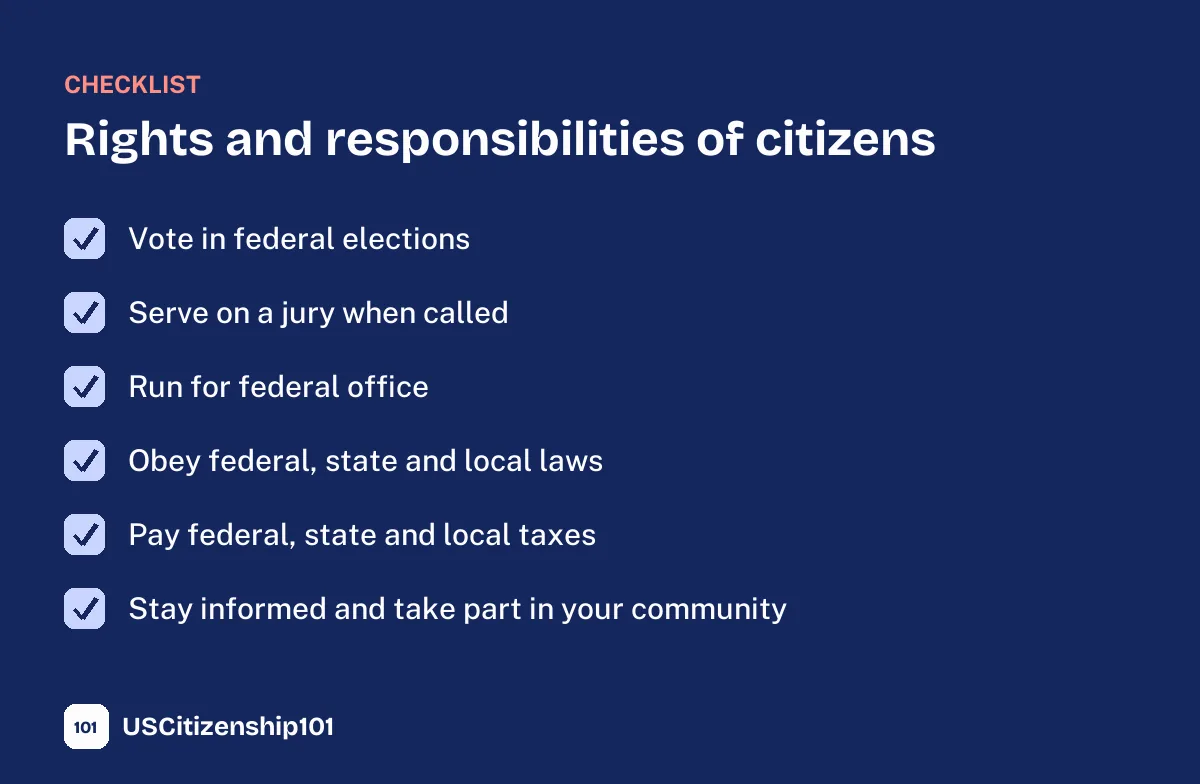
Civic participation goes beyond voting. The 2025 test asks for two examples of civic participation and for one way Americans can serve their country. Good answers include:
- Vote and help with a campaign.
- Run for office or join a political party.
- Join a civic group or a community group.
- Give an elected official your opinion on an issue, or contact elected officials.
- Support or oppose an issue or policy, or write to a newspaper.
- Vote, pay taxes, obey the law, serve in the military, run for office, or work for local, state, or federal government.
Rights and responsibilities: citizens vs. permanent residents
| Permanent resident | U.S. citizen | |
|---|---|---|
| Freedom of speech, religion, assembly | Yes | Yes |
| Vote in federal elections | No | Yes |
| Serve on a federal jury | No | Yes |
| Run for federal office | No | Yes, with conditions |
| U.S. passport | No | Yes |
| Pay taxes and obey the law | Yes | Yes |
| Register for Selective Service (men 18 to 25) | Yes | Yes |
| Can lose status for long trips abroad | Possibly | No |
How rights and responsibilities grew over time
The rights and responsibilities of American citizens have expanded throughout history. When the Constitution was written, voting was limited in most states to white men who owned property. Over time, amendments and laws opened democracy to more people:
- The 14th Amendment (1868) made people born in the United States citizens and promised equal protection of the laws.
- The 15th Amendment (1870) said citizens cannot be denied the vote because of race.
- The 19th Amendment (1920) gave women the right to vote.
- The 24th Amendment (1964) ended poll taxes in federal elections.
- The Voting Rights Act (1965) protected voters from discrimination.
- The 26th Amendment (1971) lowered the voting age to 18.
Each step expanded both rights and responsibilities, because every new voter also shares the duty of keeping democracy healthy. The 2025 civics test asks about these voting amendments, so this history is worth knowing.
Rights and responsibilities during the naturalization process
Your rights and responsibilities matter even before you become a citizen. USCIS looks at how you have met your responsibilities as a permanent resident when it decides whether you have good moral character. The officer may ask whether you:
- Filed tax returns and paid any taxes owed.
- Registered for Selective Service, if you are a man who lived in the U.S. between ages 18 and 25.
- Paid court-ordered child support.
- Obeyed the law, including traffic laws and local rules.
- Never claimed to be a citizen or voted in a federal election.
Meeting these responsibilities as a resident shows the officer that you are ready for full citizenship. If you missed one, such as Selective Service registration, talk to an immigration attorney before filing.
Your first year as a citizen
Once you take the oath, put your new rights and responsibilities into practice with this simple checklist:
- Apply for a U.S. passport.
- Update your status with the Social Security Administration.
- Register to vote, and vote in the next election.
- Learn the names of your representatives and how to contact them.
- Respond to any jury summons you receive.
- Keep your Certificate of Naturalization in a safe place.
- Help a friend or family member who is preparing for their own citizenship test.
Talking about rights and responsibilities at your interview
Officers sometimes ask why you want to become a citizen. A short, honest answer that mentions rights and responsibilities works well. For example: “I want to vote and take part in my community, and I am ready to support the Constitution.” You do not need a speech. The officer mainly wants to see that you understand what citizenship means and that you can communicate in English, unless you qualify for an exception.
Practice this answer and other common questions with our mock interview.
Rights and responsibilities at the state and local level
Rights and responsibilities do not stop at the federal government. As a citizen you also vote for your governor, state legislators, mayor, city council, school board, and often for judges and local ballot questions. Local elections often decide issues that affect daily life most directly, such as schools, roads, police, and parks. State constitutions usually add their own rights and responsibilities too, such as the right to a public education.
Taking part locally is also one of the easiest ways to start. Attend a city council meeting, join a neighborhood association, or volunteer at a polling place on election day. Many new citizens say these small actions made their new rights and responsibilities feel real.
Passing on rights and responsibilities to your family
When you become a citizen, your children under 18 with Green Cards who live with you may become citizens automatically. That makes it a good moment to talk as a family about rights and responsibilities: why voting matters, what jury duty is, and how laws are made. Children who see their parents vote are more likely to vote themselves as adults. Read about proof of citizenship for children in our guide to Form N-600.
Common misunderstandings
- “Permanent residents have no rights.” False. Most constitutional rights protect everyone in the country.
- “Citizens do not need to pay taxes abroad.” U.S. citizens generally must file U.S. tax returns even when living overseas.
- “Jury duty is optional.” A summons is a legal order. You can ask to be excused for a good reason, but you must respond.
- “Selective Service is only for citizens.” Most men living in the U.S. must register, regardless of status.
All official 2025 questions on rights and responsibilities
Here is the complete Rights and Responsibilities section of the 2025 civics test, with accepted answers from USCIS.
- There are four amendments to the U.S. Constitution about who can vote. Describe one of them. Citizens eighteen (18) and older (can vote).; You don’t have to pay (a poll tax) to vote.; and other answers
- Who can vote in federal elections, run for federal office, and serve on a jury in the United States? Citizens; Citizens of the United States; and other answers
- What are three rights of everyone living in the United States? Freedom of expression; Freedom of speech; and other answers
- What do we show loyalty to when we say the Pledge of Allegiance? The United States; The flag
- Name two promises that new citizens make in the Oath of Allegiance. Give up loyalty to other countries; Defend the (U.S.) Constitution; and other answers
- How can people become United States citizens? Be born in the United States, under the conditions set by the 14th Amendment; Naturalize; and other answers
- What are two examples of civic participation in the United States? Vote; Run for office; and other answers
- What is one way Americans can serve their country? Vote; Pay taxes; and other answers
- Why is it important to pay federal taxes? Required by law; All people pay to fund the federal government; and other answers
- It is important for all men age 18 through 25 to register for the Selective Service. Name one reason why. Required by law; Civic duty; and other answers
Practice questions to test yourself
Try answering these out loud before checking. They mirror how the officer may phrase questions on this topic.
- Who can vote in federal elections, run for federal office, and serve on a jury? Citizens.
- What are three rights of everyone living in the United States? Freedom of speech, freedom of religion, and freedom of assembly.
- Name two promises new citizens make in the Oath of Allegiance. Give up loyalty to other countries, and defend the Constitution.
- What is one way Americans can serve their country? Vote, pay taxes, or serve in the military.
- Why is it important to pay federal taxes? It is required by law.
- Why should men age 18 through 25 register for Selective Service? It is required by law.
- What do we show loyalty to when we say the Pledge of Allegiance? The United States, or the flag.
How to study rights and responsibilities
- Make two columns: “rights for everyone” and “only for citizens.” Sort each answer into a column.
- Learn the oath promises as a list of six short phrases.
- Connect answers to your own life: why you want to vote, how you help your community.
- Practice the section with the “Practice by topic” option in our civics practice test.

Frequently asked questions
Can permanent residents vote in local elections?
A few cities allow non-citizens to vote in some local elections, but non-citizens can never vote in federal elections. Be very careful, because registering or voting when not allowed can affect your naturalization.
Do I have to serve in the military?
There is no draft today. The oath promises military service if required by law, and men 18 to 25 must register with Selective Service.
Do rights and responsibilities change if I live abroad?
Citizens keep their rights abroad, including voting by absentee ballot in federal elections, and they keep responsibilities such as filing U.S. tax returns.
When can I vote after the ceremony?
As soon as you are registered. Many ceremonies offer voter registration on site, but check your state’s registration deadlines before an election.
Are rights and responsibilities the same in every state?
Federal rights and responsibilities apply everywhere in the country. States can add their own, such as different voter registration deadlines or state jury rules.
Is jury duty required?
Yes, if you are summoned, you must respond. Courts can excuse people for certain hardships.
Final thoughts
Rights and responsibilities are two sides of the same promise, and together they define what citizenship means in daily life. You gain a voice in choosing the country’s leaders, and you promise to support the Constitution that protects everyone’s freedom. Learn the difference between rights for everyone and rights only for citizens, memorize the six oath promises, practice the official questions out loud with a friend, and this section of the civics test will be one of your strongest.
Sources: USCIS, Should I Consider U.S. Citizenship?; USCIS 128 Civics Questions and Answers (2025 version); Selective Service System. Last reviewed September 2026.
Free tools
This article is for general education, not legal advice. Always confirm requirements at uscis.gov.