Naturalization Timeline: How Long Does It Take to Become a Citizen?
Every stage from filing Form N-400 to the oath, what happens at each one, what slows cases down, and what to do if yours is taking too long.
On this page
The naturalization timeline is the path from the day you file Form N-400 to the day you take the Oath of Allegiance. For some applicants it takes a few months; for others it takes more than a year. The biggest factor is not you, but the USCIS field office that handles your case. Still, understanding the naturalization timeline helps you plan, avoid delays you can control, and know when it is reasonable to follow up.
This guide walks through each stage of the naturalization timeline, what happens at each step, typical waiting periods, what commonly slows cases down, and exactly what to do if your case is taking longer than it should.
Key points about the naturalization timeline
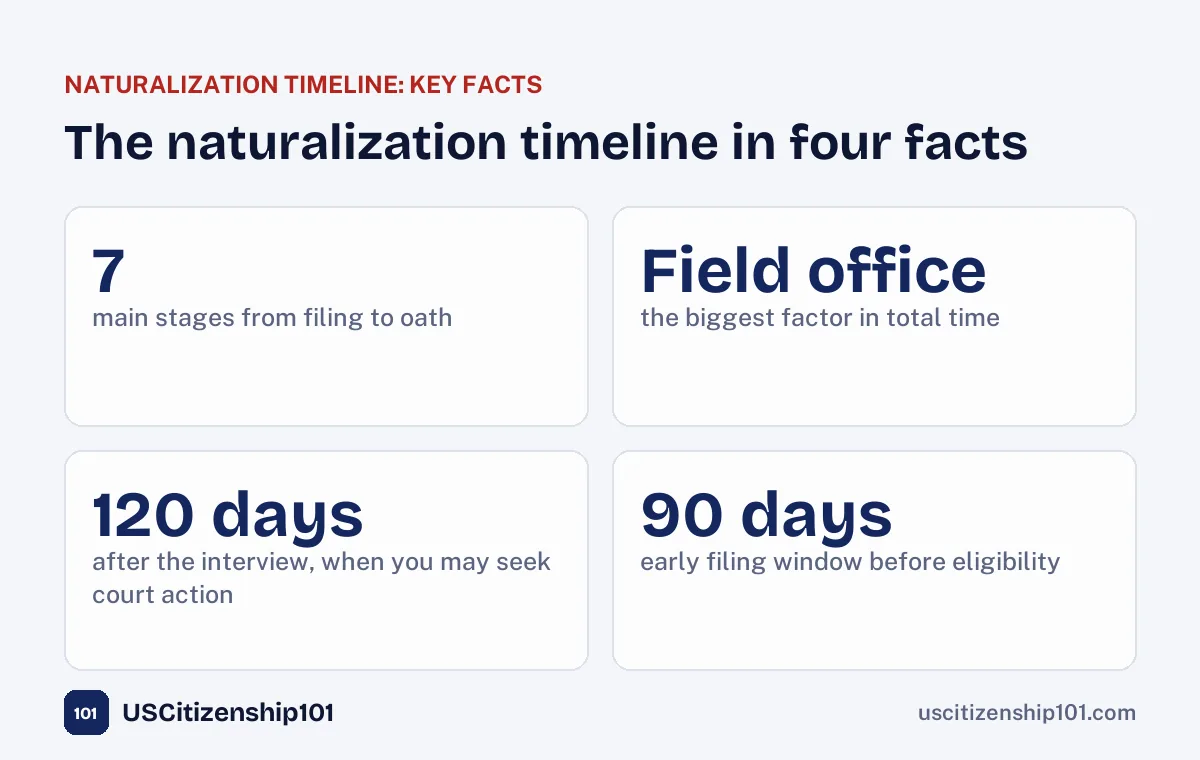
- The naturalization timeline has seven main stages, from filing to the oath.
- Total time depends mostly on your USCIS field office. Check current estimates at egov.uscis.gov/processing-times.
- You can file up to 90 days early to start the clock sooner.
- Requests for evidence, background checks, and missed appointments are common causes of delay.
- If there is no decision 120 days after your interview, the law allows you to ask a federal court to act.
Stage 1: Filing Form N-400
The naturalization timeline starts when USCIS receives your application. If you file online, you receive a receipt number immediately. If you file on paper, the receipt notice (Form I-797C) usually arrives by mail within a few weeks.
Keep your receipt notice safe. It shows your receipt number for tracking, and its received date also decides which civics test you take: the 2025 version for applications received on or after October 20, 2025, or the 2008 version for earlier ones.
Filing correctly the first time is the single best way to protect your naturalization timeline. A rejected application, for example because of a wrong fee or missing signature, restarts the clock. Our guides on how to fill out Form N-400 and the N-400 filing fee help you avoid that.
Filing early
You may file up to 90 days before you meet the continuous residence requirement. That can shorten your overall naturalization timeline by up to three months. See N-400 early filing for how to calculate your date.
Stage 2: Biometrics appointment
USCIS often schedules a biometrics appointment at an Application Support Center a few weeks after filing. Staff take your fingerprints, photo, and signature for FBI background checks. The appointment itself takes about 15 to 30 minutes. In some cases USCIS reuses fingerprints from an earlier application and skips this step.
Missing the appointment without rescheduling can lead to a denial, so treat it as a firm date. Read what to expect in our guide to the biometrics appointment.
Stage 3: Background checks and case review
Between biometrics and the interview, USCIS runs security and background checks, including an FBI fingerprint check and name checks, and reviews your file. This is usually the longest and least visible part of the naturalization timeline. Your online case status may not change for weeks or months. That is normal.
Requests for evidence
If USCIS needs more information before the interview, it may send a Request for Evidence (RFE). Answer completely and before the deadline. A quick, full response keeps your naturalization timeline moving; a late or incomplete response can lead to delay or denial.
Stage 4: Interview scheduling
When your case is ready, USCIS sends an interview notice with the date, time, and field office address, usually several weeks in advance. This is the time to intensify your study: follow a civics test study plan and practice with our mock interview.
If you truly cannot attend, request to reschedule as soon as possible, following the notice’s instructions. Rescheduling can add months to your naturalization timeline, so only do it when necessary.
Stage 5: The naturalization interview
At the interview, the officer places you under oath, reviews your N-400, and gives the English and civics tests. Most interviews last 20 to 30 minutes. Read what to expect at the USCIS citizenship interview.
Stage 6: The decision
At the end of the interview, the officer gives you Form N-652 with one of three outcomes:
- Granted: you are approved and move to the oath stage.
- Continued: USCIS needs more evidence or you need to retake part of the test. A retest happens 60 to 90 days later, which extends the naturalization timeline.
- Denied: USCIS finds you are not eligible. You may request a hearing with Form N-336 within 30 days.
Some approvals are decided on the spot. Others say a decision “cannot yet be made” while the officer reviews more information. If you need a retest, see what happens if you fail the citizenship test.
Stage 7: The Oath of Allegiance
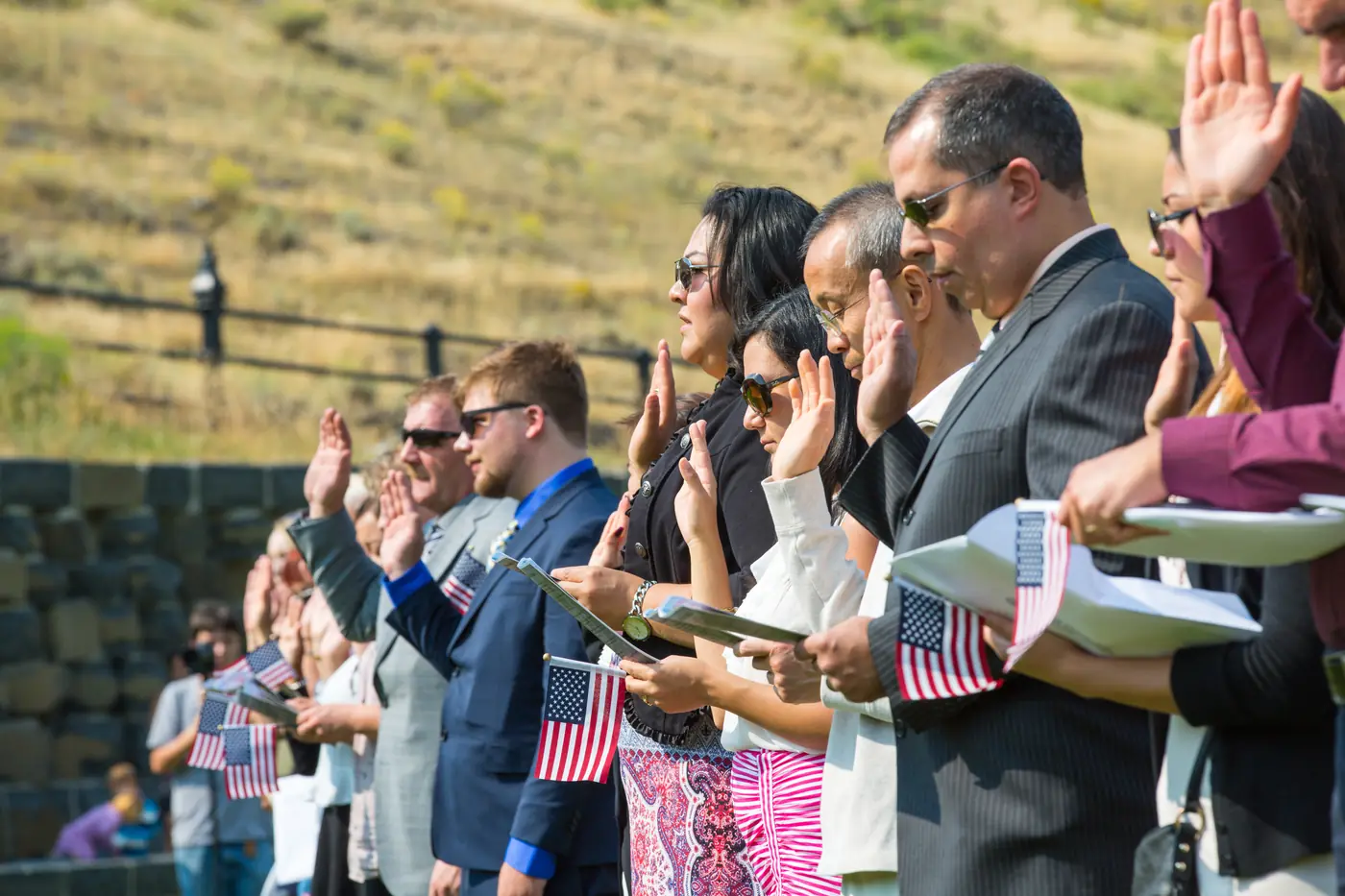
You become a citizen when you take the oath. Some offices hold the ceremony the same day as your interview. Others mail Form N-445 with a ceremony date weeks later. The oath is the final stage of the naturalization timeline. Read our guide to the oath of allegiance ceremony.
The naturalization timeline at a glance
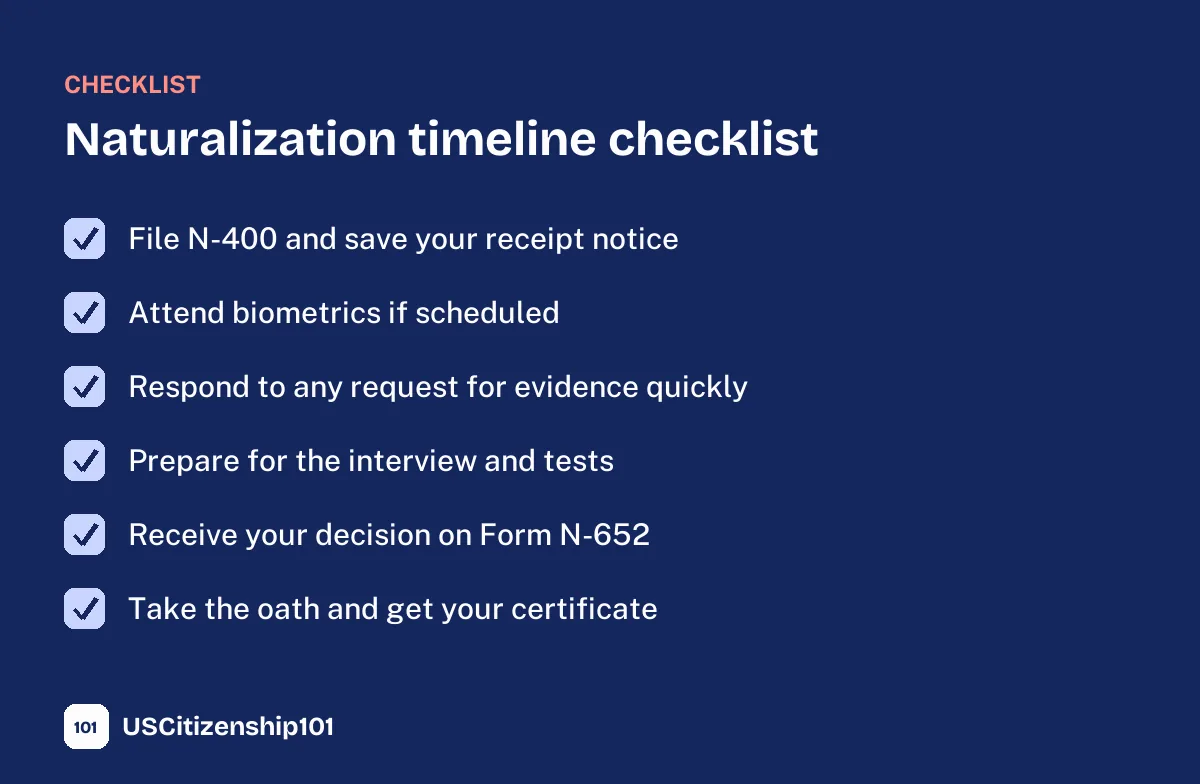
| Stage | What happens | What you do |
|---|---|---|
| 1. Filing | USCIS receives your N-400 | Save the receipt notice |
| 2. Biometrics | Fingerprints and photo | Attend with notice and ID |
| 3. Review | Background checks, possible RFE | Respond quickly to any request |
| 4. Scheduling | Interview notice issued | Study and gather documents |
| 5. Interview | Review of N-400, English and civics tests | Attend prepared |
| 6. Decision | Granted, continued, or denied | Follow instructions on Form N-652 |
| 7. Oath | Ceremony, certificate | Bring N-445 and Green Card |
How to check your case status
- Online account: if you filed online or linked a paper case, your account shows notices and updates.
- Case Status Online: enter your receipt number at egov.uscis.gov.
- Processing times: the USCIS processing times page shows current estimates for your field office.
Case status updates can lag behind reality. A notice may arrive by mail before your online status changes. Sign up for email or text updates in your USCIS account so you hear about changes as soon as they are posted, and check your physical mailbox regularly as well.
What slows down the naturalization timeline
- A busy field office. The biggest factor, and outside your control.
- Errors on the application, leading to rejection or an RFE.
- Missed or rescheduled appointments for biometrics or the interview.
- Background check issues, such as a common name or past records needing review.
- Criminal or immigration history requiring extra documents.
- A failed test, which adds a 60 to 90 day retest period.
- A move to another USCIS district after filing, which can transfer the case.
- A name change request that needs a judicial oath ceremony.
What to do if your case is taking too long
- Compare with processing times. If your case is within the posted range, waiting is usually the only option.
- Submit a case inquiry. If your case is outside normal processing times, submit an online service request or case inquiry with USCIS.
- Contact your congressional representative. Their office can make an inquiry on your behalf.
- Contact the CIS Ombudsman. For cases stuck despite inquiries, the Ombudsman can help.
- Consider court action. If USCIS has not decided your case within 120 days after your interview, the law allows you to ask a federal district court to decide it or send it back to USCIS with instructions. Talk to an immigration attorney before taking this step.
Can you expedite the naturalization timeline?
USCIS may expedite cases in limited situations, such as severe financial loss, urgent humanitarian reasons, or certain government interests. Requests are decided case by case and are not guaranteed.
What common case status messages mean
Your online case status uses short standard phrases. Here is what the most common ones usually mean along the naturalization timeline:
- Case Was Received: USCIS accepted your N-400 and issued a receipt notice.
- Fingerprint or biometrics appointment was scheduled: watch for the appointment notice.
- Case Is Being Actively Reviewed: an officer or system is working on your file. This can appear more than once.
- Request for Additional Evidence Was Sent: read the RFE carefully and respond by the deadline.
- Interview Was Scheduled: your interview notice is on its way or in your account.
- Interview Was Completed And My Case Must Be Reviewed: the officer needs more time or information before deciding.
- Case Was Approved: you passed and your application was granted.
- Oath Ceremony Was Scheduled / Oath Ceremony Notice Was Mailed: Form N-445 is coming.
Status wording changes from time to time, and not every case shows every message. Always rely on the notices you receive.
Example naturalization timelines
These examples show how the same process can take different lengths of time. They are illustrations, not predictions.
A straightforward case
Leila files online the day she becomes eligible. Biometrics happen a month later. With no issues, her interview is scheduled a few months after that. She passes, and her field office holds a same-day oath ceremony. Her naturalization timeline is well under a year.
A case with a request for evidence
Marco forgot to include court records for an old citation. USCIS sends an RFE, and he responds within three weeks. His interview is scheduled later than it would have been, adding a few months to his naturalization timeline, but his case is approved at the interview.
A case with a retest
Sunita passes English but misses civics. Her retest is scheduled about 75 days later, she passes, and her oath ceremony follows a few weeks after that. The retest adds roughly three months to her naturalization timeline.
Planning life events around the naturalization timeline
Travel
You can travel with your Green Card while your case is pending, but keep trips short, keep records of your dates, and avoid being away when appointments are likely. Trips of six months or more can raise continuous residence questions. See the continuous residence requirement.
Moving
Update your address with USCIS within 10 days of moving. A move to another USCIS district may transfer your file, which can lengthen your naturalization timeline.
Marriage, divorce, or new children
Life changes do not stop your case, but tell the officer at your interview, and report changes after the interview on Form N-445 before the oath.
An expiring Green Card
If your Green Card will expire during the process, renew it with Form I-90. Your N-400 receipt notice may help show continued status in some situations, but do not rely on it as a replacement for a valid card.
New jobs and travel for work
Changing jobs does not affect your eligibility, but be ready to update your employment history at the interview. If work requires long periods abroad, talk to an immigration attorney before you go.
Preparing before you start the naturalization timeline
The weeks before filing are part of your naturalization timeline too, even though the clock has not started. Use them to collect your travel dates, addresses, and employment history for the last five years, order any court records you need, check your eligibility date, and start studying civics. Applicants who prepare well before filing tend to move through every later stage more smoothly.
Keep your paperwork organized
Over a long naturalization timeline you will receive several official notices. Keep them together in one folder, in date order:
- Your N-400 receipt notice (Form I-797C).
- The biometrics appointment notice, stamped at your appointment.
- Any Request for Evidence and a copy of your response, with proof of delivery.
- Your interview notice.
- Form N-652, your interview results.
- Form N-445, your oath ceremony notice.
- A complete copy of the N-400 you submitted.
Scan each document to your phone or computer as a backup. If anything goes wrong, you will have proof of every step.
Special situations that change the timeline
Military applicants
Service members often have a faster, more flexible process, with interviews and ceremonies sometimes held at military bases or overseas. Military bases usually have USCIS contacts who can explain the current procedure.
Spouses of U.S. citizens
The 3-year marriage rule shortens the time before you can file, but the processing stages after filing are the same. See citizenship through marriage.
Applicants with exceptions
Applicants using the 50/20, 55/15, or 65/20 exceptions follow the same timeline, but should allow time to arrange an interpreter. Medical exception requests on Form N-648 may require extra review.
Myths about the naturalization timeline
- “Calling USCIS every week will speed things up.” It will not. Inquiries only help when your case is outside normal processing times.
- “Paying someone can get me an earlier interview.” No one can buy a faster place in line. Be wary of anyone who promises this.
- “No status change means something is wrong.” Long periods without updates are normal during background checks.
- “My friend got interviewed faster, so my case is delayed.” Different field offices move at different speeds. Compare your case with your own office’s posted times.
- “I can’t travel at all while waiting.” Short trips are fine with a valid Green Card; just plan them around your appointments.
Using the waiting time well
The waiting stages of the naturalization timeline are the perfect time to prepare. Study civics a little every day, practice the English reading and writing sentences, keep your address updated with USCIS, and avoid long trips abroad that could complicate your case. If you travel, keep records of your dates. When the interview notice arrives, you will already be ready.
Frequently asked questions
What is the fastest naturalization timeline possible?
Some applicants at fast field offices go from filing to oath in a few months. Filing online, filing complete evidence, and attending every appointment helps you get the fastest naturalization timeline your office allows.
Can I withdraw my application and refile later?
You can ask to withdraw, but the fee is not refunded and a new application restarts the naturalization timeline from the beginning. Talk to an attorney before withdrawing.
Can I travel while my case is pending?
Yes, with your Green Card, but plan around appointments and avoid long trips, which can affect continuous residence.
Is the naturalization timeline different for each state?
Yes, in practice. Each USCIS field office has its own workload, so waiting times vary from city to city, even within the same state.
Does filing online speed things up?
It removes mail and data-entry time at the start and makes it easier to respond to requests. It does not jump you ahead in the interview queue.
How long after the interview is the oath?
It can be the same day or several weeks later, depending on the field office and its ceremony schedule.
Will moving change my naturalization timeline?
It can. Update your address within 10 days. If you move to another district, your case may transfer, which can add time.
Final thoughts
The naturalization timeline has many stages, but most of the waiting is simply USCIS doing its work. Your job is to file correctly, attend every appointment, respond quickly to requests, and use the time to prepare. Do that, and your naturalization timeline will be as short as your field office allows.
Sources: USCIS, 10 Steps to Naturalization; USCIS processing times; INA section 336(b) and 8 U.S.C. 1447(b). Last reviewed September 2026. General information, not legal advice.
Free tools
This article is for general education, not legal advice. Always confirm requirements at uscis.gov.