Will the U.S. Ban Dual Citizenship? The Exclusive Citizenship Act Explained
A Senate bill would make dual citizens choose one nationality. Here is what it says, how far it has moved, the legal questions around it, and what it means if you are naturalizing now.
On this page
In December 2025, a U.S. senator introduced a bill that would end dual citizenship for Americans. News about a dual citizenship ban spread quickly, and many people who are naturalizing now are asking whether they will have to give up their other nationality.
This guide explains what the bill would do, where it stands in Congress, the legal questions it raises, and what the law allows today. It is a factual summary, not a prediction or a political argument.
Key points about the dual citizenship ban
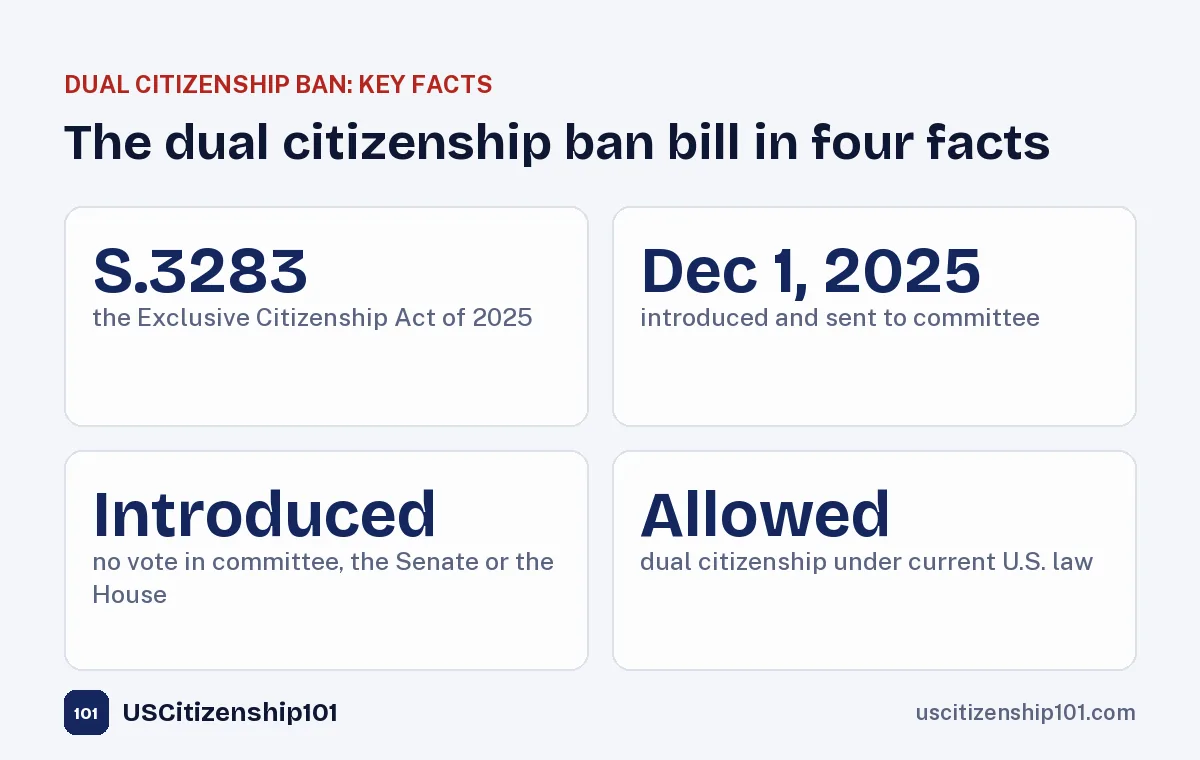
- The bill is the Exclusive Citizenship Act of 2025 (S.3283), introduced by Senator Bernie Moreno of Ohio on December 1, 2025.
- It would require U.S. citizens who hold another nationality to give up one of them.
- It was sent to the Senate Judiciary Committee and has not had a committee vote. It has not passed the Senate or the House.
- Dual citizenship is allowed under current U.S. law.
- Becoming a U.S. citizen does not, under U.S. law, end your other citizenship. Your other country’s law may.
What the Exclusive Citizenship Act would do
As introduced, the bill says a U.S. citizen may not hold citizenship in another country. People who are dual citizens when it becomes law would have one year to either:
- give up their foreign citizenship, by sending a written renunciation to the Secretary of State, or
- give up their U.S. citizenship, by sending a written renunciation to the Secretary of Homeland Security.
Anyone who does neither would be treated as having voluntarily given up U.S. citizenship. A U.S. citizen who voluntarily gains a foreign citizenship after the law takes effect would be treated as having given up U.S. citizenship. You can read the text and its status on Congress.gov.
Why the bill was proposed
The bill’s findings say allegiance to the United States must be undivided, that holding another citizenship can create conflicts of interest and divided loyalties, and that it is in the national interest for U.S. citizenship to be held exclusively. Critics answer that millions of Americans hold a second nationality through birth or family, often without choosing it, and that the bill would force many of them to lose a citizenship they did not seek.
Where the dual citizenship ban stands
| Step | Status as of October 2026 |
|---|---|
| Introduced in the Senate | Yes, December 1, 2025 |
| Committee vote (Senate Judiciary) | No |
| Passed the Senate | No |
| Passed the House | No |
| Signed into law | No |
Most bills introduced in Congress never get a vote. A bill that has not passed both chambers by the end of the current Congress in January 2027 dies and would have to be introduced again.

The legal questions
Any law that takes away citizenship faces questions under the Constitution. In Afroyim v. Rusk (1967), the Supreme Court held that Congress cannot take away a person’s U.S. citizenship without their consent. In Vance v. Terrazas (1980), the Court said the government must show a person intended to give up citizenship. Supporters and critics of the bill disagree about how these decisions would apply to it, and a court would likely have to decide if it ever became law.
How other countries treat dual citizenship
Countries take very different approaches, and that matters even under today’s U.S. law:
- Allow it: many countries, including Mexico, the United Kingdom, Canada and, since 2024, Germany, let their citizens keep their nationality when they become American.
- Do not allow it: some countries, such as China and India, do not recognize dual citizenship. Naturalizing in the United States can mean losing that citizenship. India offers Overseas Citizenship of India (OCI) instead.
- Allow it with conditions: some countries require an extra step. Former Filipino citizens, for example, can keep or regain Philippine citizenship by taking an oath under the Philippines’ dual citizenship law (RA 9225). Others require registration, permission or a choice by a certain age.
Rules change, so check with your country’s embassy or consulate before your oath.
What the law allows today
- U.S. law does not require you to give up another citizenship to naturalize, and it does not end your other citizenship when you take the oath.
- The Oath of Allegiance includes a promise to renounce allegiance to other countries. The U.S. does not treat that promise as ending your other citizenship, but your other country might. Some countries end citizenship when you naturalize elsewhere; others do not.
- U.S. citizens must use a U.S. passport to enter and leave the United States.
Our guide to dual citizenship in the USA covers passports, taxes and examples by country.
What this means if you are naturalizing now
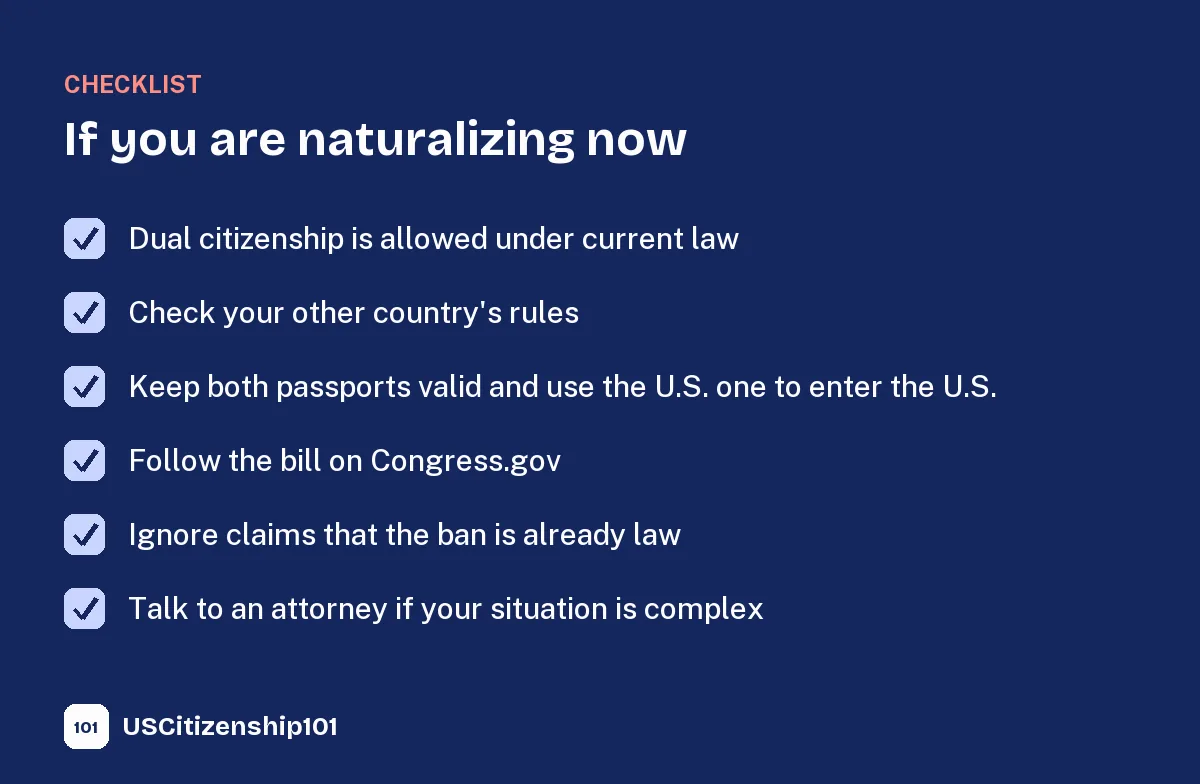
- Nothing changes today. The bill is not law, and the naturalization process is the same.
- Check what your other country’s law says about naturalizing in the United States.
- Be careful with social media posts that say the ban has passed. Check Congress.gov for the real status.
- If your situation is complex, for example a job, property or family benefits tied to your other nationality, talk to an immigration attorney.
Frequently asked questions
Is dual citizenship illegal in the United States?
No. It is allowed under current law.
Has the dual citizenship ban passed?
No. As of October 2026 it has not had a committee vote and has not passed either chamber of Congress.
Will I lose my other citizenship when I naturalize?
Not under U.S. law. It depends on your other country’s law.
Will this page be updated?
Yes. We will update it if the bill moves in Congress.
Sources: Congress.gov, S.3283 Exclusive Citizenship Act of 2025; U.S. Department of State, Dual Nationality; Afroyim v. Rusk, 387 U.S. 253 (1967); Vance v. Terrazas, 444 U.S. 252 (1980). Last reviewed October 2026. General information, not legal advice.
Free tools
This article is for general education, not legal advice. Always confirm requirements at uscis.gov.