Can You Travel While Your N-400 Is Pending? What to Know Before You Go
Yes, you can usually travel after you file your N-400. Here is how long trips affect your case, how to avoid missing an appointment, and what changes after your oath.
On this page
After you file for citizenship, life goes on. Family events, work trips, and vacations do not stop because your application is pending. The good news is that N-400 travel is usually allowed: you can leave the United States and come back while you wait. But there are rules to respect, because a long trip or a missed appointment can delay or even hurt your case.
This guide explains how N-400 travel works: what the law requires while your case is pending, how long trips affect continuous residence, how to avoid missing your biometrics, interview, or oath, what documents to carry, and what changes after you become a citizen.
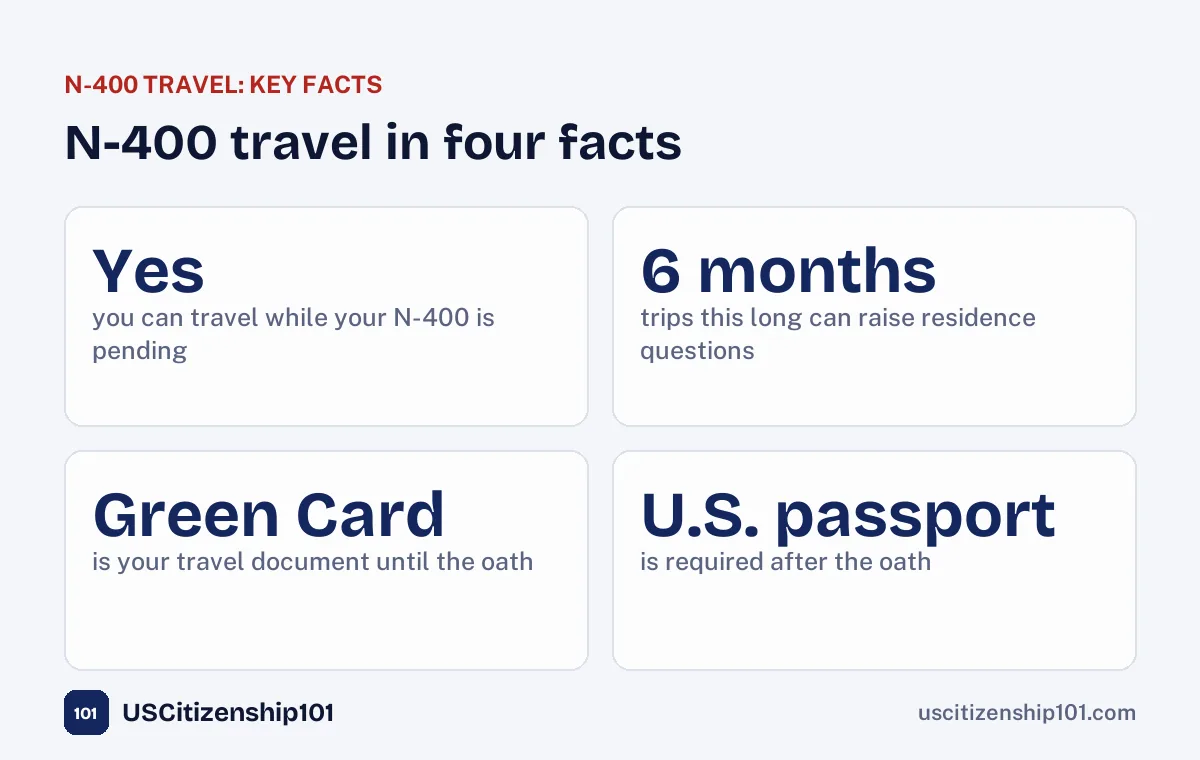
Key points about N-400 travel
- You can travel while your N-400 is pending. There is no travel permit needed for short trips.
- You must keep continuous residence from the day you file until the day you take the oath.
- A trip of more than 6 months can raise questions about continuous residence, and a trip of 1 year or more breaks it.
- Missing a biometrics appointment, interview, or oath ceremony can delay your case or lead to denial.
- You travel on your Green Card until the oath. After the oath you need a U.S. passport.
Is N-400 travel allowed after filing?
Yes. As a permanent resident, you can travel outside the United States and return with your Green Card, as you did before you filed. Filing the N-400 does not require you to stay in the country, and there is no special travel document for N-400 travel. Many applicants take short trips while they wait.
What matters is how long you are gone, whether you can return for your appointments, and whether you keep your life based in the United States. The rest of this guide covers each of those.
The rule to remember: residence continues until the oath
To naturalize, you must have continuous residence for the required period before you file: usually five years, or three if you are married to a U.S. citizen. What many people do not know is that the requirement does not stop when you file. You must continue to reside in the United States from the date you file until the day you take the Oath of Allegiance. That is why N-400 travel needs planning.
N-400 travel: how long can you be away?
- Short trips (well under 6 months): generally no problem for continuous residence. Most vacations and family visits fall here.
- More than 6 months but less than 1 year: USCIS presumes continuous residence was broken, unless you can show you kept your ties to the United States, such as your job, home, family, and taxes.
- 1 year or more: continuous residence is broken, except in limited cases protected by an approved Form N-470 for certain work abroad.
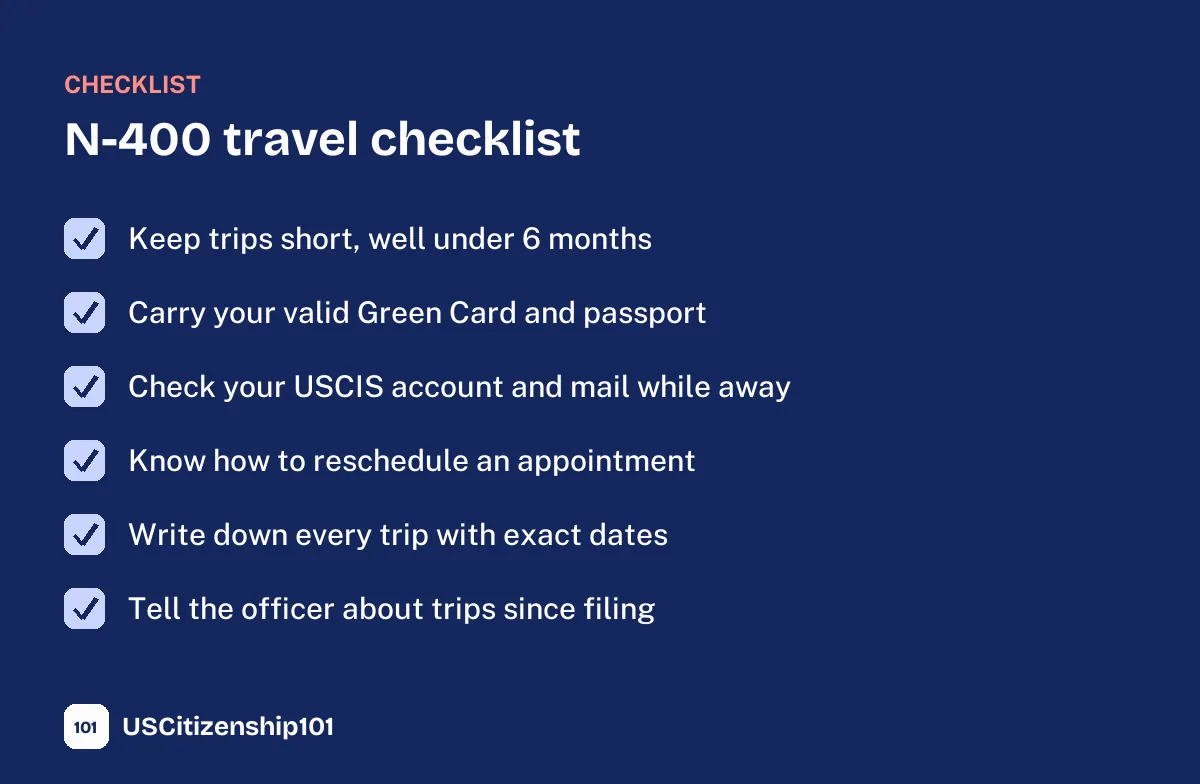
For N-400 travel, the safest plan is to keep every trip short, well under six months, and to avoid long trips entirely while your case is pending. Read our full guide to the continuous residence requirement.
Physical presence is a separate rule
Physical presence means the total number of days you were actually in the United States. It is counted over the period before you file: at least half of the five years (30 months), or half of three years (18 months) for marriage-based applicants. Trips after you file do not change that count. But continuous residence, as explained above, continues until your oath, so N-400 travel still matters.

The biggest N-400 travel risk: missing an appointment
The most common N-400 travel problem is not the trip itself. It is missing an appointment because a notice arrived while you were away. During your case, USCIS may schedule:
- A biometrics appointment for fingerprints and a photo, if USCIS needs them.
- Your interview, with the civics and English tests.
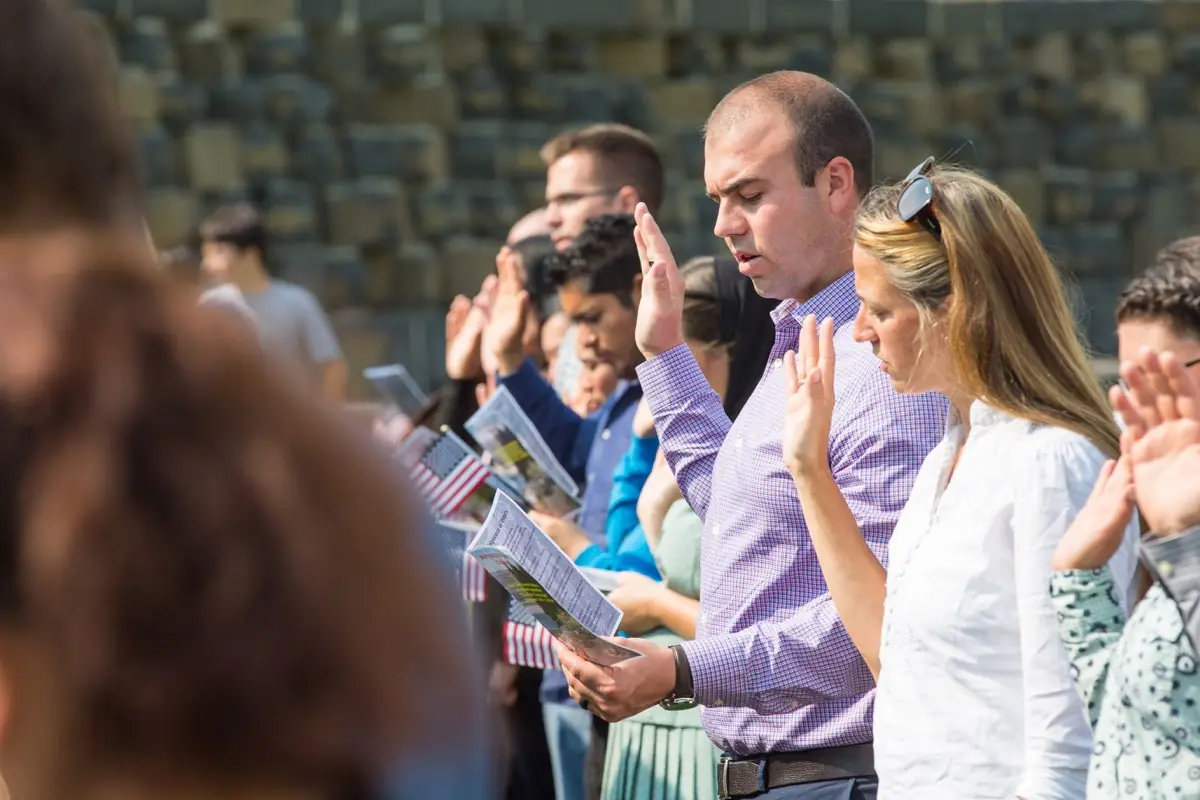
- Your oath ceremony, sometimes the same day as the interview and sometimes weeks later.
Notices usually arrive a few weeks before the appointment. If you miss your interview without rescheduling, USCIS can treat your application as abandoned. Missing appointments can also add months to your case. See our guide to your N-400 case status to follow your case.
N-400 travel examples
| Situation | What to know |
|---|---|
| Two-week vacation, case status “Case Was Received” | Low risk. Set up alerts and have someone check your mail. |
| Three-week family visit, status says ready to be scheduled for an interview | Higher risk of a notice arriving. Book flexible tickets or wait. |
| Four-month stay abroad to care for a parent | Allowed, but keep ties strong and watch for notices. Get advice if it may grow longer. |
| Seven-month stay abroad after filing | USCIS presumes continuous residence was broken unless you prove your ties. Talk to an attorney first. |
| Trip planned for the week after your interview | Possible, but you could miss a ceremony notice. Ask the officer about your oath date first. |
| Trip booked for the week after your oath | Only if your U.S. passport arrives in time. Your Green Card is gone after the oath. |
These examples are general. Your own N-400 travel decision depends on your history, your ties, and your field office’s timing.
Questions to ask before you book
- What does my case status say right now, and is an appointment likely soon?
- How long will I be away, and will I stay well under six months?
- Who will check my mail and tell me about any USCIS notice?
- Can I change my tickets if a notice arrives?
- Is my Green Card valid for the whole trip, or do I have a receipt notice that extends it?
- Have I written down the dates of every trip since I filed?
If you can answer every question with confidence, your N-400 travel plan is probably fine.
How to protect your case while you travel
- Check your case status and USCIS online account before you book and while you are away. Turn on email or text alerts.
- Ask someone you trust to check your mail and tell you right away about any USCIS letter.
- Know how to reschedule. Each notice explains how. Ask as early as possible and keep proof.
- Avoid being away when appointments are likely, for example soon after your case status says “Case Is Ready to Be Scheduled for an Interview.”
- Book flexible tickets if you can, so you can return early if a notice arrives.
- Keep your address updated with USCIS if you move.
Documents to carry for N-400 travel
- Your valid Green Card. It is your document to reenter the United States as a permanent resident.
- Your valid passport from your country of citizenship.
- A copy of your N-400 receipt notice. If your Green Card is expired, your N-400 receipt notice may extend its validity for a period; check the wording on your notice.
- Copies of any USCIS appointment notices you already have.
If your Green Card is lost or expired and the receipt notice does not cover you, talk to USCIS or an attorney before you travel.
Keep a record of all N-400 travel
Write down the exact dates you leave and return for every trip after you file. At your interview, the officer will ask whether you have traveled since filing, and before the oath you answer questions on Form N-445 about any trips since your interview. Your passport stamps help, but a simple list with dates and destinations makes these answers easy and accurate.
How the officer asks about N-400 travel
At your interview, the officer reviews the trips listed on your N-400 and asks whether you have traveled since you filed. A typical exchange sounds like this:
- Officer: “Have you traveled outside the United States since you filed your application?”
- You: “Yes. I went to Mexico from June 2 to June 20, 2026, to visit my family.”
- Officer: “Any other trips?”
- You: “No, that was the only one.”
Clear dates and honest answers make this part of the interview quick. If you took a long trip, the officer may ask about your home, job, and taxes in the United States during that time, so bring proof of your ties.
Holiday season N-400 travel
Many applicants want to travel for Thanksgiving, Christmas, or the New Year. Interviews and oath ceremonies continue in November and December in many offices, so a notice can arrive during the holidays. If you plan N-400 travel at the end of the year, check your status first, keep the trip short, and make sure someone can reach you quickly if a letter comes.
Families traveling together
If you and your spouse both filed, each case has its own appointments, which may be on different days. Plan N-400 travel around both schedules. Children under 18 who are permanent residents may become citizens automatically when a parent naturalizes, if they meet the requirements, and can then get their own U.S. passport. Read our guide to Form N-600 for proof of a child’s citizenship.
N-400 travel between the interview and the oath
After your interview, you may wait days or weeks for your oath ceremony. You can still travel, but the same rules apply: keep residing in the United States, keep the trip short, and make sure you can attend the ceremony. If you miss the ceremony, you must reschedule, which delays the day you become a citizen. The N-445 you bring to the ceremony asks about trips since your interview, so answer honestly.
After the oath: travel as a U.S. citizen
At the oath ceremony you return your Green Card and receive your Certificate of Naturalization. From that moment, you must use a U.S. passport to leave and enter the United States. You cannot travel on your Green Card anymore, and you should not carry your certificate as a travel document. Apply for your passport soon after the ceremony, and avoid booking international trips until it arrives. Our guide to getting a passport after naturalization explains each step.
Special situations
Work abroad for a U.S. employer
Some people must work abroad for a U.S. company, the U.S. government, or certain international organizations. Form N-470 can protect continuous residence in some of these cases, but it must be approved and it has strict rules. Get legal advice before a long assignment.
Family emergencies
If you must travel for a family emergency and a USCIS appointment is coming up, contact USCIS right away to reschedule, and keep proof of the emergency. If the trip will be long, talk to an attorney about how it may affect your case.
Military families
Service members and some military spouses have special rules and services, including naturalization abroad in some cases. Ask your installation’s legal office or the USCIS military help line.
Proving your ties to the United States
If any N-400 travel lasted longer than you planned, the officer may ask how you kept your life in the United States. Helpful proof includes:
- IRS tax returns or transcripts filed as a resident.
- Your lease, mortgage, or proof that you kept your home.
- A letter from your employer showing you kept your job, or proof of paid leave.
- Bank statements and bills in your name at your U.S. address.
- Evidence that your spouse or children stayed in the United States.
Keep these documents in your interview folder if you were away for a long time. See our checklist of citizenship interview documents.
Use the waiting time well
Whether or not you travel, the months while your case is pending are the best time to prepare for the civics and English tests. If you do travel, take your study with you: a few minutes of flashcards on the plane or in the evening keeps your progress going. N-400 travel and study fit together easily, and you will return ready for your interview.
Common N-400 travel mistakes
- Taking a long trip of six months or more while the case is pending.
- Not checking mail or the online account while away, and missing a notice.
- Booking a trip right after the case is ready for interview, when a notice is likely.
- Traveling on an expired Green Card without the right proof of status.
- Forgetting to report trips at the interview or on Form N-445.
- Booking international travel right after the oath before your U.S. passport arrives.
A simple plan for N-400 travel
- Before you book: check your case status, and ask yourself whether an appointment is likely during the trip.
- Before you leave: set up alerts, arrange for mail checks, and pack your Green Card, passport, and receipt notice.
- While you are away: check your USCIS account regularly and respond to any notice right away.
- When you return: add the trip dates to your list.
- At the interview and ceremony: report your trips honestly.
Frequently asked questions
Can I travel while my N-400 is pending?
Yes. You can travel with your Green Card. Keep trips short and make sure you can return for your appointments.
How long can I leave the U.S. after filing N-400?
There is no fixed limit, but trips of more than six months can raise questions about continuous residence, and trips of one year or more break it. For N-400 travel, short trips are safest.
What happens if I miss my interview while traveling?
USCIS may treat your application as abandoned if you do not reschedule. Contact USCIS as soon as you know you cannot attend.
Do I need a reentry permit for a short trip?
No. A reentry permit is for long absences and protects your Green Card, not your naturalization timeline.
Can I travel after my interview but before the oath?
Yes, but make sure you can attend the ceremony, keep the trip short, and report the trip on Form N-445. N-400 travel rules apply until the moment you take the oath.
Will traveling slow down my case?
A short trip by itself does not slow down your case. Delays happen when you miss or reschedule an appointment, or when a long absence raises questions about continuous residence that the officer needs to review.
What if a notice arrives while I am abroad?
Read it right away. If you can return in time, plan to attend. If you cannot, follow the rescheduling instructions on the notice as soon as possible and keep proof that you asked.
Can I travel to my home country?
Yes. Traveling to your country of origin is normal. The same rules about trip length and appointments apply.
Do I have to tell USCIS about my trips?
Yes. The officer asks about trips since you filed, and Form N-445 asks about trips since your interview. Answer honestly and bring your dates.
Final thoughts
N-400 travel is allowed, and with a little planning it is low risk. Keep trips short, carry your Green Card and passport, watch your USCIS account and mail while you are away, and never miss an appointment without rescheduling. After the oath, travel only with your new U.S. passport.
Sources: USCIS, Form N-400; USCIS, Form N-400 Instructions; USCIS Policy Manual, Continuous Residence. Last reviewed September 2026. This guide is general information, not legal advice.
Free tools
This article is for general education, not legal advice. Always confirm requirements at uscis.gov.