Civics Test Answers That Change: Current Officials for Your 2026 Interview
Some civics answers depend on who is in office on your interview day or where you live. Here are the current answers and how to find yours.

On this page
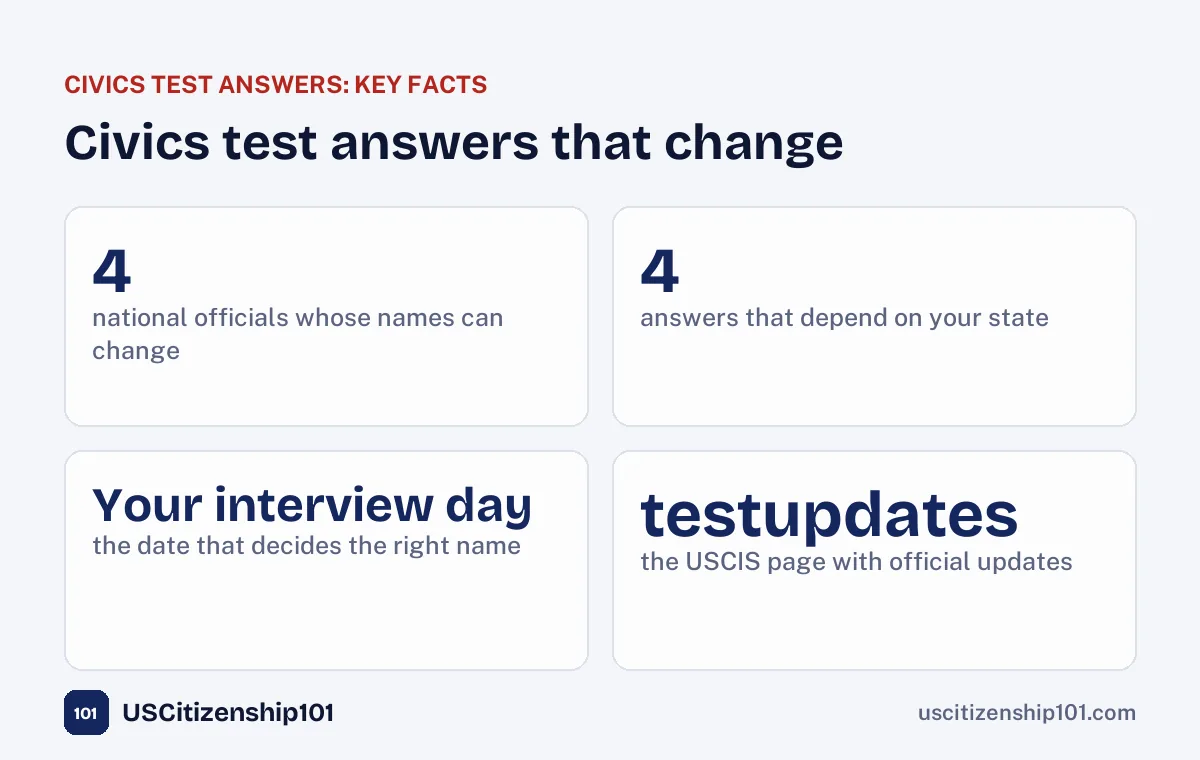
Most civics test answers never change. The Constitution will always be the supreme law of the land, and there will always be 50 stars on the flag while there are 50 states. But a small group of civics test answers depend on who holds office on the day of your interview, or on where you live. If an election or appointment happens before your interview, the correct answer changes too.
This guide lists every one of these changing civics test answers for both the 2025 and 2008 versions of the naturalization test. It gives the current national answers, shows you how to find the answers for your own state in a few minutes, and explains what to do if something changes right before your interview.
Key points about civics test answers that change
- Some civics test answers depend on who holds office on the day of your interview.
- Others depend on where you live: your senators, representative, governor, and state capital.
- You must give the name of the official serving on your interview day.
- USCIS lists official current civics test answers at uscis.gov/citizenship/testupdates.
- Check your answers again during the week before your interview.
Current national civics test answers (checked September 2026)
| Question | 2025 test | 2008 test | Current answer |
|---|---|---|---|
| What is the name of the President of the United States now? | Q38 | Q28 | Donald J. Trump |
| What is the name of the Vice President of the United States now? | Q39 | Q29 | JD Vance |
| What is the name of the Speaker of the House of Representatives now? | Q30 | Q47 | Mike Johnson |
| Who is the Chief Justice of the United States now? | Q57 | Q40 | John G. Roberts, Jr. |
| What is the political party of the President now? | Not on the 2025 list | Q46 | Republican |
| How many justices are on the Supreme Court? | Not on the 2025 list | Q39 | Nine (9) |
These civics test answers are correct as of September 2026. Always double-check uscis.gov/citizenship/testupdates in the week before your interview. If an official changes, give the name of the person serving on your interview day.
Why some civics test answers change
The civics test checks that you understand how American government works today, not just in history books. Knowing who leads the country and who represents you is part of being an informed citizen. That is why USCIS keeps a few questions about current officials, even though the right civics test answers depend on the calendar.
National officials change on predictable schedules:
- The President and Vice President are elected every four years. A new term begins on January 20 after the election.
- The Speaker of the House is elected by the House of Representatives, usually at the start of each new Congress in January of odd-numbered years, and can change at other times if the House elects someone new.
- The Chief Justice serves for life and changes only after a retirement or death, followed by a nomination and Senate confirmation.
How to answer the President and Vice President questions
Give the full name or the last name of the person in office on your interview day. “Donald Trump” or “Trump” is accepted for the President question, just as “JD Vance” or “Vance” is accepted for the Vice President. Officers are listening for the correct person, not a formal title.
Be careful in the months after a presidential election. The winner is not the President until Inauguration Day on January 20. If your interview is in December after an election, the correct civics test answers are still the names of the people currently serving.
The Speaker of the House question
The Speaker leads the House of Representatives and is second in line to become President after the Vice President. Many applicants forget this name because it appears less often in the news. Make a point of learning it. It is currently Mike Johnson.
If the House elects a new Speaker before your interview, USCIS updates the test updates page. The Speaker can change in the middle of a Congress, so this is one of the civics test answers most worth checking just before your interview.
The Chief Justice question
The Chief Justice leads the Supreme Court. John G. Roberts, Jr. has held the position since 2005. “John Roberts” or “Roberts” is accepted. Because justices serve for life, this answer changes rarely, but it can.
Do not confuse the Chief Justice with other Supreme Court justices. Naming a different justice is a wrong answer.
Civics test answers that depend on where you live
Four civics test answers change based on your address. There is no single national answer, so you need to look up yours. It takes only a few minutes.
Who is one of your state’s U.S. senators now?
Every state has two U.S. senators, and you only need to name one. Find yours at senate.gov by choosing your state. If you live in Washington, D.C. or a U.S. territory, the correct answer is that D.C. (or your territory) has no U.S. senators.
Name your U.S. representative.
Your representative depends on your congressional district, which depends on your exact home address, not just your city. Enter your ZIP code at house.gov. If your ZIP code covers more than one district, the site asks for your street address. Residents of territories with a nonvoting delegate or resident commissioner may name that person, or say that the territory has no voting representative.
Who is the governor of your state now?
Search your state’s official website or usa.gov/state-governments. D.C. residents should answer that D.C. does not have a governor. Residents of territories should name the territory’s governor.
What is the capital of your state?
This one does not change with elections, but it is state-specific. Many people confuse the capital with the largest city. The capital of New York is Albany, of California is Sacramento, of Texas is Austin, of Florida is Tallahassee, and of Illinois is Springfield. D.C. residents should answer that D.C. is not a state and does not have a capital. Territory residents name the territory’s capital.
All 50 state capitals
The state capital question is one of the civics test answers that depends on where you live. Find your state in this table and learn its capital. Notice how often the capital is not the largest or best-known city.
| State | Capital |
|---|---|
| Alabama | Montgomery |
| Alaska | Juneau |
| Arizona | Phoenix |
| Arkansas | Little Rock |
| California | Sacramento |
| Colorado | Denver |
| Connecticut | Hartford |
| Delaware | Dover |
| Florida | Tallahassee |
| Georgia | Atlanta |
| Hawaii | Honolulu |
| Idaho | Boise |
| Illinois | Springfield |
| Indiana | Indianapolis |
| Iowa | Des Moines |
| Kansas | Topeka |
| Kentucky | Frankfort |
| Louisiana | Baton Rouge |
| Maine | Augusta |
| Maryland | Annapolis |
| Massachusetts | Boston |
| Michigan | Lansing |
| Minnesota | Saint Paul |
| Mississippi | Jackson |
| Missouri | Jefferson City |
| Montana | Helena |
| Nebraska | Lincoln |
| Nevada | Carson City |
| New Hampshire | Concord |
| New Jersey | Trenton |
| New Mexico | Santa Fe |
| New York | Albany |
| North Carolina | Raleigh |
| North Dakota | Bismarck |
| Ohio | Columbus |
| Oklahoma | Oklahoma City |
| Oregon | Salem |
| Pennsylvania | Harrisburg |
| Rhode Island | Providence |
| South Carolina | Columbia |
| South Dakota | Pierre |
| Tennessee | Nashville |
| Texas | Austin |
| Utah | Salt Lake City |
| Vermont | Montpelier |
| Virginia | Richmond |
| Washington | Olympia |
| West Virginia | Charleston |
| Wisconsin | Madison |
| Wyoming | Cheyenne |
If you live in a U.S. territory, name the capital of your territory. For example, the capital of Puerto Rico is San Juan and the capital of Guam is Hagåtña.
Related questions that never change
Several questions sit right next to the changing ones and are easy to mix up. Unlike the changing civics test answers, these stay the same, so learn them once and you are done. These are from the 2025 list.
- How many U.S. senators are there? One hundred (100).
- How many senators does each state have? Two (2).
- How long is a term for a U.S. senator? Six (6) years.
- How many voting members are in the House of Representatives? Four hundred thirty-five (435).
- How long is a term for a member of the House of Representatives? Two (2) years.
- The President of the United States is elected for how many years? Four (4) years.
- If the president can no longer serve, who becomes president? The Vice President.
- Who is Commander in Chief of the U.S. military? The President.
- Who signs bills to become laws? The President.
Notice the pattern: the numbers and roles are permanent, while the names are the changing civics test answers. Learning them together helps you remember both.
Recent changes to these civics test answers
Looking at recent history shows why checking matters. Several of these civics test answers changed in just the last few years:
- President: Joe Biden served from January 2021 to January 2025. Donald J. Trump began his current term on January 20, 2025.
- Vice President: Kamala Harris served from 2021 to 2025. JD Vance became Vice President on January 20, 2025.
- Speaker of the House: Kevin McCarthy was removed as Speaker in October 2023, and Mike Johnson was elected Speaker later that month.
- Chief Justice: John G. Roberts, Jr. has served since 2005, so this answer has not changed in a long time.
Applicants who studied from materials printed in 2023 or 2024 could easily give an outdated name. That is exactly the kind of mistake that costs points.
How officers judge these civics test answers
USCIS officers are trained to accept any answer that clearly identifies the right person or place. You do not need a middle initial, a title, or a perfect pronunciation. If your pronunciation of a name is unusual, the officer may ask you to repeat it or spell it. For state questions, officers can check the correct civics test answers for your address, so give the answer for where you actually live.
Tips for residents of D.C. and U.S. territories
If you live in Washington, D.C., Puerto Rico, Guam, the U.S. Virgin Islands, American Samoa, or the Northern Mariana Islands, some of these questions have special civics test answers. D.C. and the territories have no U.S. senators. Territories have a nonvoting delegate or resident commissioner in the House. D.C. has no governor and no state capital, because it is not a state. Learn the exact wording on the official USCIS list for your version so you can answer confidently.
What if you moved recently?
Answer based on where you live at the time of your interview. If you moved from New Jersey to Texas after filing, your correct civics test answers are the Texas senators, your new representative, the Texas governor, and Austin. Update your address with USCIS within 10 days of moving, too.
What if an official changes right before your interview?
Give the name of whoever holds the office on the day of your interview. Officers know the current civics test answers. If a change happened only a day or two earlier and you are not sure, you can explain what you know, for example, “The new Speaker was elected yesterday; it is now [name].” The safest approach is to check the USCIS updates page and a reliable news source the evening before your interview.
A simple method to remember these answers
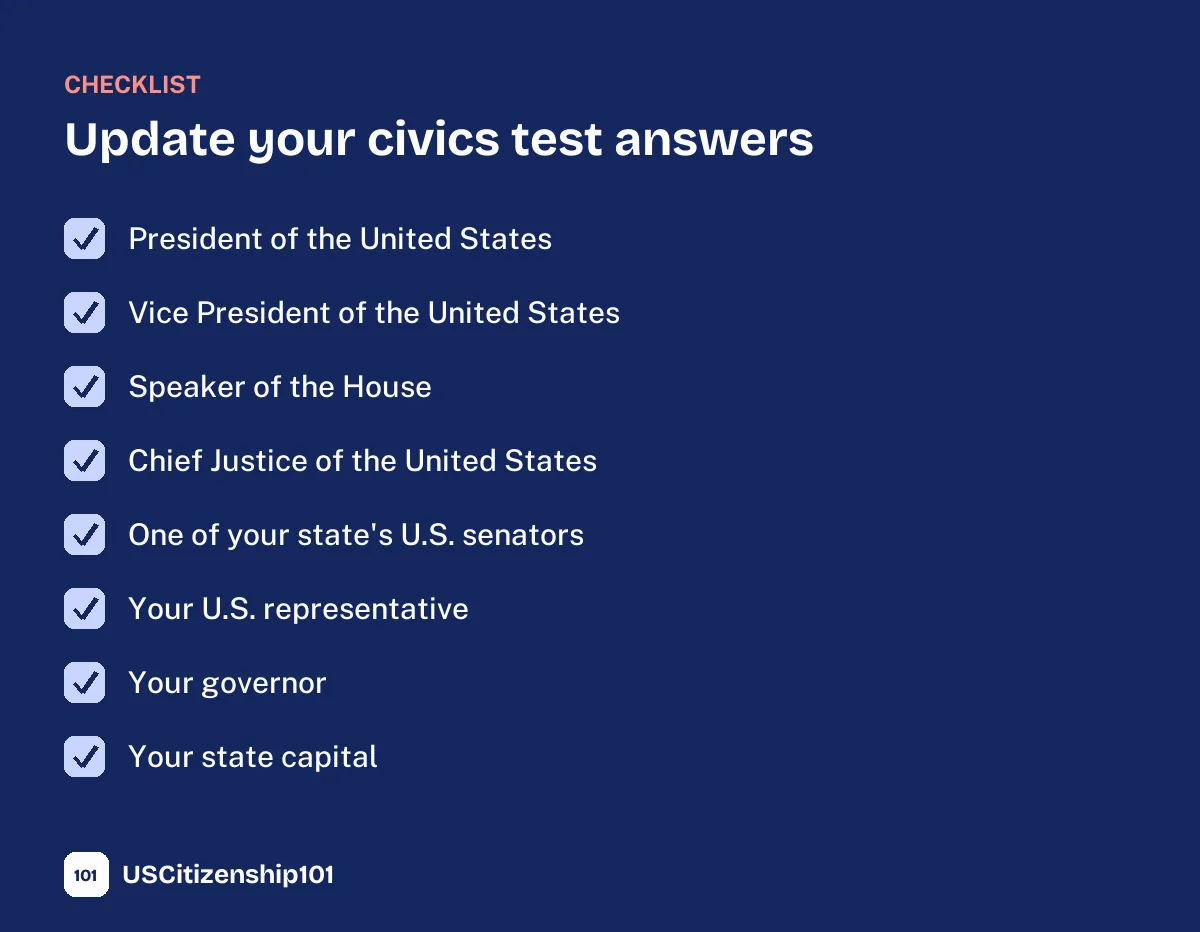
- Write all eight changing civics test answers on one index card: the four national names and your four state answers.
- Read the card out loud every morning, in full sentences, such as “The President is Donald J. Trump.”
- Tape a copy to your fridge or bathroom mirror.
- Ask a family member to quiz you on the card at random times.
- Check each answer again the week of your interview.
Our civics practice test always shows the current national answers and asks you to say your state answers out loud before checking them.
Practice these answers the way the officer asks them
Knowing the civics test answers is one thing. Saying them quickly and clearly when an officer asks is another. Try this short routine every day for a week before your interview:
- Ask a friend or family member to read each of the eight questions in a random order.
- Answer out loud in a full sentence, such as “The governor of my state is [name].”
- Then answer with only the name, which is also acceptable.
- Switch the order every day so you are not relying on the sequence.
- Finish by taking one full mock test to mix these questions with the rest of the list.
This practice takes less than five minutes, and it turns eight potentially tricky questions into guaranteed points. Many applicants find that once these answers are automatic, the rest of the interview feels calmer too, because they have a set of questions they know they will get right.
Which version of the test are you taking?
The question numbers above differ between the two versions. If USCIS received your N-400 on or after October 20, 2025, you take the 2025 civics test with 128 questions. If it was received earlier, you take the 2008 test with 100 questions. Our guide to the 100 civics questions covers the older list, and our guide to the 128 civics questions covers the new one.
Common mistakes with changing civics test answers
- Using an old study guide. Printed books and old videos often list former officials. Always check the date.
- Naming the President-elect too early. Until January 20, the current President is still the answer.
- Naming a senator from another state. Learn a senator from the state where you live now.
- Naming a mayor instead of a governor. The governor leads the state, the mayor leads a city.
- Naming the largest city instead of the capital. Double-check your state capital.
- Guessing a representative. Look it up by address. Neighboring towns can have different representatives.
Frequently asked questions
Can I say only the last name?
Yes. For the national officials, the last name is usually enough, as long as it clearly identifies the right person.
What if my state has a new senator appointed after a vacancy?
Name either of the senators serving on your interview day. You only need one, so you can choose the one you are most confident about.
Do officers ask all of these questions?
Not necessarily. The officer chooses questions from the full list, so any of these civics test answers could come up. Be ready for all of them.
What if I give an outdated name?
It counts as a wrong answer for that question. On the 2025 test you can still pass with up to 8 wrong answers, but it is an easy point to lose, so check before your interview.
Where does USCIS publish updates?
On its citizenship test updates page. It lists the current national officials and links for finding state officials.
Are the other civics test answers ever updated?
Rarely. USCIS can revise the list, but most answers are historical or constitutional facts that do not change. The questions in this guide are the ones that change regularly.
Final thoughts
The civics test answers that change are some of the easiest points on the test, as long as you check them. Learn the four national names, look up your four state answers once, and review them the week of your interview. With those eight answers locked in, you can focus your energy on the rest of the civics questions.
Sources: USCIS Test Updates; USCIS 128 Civics Questions and Answers (2025 version); USCIS 100 Civics Questions and Answers (2008 version). Officials last checked September 26, 2026.
Free tools
This article is for general education, not legal advice. Always confirm requirements at uscis.gov.