Continuous Residence and Physical Presence for U.S. Citizenship Explained
How long trips abroad affect your eligibility for citizenship, the difference between continuous residence and physical presence, and how to protect your case.

On this page
Continuous residence is one of the most important requirements for U.S. citizenship, and one of the most misunderstood. It means you have kept your permanent home in the United States for the required period, without long absences that break it. Together with physical presence, continuous residence decides when you can apply and whether long trips abroad could delay your citizenship.
This guide explains continuous residence in plain English: the 6-month and 1-year rules, how physical presence is different, what to do if your residence was broken, how to prove your ties to the United States, and when Form N-470 can help.
Key points about continuous residence
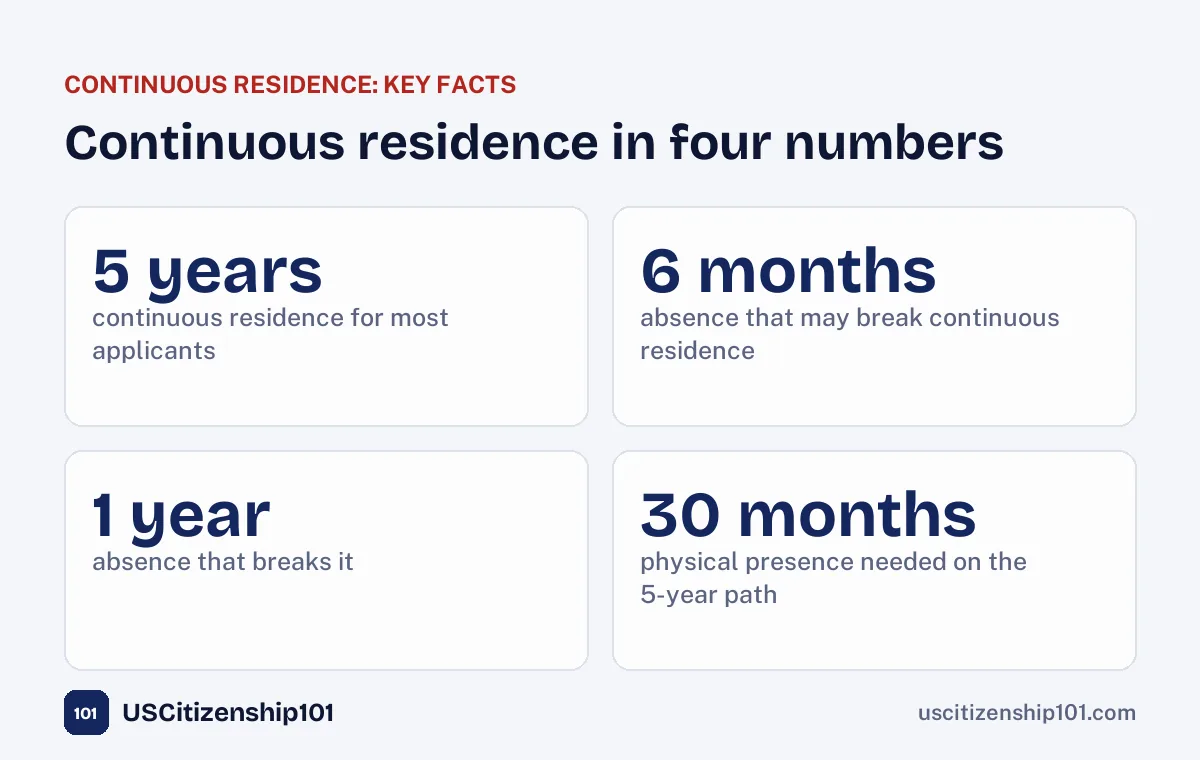
- You need 5 years of continuous residence as a permanent resident (3 years if married to a U.S. citizen).
- An absence of more than 6 months but less than 1 year is presumed to break continuous residence, unless you prove otherwise.
- An absence of 1 year or more breaks continuous residence.
- Physical presence is separate: you must be in the U.S. for at least half the period (30 or 18 months).
- You must also live in your state or USCIS district for 3 months before filing.
What continuous residence means
In simple terms, continuous residence means your permanent home has been in the United States for the whole statutory period, starting from the date you became a permanent resident (the “Resident Since” date on your Green Card). It does not mean you never left. Short trips abroad are normal and do not break continuous residence. What matters is the length of each trip and whether you kept your life centered in the United States.
The time periods
- Standard path: 5 years of continuous residence as a permanent resident.
- Marriage path: 3 years if you have been married to and living with a U.S. citizen for those 3 years, and your spouse has been a citizen for all 3 years.
- After filing: you must continue to reside in the United States from the date you file until you become a citizen.
How trips affect continuous residence
| Length of a single trip | Effect on continuous residence |
|---|---|
| Less than 6 months | Generally does not break continuous residence |
| More than 6 months but less than 1 year | Presumed to break it, but you can rebut the presumption with evidence |
| 1 year or more | Breaks continuous residence (unless an approved N-470 applies) |
Rebutting the presumption for 6 to 12 month trips
If you were away more than 6 months but less than a year, you can show you did not abandon your U.S. residence. Helpful evidence includes proof that during the absence you:
- Did not quit your job in the United States.
- Kept your home, lease, or mortgage, and did not obtain other long-term housing abroad.
- Kept immediate family living in the United States.
- Filed U.S. income tax returns as a resident.
- Kept access to your U.S. home and belongings.

Physical presence: the other requirement
Physical presence is different from continuous residence. It counts the actual days you were inside the United States. You must have been physically present for at least half of the statutory period:
- 30 months (913 days) on the 5-year path.
- 18 months (548 days) on the 3-year path.
You can meet continuous residence and still fail physical presence if you took many shorter trips. For example, ten trips of five months each would not break continuous residence, but they could leave you short of 30 months in the country. Count your days carefully before you file.
The 3-month state or district rule
You must have lived in the state or USCIS district where you file for at least 3 months before filing. Students may sometimes file where they attend school or where their family lives. If you recently moved, wait until you reach 3 months.
If your continuous residence was broken
If a trip of 1 year or more broke your continuous residence, you generally need to build a new period. A widely used rule is that you can file again 4 years and 1 day after returning from the long absence on the 5-year path (because the 90-day early filing window applies to the new 5-year period), or 2 years and 1 day on the 3-year path. The exact date depends on your situation, so check carefully or talk to an attorney.
A very long absence can also raise questions about whether you abandoned your permanent residence altogether. If you were abroad for more than a year without a reentry permit, get legal advice before filing.
Form N-470: preserving residence for work abroad
Some people must work abroad for long periods for the U.S. government, certain American companies or their subsidiaries, qualifying research institutions, certain international organizations, or as religious workers. Form N-470, Application to Preserve Residence for Naturalization Purposes, can protect continuous residence during such an absence. You must usually file it before you have been abroad for 1 year. It does not waive the physical presence requirement for most applicants, so plan carefully.
Reentry permits are different
A reentry permit (Form I-131) helps protect your Green Card during a long trip, so you can return as a permanent resident. It does not preserve continuous residence for naturalization. Many people confuse the two.
Five examples
These illustrations show how the rules apply. Every case is different, so treat them as a guide, not legal advice.
Example 1: Several short trips
Priya took six trips of two to four weeks each over five years. None was longer than six months, so her residence was not interrupted. Her total time abroad was about five months, so she easily meets the 30-month physical presence rule.
Example 2: One eight-month trip
Kwame spent eight months abroad caring for a sick parent. Because the trip was longer than six months, USCIS presumes a break. Kwame kept his apartment, stayed employed on approved leave, filed U.S. taxes, and his wife and children stayed in the U.S. He brings this evidence to his interview to rebut the presumption.
Example 3: A trip longer than a year
Elena lived abroad for 14 months. That absence broke her residence period. She must build a new period after returning, and she also consults a lawyer to confirm she did not abandon her permanent resident status.
Example 4: Many long trips
Jorge took five trips of five months each. No single trip reached six months, but together he was abroad about 25 months of the last five years, leaving him with less than the 30 months of physical presence required. He must wait until his days inside the country add up.
Example 5: A work assignment abroad
Mei was sent abroad for two years by a U.S. company. Before she had been away a year, she filed Form N-470, which was approved. Her residence period is preserved, but she still needs to meet physical presence when she applies.
How to count physical presence days
- Write down the statutory period: the 5 years (or 3 years) before your planned filing date.
- List every trip abroad during that period with departure and return dates.
- Count the days of each trip. Days of departure and return are generally counted as days in the United States.
- Add up all days abroad and subtract from the total days in the period.
- Confirm the result is at least 913 days (5-year path) or 548 days (3-year path).
A simple spreadsheet makes this easy, and it gives you a ready list for your N-400.
Evidence of ties to the United States
| Type of evidence | Examples |
|---|---|
| Employment | Letter from employer confirming leave and continued employment; pay stubs |
| Home | Lease, mortgage statements, property tax records, utility bills |
| Taxes | IRS tax transcripts showing you filed as a U.S. resident |
| Family | Proof that your spouse and children lived in the U.S. |
| Finances | U.S. bank statements, credit cards, car registration |
| Reason for trip | Medical records of a relative, a death certificate, or employer assignment letter |

Special situations
Commuters from Canada or Mexico
Some permanent residents live across the border and commute to work in the United States. People in this “commuter” status generally cannot count that time as residence until they actually move to the United States.
Students
Students may be able to file where they attend school or where their family lives if they are financially dependent on their parents. Check the instructions for your situation.
Military members
Members of the U.S. armed forces have special rules that can reduce or remove the residence requirements, including for time served abroad.
Spouses of citizens working abroad
Some spouses of U.S. citizens employed abroad by certain employers can naturalize without meeting the usual residence period. See citizenship through marriage.
What the officer asks about trips
At your interview, the officer reviews your travel list and may ask:
- How many trips have you taken since becoming a permanent resident?
- What was the longest trip, and why did you go?
- Did you keep your job and home during that trip?
- Did you file U.S. taxes those years?
- Did you work or live abroad?
Short, honest answers and supporting documents make these questions easy. See citizenship interview questions.
Reentry permit vs. Form N-470
| Reentry permit (I-131) | Form N-470 | |
|---|---|---|
| Purpose | Protects your Green Card during a long trip | Protects residence for naturalization during qualifying work abroad |
| Who can use it | Most permanent residents | Only people working abroad for qualifying employers |
| When to file | Before you leave | Before you have been abroad 1 year |
| Waives physical presence? | No | Generally no |
Planning trips while you wait to apply
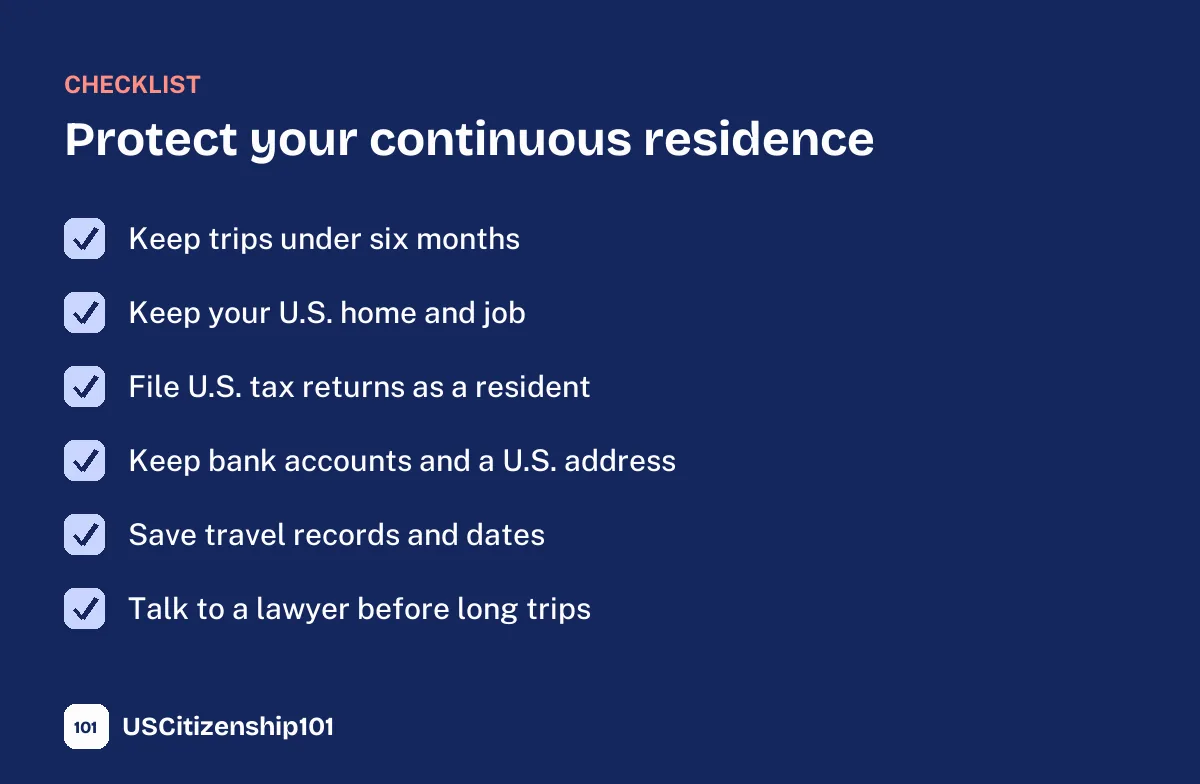
- Keep each trip well under six months.
- Track your total days abroad so you stay above the physical presence minimum.
- Keep your U.S. job, home, bank accounts, and car registration active.
- File U.S. tax returns as a resident every year.
- If a family emergency requires a long stay abroad, gather evidence of the reason and of your U.S. ties while you are away.
- Before any trip that could last six months or more, talk to an immigration attorney.
Example of the 4 years and 1 day rule
Suppose Ahmed returned to the United States on March 1, 2024, after a trip of 13 months that broke his residence period. On the 5-year path, he would start counting a new five-year period from his return. Because USCIS allows filing up to 90 days before meeting the requirement, many practitioners advise that he could file on or after March 2, 2028, which is 4 years and 1 day after his return. He should double-check the date with an attorney, because the right date can depend on his exact circumstances.
Common mistakes
- Confusing residence with presence: meeting one rule does not mean you meet the other.
- Forgetting short trips: every trip over 24 hours must be listed.
- Relying on a reentry permit: it protects your Green Card, not your naturalization timeline.
- Filing too early: after a long trip, count the new period carefully.
- No evidence for a long trip: without proof of ties, the officer may find a break.
How the officer decides
For trips between six months and a year, the officer weighs all the evidence. There is no single document that guarantees a result. The officer looks at the overall picture: why you left, how long you stayed, whether you kept your job, home, and family in the United States, whether you filed taxes as a resident, and whether you intended to return all along. Clear, organized evidence makes it easier for the officer to see that your life stayed rooted in the United States.
If the officer decides your residence was broken, your application may be denied, but you can usually apply again once you build a new period. A denial on this basis does not by itself take away your Green Card.
Documents to bring if you traveled a lot
- All passports, current and expired, covering the statutory period.
- Your list of trips with exact dates.
- IRS tax transcripts for each year of the period.
- Employer letters for long trips, confirming leave or remote work arrangements.
- Lease or mortgage records showing you kept your home.
- Evidence of the reason for any long trip, such as medical records.
Continuous residence after you file
The requirement does not stop when you submit your application. You must continue to reside in the United States from the date you file until the day you take the oath. In practice, this means avoiding long trips while your case is pending. If you travel, keep the trip short, bring your Green Card, keep your address updated, and make sure you can return in time for your biometrics appointment, interview, and ceremony. Report any trips taken after filing to the officer at your interview and on Form N-445 before the oath.
If an emergency requires you to be abroad for a long time after filing, contact an immigration attorney as soon as possible, because the rules about maintaining residence apply all the way to the ceremony.
How to list trips on your N-400
List every trip outside the United States that lasted more than 24 hours during the statutory period, with exact dates. Use your passport stamps, airline records, and calendars. Officers can compare your list with travel records, so accuracy matters. See how to fill out Form N-400.
Frequently asked questions
Does a trip of exactly 6 months break continuous residence?
The presumption applies to absences of more than 6 months. If you are close to that length, bring evidence of your ties to the United States anyway.
Can I travel after I file?
Yes, but you must maintain residence until you naturalize. Avoid long trips, plan around appointments, and make sure USCIS can reach you by mail and through your online account while you are away.
Does working remotely for a U.S. company from abroad protect me?
It can be helpful evidence of ties for a trip under a year, but it does not automatically preserve residence. Only an approved N-470 does that, and only for qualifying employers.
Does time before I got my Green Card count?
No. The period starts from your date of permanent residence, except in special cases such as some refugees and asylees whose residence date is rolled back.
What if I lost my passport and do not know my exact dates?
Reconstruct them as best you can from airline records, emails, and calendars. You can also request your travel history from government records. Note on your N-400 that dates are approximate.
Do short trips add up?
For continuous residence, each trip is judged on its own. For physical presence, all days abroad add up.
Final thoughts
Continuous residence protects the idea that citizenship is for people whose lives are rooted in the United States. Keep trips short, keep your home, job, and taxes in the U.S., count your days of physical presence, and get advice before any trip longer than six months.
Sources: USCIS Policy Manual, Volume 12, Part D (Continuous Residence and Physical Presence); USCIS Form N-470 and N-400 instructions. Last reviewed September 2026. General information, not legal advice.
Free tools
This article is for general education, not legal advice. Always confirm requirements at uscis.gov.