The N-400 Yes or No Questions, Explained in Plain English
Part 9 of the N-400 is a long list of yes or no questions, and the officer reviews them with you at the interview. Here is what they mean, the hard words, and how to answer.
On this page
At your citizenship interview, the officer goes through your Form N-400 with you. The longest part is a list of yes or no questions in Part 9, “Additional Information About You.” These questions ask about voting, taxes, crimes, military service, group memberships, and your willingness to take the Oath of Allegiance. Many applicants find them stressful, not because the honest answer is hard, but because the questions use long, formal English.
This guide explains the N-400 yes or no questions in plain English, group by group. It lists the hard words and what they mean, shows how the officer usually asks them, and explains what to do if your honest answer is yes. It is based on the current edition of Form N-400 (edition 01/20/25).
Key points about the N-400 yes or no questions
- The yes or no questions are in Part 9 of Form N-400, “Additional Information About You.”
- When a question says EVER, it means anywhere in the world, at any time in your life.
- Every Yes answer to most questions needs an explanation in Part 14, and often documents.
- At the interview, the officer reviews the questions with you, and your understanding is part of the English speaking test.
- Honesty matters most. A truthful Yes with an explanation is far better than a false No.

How the officer uses the yes or no questions
After you take an oath to tell the truth, the officer reviews your N-400. When they reach Part 9, they usually read some or all of the yes or no questions to you, one by one, and ask you to confirm your answer. Some officers read each question in full. Others use simpler words, such as “Have you ever been arrested?” The officer may also ask what a word means, for example, “What does ‘claim’ mean?” to check that you understand.
Reviewing the yes or no questions does two things at once. It confirms the facts in your application, and it tests your English speaking and listening. If you do not understand a question, say so: “I’m sorry, I don’t understand. Could you please say it another way?” Officers can rephrase questions, and asking for clarification is much better than guessing.
What “EVER” means
The N-400 explains that when a question includes the word EVER, you must tell about any actions or conduct that happened anywhere in the world, at any time, unless the question says otherwise. That includes things that happened before you came to the United States, when you were young, or a long time ago. Keep this in mind for all the yes or no questions that use the word.
The yes or no questions, group by group
1. Voting and claiming citizenship
These questions ask whether you have ever claimed to be a U.S. citizen, in writing or any other way, and whether you have ever registered to vote or voted in a federal, state, or local election in the United States. The form notes that if you lawfully voted only in a local election where noncitizens are allowed to vote, you may answer No. Checking the “citizen” box on a job form or voter registration form can count as a claim. Once you are a citizen, you can register freely. See our guide on how to register to vote after naturalization.
2. Taxes
These yes or no questions ask whether you currently owe overdue federal, state, or local taxes, and whether, since becoming a permanent resident, you called yourself a “nonresident alien” on a tax return or did not file because you considered yourself a nonresident. If you owe taxes and have a payment plan, that can be explained.
3. Groups and political organizations
These questions ask whether you have ever been a member of, involved in, or associated with a Communist or totalitarian party, or with a group that supported overthrowing the government by force, opposing all government, killing government officials, destroying property, or sabotage.
4. Violence, weapons, and armed groups
A long set of questions asks about serious acts: using weapons or explosives to harm people, kidnapping, hijacking, torture, genocide, killing, sexual contact without consent, severely injuring someone, not letting someone practice their religion, and harming people because of race, religion, nationality, social group, or political opinion. Others ask whether you served in a military, police, or armed group, worked in a prison or detention place, received weapons training, sold or transported weapons, or used or recruited children under 15 in an armed group.
Some of these questions can apply to ordinary situations. If you did required military service in your home country, the honest answer to the military unit question is Yes, with an explanation of the country, unit, rank, and dates. That is common and is not, by itself, a problem.

5. Crimes and offenses
These yes or no questions ask whether you have ever committed a crime or offense you were not arrested for, and whether you have ever been arrested, cited, detained, or charged by any law enforcement, military, or immigration official. If you answer Yes, you list each incident in a table. The form is very clear: you must include incidents even if records were sealed, expunged, or cleared, and even if a judge, officer, or attorney told you that you did not need to disclose them. A follow-up question asks whether you completed any probation, parole, or suspended sentence.
6. Other moral character questions
These ask whether you have ever been involved in prostitution, drug trafficking, marrying someone to get an immigration benefit, being married to more than one person at the same time, helping someone enter the United States illegally, illegal gambling, failing to pay child support or alimony, or making a misrepresentation to get a public benefit. Read our guide to good moral character.
7. Immigration history
These questions ask whether you have ever given U.S. officials false or misleading information, lied to get into the United States or get an immigration benefit, been removed or deported, or been placed in removal, rescission, or deportation proceedings.
8. Selective Service and military
Men who lived in the United States between their 18th and 26th birthdays, other than as lawful nonimmigrants, are asked whether they registered with the Selective Service, and to give their registration number and date. Other questions ask whether you left the country to avoid the draft, applied for an exemption from military service, served in the U.S. armed forces, and, if so, about deployment, discharge, and desertion.
9. Titles of nobility and the Oath of Allegiance
The last yes or no questions ask whether you have a hereditary title or order of nobility and are willing to give it up, whether you support the Constitution and form of government of the United States, whether you understand the full Oath of Allegiance, whether you are unable to take the oath because of a disability, whether you are willing to take the full oath, and whether, if the law requires it, you are willing to bear arms, perform noncombatant service, or do work of national importance under civilian direction.
Most applicants answer Yes to the oath questions. If your religious beliefs prevent you from bearing arms or doing noncombatant service, you may qualify for a modified oath. Explain your beliefs honestly instead of answering Yes when it is not true.
Hard words in the yes or no questions
| Word | Simple meaning |
|---|---|
| Claim | To say something is true about you |
| Overdue | Late; should have been paid already |
| Totalitarian | A government with total control and no freedom |
| Sabotage | Destroying something on purpose to cause harm |
| Genocide | Killing a whole group of people because of who they are |
| Torture | Causing extreme pain to someone on purpose |
| Detained | Held by police or officials; not free to leave |
| Paramilitary | An armed group that acts like an army but is not the official army |
| Controlled substances | Illegal or restricted drugs |
| Smuggle | To bring something or someone in secretly and illegally |
| Alimony | Money a court orders you to pay a former spouse |
| Misrepresentation | Giving false information |
| Deported / removed | Forced to leave the country by the government |
| Desert | To leave the military without permission |
| Bear arms | To carry weapons, for example in the military |
| Noncombatant | Military service that does not involve fighting |
| Allegiance | Loyalty to a country |
Officers often ask about the meaning of words like “claim,” “totalitarian,” and “oath.” Practice explaining each word in one short sentence.
How to answer the yes or no questions
Listen to each of the yes or no questions to the end before you answer. Then answer clearly with a full short sentence. Full sentences show your English and reduce misunderstandings:
- “Have you ever been arrested?” “No, I have not.”
- “Do you owe any overdue taxes?” “No, I do not.”
- “Are you willing to take the full Oath of Allegiance?” “Yes, I am.”
- “Do you support the Constitution?” “Yes, I do.”
Notice that many of the yes or no questions are negative in meaning, and the expected answer for most applicants is No, while the oath questions near the end are usually Yes. Pay attention to the change so you do not answer out of habit.
If your honest answer is Yes
- Answer Yes truthfully. A Yes is not an automatic denial. Many applicants with Yes answers are approved.
- Explain briefly and calmly. Say what happened, when, where, and the result.
- Bring documents. For arrests and citations, bring certified court records and proof of the final result. See our checklist of citizenship interview documents.
- Be consistent. Your explanation should match your N-400 and your documents.
- Get legal advice. For any arrest, conviction, immigration violation, or tax problem, talk to an immigration attorney before your interview.
If you made a mistake on your N-400
If you realize that you answered one of the yes or no questions incorrectly, tell the officer at the beginning of the interview, when they ask whether anything has changed. The officer can update your answer and ask follow-up questions. Correcting a mistake yourself shows honesty. Hiding it, or hoping the officer will not notice, can be treated as a misrepresentation, which is much more serious.
Things can also change after you file, for example a new traffic citation or a trip abroad. Tell the officer about any changes since you filed.
Practice the yes or no questions out loud
Reading the yes or no questions silently is not enough. Ask a friend or family member to read your Part 9 questions aloud, quickly and in the formal wording, and answer each one in a full sentence. Then have them ask a few questions in simpler words, the way some officers do. Our free mock interview reads interview questions aloud so you can practice listening and answering, and our list of citizenship interview questions includes the common Part 9 questions.
Practice ten minutes a day for a week or two before your interview. By interview day, the long questions will sound familiar, and you will be able to focus on answering honestly.
A sample exchange
- Officer: “Have you ever claimed to be a U.S. citizen, in writing or any other way?”
- You: “No, I have not.”
- Officer: “What does ‘claim’ mean?”
- You: “To say something is true, like saying I am a citizen.”
- Officer: “Have you ever been arrested, cited, or detained by any law enforcement officer?”
- You: “Yes. I received a speeding ticket in 2021. I paid the fine. I brought the court record.”
Simple, honest answers like these are exactly what officers want to hear.
Yes or no questions with an interpreter
If you qualify for an English exemption because of your age and years as a permanent resident (50/20 or 55/15), or you have an approved disability exception, you may bring an interpreter. The officer still reviews the yes or no questions with you, through the interpreter. Your interpreter should understand the formal words in Part 9, so give them a copy of your N-400 ahead of time and go over the hard words together. Everyone else answers the yes or no questions in English, because this conversation is part of the English speaking test.

A one-week practice plan
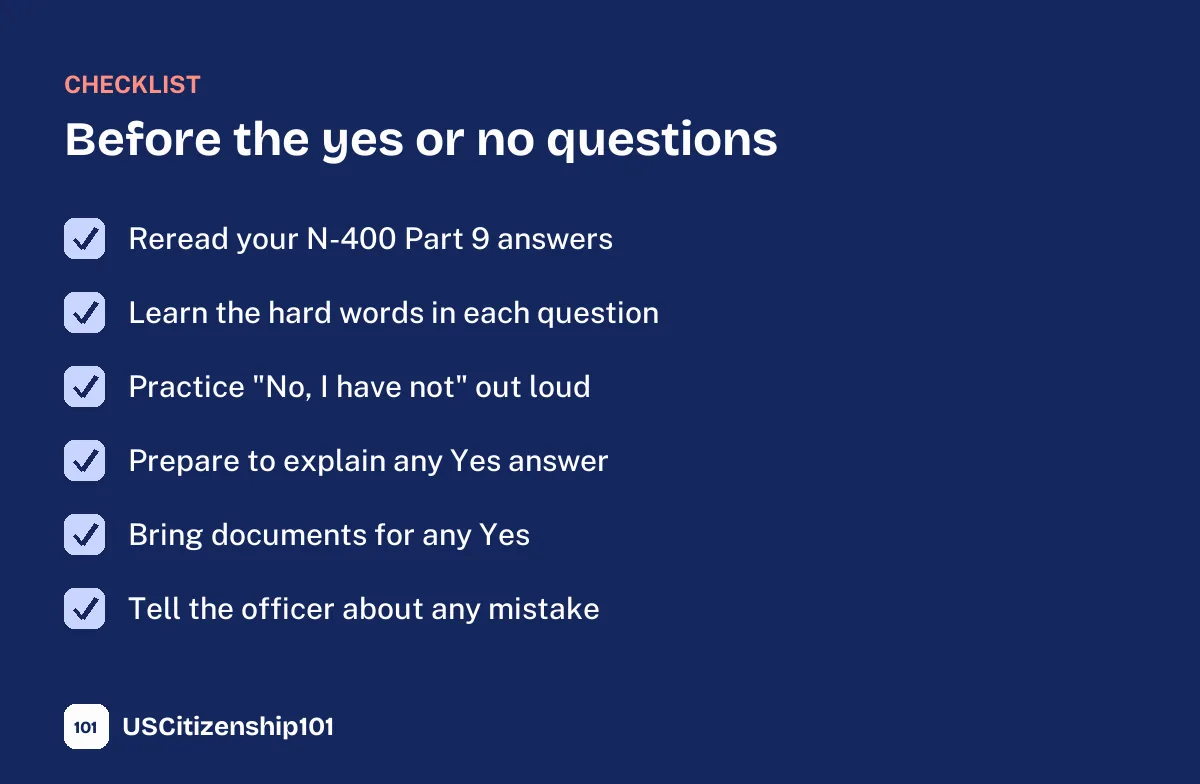
- Day 1: reread every answer in Part 9 of your copy of the N-400.
- Day 2: learn the hard words in the table above, five at a time.
- Day 3: have someone read the yes or no questions to you in the exact form wording.
- Day 4: practice the same yes or no questions in simpler words, the way some officers ask them.
- Day 5: practice explaining any Yes answer in three or four short sentences.
- Day 6: gather the documents for any Yes answer and put them in your interview folder.
- Day 7: do a full mock interview, from the oath to the yes or no questions to the civics test.
Common mistakes with the yes or no questions
- Answering too fast before the officer finishes the question.
- Answering No out of habit to the oath questions, where the usual answer is Yes.
- Forgetting old or foreign incidents, even though “EVER” includes them.
- Leaving out sealed or expunged records, which the form says you must include.
- Forgetting traffic citations. Citations count as being “cited,” so read the form instructions about which traffic incidents need documents.
- Not asking for clarification when you do not understand a word.
- Giving long stories instead of short, clear explanations.
Frequently asked questions
Will the officer ask all the yes or no questions?
Many officers review most of them, some read every one, and some focus on the key questions. Be ready for all of them.
Does a Yes answer mean I will be denied?
No. Many Yes answers, such as required military service abroad or a minor citation, are explained and do not stop approval. Some serious issues can, so get legal advice if you have any criminal or immigration history.
Do I need to report a traffic ticket?
Citations count, so answer honestly. The N-400 instructions explain which minor traffic incidents do not require documents. Serious incidents, and any involving alcohol or drugs, always do.
What if I do not understand one of the yes or no questions?
Ask the officer to repeat or rephrase it. That is normal and allowed.
Can I bring notes with my answers?
Bring a copy of your N-400 in your folder, but answer from memory when the officer asks. The officer wants to hear that you understand each question, not that you can read an answer.
Are the yes or no questions part of the English test?
Yes, in the sense that your ability to understand and answer questions about your N-400 is how the officer judges your English speaking.
Final thoughts
The N-400 yes or no questions look long and formal, but they become easy once you understand the words and practice answering out loud. Know what “EVER” means, learn the hard vocabulary, answer in short full sentences, and always tell the truth. If any answer is Yes, explain it calmly and bring your documents.
Sources: USCIS, Form N-400 (edition 01/20/25), Part 9; USCIS, Form N-400 Instructions. Last reviewed September 2026.
Free tools
This article is for general education, not legal advice. Always confirm requirements at uscis.gov.