Citizenship Reading Test: What to Expect and How to Practice
You read one sentence out loud, and you get up to three chances. Here is how the citizenship reading test works, the words it uses, and 30 practice sentences.
On this page
The citizenship reading test is one of the three parts of the English test at your naturalization interview, together with speaking and writing. It is short: the officer shows you a sentence and you read it out loud. You get up to three sentences, and you pass when you read one of them correctly. With a little daily practice, almost everyone can pass it on the first try.
This guide explains exactly how the citizenship reading test works, what the officer listens for, the official reading vocabulary, 30 practice sentences, pronunciation tips, and a simple study plan. The English test is the same whether you take the 2025 or the 2008 civics test.
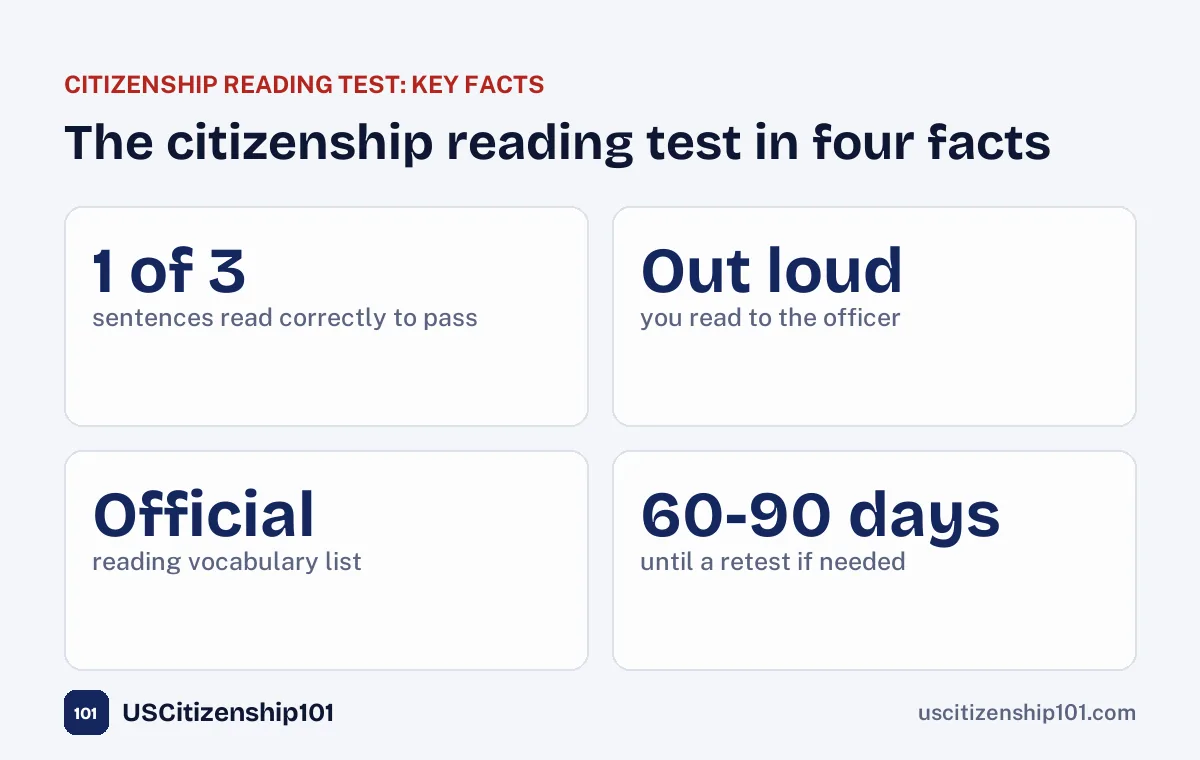
Key points about the citizenship reading test
- You read a sentence out loud, usually shown on a tablet.
- You get up to three sentences and need to read one correctly.
- Sentences use words from the official USCIS reading vocabulary list, and are usually questions.
- An accent is fine. Skipping important words or very long pauses can fail a sentence.
- If you do not pass, you get a retest, usually within 60 to 90 days.
How the citizenship reading test works
The citizenship reading test usually comes near the end of your interview, after the officer reviews your N-400. The officer shows you a sentence, often on a tablet or a card, and asks you to read it out loud. If you read the first sentence correctly, the reading test is over. If not, the officer gives you a second sentence, and then a third if needed.
The sentences are short and simple, and they are usually questions about American history, government, or holidays, such as “Who was the first President?” or “When is Labor Day?” Every word comes from the official reading vocabulary list, so if you know that list, nothing on the citizenship reading test will surprise you.
What counts as passing
You pass a sentence when you read it in a way the officer can understand. The officer looks for three things:
- You read the whole sentence without leaving out or replacing important words.
- Your pronunciation is clear enough that the meaning is understood.
- You read without very long pauses between words.
Small pronunciation differences and an accent do not cause failure. Many successful applicants have strong accents. What can fail a sentence is skipping or changing a content word, such as reading “Who was the second President?” instead of “first,” or stopping for a long time in the middle.
The citizenship reading test vocabulary
USCIS publishes the words used on the citizenship reading test. They fit into a few groups:
- People: Abraham Lincoln, George Washington
- Civics: American flag, Bill of Rights, capital, citizen, city, Congress, country, Father of Our Country, government, President, right, Senators, state/states, White House
- Places: America, United States, U.S.
- Holidays: Presidents’ Day, Memorial Day, Flag Day, Independence Day, Labor Day, Columbus Day, Thanksgiving
- Question words: How, What, When, Where, Who, Why
- Verbs: can, come, do/does, elects, have/has, is/are/was/be, lives/lived, meet, name, pay, vote, want
- Other words: a, for, here, in, of, on, the, to, we, colors, dollar bill, first, largest, many, most, north, one, people, second, south
That is the whole list. Learn to read every word on it, and you are ready for any sentence. Our guide to the USCIS vocabulary list explains each word and includes the writing list too. USCIS can update its lists, so check uscis.gov before your interview.

The hardest words on the citizenship reading test
Most words on the list are short and common. These are the ones people most often find difficult, with a simple way to say each one:
| Word | Say it like | Tip |
|---|---|---|
| Independence | in-dih-PEN-dence | Four parts; stress the third |
| Thanksgiving | thanks-GIV-ing | Start with a soft “th” |
| Government | GUV-ern-ment | The first “o” sounds like “u” |
| Senators | SEN-uh-ters | Say the final “s” |
| President | PREZ-ih-dent | The “s” sounds like “z” |
| Congress | KONG-gress | Two parts only |
| Citizen | SIT-ih-zen | The “c” sounds like “s” |
| Columbus | kuh-LUM-bus | Stress the middle |
| Memorial | meh-MOR-ee-al | Four parts |
| Largest | LAR-jest | The “g” is soft, like “j” |
| Father | FAH-ther | Soft “th” in the middle |
| Where / Why / White | wair / wai / wait | Start with a “w” sound |
Practice these words alone first, then inside the practice sentences. When the hard words feel easy, the whole citizenship reading test feels easy.
30 practice sentences for the citizenship reading test
These sentences use only words from the reading vocabulary list, just like the real citizenship reading test. Read each one out loud, slowly and clearly.
- Who was the first President?
- Who was the second President?
- Who is the Father of Our Country?
- Who was Abraham Lincoln?
- What is the capital of the United States?
- Where is the White House?
- Who lives in the White House?
- Where does the President live?
- Who elects Congress?
- Where does Congress meet?
- How many Senators do we have?
- Who can vote?
- Who can vote for President?
- When do people vote?
- What is the Bill of Rights?
- What is one right in the Bill of Rights?
- What are the colors of the American flag?
- When is Flag Day?
- When is Labor Day?
- When is Memorial Day?
- When is Independence Day?
- When is Columbus Day?
- When is Thanksgiving?
- Why do we have Presidents’ Day?
- What is the largest state?
- What state has the most people?
- What country is north of the United States?
- What country is south of the United States?
- Who is on the dollar bill?
- Why do people come to America?
Once these feel easy, ask someone to mix them up and show you one at a time, the way the officer will. Then time yourself: each sentence should take only a few seconds to read at a calm, natural speed.
Pronunciation tips for the citizenship reading test
- “th” sounds: practice “the,” “Thanksgiving,” “north,” and “south.” Put your tongue lightly between your teeth.
- “v” and “b”: “vote” starts with a “v,” with your top teeth on your lower lip. Do not say “bote.”
- “w” and “wh”: “White House,” “Where,” “Who,” and “Why” start with a soft “w” or “h” sound, not a “g.”
- Long words: break them into parts: In-de-pen-dence, Se-na-tors, Pres-i-dent, gov-ern-ment.
- Endings: say the end of words like “Senators,” “lived,” and “states.” Endings can change the meaning.
- Numbers of syllables: “Congress” has two syllables, “America” has four. Clap them out while you practice.
How to practice every day
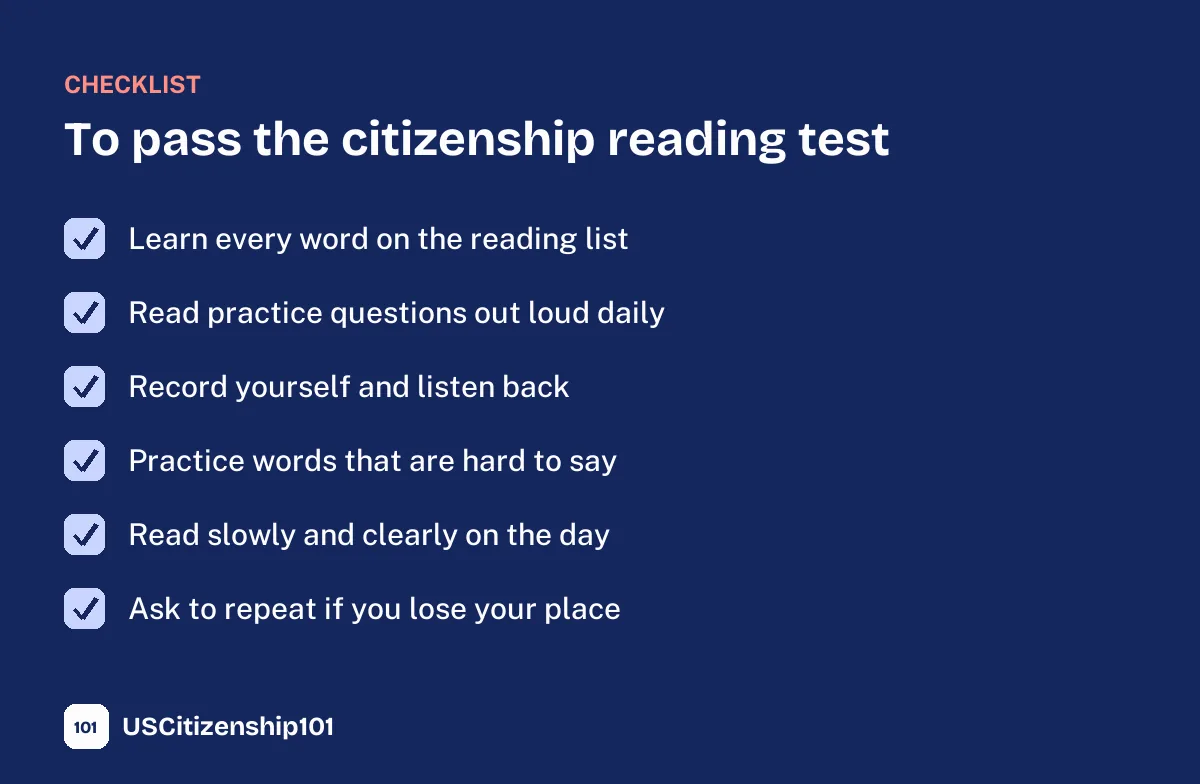
- Read out loud, not silently. The test is spoken.
- Record yourself on your phone and listen. You will hear your own mistakes.
- Use our free English practice page, which shows official-style sentences and lets you listen to how they sound.
- Read the sentence twice in your head before you say it, the way you will at the interview.
- Practice with a partner who shows you random sentences.
- Read simple English every day, such as signs, labels, and children’s books about American history.
Ten minutes a day for three or four weeks is enough for most people to feel confident on the citizenship reading test.
Answers to the practice sentences
You do not answer the question on the citizenship reading test, you only read it. But knowing the answers helps, because they are often the sentences you write on the writing test:
- First President: Washington. Second President: Adams. Father of Our Country: Washington.
- Abraham Lincoln was the President during the Civil War.
- The capital of the United States is Washington, D.C. The President lives in the White House, in Washington, D.C.
- The people elect Congress. Congress meets in Washington, D.C. We have one hundred (100) Senators.
- Citizens can vote for President. People vote in November.
- The Bill of Rights is the first ten amendments. Freedom of speech is one right.
- The American flag is red, white, and blue. Flag Day is in June.
- Labor Day is in September. Memorial Day is in May. Independence Day is in July. Columbus Day is in October. Thanksgiving is in November. Presidents’ Day is in February.
- Alaska is the largest state. California has the most people.
- Canada is north of the United States. Mexico is south of the United States.
- Washington is on the dollar bill. People come to America to be free.
Why there is a citizenship reading test
U.S. immigration law requires most applicants for naturalization to show that they can read, write, and speak basic English. The citizenship reading test is how USCIS checks the reading part. It is designed to be basic on purpose: the goal is everyday English that helps new citizens take part in daily life and civic life, such as reading a ballot, a street sign, or a notice from school.
Practice with your family
Turn practice into a daily routine at home. Write the 30 sentences on cards, and ask a child, spouse, or friend to hold up one card at a time while you read. Switch roles, and let them read while you check. Children who go to school in the United States are often great reading partners. Five minutes after dinner every day is enough to make the citizenship reading test feel routine.
Reading and writing are connected
On the English test, reading sentences are usually questions and writing sentences are usually the answers. You might read “When is Labor Day?” and then write “Labor Day is in September.” Practicing them as pairs helps with both parts at once. Our guide to the citizenship English test covers all three parts together.
What to do on test day
- Take a breath before you start. There is no time limit for one short sentence.
- Look at the whole sentence first, then read it at a normal, steady speed.
- Do not rush. Clear and steady is better than fast.
- If you make a small mistake, you can calmly correct yourself and continue.
- Bring your reading glasses if you use them.
- If you cannot see the sentence well, politely tell the officer.
A sample exchange
- Officer: “Now we will do the reading test. Please read this sentence out loud.”
- You (reading): “Who was the first President?”
- Officer: “Thank you. That’s correct.”
That is the whole citizenship reading test for most people: one sentence, read clearly.
If you do not pass the citizenship reading test
If you cannot read any of the three sentences correctly, you have not failed your case. USCIS schedules a second interview, usually within 60 to 90 days, and you retake only the part you did not pass. Your other results, such as the civics test, still count. Use the time to practice every day. If you do not pass the retest, your application can be denied, so take the second chance seriously. Read more about what happens if you fail the citizenship test.
Study civics and reading at the same time
Many sentences on the citizenship reading test are the same kind of questions you study for the civics test: the first President, the capital, the colors of the flag, the national holidays. When you practice civics, read each question out loud before you answer it. You will prepare for two tests with one habit. Our free civics practice test shows every question in writing, so you can read it aloud first.
If you are new to reading English
Some applicants learned to read in another alphabet, or had little chance to go to school. The citizenship reading test is still very passable, because the word list is short. Start by learning the letters and sounds, then the question words (who, what, when, where, why, how), and then one group of words at a time. Many public libraries, community colleges, and nonprofit organizations offer free citizenship and English classes, and USCIS lists resources on its website. Practicing with a teacher or a class for a few weeks can make a big difference.
Who does not take the citizenship reading test
Some applicants are exempt from the English test, including reading:
- People 50 or older with 20 years as a permanent resident when they file (50/20).
- People 55 or older with 15 years as a permanent resident (55/15).
- People 65 or older with 20 years as a permanent resident, who also get a simplified civics test (65/20).
- People with an approved medical disability exception on Form N-648.
See our guide to citizenship test exemptions for details.
Common mistakes on the citizenship reading test
- Reading silently first for too long, which the officer may count as a long pause.
- Skipping small but important words, like “first” or “second.”
- Guessing a word from the first letter instead of reading it.
- Practicing only by reading silently, never out loud.
- Studying words that are not on the list instead of mastering the official list.
- Getting nervous after one mistake. You have two more chances.
A 3-week plan for the citizenship reading test
- Week 1: learn to read every word on the reading list. Read each group out loud every day.
- Week 2: read the 30 practice sentences out loud every day, and record yourself twice.
- Week 3: have someone show you random sentences. Practice the writing answers too. Do one full mock interview.
Frequently asked questions
How many sentences do I have to read?
You need to read one sentence correctly out of up to three.
Does my accent matter?
No, as long as the officer understands the sentence. An accent is normal and does not cause failure.
Are the sentences the same for the 2025 and 2008 civics tests?
Yes. The citizenship reading test is the same for both civics versions.
What if I read a word wrong?
If it is a small pronunciation difference, it is usually fine. If you change or skip an important word, the officer may give you another sentence.
Can I read the sentence twice?
You can correct yourself calmly. Reading steadily the first time is best, so practice until the sentences feel familiar.
How long does the citizenship reading test take?
Usually less than a minute. Most people read one sentence correctly and the officer moves on to the writing test.
Can I use my finger to follow the words?
Yes. Following the words with your finger is fine and can help you keep your place. What matters is that you read the whole sentence clearly.
What if I am very nervous?
That is normal. Take a slow breath before you start, read at a calm pace, and remember that you have up to three sentences. Officers see nervous applicants every day and give you a moment to begin.
Is the reading test on paper or a tablet?
Often on a tablet, but it can vary by office. Either way, the task is the same: read the sentence out loud.
Final thoughts
The citizenship reading test is short, simple, and very passable. Learn every word on the official reading list, read the practice sentences out loud every day, record yourself, and stay calm on test day. One clear sentence is all you need to pass the citizenship reading test.
Sources: USCIS, Study for the Test (reading vocabulary); USCIS, The Naturalization Interview and Test. Last reviewed September 2026.
Free tools
This article is for general education, not legal advice. Always confirm requirements at uscis.gov.