Citizenship Writing Test: Practice Sentences and Tips That Work
The officer reads a sentence and you write it. You get up to three tries. Here is how the citizenship writing test works, the words it uses, and 30 sentences to practice.
On this page
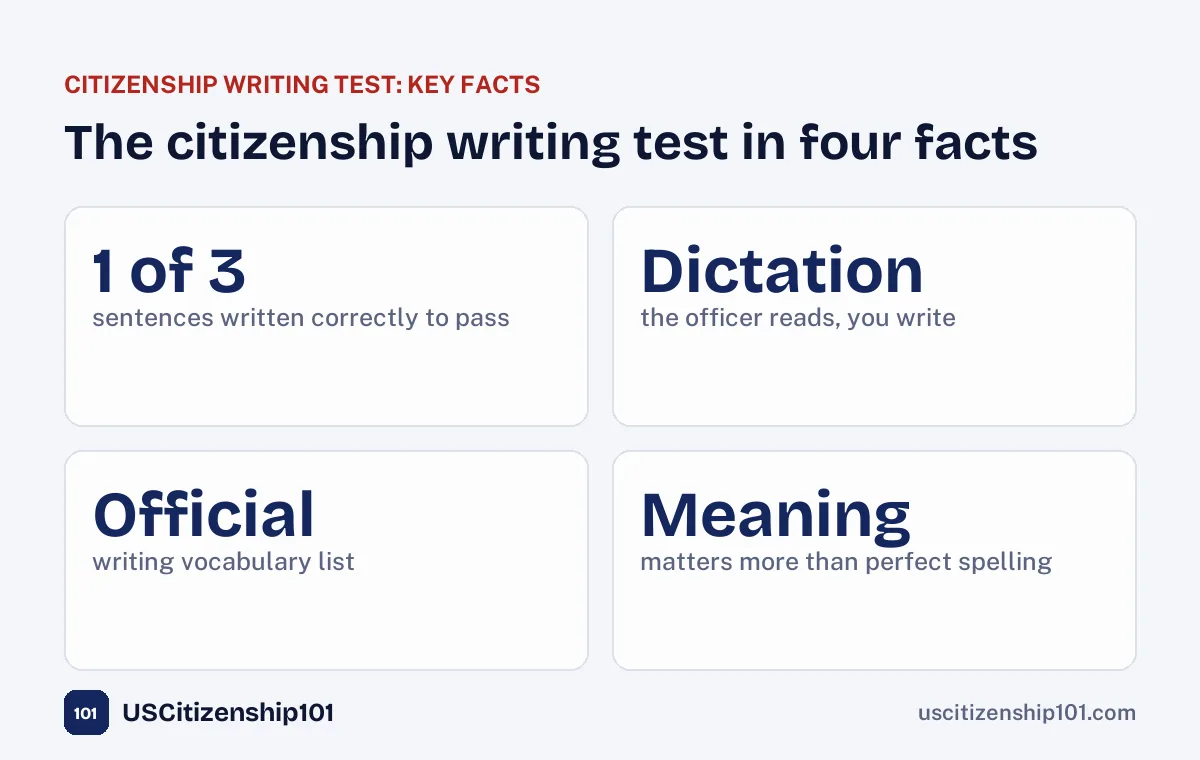
The citizenship writing test is the last short part of the English test at your naturalization interview. The officer reads a sentence out loud and you write it down, usually on a tablet with a stylus. You get up to three sentences, and you pass when you write one of them correctly. The sentences are short statements, such as “Washington was the first President.”
This guide explains how the citizenship writing test works, what the officer looks for, the official writing vocabulary, 30 practice sentences, spelling and capitalization tips, and a simple plan to get ready. The English test is the same whether you take the 2025 or the 2008 civics test.
Key points about the citizenship writing test
- The officer reads a sentence out loud and you write it, often on a tablet.
- You get up to three sentences and need to write one correctly.
- Sentences use words from the official USCIS writing vocabulary list, and are usually statements.
- Small spelling, capitalization, or punctuation mistakes are often accepted if the meaning stays clear.
- Missing or wrong important words, or writing that cannot be read, can fail a sentence.
How the citizenship writing test works
The citizenship writing test usually comes right after the reading test, near the end of your interview. The officer reads one sentence out loud, sometimes twice, and asks you to write it. Many offices use a tablet or electronic pad, and you write with a stylus. If your first sentence is correct, the writing test is over. If not, the officer reads a second sentence, and a third if needed.
The sentences are simple statements about American history, government, geography, and holidays. Every word comes from the official writing vocabulary list, so if you can spell every word on that list, you are ready for any sentence on the citizenship writing test.
What counts as passing
The officer checks whether your written sentence communicates the same meaning as the sentence they read. In practice:
- Accepted: small spelling mistakes that do not change the meaning, missing capital letters, a missing period, and numbers written as words or as digits.
- Not accepted: leaving out an important word, writing a different word that changes the meaning, abbreviating words that should be written in full, or writing that cannot be read.
For example, if the officer reads “Washington was the first President,” writing “washington was the first presidint” will usually pass, because the meaning is clear. Writing “Washington was the President,” without “first,” changes the meaning and will not.
The citizenship writing test vocabulary
USCIS publishes the words used on the citizenship writing test:
- People: Adams, Lincoln, Washington
- Civics: American Indians, capital, citizens, Civil War, Congress, Father of Our Country, flag, free, freedom of speech, President, right, Senators, state/states, White House
- Places: Alaska, California, Canada, Delaware, Mexico, New York City, United States, Washington, Washington, D.C.
- Months: February, May, June, July, September, October, November
- Holidays: Presidents’ Day, Memorial Day, Flag Day, Independence Day, Labor Day, Columbus Day, Thanksgiving
- Verbs: can, come, elect, have/has, is/was/be, lives/lived, meets, pay, vote, want
- Other words: and, during, for, here, in, of, on, the, to, we, blue, dollar bill, fifty/50, first, largest, most, north, one, one hundred/100, people, red, second, south, taxes, white
Our guide to the USCIS vocabulary list explains every word, with the reading list too. USCIS can update its lists, so check uscis.gov before your interview.
30 practice sentences for the citizenship writing test
These sentences use only words from the writing vocabulary list, like the real citizenship writing test. Ask someone to read each one aloud while you write it by hand.
- Washington was the first President.
- Adams was the second President.
- Washington is the Father of Our Country.
- Lincoln was the President during the Civil War.
- Washington, D.C. is the capital of the United States.
- The President lives in the White House.
- The White House is in Washington, D.C.
- Congress meets in Washington, D.C.
- The people elect Congress.
- Citizens elect the President.
- We have one hundred (100) Senators.
- The United States has fifty (50) states.
- Citizens can vote.
- Citizens have the right to vote.
- Freedom of speech is one right.
- People pay taxes.
- People come here to be free.
- People want to be free.
- American Indians lived here first.
- The flag is red, white, and blue.
- Flag Day is in June.
- Presidents’ Day is in February.
- Memorial Day is in May.
- Independence Day is in July.
- Labor Day is in September.
- Columbus Day is in October.
- Thanksgiving is in November.
- Alaska is the largest state.
- California has the most people.
- Canada is north of the United States.
More to practice: “Mexico is south of the United States.” “New York City was the first capital.” “Delaware was the first state.” “Washington is on the dollar bill.”
Spelling tips for the hardest words
| Word | Common mistake | Tip |
|---|---|---|
| February | Febuary | Say “Feb-RU-ary” as you write: there is an “r” after “b” |
| Thanksgiving | Tanksgiving | Starts with “Th”: thanks + giving |
| Independence | Independance | Ends in “-ence” |
| Washington | Wasington | “Wash” + “ing” + “ton” |
| Senators | Senaters | Ends in “-ors” |
| Citizens | Sitizens | Starts with “C,” sounds like “s” |
| Delaware | Delawer | Ends in “-ware,” like “aware” |
| California | Califonia | Do not forget the “r” |
| Columbus | Colombus | “Col-um-bus,” with a “u” |
| Freedom of speech | Fredom of spech | Double “e” in both words |
| Largest | Largets | “Large” + “st” |
| People | Pepole | “Peo” + “ple” |
| During | Durring | Only one “r” |
Words that sound alike
Dictation is tricky when two words sound the same but are spelled differently. On the citizenship writing test, the meaning of the sentence tells you which word to write. Watch for these pairs:
- right / write: “Citizens have the right to vote.” The test word is “right.”
- here / hear: “People come here to be free.” The test word is “here.”
- to / two / too: “People want to be free.” The test word is “to.”
- for / four: “Citizens can vote for the President.” The test word is “for.”
- one / won: “Freedom of speech is one right.” The test word is “one.”
- red / read: “The flag is red, white, and blue.” The test word is “red.”
- blue / blew: the color is always “blue.”
- meets / meats: “Congress meets in Washington, D.C.”
Because every word comes from the official list, the answer is always the word on the list. If you know the list well, the sound-alike words become easy, and you can write each sentence with confidence.
Capitalization and punctuation
Capital letters and periods usually do not decide whether you pass, but writing them correctly makes your sentence clearer, and it is good practice:
- Start every sentence with a capital letter.
- Capitalize names of people and places: Washington, Lincoln, Alaska, Canada.
- Capitalize months and holidays: October, Columbus Day, Thanksgiving.
- Capitalize “President,” “Congress,” and “White House” when they appear in the test sentences.
- End each sentence with a period.
- Write “Washington, D.C.” with a comma and periods.
How to practice dictation
- Find a partner. A friend, spouse, or child reads a sentence at normal speed.
- Listen to the whole sentence before you start writing.
- Write it by hand. The real citizenship writing test is handwritten, often with a stylus.
- Check it together against the correct sentence.
- Write each mistake five times correctly.
- Practice alone with our free English practice page, which reads sentences aloud and checks what you type word by word.
Fifteen minutes a day for three or four weeks is enough for most people to feel confident on the citizenship writing test.
Writing on a tablet
Many offices use an electronic pad instead of paper. Writing with a stylus feels a little different, so practice once or twice with a stylus or even your finger on a phone or tablet. Write a bit larger than usual, leave clear spaces between words, and do not rush. If you make a mistake, ask the officer whether you can clear it and start again.
If you are new to writing in English
Some applicants learned to write in another alphabet, or had little chance to go to school. The citizenship writing test is still very passable, because the list of words is short. Start with the alphabet in print letters, then the short words (the, in, of, is, was), then names and months, then full sentences. Print letters are fine; you do not need to write in cursive. Many libraries, community colleges, and nonprofit organizations offer free citizenship and English classes where a teacher can check your writing each week.
Practice the same small set of sentences many times rather than many different sentences once. Repetition builds confidence, and on the citizenship writing test, confidence helps you write clearly.
Why there is a citizenship writing test
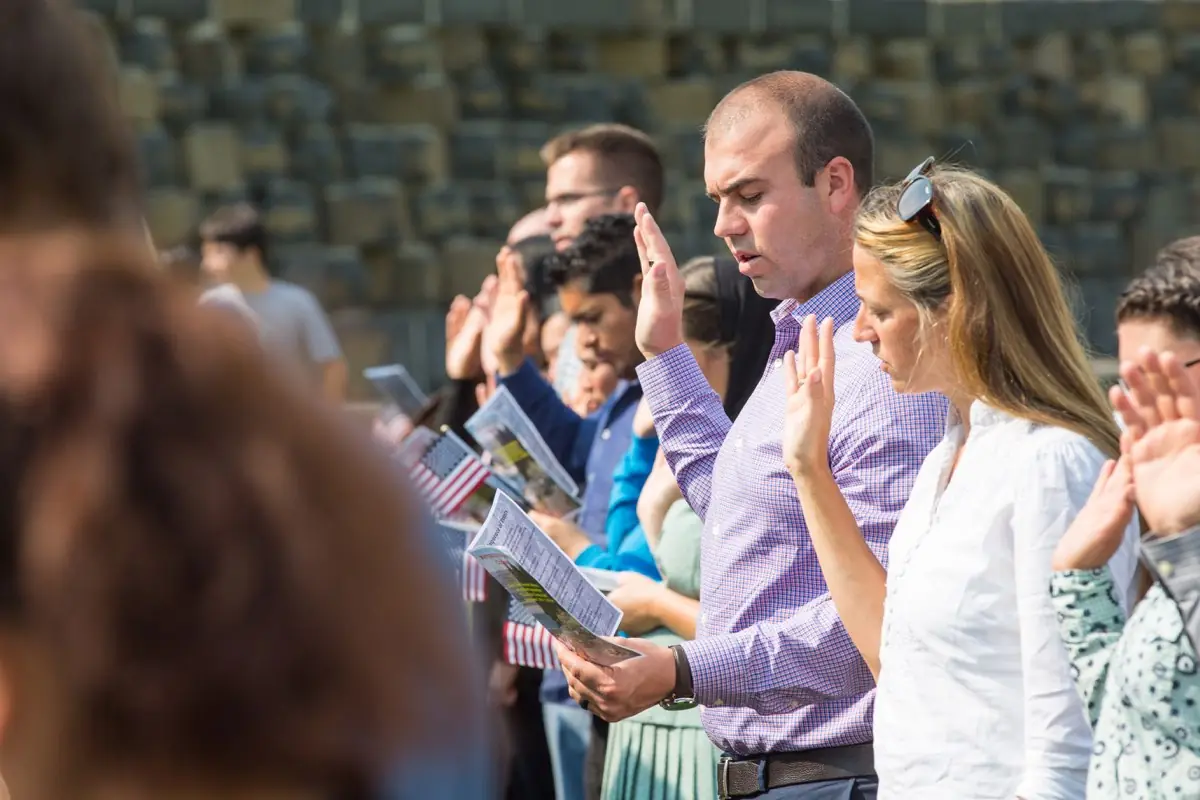
U.S. immigration law requires most applicants for naturalization to show they can read, write, and speak basic English. The citizenship writing test checks the writing part with one short, everyday sentence. The goal is practical English, the kind you need to fill out a simple form, write a note, or take part in civic life.
Practice with your family
Make dictation part of your daily routine. After dinner, ask a family member to read three sentences from the list while you write them in a notebook. Check them together, and circle any mistakes. Children who go to school in the United States are often excellent helpers, because they do dictation in class. Keep the notebook, so you can see your progress over a few weeks.
Reading and writing are connected
Writing sentences are usually the answers to the reading questions. You might read “When is Labor Day?” and write “Labor Day is in September.” Practicing matching pairs is the fastest way to prepare for both. Read our guide to the citizenship reading test, and our overview of the citizenship English test.
Reading and writing pairs
| You might read | You might write |
|---|---|
| Who was the first President? | Washington was the first President. |
| When is Labor Day? | Labor Day is in September. |
| What is the capital of the United States? | Washington, D.C. is the capital of the United States. |
| How many Senators do we have? | We have one hundred (100) Senators. |
| What is the largest state? | Alaska is the largest state. |
| Who lives in the White House? | The President lives in the White House. |
| What are the colors of the American flag? | The flag is red, white, and blue. |
| When is Thanksgiving? | Thanksgiving is in November. |
Listening tips for dictation
The citizenship writing test is also a listening test. Officers speak clearly, but everyone has their own accent and speed. Before your interview, listen to many different English speakers read the practice sentences: family members, videos, and the audio on our English practice page. Focus on the key words first, such as the name, the number, or the month, because those carry the meaning. If you miss a word, it is better to ask the officer to repeat the sentence than to guess.
Study civics and writing together
Many writing sentences are answers to civics questions: the first President, the capital, the number of senators, the national holidays. When you study civics, write the answer as a full sentence once a day. You will prepare for the civics test and the citizenship writing test at the same time.
What to do on test day
- Listen carefully to the whole sentence. If you did not hear it clearly, politely ask the officer to repeat it.
- Write steadily, one word at a time, with clear spaces.
- Read your sentence back in your head before you say you are done.
- Bring your reading glasses if you use them.
- Stay calm after a mistake. You have up to three sentences.
A sample exchange
- Officer: “Now the writing test. Please write this sentence: Columbus Day is in October.”
- You (writing): Columbus Day is in October.
- Officer: “Thank you. That’s correct.”
If you do not pass the citizenship writing test
If you cannot write any of the three sentences correctly, USCIS schedules a second interview, usually within 60 to 90 days, and you retake only the part you did not pass. Use that time for daily dictation practice. If you do not pass the second time, your application can be denied, so take the retest seriously. Read more about what happens if you fail the citizenship test.
Who does not take the citizenship writing test
Applicants who qualify for the 50/20, 55/15, or 65/20 age-based English exemptions, and applicants with an approved disability exception on Form N-648, do not take the English test, including writing. See our guide to citizenship test exemptions.
Common mistakes on the citizenship writing test
- Leaving out small but important words, such as “first” or “most.”
- Writing a similar word, like “Senate” instead of “Senators.”
- Abbreviating, like “Pres.” for “President,” or “Wash.” for “Washington.”
- Writing too small or too fast to be read.
- Practicing only by typing and never by hand.
- Starting to write before the officer finishes the sentence.
A 3-week plan for the citizenship writing test
- Week 1: learn to spell every word on the writing list. Write each group five times.
- Week 2: do daily dictation with the 30 practice sentences.
- Week 3: mix reading and writing pairs, practice on a tablet once, and do one full mock interview.
Frequently asked questions
How many sentences do I have to write?
One correct sentence out of up to three.
Do spelling mistakes fail the citizenship writing test?
Small spelling mistakes are usually accepted if the meaning stays clear. Missing or changed important words are not.
Can I write numbers as digits?
Yes. You can write “100” or “one hundred,” and “50” or “fifty.”
Is the writing test the same for the 2025 and 2008 civics tests?
Yes. The citizenship writing test does not change with the civics version.
Can the officer repeat the sentence?
Yes. It is fine to ask politely: “Could you please repeat the sentence?”
Can I write in cursive?
Yes, if it is clear. Many people find print letters easier to read on a tablet, so print is a safe choice for the citizenship writing test.
How long does the citizenship writing test take?
Usually a minute or two. Most people write one sentence correctly and the test is over.
What if I hear the sentence but forget part of it?
Ask the officer to repeat it. It is better to hear the sentence again than to leave out a word. Many applicants write the key words first in their mind, such as the name and the month, and then write the full sentence.
Do I need perfect handwriting?
No. Your writing only needs to be clear enough to read.
Final thoughts
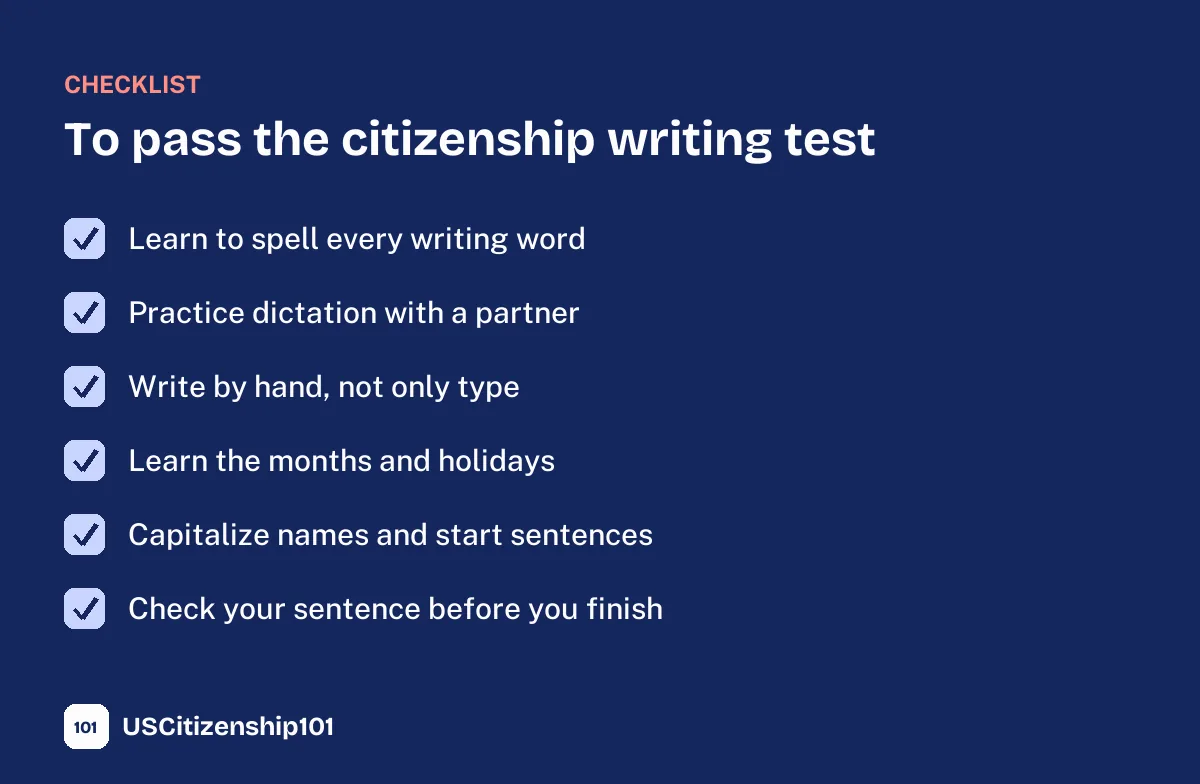
The citizenship writing test takes only a minute or two, and it becomes easy with regular practice. Learn to spell every word on the official writing list, practice dictation by hand every day, pay attention to the hardest words, and stay calm on test day. One clear sentence is all you need to pass the citizenship writing test.
Sources: USCIS, Study for the Test (writing vocabulary); USCIS, The Naturalization Interview and Test. Last reviewed September 2026.
Free tools
This article is for general education, not legal advice. Always confirm requirements at uscis.gov.