Citizenship Interview Questions: 50+ N-400 Questions With Sample Answers
The personal questions the officer asks about your application, section by section, with sample answers and the vocabulary you need to understand.

On this page
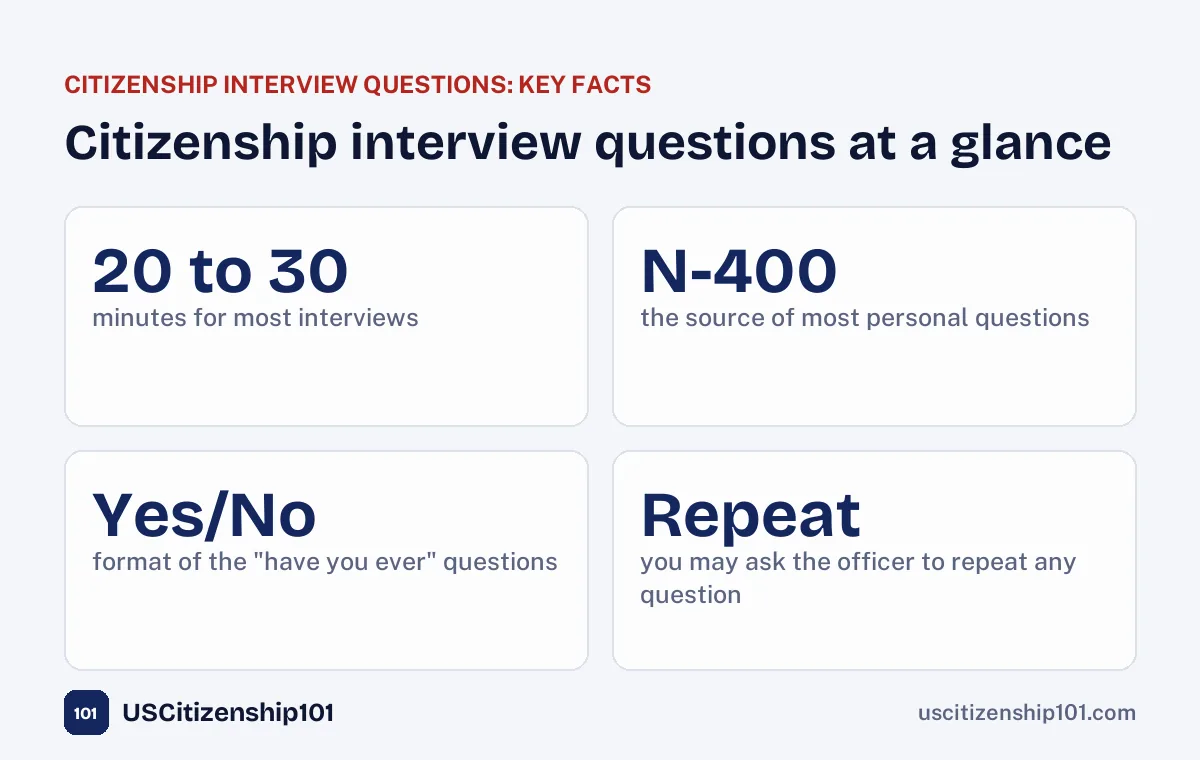
At your naturalization interview, the officer asks two kinds of questions. Some are from the civics test. Most, however, are citizenship interview questions about you and your Form N-400: your name, addresses, work, travel, family, and a long list of “have you ever” questions. These citizenship interview questions check that your application is true and that you understand English well enough to discuss it.
This guide lists more than 50 citizenship interview questions organized like the N-400, with sample answers, tips on answering, and the definitions of difficult words officers often ask about. Practice them out loud, and use your own true information.
Key points about citizenship interview questions
- Most citizenship interview questions come directly from your N-400.
- Answers must be truthful and consistent with your application and documents.
- Short answers are best. Do not add information you were not asked for.
- You may ask the officer to repeat or rephrase any question.
- Officers may ask what certain words mean, to check your English.
How the interview begins
- “Please remain standing and raise your right hand. Do you swear to tell the truth and nothing but the truth?” Yes, I do.
- “Please have a seat. How are you today?” I am fine, thank you.
- “Do you know why you are here today?” Yes, for my citizenship interview.
- “May I see your appointment letter, Green Card, and ID?” Yes, here they are.
These opening citizenship interview questions are also an informal English check. Answer clearly and politely.
Personal information
- What is your full name? My name is [first, middle, last].
- Have you used any other names? Yes, my maiden name was [name]. / No.
- Do you want to change your name? Yes, to [name]. / No.
- What is your date of birth? I was born on [month, day, year].
- Where were you born? I was born in [city, country].
- What is your nationality? I am a citizen of [country].
- When did you become a permanent resident? On [date on your Green Card].
- What is your Social Security number? Say it clearly, or say you have your card with you.
Residence and contact information
- What is your current address? I live at [street, city, state, ZIP code].
- How long have you lived there? Since [month, year].
- Where did you live before that? At [address], from [date] to [date].
- Who do you live with? My wife and two children. / I live alone.
- What is your phone number and email? Give the current ones.
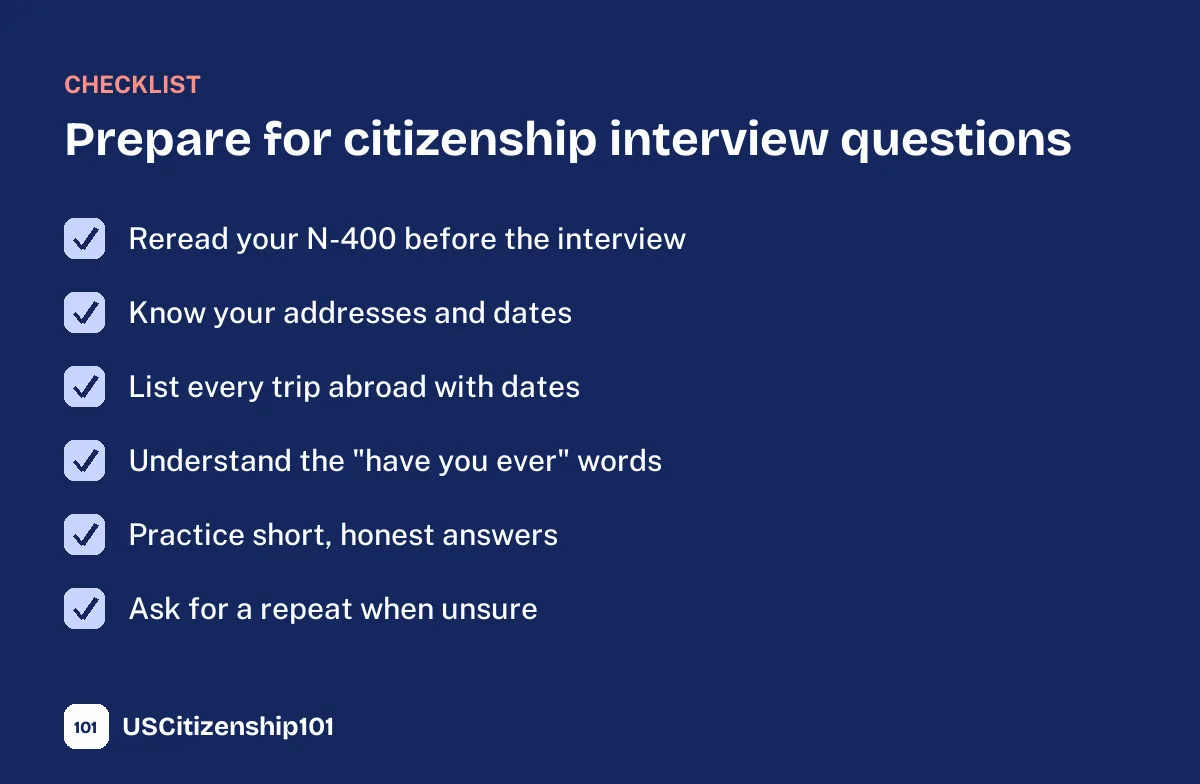
Before your interview, review every address you listed for the last five years (or three, on the marriage path). Dates do not need to be perfect to the day, but they should match your application.
Family and marriage
- What is your marital status? I am married. / single / divorced / widowed.
- What is your spouse’s name? [Name].
- When and where did you get married? On [date], in [city, country].
- Is your spouse a U.S. citizen? Yes, since [date]. / No.
- How many times have you been married? Once. / Twice.
- How many children do you have? [Number]. Their names are [names].
- Where do your children live? With me. / In [country].
If you are applying through marriage to a U.S. citizen, expect extra citizenship interview questions about your life together. See citizenship through marriage.

Employment and school
- Are you working now? Yes. / No, I am retired. / I am a student.
- Where do you work? I work at [employer].
- What do you do there? I am a [job title].
- How long have you worked there? Since [year].
- Where did you work before? At [employer], from [date] to [date].
Time outside the United States
- Have you traveled outside the United States since you became a permanent resident? Yes. / No.
- How many trips have you taken? [Number].
- Where did you go, and for how long? I went to [country] from [date] to [date].
- What was the reason for your longest trip? To visit my family.
- Did you take any trips longer than six months? No. / Yes, [explain].
Travel is one of the most important topics among citizenship interview questions, because long trips can affect continuous residence. Read the continuous residence requirement guide.
The “have you ever” questions
This is the part many applicants find hardest. The officer reviews Part 9 of the N-400 (the eligibility questions), which ask whether you have ever done certain things. Listen carefully. Most honest answers are “No,” but answer truthfully, and if the answer is “Yes,” be ready to explain and show documents.
- Have you ever claimed to be a U.S. citizen? No, I have not.
- Have you ever registered to vote or voted in any U.S. federal, state, or local election? No.
- Do you owe any overdue federal, state, or local taxes? No.
- Have you ever not filed a tax return because you considered yourself a nonresident? No.
- Have you ever been a member of the Communist Party or any totalitarian party? No.
- Have you ever been a member of or associated with a terrorist organization? No.
- Have you ever been arrested, cited, or detained by any law enforcement officer? No. / Yes, [explain and show records].
- Have you ever been a habitual drunkard? No.
- Have you ever sold or smuggled illegal drugs? No.
- Have you ever been married to more than one person at the same time? No.
- Have you ever gambled illegally? No.
- Have you ever failed to support your dependents or pay alimony? No.
- Have you ever lied to a U.S. government official to gain an immigration benefit? No.
- Have you ever been removed or deported from the United States? No.
- If you are a man who lived in the U.S. between ages 18 and 26, did you register for Selective Service? Yes, I did.
Questions about the Constitution and the oath
- Do you support the Constitution and form of government of the United States? Yes, I do.
- Do you understand the full Oath of Allegiance? Yes.
- Are you willing to take the full Oath of Allegiance? Yes, I am.
- If the law requires it, are you willing to bear arms on behalf of the United States? Yes.
- If the law requires it, are you willing to perform noncombatant services? Yes.
- If the law requires it, are you willing to perform work of national importance under civilian direction? Yes.
Citizenship interview questions after the tests
After the English and civics tests, the officer may return to a few citizenship interview questions to finish the review. Common ones include:
- Has anything changed since you filed your application, such as your address, job, or marital status?
- Do you have any new trips outside the United States to add?
- Is all the information on your application still true and correct?
- Will you please sign here to confirm the changes we made today?
Read anything you are asked to sign. If the officer made changes to your N-400 during the interview, you will usually sign to confirm them.
Difficult citizenship interview questions and calm answers
Some citizenship interview questions can feel uncomfortable. Here is how to handle them:
- “Why did you stay abroad so long?” Explain the reason simply and show proof, such as medical records for a sick parent.
- “Why is this date different from your records?” Say it was an honest mistake and give the correct date.
- “Can you explain this arrest?” Describe what happened in one or two sentences and hand over the court records.
- “Why do you want to become a citizen?” A short, sincere reason in your own words, such as wanting to vote.
Staying calm and honest matters far more than having perfect English.
Words officers may ask you to explain
Officers sometimes ask what a word means to confirm you understood the question. Short, simple definitions are enough.
- Arrested: when police take you into custody.
- Citation: a ticket from police, for example for speeding.
- Habitual drunkard: a person who drinks too much alcohol all the time.
- Totalitarian party: a political party that wants complete control of the government and people.
- Terrorist: a person who uses violence to scare people for political reasons.
- Smuggle: to bring something into a country secretly and illegally.
- Allegiance: loyalty.
- Oath: a serious promise.
- Bear arms: to carry weapons, to fight for the country.
- Noncombatant: a person in the military who does not fight, such as a medic.
- Constitution: the supreme law of the land.
A sample interview dialogue
Here is how part of a typical interview might sound. Your own citizenship interview questions will follow your application.
- Officer: Good morning. Please raise your right hand. Do you swear that everything you say today will be the truth?
- You: Yes, I do.
- Officer: Please sit down. What is your current address?
- You: I live at 42 Oak Street, Denver, Colorado, 80203.
- Officer: How long have you lived there?
- You: Since June 2021.
- Officer: I see you traveled to Mexico in 2024. How long was that trip?
- You: Three weeks, to visit my mother.
- Officer: Have you ever been arrested or cited by the police?
- You: I got one speeding ticket in 2022. I paid it. Here is the receipt.
- Officer: Thank you. What does “citation” mean?
- You: A ticket from the police.
- Officer: Good. Are you willing to take the full Oath of Allegiance?
- You: Yes, I am.
Notice the pattern: short, direct answers, with documents offered when relevant.
Follow-up citizenship interview questions about arrests and citations
If you answered “Yes” to any question about arrests, citations, or charges, the officer will ask follow-up citizenship interview questions such as:
- When and where did this happen?
- What were you arrested or cited for?
- What happened with the case? Was it dismissed, or were you convicted?
- Did you pay the fine or complete the sentence?
- Do you have the court records with you?
Bring certified court dispositions for every incident, even minor ones. Traffic tickets under a certain amount without an arrest may not require records, but bringing proof of payment is never a mistake. For serious incidents, speak with an immigration attorney before your interview.
Citizenship interview questions for marriage-based applicants
If you are applying after 3 years of marriage to a U.S. citizen, the officer checks that you are still married and living together. Expect citizenship interview questions like:
- When did your spouse become a U.S. citizen?
- Do you and your spouse live together? Since when?
- Do you have joint bank accounts, a lease, or a mortgage together?
- Do you file taxes jointly?
- Have either of you been married before?
Bring evidence of your shared life, such as joint tax transcripts, bank statements, and a lease or deed.
Questions about taxes and Selective Service
Taxes and Selective Service are part of good moral character, so they appear among the citizenship interview questions. The officer may ask whether you filed tax returns every year, whether you owe taxes, and, for men, whether you registered for Selective Service between ages 18 and 26. If you owe taxes, bring a payment plan agreement from the IRS. If you did not register for Selective Service, bring a status information letter and be ready to explain why. See our guide to good moral character.
How officers check your English
Unless you qualify for an exception, your ability to understand and answer citizenship interview questions in English is your speaking test. The officer is not grading grammar. They are checking whether you understand the questions and can respond in a way they understand. Simple, complete sentences are perfect. If you need a question repeated, that is normal and does not mean you failed the speaking part.
A 7-day practice routine
- Day 1: reread your entire N-400 copy and mark any mistakes or changes.
- Day 2: practice personal information and address questions out loud.
- Day 3: practice family, marriage, and work questions.
- Day 4: list every trip abroad with dates and practice the travel questions.
- Day 5: practice all the “have you ever” questions and the word definitions.
- Day 6: do a full mock interview with a friend, including civics and English.
- Day 7: gather documents and rest.
Repeat the routine in the week before your interview, and the citizenship interview questions will feel familiar.
Tips for answering citizenship interview questions
- Tell the truth. Honesty matters more than a perfect answer.
- Keep answers short. Answer the question asked, then stop.
- Listen for the key words. “Ever,” “since,” and “in the last five years” change the meaning.
- Ask for a repeat. “Could you please repeat the question?” or “Could you say it another way?” is always fine.
- Bring documents. If your answer is “Yes” to a sensitive question, show the records.
- Correct yourself. If you realize you gave a wrong answer, tell the officer right away.
Practice with our mock interview, which reads citizenship interview questions aloud, and read citizenship interview tips for more strategies.

Frequently asked questions
Will the officer ask every question on the N-400?
Not always. Officers often review key parts and may ask only some of the citizenship interview questions, especially if your application is clear.
Are citizenship interview questions the same for everyone?
The topics are the same because they follow the N-400, but the officer adapts the citizenship interview questions to your application and history.
What if I do not remember an exact date?
Give the best answer you can, such as the month and year, and say it is approximate. Bring documents that show dates if possible.
Can my lawyer attend the interview?
Yes. An attorney or accredited representative may attend with you if they have filed Form G-28. They can observe and help clarify, but you must answer the questions yourself.
Can I bring notes into the interview?
You can bring documents. Reading prepared answers is not appropriate, but you can refer to your records, such as a list of travel dates, if the officer allows.
How long does the question part take?
The review of your application usually takes 10 to 20 minutes of the interview. Simple cases move quickly; cases with travel or arrest history take longer.
What if I answered a question wrong on my N-400?
Tell the officer at the interview. Officers can correct many mistakes on the form during the interview.
What to bring to answer these questions well
- A copy of the N-400 you submitted.
- A list of your trips abroad with exact dates, or your passports with stamps.
- Certified court records for any arrest, citation, or charge.
- Marriage and divorce certificates, if they apply to you.
- IRS tax transcripts if you owed taxes or filed late.
- Your Selective Service registration proof, if applicable.
Having these documents ready lets you answer difficult citizenship interview questions quickly and confidently.
Final thoughts
Citizenship interview questions are about your own life, which means you already know the answers. What you need is practice saying them clearly in English and understanding the key words. Reread your N-400, practice these questions out loud, and answer honestly. That is the formula for a smooth interview.
Sources: USCIS Form N-400 (edition 01/20/25) and instructions; USCIS, The Naturalization Interview and Test. Last reviewed September 2026. General information, not legal advice.
Free tools
This article is for general education, not legal advice. Always confirm requirements at uscis.gov.