Form N-648: The Medical Disability Exception for the Citizenship Test
If a disability prevents you from learning English or civics, a doctor can certify it on Form N-648. Here is who qualifies and how to make the form strong.
On this page
Form N-648, Medical Certification for Disability Exceptions, lets applicants with a qualifying physical or developmental disability or mental impairment ask to be excused from the English test, the civics test, or both. It is completed by a licensed medical professional who explains how your condition prevents you from learning or demonstrating knowledge of English or U.S. history and government.
This guide explains who may qualify for the exception, who can complete Form N-648, what a strong certification includes, how the officer reviews it, and what to do if it is not accepted.
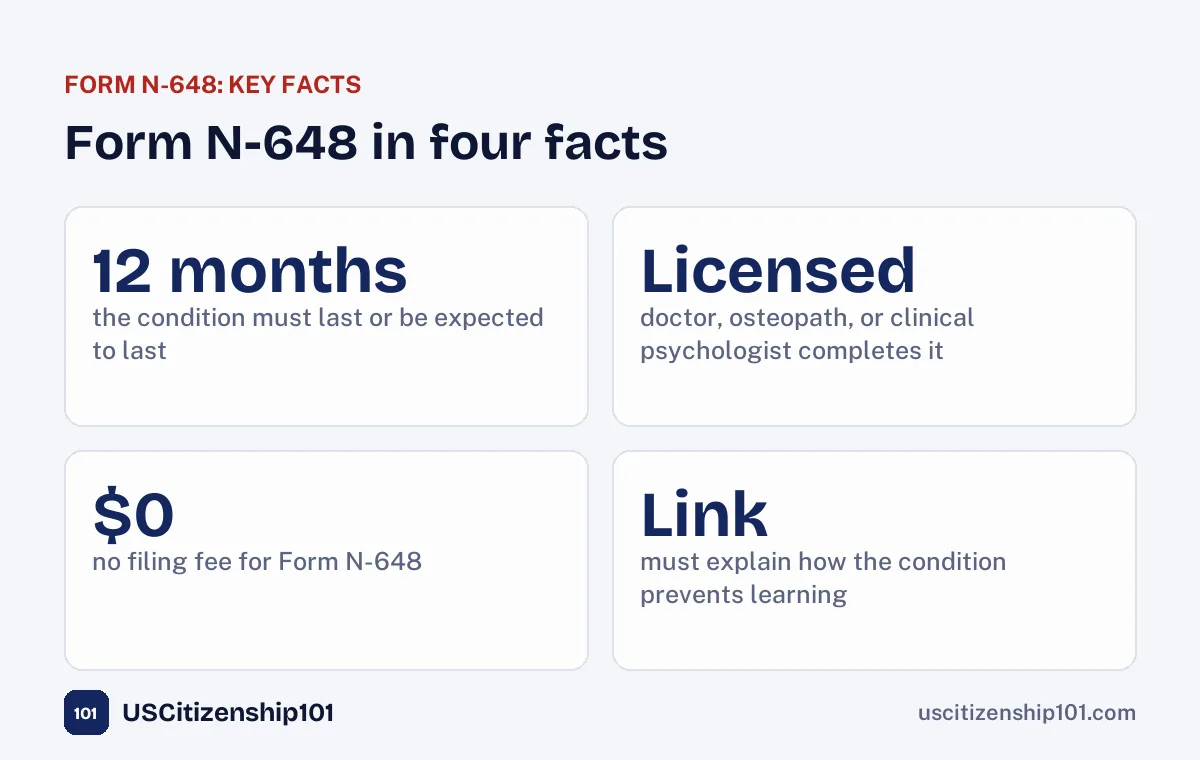
Key points about Form N-648
- Form N-648 requests an exception to the English and/or civics requirement.
- A licensed medical doctor, doctor of osteopathy, or licensed clinical psychologist must complete it.
- The condition must have lasted, or be expected to last, at least 12 months.
- The form must explain the link between the condition and the inability to learn or show knowledge.
- There is no separate fee for Form N-648.
Who may qualify
The exception is for people whose physical or developmental disability, or mental impairment, prevents them from meeting the English or civics requirements even with reasonable effort. Examples may include serious cognitive impairments, dementia, some developmental disabilities, severe stroke effects, and certain psychiatric conditions. What matters is not only the diagnosis, but how it affects your ability to learn and remember.
Conditions caused by illegal drug use do not qualify. Low literacy or limited education alone is not a disability for this purpose, and neither is simple difficulty with English as a second language. Those applicants may benefit from classes and more study time instead.
Who can complete Form N-648
- A licensed medical doctor (M.D.).
- A licensed doctor of osteopathy (D.O.).
- A licensed clinical psychologist.
The professional must be licensed in the United States, and should know your condition well, ideally as your treating provider. They complete the form based on an in-person examination. A specialist, such as a neurologist or psychiatrist, can often give the most detailed explanation, but a primary care doctor who knows your history well can also complete it.
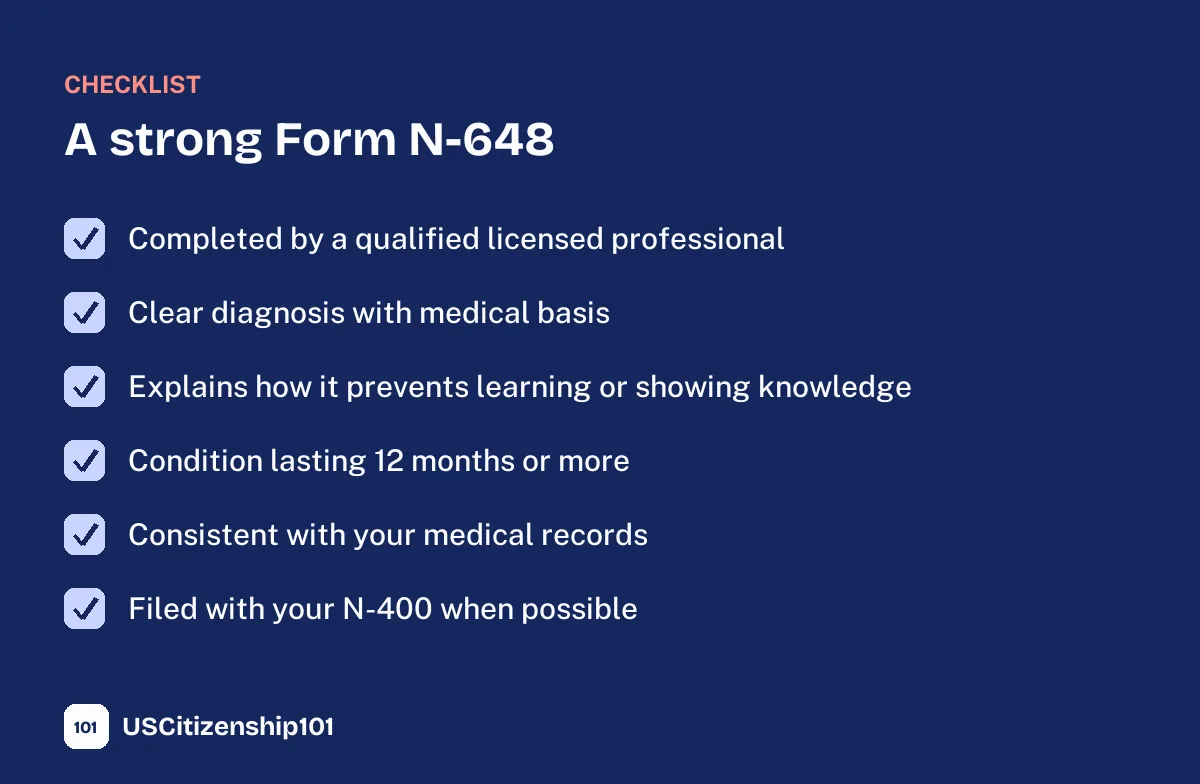
What a strong certification includes
- A clear diagnosis, with the medical basis for it.
- The date the condition began, and that it has lasted or is expected to last 12 months or more.
- An explanation, in plain terms, of how the condition affects functions like memory, attention, reasoning, speech, or learning.
- A clear link showing why those effects prevent you from learning or demonstrating English and/or civics knowledge.
- Which requirements the exception covers: English, civics, or both.
- Consistency with your medical records and history.
How to file
Timing matters. USCIS encourages you to submit Form N-648 together with your N-400, so the officer can review it before your interview. Indicate on your N-400 that you are requesting a disability exception. Check the current instructions for any rules about submitting it at a later stage. Bring copies of supporting medical records to your interview.
At the interview
The officer reviews Form N-648 and may ask you or your family questions to confirm the information. The officer checks that the form is complete, that the explanation makes sense, and that it is consistent with what they observe and with your records. If the officer accepts it, you are excused from the covered requirements. You must still meet all other requirements, including good moral character, and take the oath unless separately waived.
If Form N-648 is not accepted
If the officer finds the form insufficient, you will be asked to take the tests. See what happens if you fail the citizenship test for the retest rules. If you do not pass, you get a retest 60 to 90 days later, and you may be able to submit a new or corrected Form N-648 before the retest. Ask your doctor to address the officer’s concerns.
Examples
Dementia
Rosa, 74, has moderate Alzheimer’s disease diagnosed three years ago. Her neurologist completes Form N-648, explaining that her memory loss prevents her from learning and recalling new information, even the shorter 65/20 question list. The officer reviews it with her daughter present and accepts the exception for both English and civics.
Developmental disability
Ahmed, 25, has an intellectual disability documented since childhood. His doctor explains how his cognitive limitations prevent him from learning to read and write English and from retaining civics facts. His school records support the certification.
Stroke
Mei had a stroke two years ago that affected her language abilities. Her physician explains that her aphasia prevents her from reading, writing, and learning new verbal information. The exception covers both tests.
Insufficient certification
Carlos’s form lists “depression” but does not explain how it prevents him from learning. The officer finds it insufficient and gives him the tests. Before his retest, his psychologist submits a new Form N-648 describing specific effects on concentration and memory, with supporting records.
Working with your doctor
Many doctors have never completed this form, so help them help you:
- Print the current Form N-648 and instructions and bring them to the appointment.
- Bring your medical records, test results, and a list of medications.
- Explain what the citizenship test involves: reading and writing a sentence, and answering civics questions from memory.
- Ask the doctor to describe your abilities in concrete terms: for example, “cannot retain new information for more than a few minutes.”
- Ask them to state clearly which requirements the exception should cover.
- Review the form for completeness before you submit it.
Why certifications are found insufficient
- Diagnosis without explanation: naming a condition is not enough; the form must explain how it prevents learning.
- Missing duration: the form must show the condition has lasted or will last 12 months.
- Inconsistency: answers in the interview, or medical records, contradict the form.
- Unqualified provider: the professional is not one of the listed license types.
- Incomplete sections: blank fields or unclear handwriting.
- Medical jargon only: the officer needs a plain-language explanation of the functional impact.
Form N-648 compared with other options
| Option | What it changes | Who qualifies |
|---|---|---|
| Form N-648 | Excuses English, civics, or both | People with a qualifying disability or impairment |
| 50/20 and 55/15 | Excuses English; civics in your language | Older applicants with long residence |
| 65/20 | Excuses English; shorter civics list in your language | Age 65+ with 20 years of residence |
| Accommodations | Changes how the test is given | People with disabilities who can take the test with support |
You can combine options. For example, an applicant who qualifies for 65/20 may still use Form N-648 if their condition prevents them from learning even the shorter list. See citizenship test exemptions and the citizenship test for seniors.
Step by step
- Talk with your doctor about whether your condition prevents you from learning English or civics.
- Have the doctor complete Form N-648 after examining you.
- File it with your N-400, and mark the disability exception on the application.
- Gather supporting medical records.
- Bring a family member or caregiver to the interview if helpful, and an interpreter if needed.
- At the interview, answer the officer’s questions about your condition.
- If accepted, you are excused from the covered tests; continue to the decision and oath.
The role of family and caregivers
Family members often know the applicant’s daily abilities best. They can help gather records, accompany the applicant to the interview, and explain day-to-day challenges if the officer asks. If the applicant has a legal guardian, the guardian may need to be involved in signing documents.
Understanding the standard
The law excuses applicants who are unable to comply with the English or civics requirements because of a physical or developmental disability or mental impairment. USCIS looks for three things: a medically determinable condition, that it has lasted or will last at least 12 months, and a clear connection between the condition and the inability to learn or demonstrate the required knowledge even with reasonable accommodations. Officers are not medical experts, so the explanation must be understandable to someone without medical training.
Conditions that are often involved
There is no official list of qualifying conditions, because the decision depends on how the condition affects each person. Certifications commonly involve dementia and Alzheimer’s disease, intellectual and developmental disabilities, traumatic brain injury, effects of stroke, serious psychiatric conditions that severely affect memory or concentration, and severe hearing or vision impairments combined with other limitations. Having one of these diagnoses does not guarantee an exception, and people with other conditions may qualify if the impact is severe enough.
Supporting documents
- Recent medical records confirming the diagnosis and its history.
- Results of cognitive or psychological testing, if available.
- School or special education records for developmental disabilities.
- Records from hospitals or specialists.
- A list of current medications and treatments.
These records should tell the same story as the certification.
Accessibility and home interviews
If your condition makes it difficult to travel or wait at a field office, you can request accommodations. USCIS can provide wheelchair access, allow a caregiver to accompany you, schedule a shorter wait, or, in some cases, conduct the interview at your home or care facility. Request these on your N-400 or by contacting USCIS as soon as possible, because arrangements take time.
Timing
The certification is based on a recent examination, so ask your doctor to complete it close to the time you file. If your case takes a long time and your condition changes, your doctor may need to update it. If your interview is rescheduled, check that your documentation is still current.
Tips for caregivers of older applicants
Caregivers of older applicants with memory loss often ask whether the 65/20 option is enough. If the applicant can learn 20 questions with practice, 65/20 may work. If they cannot retain new information at all, a medical exception is the better route. Talk with the doctor honestly about day-to-day abilities, and bring the applicant’s medication list and records to the interview.
What the form looks like
Form N-648 is several pages long. It asks for the applicant’s information, the medical professional’s information and license details, the diagnosis and relevant medical codes, the date the condition began, how the professional examined the applicant, and an explanation of how the condition affects the applicant’s ability to learn or demonstrate knowledge of English and civics. It ends with an attestation signed by the professional. Because the explanation section is the heart of the form, encourage your doctor to write in full sentences and give concrete examples of what you can and cannot do.
Honesty and integrity
USCIS takes the integrity of Form N-648 seriously. The certification must reflect a genuine medical condition and a real examination. Submitting a false certification can lead to denial and serious consequences for both the applicant and the professional. Choose a provider who knows your history, and make sure everything on the form is accurate. A truthful, well-documented form is the strongest form.
After the exception is accepted
If the officer accepts your certification, the interview continues with the review of your application. You still need to meet every other requirement for naturalization, including continuous residence, physical presence, and good moral character. If you are approved, you will be scheduled for the oath ceremony. If you cannot understand the oath because of your condition, a separate oath waiver may be possible; discuss this with USCIS early.
Common questions from families
- Will my parent have to answer questions? The officer will usually try to speak with the applicant, and may also ask family members questions about daily functioning.
- Can we bring a caregiver? Yes, and it is often helpful. Request it in advance if you need special arrangements.
- What if my parent’s condition gets worse? Update the medical documentation, and contact USCIS about accommodations or an oath waiver if needed.
Checklist before you submit
- The professional is a licensed M.D., D.O., or clinical psychologist in the United States.
- The form is the current edition and every section is complete.
- The diagnosis is clear and supported by records.
- The form states the condition has lasted, or will last, 12 months or more.
- The explanation connects the condition to the specific tests being excused.
- The professional signed and dated the attestation.
- You kept a copy of the form and all supporting records.
- Your N-400 indicates that you are requesting a disability exception.
Going through this checklist with your doctor can prevent the most common reasons certifications are found insufficient. If you have questions about your specific situation, a legal aid organization or immigration attorney can review the form before you file.
Preparing even if you file Form N-648
It is wise to prepare as much as your condition allows, even when you submit a medical certification. If the officer does not accept the form, you will be asked to take the tests. Practicing a few civics questions and simple English sentences, in whatever way is comfortable, means you will be better prepared either way. Our free civics practice test can read questions aloud and let you practice at your own pace.
Accommodations and oath waivers
If you do not need a full exception, you can request accommodations such as extra time, a sign language interpreter, or an off-site interview. In rare cases where a person cannot understand or communicate an understanding of the oath, USCIS can waive the oath itself. These are separate from Form N-648.
Frequently asked questions
Can a doctor from another country complete it?
The professional must be licensed in the United States. Records from doctors abroad can support the certification, but they cannot replace it.
How long is the certification valid?
It should reflect a recent examination. If your case takes a long time or your condition changes, ask your doctor whether an update is needed.
Can a nurse practitioner complete Form N-648?
Check the current instructions. Historically, only licensed medical doctors, doctors of osteopathy, and licensed clinical psychologists have been authorized.
Is there a fee?
No. There is no separate fee for Form N-648, though you pay the normal N-400 fee.
Can my family doctor complete it?
Yes, if they are a licensed M.D. or D.O. and know your condition.
Can a Form N-648 be used for both tests?
Yes. The doctor can certify that the condition prevents you from meeting the English requirement, the civics requirement, or both.
Does Form N-648 excuse the interview?
No. You still attend the interview, where the officer reviews your application and the certification.
Do I still need an interpreter?
You may bring one for the interview if you do not speak English.
Final thoughts
Form N-648 makes citizenship possible for people whose disabilities make the tests impossible. A clear, detailed certification from a professional who knows you well is the key. Combine it with good medical records, request any accommodations you need early, and bring a trusted family member or caregiver to the interview. With the right preparation, a disability does not have to stand between you and U.S. citizenship.
Sources: USCIS Form N-648 and instructions; USCIS Policy Manual, Volume 12, Part E. Last reviewed September 2026. General information, not legal or medical advice.
Free tools
This article is for general education, not legal advice. Always confirm requirements at uscis.gov.