How to Use Flashcards to Pass the Citizenship Test
Flashcards are one of the fastest ways to learn the civics questions, if you use them the right way. Here is a simple method, a daily routine, and free online flashcards.
On this page
Flashcards are one of the oldest study tools in the world, and still one of the best for the civics test. Each card has a question on one side and the answer on the other. You look at the question, try to remember the answer, and then flip the card to check. Used the right way, citizenship test flashcards help you learn 100 or 128 questions in a few weeks, even if you only have 15 minutes a day.
This guide explains how to use citizenship test flashcards effectively: what to put on each card, a simple box system for review, a daily routine, how to use our free online flashcards, and how to use flashcards for the English test and your N-400 vocabulary too.
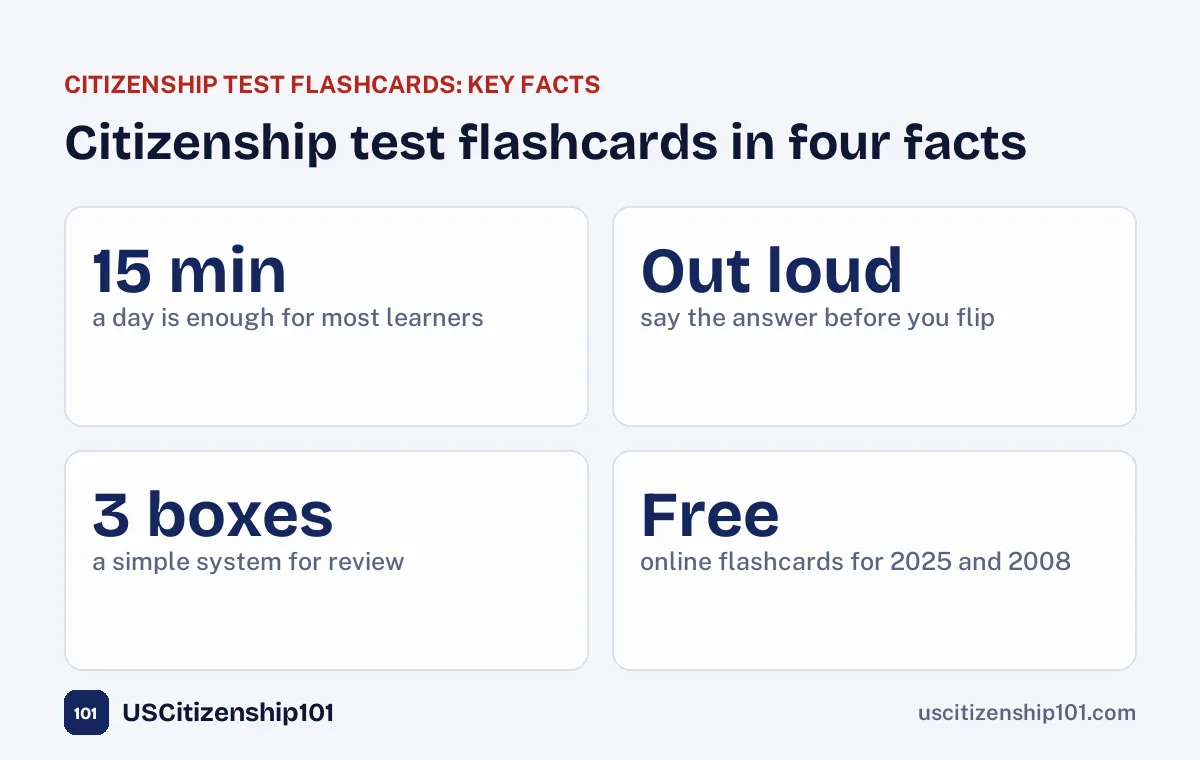
Key points about citizenship test flashcards
- Put one question on the front and the official answer on the back.
- Always say the answer out loud before you flip. The real test is spoken.
- Use three boxes or piles to review hard cards more often than easy ones.
- 15 minutes a day works better than long sessions once a week.
- Use the list for your test version: 2025 (128 questions) or 2008 (100 questions).
Why flashcards work so well for the civics test
The civics test is a question-and-answer test. The officer asks a question out loud, and you must remember the answer on your own, without choices. Citizenship test flashcards train exactly that skill. Every time you look at a question and try to remember the answer before you check, you practice recalling it, which makes it easier to remember next time.
Flashcards also help you notice what you do not know. Reading a list of 128 answers feels productive, but it is easy to think you know an answer when you only recognize it. A flashcard makes you prove it.
First, choose the right list
Before you make or use any citizenship test flashcards, confirm which civics test you will take. If USCIS received your N-400 on or after October 20, 2025, you take the 2025 test with 128 questions. If it was received before that date, you take the 2008 test with 100 questions. Read our guide to which civics test you will take. If you qualify for the 65/20 option, you only need the 20 questions for your version.
What to put on each flashcard
- Front: the question exactly as USCIS writes it, for example “What is the supreme law of the land?”
- Back: the official answer, in short form: “The Constitution.”
- For questions with many answers: write the one or two answers you will use, and circle your favorite. You only need to give one (or the number the question asks for).
- Optional memory hook: a short picture or phrase that helps you remember, such as a drawing of a flag for “red, white, and blue.”
- Question number: a small number in the corner helps you find it on the official list.
Keep each card simple. One question, one short answer. Long notes turn a flashcard into a page of reading, and you lose the benefit of quick recall.

10 citizenship test flashcards to start with
These questions have the same wording on the 2025 and the 2008 tests, so they are a perfect first set of citizenship test flashcards for everyone. Front, then back:
| Front (question) | Back (answer) |
|---|---|
| What is the supreme law of the land? | The Constitution |
| What are the two parts of the U.S. Congress? | The Senate and the House of Representatives |
| How many U.S. senators are there? | One hundred (100) |
| Who signs bills to become laws? | The President |
| What is the highest court in the United States? | The Supreme Court |
| Who wrote the Declaration of Independence? | (Thomas) Jefferson |
| When was the Declaration of Independence adopted? | July 4, 1776 |
| Name the U.S. war between the North and the South. | The Civil War |
| Why does the flag have 13 stripes? | Because there were 13 original colonies |
| What is the name of the national anthem? | The Star-Spangled Banner |
Start with these ten today. Tomorrow, add five to eight more from your version’s official list. In a week, you will have a solid first box of cards and a daily habit.
Make memory hooks that stick
A memory hook is a tiny picture, story, or phrase you add to citizenship test flashcards for the questions that do not stick. Good hooks are personal and a little funny. For example:
- “How many U.S. senators are there?” Two per state, times 50 states, equals 100.
- “Why does the flag have 50 stars?” One star for each state.
- “Who vetoes bills?” Imagine the President holding a big red “NO” stamp.
- “What territory did the United States buy from France in 1803?” Louisiana, where French words are still on street signs in New Orleans.
- “Who was president during the Great Depression and World War II?” Roosevelt, who led the country through both.
Only add hooks where you need them. Most cards work fine with just the question and the answer.
The three-box method
You do not need to review every card every day. Use three boxes, envelopes, or piles:
- Box 1, New and hard: review every day.
- Box 2, Getting there: review every two or three days.
- Box 3, Known: review once a week.
All cards start in Box 1. When you answer a card correctly out loud, move it to the next box. When you miss a card, move it back to Box 1, no matter where it was. Over a few weeks, most of your citizenship test flashcards move into Box 3, and you spend your time on the few questions that are still hard. This is a simple version of spaced repetition, a well-known study method.
A 15-minute daily routine
- Minutes 1 to 8: go through Box 1. Say each answer out loud, then flip.
- Minutes 9 to 12: go through the Box 2 cards that are due today.
- Minutes 13 to 15: add five new cards to Box 1, or review a few Box 3 cards.
Do this every day, at the same time if possible, such as with your morning coffee or on your lunch break. Consistency matters more than the length of each session.
How to use our free online flashcards
You can use citizenship test flashcards online for free on our civics practice test page:
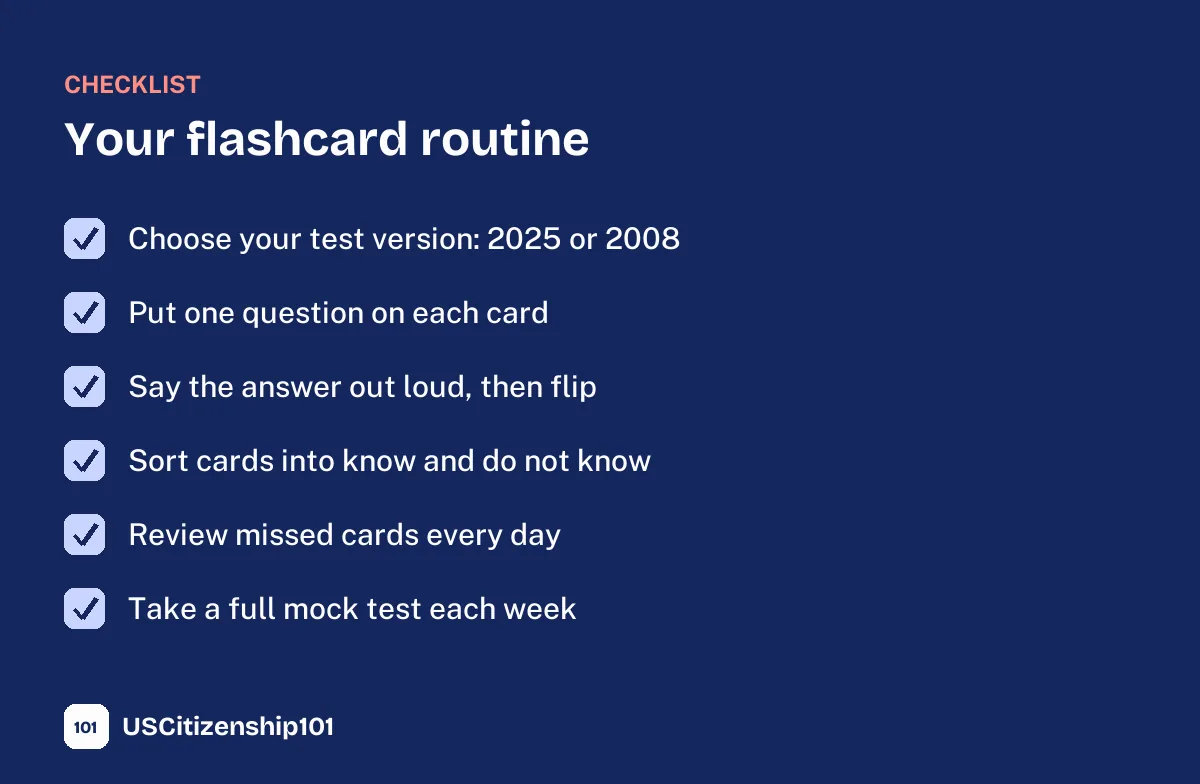
- Choose your version: 2025 or 2008.
- Select Flashcards mode.
- Read or listen to the question. Our flashcards can read the question aloud in an American English voice, so you get used to hearing it.
- Say the answer out loud, then flip the card to check.
- Mark whether you knew it. Questions you miss appear in Review mistakes mode.
- If you qualify for 65/20, check the option to practice only those questions.
Online flashcards are easy to use on your phone anywhere, while paper cards are great at home and help some people remember better because they wrote them by hand. Many learners use both.
Say the answer out loud with every card
The most common mistake with citizenship test flashcards is answering silently in your head. On the real test, you answer out loud in English. Speaking the answer builds the connection between the question you hear and the words you say, and it helps your pronunciation. If you are in a public place, whisper it. At home, say it clearly, as if the officer were in front of you.
Study by topic, then mix
At first, make or choose flashcards by topic: all the Congress questions, then all the President questions, then the colonial history questions. Related questions are easier to learn together. Once you know a topic, shuffle it with the others. On test day, the officer asks questions in random order, so your final practice should be random too.
Flashcards for answers that change
Some answers depend on the current officials and where you live: the President, the Vice President, the Speaker of the House, the Chief Justice, your U.S. senators, your representative, your governor, and your state capital. Make a special set of citizenship test flashcards for these, with a different color. Check the answers again a week or two before your interview, because officials can change. Our guide to civics test answers that change has the current national answers and tools to find your state’s.
Flashcards for the English test
Flashcards also work for the reading and writing tests. Make one card for each word on the official vocabulary lists, with the word on the front and a short example sentence on the back. For writing practice, have someone read the sentence on the back while you write it without looking. Read our guides to the citizenship reading test and the citizenship writing test.
Flashcards for your N-400 interview
The officer will review your N-400 with you, and some words are hard, such as “claim,” “overdue,” “totalitarian,” and “allegiance.” Make a small set of cards with the word on the front and a simple meaning on the back. Practicing these helps you understand the N-400 yes or no questions and answer confidently.
Study with family and friends
Citizenship test flashcards are perfect for studying with someone else. A spouse, friend, or child can hold up a card and read the question aloud, just like the officer, while you answer. Switch roles if they are studying too. Children often enjoy being the “officer,” and it turns study time into family time.
An 8-week plan with citizenship test flashcards
- Weeks 1 to 2: make or choose cards for American government. Add about 8 new cards a day.
- Weeks 3 to 4: add the American history cards.
- Week 5: add symbols, holidays, and the answers that change where you live.
- Week 6: shuffle all cards together and use the three-box method every day.
- Weeks 7 to 8: keep the daily flashcards and add one full mock test every day.
If you take the 2008 test with 100 questions, you can finish this plan in five or six weeks. If you qualify for 65/20, two or three weeks with 20 cards is usually enough.
Paper citizenship test flashcards: how to make them
If you like paper, index cards work well, but any paper cut into small rectangles is fine. Write the question on one side in large, clear letters, and the answer on the other. Use one color of pen for government, another for history, and a third for symbols and holidays, so you can see your progress by topic. Keep a rubber band around each box or pile, and carry a small stack in your pocket or bag for spare moments: waiting for the bus, standing in line, or during a break at work. Making your own citizenship test flashcards takes an evening or two, and writing each question by hand is already a first round of study.
Citizenship test flashcards on your phone
If you prefer your phone, online flashcards save time because the cards are ready and the order is shuffled for you. Save our practice test page to your home screen so it opens like an app. Turn on the audio, so you hear each question the way the officer will say it. Use the mistakes review often, because it works like Box 1: it shows you only the questions you missed.
Common citizenship test flashcards mistakes
- Answering silently instead of out loud.
- Flipping too fast before really trying to remember.
- Writing long answers on the back.
- Using old cards from the wrong test version.
- Reviewing only the easy cards because it feels good.
- Studying only flashcards and never taking a full mock test.
Citizenship test flashcards for the 65/20 group
If you are 65 or older with 20 years as a permanent resident when you file, you study only 20 questions, and you may take the civics test in your own language with an interpreter. That makes citizenship test flashcards even more useful: 20 cards fit in one small pile. Write the question in English on the front and, if it helps, the answer in your language on the back. Review all 20 every day for two weeks, and you will be ready. Our citizenship test for seniors guide lists the details.
Track your progress
Count the cards in each box once a week and write the numbers on a calendar. Watching Box 3 grow is motivating, and it shows you clearly when you are ready. If one topic stays in Box 1 for a long time, make new citizenship test flashcards for those questions with memory hooks, or study that topic with a video or a short article before going back to the cards.
When are you ready?
You are ready for the civics test when almost all your citizenship test flashcards are in Box 3, you can answer them in random order out loud, and you pass several full mock tests in a row. For the 2025 test, that means 12 correct answers before 9 wrong. For the 2008 test, 6 correct before 5 wrong.
Frequently asked questions
Are paper or online citizenship test flashcards better?
Both work. Online flashcards are convenient and can read questions aloud. Paper cards help some people remember because they write them by hand. Use what you will use every day.
How many new citizenship test flashcards should I learn each day?
Five to eight new cards a day is a good pace for most people, plus review of the older cards.
Should I shuffle my citizenship test flashcards?
Yes, once you know a topic. Studying by topic helps at first, but the officer asks questions in random order, so shuffle your citizenship test flashcards for the final weeks.
What if I keep forgetting the same answer?
Add a memory hook, say the answer out loud five times, and use it in a sentence about your own life. Then review that card twice a day for a few days. Hard cards usually stick after a week of extra attention.
Does USCIS have official flashcards?
USCIS offers free study materials, including flashcards and the official question lists, on its website.
Can I use flashcards if I qualify for 65/20?
Yes. Make or choose cards for just the 20 questions for your version. You may take the test in your own language, so you can study in your language too.
How long does it take to learn all the questions with flashcards?
With 15 to 20 minutes a day, most people learn the 2008 list in four to six weeks and the 2025 list in six to eight weeks.
Final thoughts
Citizenship test flashcards are simple, cheap or free, and very effective when you use them well. Put one question and one short answer on each card, say every answer out loud, review hard cards more often with three boxes, and practice a little every day. Add full mock tests near the end, and you will walk into your interview ready.
Sources: USCIS, Study for the Test; USCIS, Test Updates. Last reviewed September 2026.
Free tools
This article is for general education, not legal advice. Always confirm requirements at uscis.gov.