Lost Your Naturalization Certificate? How to Replace It With Form N-565
Your certificate is lost, damaged, or has an error? Form N-565 replaces it. Here is the fee, what to send, how to file, and when a U.S. passport is all you need.
On this page
Your Certificate of Naturalization is the document that proves you became a U.S. citizen. If it is lost, stolen, damaged, or has a mistake, you can ask USCIS for a new one with Form N-565, Application for Replacement Naturalization/Citizenship Document. The process is simple, but it costs money and takes time, so it helps to know exactly what to send and whether you need a replacement at all.
This guide explains when to use Form N-565, the current fee, the evidence you need for each situation, how to file online or by mail, what happens after you file, and when a U.S. passport may be all the proof of citizenship you need.
Key points about Form N-565
- Form N-565 replaces a lost, stolen, destroyed, damaged, or incorrect Certificate of Naturalization or Certificate of Citizenship.
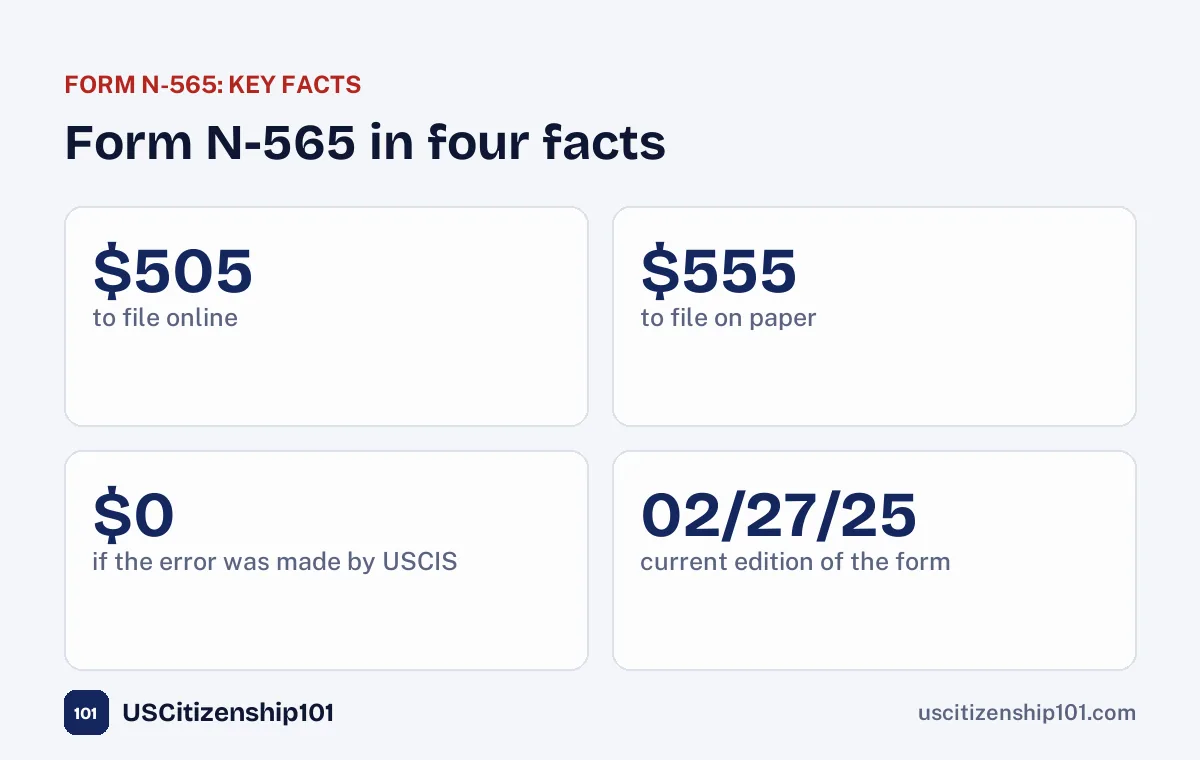
- The fee is $505 online or $555 on paper. There is no fee if the certificate has an error made by USCIS.
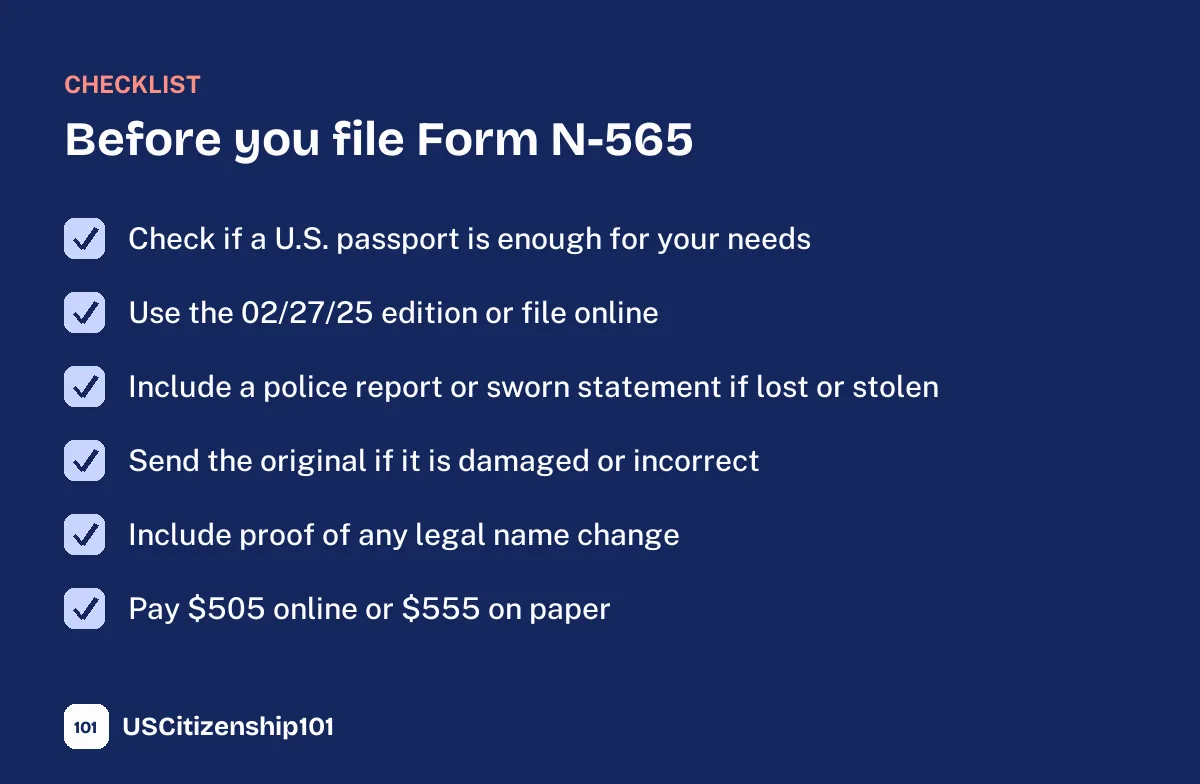
- For a lost or stolen certificate, include a police report or sworn statement.
- For a damaged or incorrect certificate, send the original.
- A valid U.S. passport is also proof of citizenship, so you may not need a replacement right away.
What Form N-565 is for
Form N-565 is the USCIS application to replace or correct a citizenship document. You can use it for:
- A Certificate of Naturalization, the certificate you received at your oath ceremony.
- A Certificate of Citizenship, issued to people who became citizens through their parents (see Form N-600).
- A Declaration of Intention or a Repatriation Certificate, which are rare.
- A special certificate that a naturalized citizen may need to be recognized as a U.S. citizen by a foreign country.
Most people who file Form N-565 simply need to replace a naturalization certificate that was lost, damaged, or printed with an error.
When to file Form N-565
- Lost, stolen, or destroyed: the certificate is gone, for example after a move, a theft, a fire, or a flood.
- Mutilated or damaged: the certificate is torn, faded, water-damaged, or otherwise hard to read.
- Error made by USCIS: your name, date of birth, or other information was printed incorrectly, and the mistake was USCIS’s, not yours.
- Legal name change: you changed your name after naturalization, for example by marriage or court order, and want a certificate in your new name.
- Change of gender, date of birth, or marital status in limited situations described in the form instructions.
If you only want a certificate in a new married name, remember that it is optional. Many people keep the original certificate and use their marriage certificate together with a U.S. passport in the new name.
Form N-565 fee in 2026
| Situation | Fee |
|---|---|
| Filed online | $505 |
| Filed on paper | $555 |
| Certificate has incorrect information because of a USCIS error | $0 |
| Approved fee waiver (Form I-912), if eligible | $0 |
These amounts come from the USCIS fee schedule, Form G-1055, edition 09/09/26. Fees change, so check uscis.gov/n-565 before you pay. For the costs of the citizenship application itself, see our guide to the N-400 filing fee.

Evidence to include with Form N-565
If your certificate was lost, stolen, or destroyed
- A copy of the certificate, if you have one.
- A police report, if one was filed, or a sworn statement explaining when, where, and how the certificate was lost, stolen, or destroyed.
If your certificate is damaged
- The original damaged certificate.
If your certificate has an error
- The original certificate with the error.
- Evidence of the correct information, such as your birth certificate or passport, if you are correcting your date of birth or name.
- If the error was made by USCIS, a short explanation of the error. There is no fee in that case.
If your name changed after naturalization
- The original certificate.
- The legal document that changed your name, such as a marriage certificate, divorce decree, or court order.
If you live outside the United States
- Two identical passport-style photos. Applicants inside the United States usually give their photo at a biometrics appointment instead.
Always read the latest form instructions, because evidence rules can change.
Sample sworn statement for a lost certificate
If you did not file a police report, a short signed statement explaining what happened is usually enough. Keep it simple and factual. For example:
I, [full name], born [date of birth], A-Number [A-Number], state that my Certificate of Naturalization, number [certificate number if known], issued on [date] in [city], was lost on or about [date] when [short description, such as “my family moved from Houston to Dallas and a box of documents was lost”]. I have searched for it and have not found it. I declare under penalty of perjury that this statement is true and correct. [Signature, date]
Include the statement with your Form N-565. If you later find the original certificate after the replacement is issued, do not use both; contact USCIS for instructions.
How to find your certificate number and A-Number
Your A-Number (Alien Registration Number) appears on your old Green Card, your N-400 receipt notice, and most USCIS notices. Your certificate number is printed in the top right corner of the certificate itself, usually in red. If you lost the certificate and never wrote down the number, you can still file Form N-565; give as much information as you can, such as the date and place of your oath ceremony, and USCIS will locate your record. This is one reason to keep a photo or copy of your certificate in a safe place, separate from the original.
Certificate of Naturalization vs. Certificate of Citizenship
These two documents look similar but come from different paths. A Certificate of Naturalization is issued to someone who applied for citizenship with Form N-400 and took the Oath of Allegiance. A Certificate of Citizenship is issued to someone who became a citizen through a U.S. citizen parent, usually after filing Form N-600. Both prove citizenship, and both are replaced with the same Form N-565. On the form, you simply indicate which document you are replacing.
The special certificate for recognition abroad
A small number of naturalized citizens need a special certificate so that a foreign country will recognize them as U.S. citizens, usually when that country’s government formally asks for proof. Form N-565 includes an option for this special certificate. It is not a replacement for your regular certificate and most people never need it. If a foreign government asks you for it, read the Form N-565 instructions carefully and include the request from that government.
How to file Form N-565
Online
You can file Form N-565 online through a free USCIS online account. Online filing costs less ($505), lets you upload evidence and pay online, and shows your case updates and notices in the same account. If you already have a USCIS account from your N-400, you can use it.
By mail
If you file on paper, use the current edition of the form (02/27/25) and make sure every page shows that edition date. Sign the form, include the fee and your evidence, and mail it to the address in the form instructions. At the time of writing, paper Form N-565 is filed with the USCIS Phoenix Lockbox. Always confirm the address on uscis.gov/n-565 before you mail anything.
Step-by-step: filing Form N-565
- Decide if you need it. If you already have a valid U.S. passport, it may be enough proof of citizenship for now.
- Choose online or paper. Online is cheaper and easier to track.
- Gather your evidence for your situation, as listed above.
- Complete the form with your name, A-Number, certificate number (if you know it), and the reason for your request.
- Pay the fee, or document why none is owed.
- Submit and save your receipt notice.
- Attend biometrics if USCIS schedules an appointment.
- Watch your case status in your USCIS account until the new certificate arrives.
What happens after you file
After USCIS accepts Form N-565, you receive a receipt notice with a receipt number. You can track your case online the same way you track an N-400; see our guide to your N-400 case status. USCIS may schedule a biometrics appointment for your photo and signature, and may ask for more evidence. When your application is approved, USCIS mails the new certificate. Processing times vary, so check the USCIS processing times page for Form N-565.
If you need proof of citizenship urgently while you wait, a U.S. passport is usually the fastest option if you already have one or can apply for one.
Do you really need a replacement certificate?
For many everyday needs, a valid U.S. passport is accepted as proof of U.S. citizenship, for example for jobs, many benefits, and travel. If you already have a passport, you may be able to wait before replacing your certificate, and save the fee. Still, many people want the certificate back for their records, for situations that specifically require it, or to apply for a passport if they never had one. Our guide to getting a passport after naturalization explains how the certificate and passport work together.
How to protect your certificate
- Store it flat and dry, in a folder or document protector, in a safe place at home.
- Do not laminate it. Lamination can make it look altered.
- Do not carry it in your wallet or bag. Use your U.S. passport for everyday proof.
- Write down the certificate number and your A-Number and keep them separately. They make a replacement easier.
- Check it for errors at the ceremony, before you leave. Errors noticed right away are the easiest to fix.
Changing your name: certificate, passport, and Social Security
If you change your name after you become a citizen, for example by marriage, you do not have to change your naturalization certificate. The order that usually works best is:
- Social Security: update your name with the Social Security Administration first.
- Driver’s license or state ID: update it with your state.
- U.S. passport: apply for a passport in your new name with your marriage certificate or court order.
- Certificate (optional): file Form N-565 only if you want a certificate in your new name.
With a passport in your new name, most people never need a new certificate. If you register to vote, use the name on your current ID. See our guide on how to register to vote after naturalization.

If your certificate was lost in a disaster
Fires, floods, and hurricanes destroy many important documents every year. If your certificate was destroyed in a disaster, file Form N-565 with a sworn statement describing the event. After major disasters, USCIS sometimes announces special help, such as expedited processing or fee relief for replacement documents, so check the USCIS newsroom for current announcements before you file. Keep copies of any disaster-related records, such as an insurance claim, in case USCIS asks for them.
A typical Form N-565 timeline
- Day 1: you file online or mail your application.
- A few weeks later: you receive the receipt notice and, if needed, a biometrics appointment.
- Biometrics: USCIS takes your photo and signature for the new certificate.
- Some months later: USCIS approves the application and mails the new certificate.
Processing times change often, so use the USCIS processing times tool for Form N-565 to see the current estimate.
Keep good records of your citizenship
The best way to avoid needing a replacement is to build a small, safe citizenship file at home. Keep the original certificate flat in a folder, together with your old Green Card if you still have a copy, your N-400 receipt notice, your oath ceremony notice, and your first U.S. passport application receipt.
Store a scan of the certificate in a secure place, such as an encrypted folder or a safe-deposit box, and write down the certificate number and your A-Number on a separate card. If you ever need to file Form N-565, these records make it faster, and they are helpful for your children and grandchildren if they ever need to prove that you were a citizen, for example when they apply for their own documents. A little organization today can save months later.
Common Form N-565 mistakes
- Using an old edition of the paper form.
- Forgetting the police report or sworn statement for a lost or stolen certificate.
- Not sending the original when correcting or replacing a damaged certificate.
- Paying the fee for a USCIS error, when no fee is owed.
- Paying the paper fee when online filing would cost less.
- Mailing to an outdated address. Always check the current instructions.
Replacement certificates for other family members
Each person files their own Form N-565 for their own certificate. Parents can file for a child under 18. If your child became a citizen automatically through you but never received a certificate, the right form is not Form N-565 but Form N-600, which asks USCIS to issue a Certificate of Citizenship for the first time.
Frequently asked questions
How much does Form N-565 cost?
$505 if you file online and $555 if you file on paper. There is no fee if you are correcting a USCIS error, and some applicants qualify for a fee waiver.
Can I file Form N-565 online?
Yes, through a USCIS online account. Online filing is $50 cheaper than paper.
Do I need a police report?
For a lost, stolen, or destroyed certificate, include a police report if one was filed, or a sworn statement describing what happened.
Will I lose my citizenship if I lose my certificate?
No. Losing the document does not change your citizenship. The certificate is only proof of it.
Can I use a photocopy of my certificate?
A copy can help you fill out Form N-565, but most offices that ask for proof of citizenship want the original certificate or a U.S. passport.
Do I need Form N-565 to get a passport?
If you already had a U.S. passport, you can usually renew it without your certificate. If you never had one and lost your certificate, contact the State Department about your options, and consider filing Form N-565 at the same time.
Can someone else file Form N-565 for me?
You must sign your own form, but a family member, attorney, or accredited representative can help you prepare it. A parent or legal guardian can file for a child under 18.
Do I need a lawyer to file Form N-565?
Usually not. Most replacements are straightforward. Consider legal help if your case involves a disputed date of birth, an identity question, or a complicated name history.
Can I travel while my Form N-565 is pending?
Yes. As a U.S. citizen, you travel with your U.S. passport. Just make sure you can attend a biometrics appointment if USCIS schedules one.
Final thoughts
Form N-565 is the simple fix for a lost, damaged, or incorrect citizenship certificate. File online to save money, include the right evidence for your situation, and pay nothing if the error was USCIS’s. While you wait, a U.S. passport can serve as your proof of citizenship.
Sources: USCIS, Form N-565; USCIS Fee Schedule, Form G-1055 (edition 09/09/26). Last reviewed September 2026.
Free tools
This article is for general education, not legal advice. Always confirm requirements at uscis.gov.