Military Naturalization: How Service Members and Veterans Become U.S. Citizens
Service members and veterans have their own path to citizenship. Here is who qualifies, how Form N-426 works, and what changes for families and applicants overseas.
On this page
The United States has a long tradition of offering citizenship to people who serve in its armed forces. Military naturalization follows special rules: most service members pay no filing fee, some do not need a green card first, and interviews and oath ceremonies can take place overseas. Veterans can use these rules too.
This guide explains the two service-based paths, how Form N-426 works, the steps to apply, and what is available for spouses and children. Veterans Day, November 11, is a good reminder that this path exists.
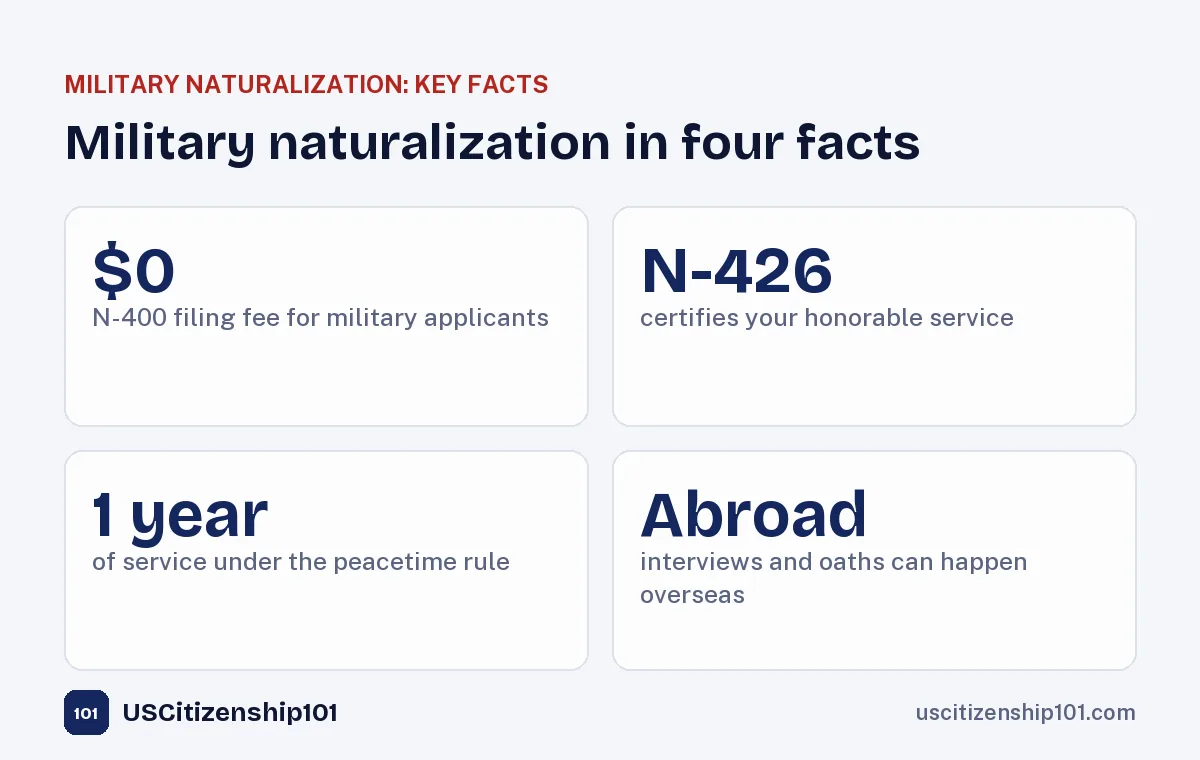
Key points about military naturalization
- There are two main paths: peacetime service (section 328 of the immigration law) and service during a period of hostilities (section 329).
- Military applicants who apply based on their service pay no N-400 filing fee.
- Form N-426, Request for Certification of Military or Naval Service, proves your honorable service.
- You still take the English and civics tests and must show good moral character.
- USCIS can hold interviews and oath ceremonies at some military bases overseas.
The two military naturalization paths
| Peacetime (section 328) | Period of hostilities (section 329) | |
|---|---|---|
| Length of service | At least 1 year of honorable service | Any honorable service, even one day |
| Green card needed? | Yes, you must be a permanent resident | Not always; you must have enlisted or been inducted in the U.S. or certain areas, or be a permanent resident |
| Residence and physical presence | Reduced or waived if you apply while serving or within 6 months of leaving | Not required |
| Filing fee | None for military applicants | None for military applicants |
The United States has been in a designated period of hostilities since September 11, 2001, so most people who have served since then can use section 329. Check the current USCIS guidance for your situation, because the details depend on how and when you served.
What Form N-426 does
Form N-426 asks the military to certify your service: when you served, in which branch, and whether your service was honorable. USCIS uses it to confirm you qualify for military naturalization.
- If you are serving now, your command or the designated certifying official completes and certifies the form.
- If you have left the military, you can usually submit Form N-426 with your discharge record, such as DD Form 214, instead of waiting for a certification. Check the current instructions.
How to apply, step by step
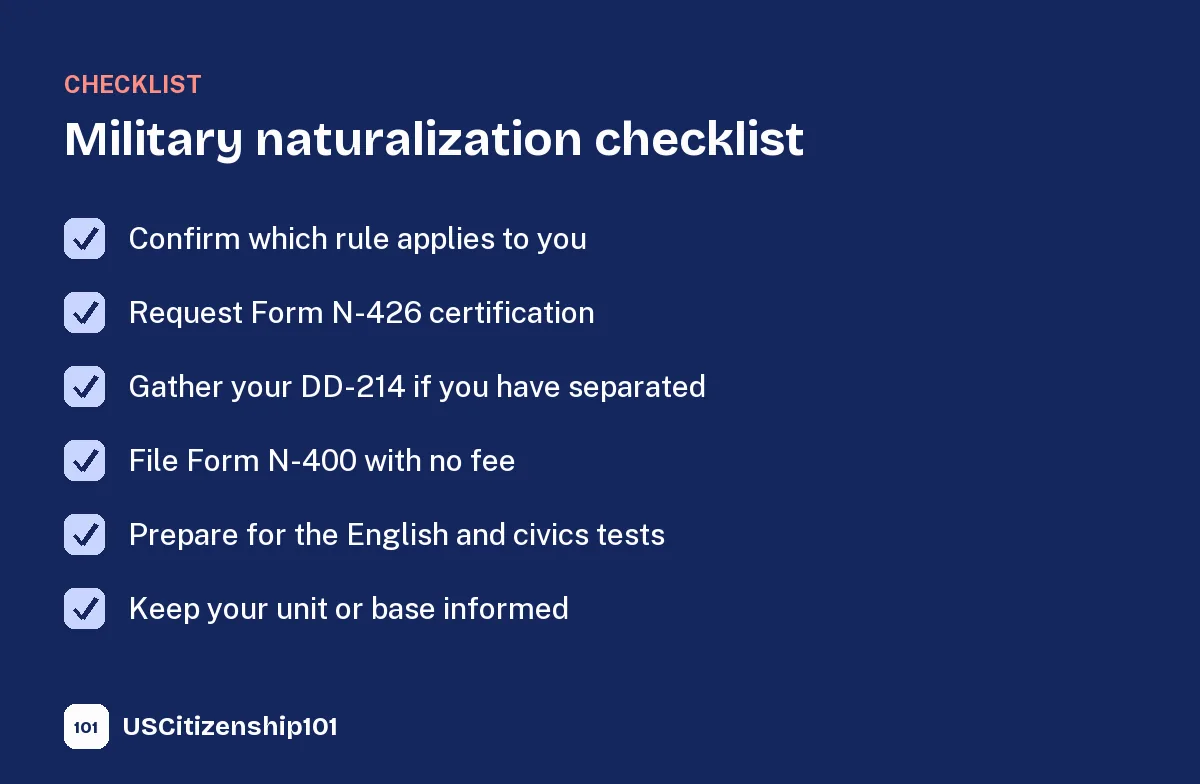
- Talk to your installation’s legal or naturalization point of contact. Many bases have one, and they know the local process.
- Complete Form N-426 and request certification, or gather your DD-214 if you have separated.
- File Form N-400 with Form N-426. Mark that you are applying based on military service. There is no filing fee for military applicants.
- Attend biometrics. USCIS may be able to use fingerprints already taken by the military.
- Prepare for the interview. You take the same English and civics tests as other applicants. Our free civics practice test works on a phone during downtime.
- Take the Oath of Allegiance. Many ceremonies for service members happen on base, including overseas.

Applying while stationed overseas
You do not have to return to the United States to naturalize. USCIS works with the military to hold interviews and oath ceremonies at certain installations abroad. Tell your point of contact early if you expect to deploy or move, so your case can follow you.
Spouses and children of service members
- Spouses: a spouse of a U.S. citizen service member who is stationed abroad on official orders may be able to count time abroad as time in the United States, and in some cases naturalize overseas.
- Children: children of service members may get citizenship through their parent, and in some cases can complete the process abroad.
The rules for families are detailed. Read the USCIS military family guidance or ask your installation’s legal office before you file. See also citizenship through marriage for the general spouse rules.
Veterans
If you served honorably and have left the military, you may still qualify. Under the peacetime rule, applying within 6 months of leaving keeps the residence and physical presence requirements reduced. Under the hostilities rule, there is no such deadline. Your DD-214 is the key document, so keep a copy safe.
Posthumous citizenship
If a noncitizen dies as a result of injury or disease from honorable service during a period of hostilities, the next of kin can request posthumous citizenship with Form N-644. The request must be filed within two years of the service member’s death. It honors the service member but does not give immigration benefits to relatives.
Common mistakes to avoid
- Paying a fee you do not owe. Military applicants applying based on service do not pay the N-400 fee.
- Waiting too long after separation when the peacetime rule applies.
- Submitting an N-426 that is unsigned or uncertified while you are still serving.
- Not studying for the tests because the rest of the process is simpler.
Frequently asked questions
Do I need a green card to apply through military service?
Under the peacetime rule, yes. Under the hostilities rule, not always. It depends on where you enlisted or were inducted.
Is there a fee?
No. Military applicants who apply based on their service do not pay the N-400 filing fee.
Do I still take the citizenship test?
Yes. You take the English and civics tests like other applicants. See how many questions are on the test.
Where can I get help?
Your installation’s legal office, and the military resources on uscis.gov/military.
Sources: USCIS, Military Naturalization; USCIS, Form N-426; USCIS Policy Manual, Volume 12, Part I. Last reviewed October 2026. General information, not legal advice.
Free tools
This article is for general education, not legal advice. Always confirm requirements at uscis.gov.