Dual Citizenship in the USA: Can You Keep Your Other Nationality?
The United States allows dual citizenship, but your other country may not. Here is what the oath means, how passports and taxes work, and what to check before you naturalize.

On this page
Dual citizenship means being a citizen of two countries at the same time. One of the most common questions from people preparing for naturalization is whether they can keep their current nationality after becoming a U.S. citizen. The short answer: U.S. law generally allows dual citizenship, but whether you keep your other nationality depends on the laws of that other country.
This guide explains how dual citizenship works for naturalized Americans: what the Oath of Allegiance actually means, why your home country’s law matters, how passports and travel work, tax obligations, and what to check before your ceremony.
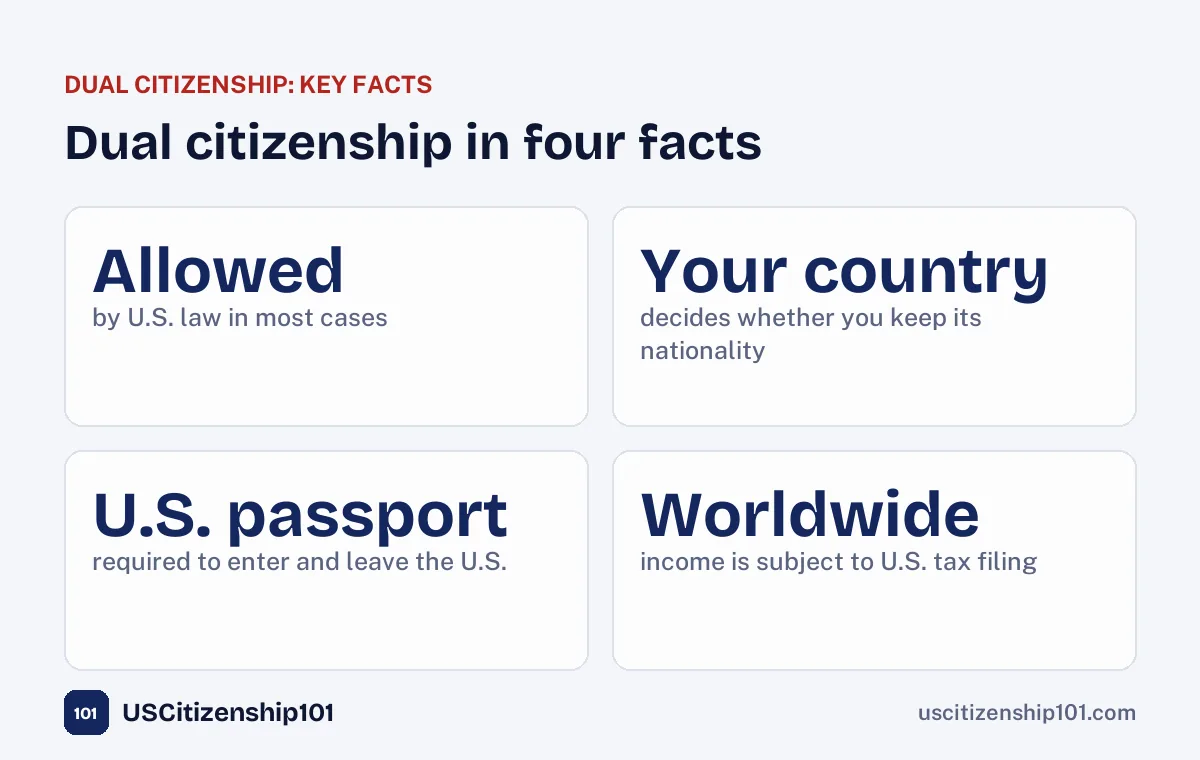
Key points about dual citizenship
- The United States does not require you to give up your other citizenship in practice.
- Your other country’s law decides whether you keep its nationality.
- U.S. citizens must use a U.S. passport to enter and leave the United States.
- U.S. citizens are taxed on worldwide income and must file U.S. returns even if living abroad.
- Check with your home country’s embassy before you naturalize.
What the Oath of Allegiance says
The Oath of Allegiance includes a promise to “absolutely and entirely renounce and abjure all allegiance and fidelity” to any foreign state. Many people understandably worry that this means they lose their other citizenship. In U.S. practice, taking the oath does not by itself end your other nationality under that country’s law. The United States does not notify your other country or require you to surrender its passport. What happens to your other nationality is decided by that country. Read the full oath in our guide to the oath of allegiance ceremony.
Why your home country’s law matters
Every country sets its own rules on dual citizenship, and they can change when new laws pass. Broadly, countries fall into three groups:
- Countries that allow dual citizenship: you keep your original nationality automatically, sometimes with a registration step. Mexico, Canada, the United Kingdom, and Germany (since 2024) are examples.
- Countries that restrict it: you may lose your original nationality automatically when you voluntarily become a citizen of another country, or you may need to apply to keep it.
- Countries that do not allow it: naturalizing elsewhere ends your original citizenship. Some offer an alternative status, such as India’s Overseas Citizenship of India (OCI) card.
Rules change, and there are many exceptions. Always check the current law with your country’s embassy or consulate before your oath ceremony.

Can you lose U.S. citizenship by having another nationality?
Under U.S. law, you can only lose U.S. citizenship by voluntarily performing certain acts with the intention of giving up U.S. citizenship, such as formally renouncing it at a U.S. embassy. Simply holding or using another nationality does not end your U.S. citizenship. Naturalized citizens can also lose citizenship through denaturalization if the naturalization was obtained by fraud or illegally, which is why honesty on your N-400 matters.
Passports and travel
- Entering and leaving the United States: as a U.S. citizen, you must use your U.S. passport.
- Entering your other country: you may need to use that country’s passport, depending on its rules.
- Consular help: in the country of your other nationality, U.S. consular assistance may be limited because that country considers you its own citizen.
- Military service: some countries require military service from their citizens, including dual nationals. Check before traveling.
Carry both passports when you travel between your two countries, and apply for your U.S. passport soon after the ceremony. See passport after naturalization.
Taxes
The United States taxes its citizens on their worldwide income, wherever they live. If you move abroad after naturalizing, you generally must still file U.S. tax returns. Tax treaties and foreign tax credits can reduce double taxation, and there may be reporting rules for foreign bank accounts. Your other country may also have tax rules for its citizens. Talk to a tax professional if you have income or accounts abroad.
Examples by country
The table below gives general examples for some countries that many applicants come from. Laws change and have exceptions, so treat it only as a starting point and confirm with the country’s embassy or consulate.
| Country | General position on dual citizenship |
|---|---|
| Mexico | Allowed. Mexican nationality by birth is generally kept. |
| Canada | Allowed. |
| United Kingdom | Allowed. |
| Ireland, Italy, France | Generally allowed. |
| Germany | Allowed since 2024 reforms. |
| Philippines | Allowed; former citizens can reacquire Philippine citizenship under Republic Act 9225. |
| Colombia, El Salvador, Dominican Republic | Generally allowed. |
| Pakistan | Allowed with certain countries, including the United States. |
| India | Not allowed; Overseas Citizenship of India (OCI) is available instead. |
| China | Not recognized; Chinese nationality is generally lost on naturalizing abroad. |
| Japan | Generally not allowed for people who voluntarily naturalize elsewhere. |
How to keep your other citizenship
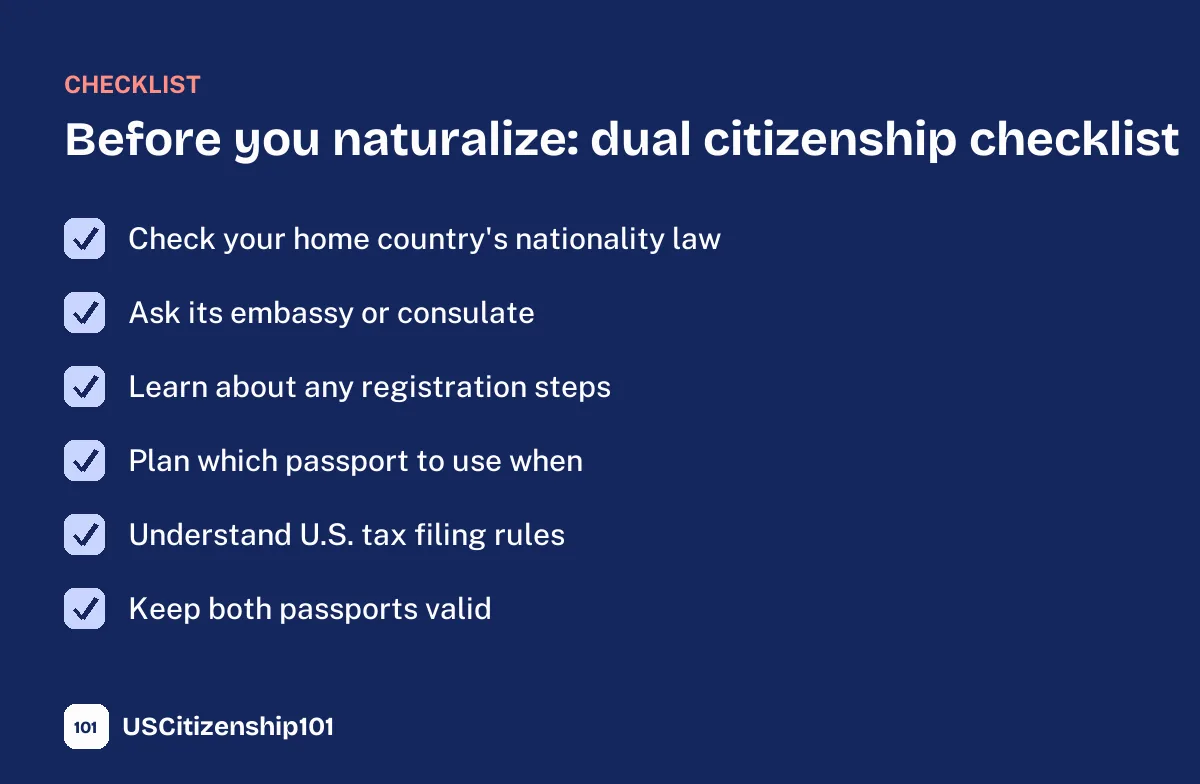
- Research the law: read your country’s nationality law or official guidance.
- Contact the embassy or consulate: ask whether you keep citizenship automatically or must apply or register.
- Complete any steps before your oath: some countries require an application to retain nationality before you naturalize.
- Keep your foreign passport valid: renew it if needed.
- Report your new status if required: some countries ask dual nationals to register.
Benefits of dual citizenship
- Live, work, and own property in both countries without visas.
- Travel more easily to your country of origin.
- Keep inheritance and property rights that may be limited for foreigners.
- Pass nationality to your children in some cases.
- Maintain a strong connection to family and culture.
Obligations and drawbacks
- Two sets of laws: you may be subject to both countries’ laws, including military service.
- Taxes: U.S. citizens file U.S. returns on worldwide income; your other country may also tax you.
- Limited consular help: in your other country, U.S. officials may have limited ability to assist you.
- Security clearances: some U.S. government jobs look closely at dual nationality.
- Passport rules: you must use your U.S. passport to enter and leave the United States.

Dual citizenship for children
Children under 18 with Green Cards who live with you often become U.S. citizens automatically when you naturalize. Whether they keep your other nationality depends on that country’s law. Children born abroad to U.S. citizens may be citizens of both countries from birth. See Form N-600 for proof of U.S. citizenship for children.
Voting and public office
As a U.S. citizen, you can vote in U.S. federal elections even if you also hold another nationality. Some countries allow their citizens abroad to vote in their elections too. A few U.S. positions, and some foreign ones, restrict dual nationals, so check if you plan to run for office or work in sensitive roles.
Renouncing another citizenship
If you decide you do not want to keep your other nationality, you usually must follow that country’s formal renunciation process. Taking the U.S. Oath of Allegiance is not treated by most countries as a formal renunciation.
Myths about dual citizenship
- “The U.S. oath automatically cancels my other citizenship.” Not under U.S. practice. Your other country decides.
- “I must hand in my foreign passport.” No. USCIS only takes your Green Card.
- “Dual citizenship is illegal in the U.S.” No. U.S. law generally permits dual citizenship.
- “I can enter the U.S. on my foreign passport.” U.S. citizens must use a U.S. passport to enter and leave.
- “If I keep my old citizenship, I cannot vote in U.S. elections.” False. Dual citizenship does not affect your right to vote as a U.S. citizen.
Travel scenarios
Visiting family abroad
Maria is a U.S. and Mexican citizen. She leaves the U.S. with her U.S. passport and enters Mexico with her Mexican passport. On the way back, she shows her U.S. passport to the airline and to U.S. border officers.
Traveling to a third country
Arjun lost his Indian citizenship when he naturalized and now holds an OCI card for visits to India. He travels to Europe on his U.S. passport.
Long stay in the other country
Nguyen plans to live abroad for a year. As a dual citizen, he does not need a visa there, but he continues to file U.S. tax returns and keeps his U.S. passport valid for his return.
Questions to ask your embassy or consulate
- Will I keep my citizenship automatically if I become a U.S. citizen?
- Do I need to apply or register before or after I naturalize?
- Must I inform you of my new citizenship?
- Which passport must I use to enter the country?
- Are there military service, tax, or property rules for dual citizens?
- Will my children keep or be able to claim your citizenship?
Property, inheritance, and benefits
Property and inheritance rules are one of the main reasons people keep a second nationality. Some countries restrict land ownership or inheritance for foreigners. Keeping your original nationality through dual citizenship can protect these rights. In the United States, benefits such as Social Security depend on your work history and residence rules, not on whether you hold another citizenship, though living abroad can affect some benefits. Check with the relevant agencies if you plan to retire outside the U.S.
What to do before and after the oath
- Before filing: learn your country’s rules on dual citizenship.
- Before the oath: complete any retention application your country requires.
- At the ceremony: take the oath and receive your Certificate of Naturalization.
- After the ceremony: apply for your U.S. passport and, if required, register your new status with your other country.
- Ongoing: keep both passports valid and follow both countries’ travel rules.
How the United States views dual nationals
The U.S. Department of State explains that U.S. law does not mention dual citizenship or require a person to choose one citizenship or another. A U.S. citizen may naturalize in another country without risk to U.S. citizenship, and a person who becomes a U.S. citizen may keep a foreign nationality if that country allows. Dual nationals owe allegiance to both countries and must obey the laws of both. When you are in the United States, you are treated as a U.S. citizen, and U.S. law applies to you in full.
Dual citizenship and jobs
Most private employers do not care whether you hold dual citizenship. Some federal jobs, especially those requiring a security clearance, review foreign ties carefully. Holding another passport is not automatically disqualifying, but you may be asked about it, and in some cases you may need to surrender or destroy a foreign passport to hold a clearance. If you plan a career in government or defense, keep this in mind.
Dual citizenship and the civics test
The 2025 civics test asks you to name two promises new citizens make in the Oath of Allegiance, and one accepted answer is “give up loyalty to other countries.” You can give that answer confidently. It is one of the promises in the oath, even though, in practice, keeping another nationality depends on that other country’s law. Knowing both facts helps you understand the oath and answer the question correctly.
Documents to keep
- Your Certificate of Naturalization.
- Your U.S. passport.
- Your other country’s passport and national ID, if you keep that citizenship.
- Any registration or retention documents from your other country.
- Birth and marriage certificates for both countries’ records.
Keep originals in a safe place and scans in secure digital storage.
When to get legal advice
Consider advice from an immigration attorney, or from a lawyer in your other country, if you hold property or significant assets abroad, if your country requires military service, if you want to work in a sensitive U.S. government role, or if your country’s rules on dual citizenship are unclear. A short consultation before your oath can prevent unexpected problems later.
Dual citizenship and your identity
For many new Americans, dual citizenship is about more than paperwork. It reflects a life that belongs to two places: the country where you were born and the country you have chosen. Keeping both citizenships can make it easier to visit aging parents, care for family property, and pass on language and culture to your children. At the same time, becoming a U.S. citizen gives you a full voice in American democracy. Many people find that holding both reflects who they really are.
If your country does not allow dual citizenship, the decision can feel harder. Take time to learn about alternatives, such as long-term visas or special status cards for former citizens, and talk with family about what matters most. There is no single right answer, and many people decide that the benefits of U.S. citizenship outweigh the loss of their original passport.
A quick decision guide
- If your country allows dual citizenship: naturalize, complete any registration step, and keep both passports valid.
- If your country requires an application to keep citizenship: apply before your oath.
- If your country does not allow it: learn about alternative statuses and decide whether U.S. citizenship is worth the change.
- If you are unsure: contact the embassy or consulate and get the answer in writing if possible.
Frequently asked questions
Can I use my foreign passport to travel to other countries?
Generally yes, when entering third countries, as long as you follow each country’s rules. But you must use your U.S. passport to enter and leave the United States.
Does dual citizenship cost anything?
Keeping two passports means paying two sets of renewal fees, and some countries charge for registration or retention applications.
Do I have to give USCIS my foreign passport?
No. You return your Green Card at the ceremony, not your foreign passport. Keep your foreign passport safe, and renew it according to your other country’s rules if you keep that citizenship.
Will the United States tell my country that I naturalized?
The U.S. does not generally notify other countries. Some countries require you to report it yourself, and failing to report can create problems when you renew your foreign passport or travel there.
Does dual citizenship affect my naturalization application?
No. USCIS does not deny naturalization because you plan to keep another nationality.
Should I tell the officer about my other citizenship?
Answer questions about your nationality honestly. Your country of citizenship is part of your N-400.
Is dual citizenship common among naturalized Americans?
Yes. Many naturalized citizens keep their original nationality, depending on their country’s law.
Can I get back a citizenship I lost when I naturalized?
Some countries allow former citizens to reacquire their nationality, sometimes with a simple process. Ask your country’s consulate.
Can my children have dual citizenship?
Often yes, depending on the laws of both countries. Many children born to immigrant parents hold two citizenships from birth. Check with your country’s consulate about registering their births.
Final thoughts
For many new Americans, dual citizenship is possible and practical, and it often makes family life across borders much easier. The key is your other country’s law. Check it before your oath, plan how you will use each passport, and understand your tax obligations. Then you can enjoy the benefits of U.S. citizenship while keeping your connection to your country of origin.
Sources: U.S. Department of State, Dual Nationality; INA section 349. Last reviewed September 2026. General information, not legal or tax advice.
Free tools
This article is for general education, not legal advice. Always confirm requirements at uscis.gov.