American Indian Tribes on the Civics Test: Questions, Answers, and Easy Ways to Remember
Two civics questions ask about the first people in America. Here are the official answers for both test versions, a short story behind each tribe name, and simple memory tricks.
On this page
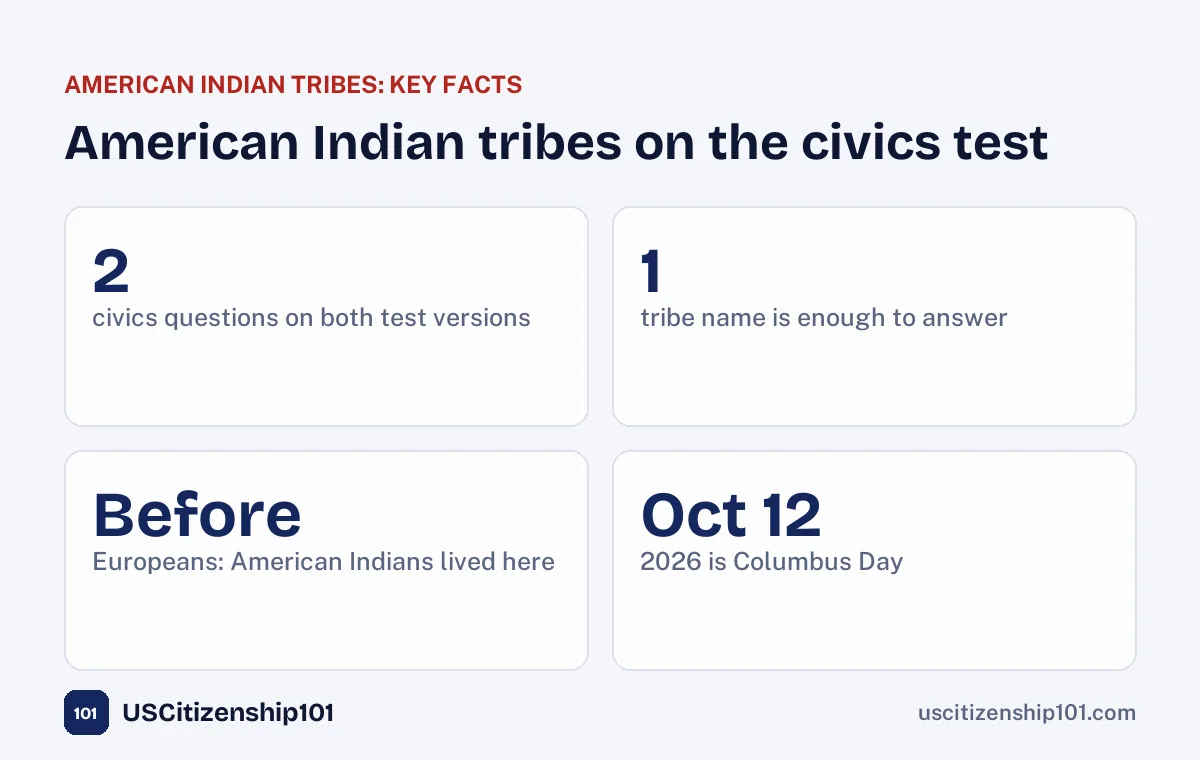
Two questions on the U.S. citizenship civics test are about the first people who lived in America: who lived here before the Europeans arrived, and the name of one of the American Indian tribes in the United States. Both are on the 2025 and the 2008 versions of the test, and both are among the easiest points you can earn once you know the answers.
This guide gives you the official questions and accepted answers for both versions, a short introduction to the American Indian tribes on the list, simple memory tricks, and practice ideas. With October 12 bringing Columbus Day, also known in many places as Indigenous Peoples’ Day, it is a good time to learn this part of American history.
Key points about American Indian tribes on the civics test
- The question “Who lived in America before the Europeans arrived?” is answered with American Indians or Native Americans.
- For “Name one American Indian tribe in the United States,” any one tribe on the list is correct, such as Cherokee or Navajo.
- Both questions are on the 2025 test (questions 74 and 117) and the 2008 test (questions 59 and 87).
- On the 2025 test, question 74 is one of the 20 questions for applicants 65/20.
- USCIS officers have a list of federally recognized American Indian tribes to check your answer.
Question 1: Who lived in America before the Europeans arrived?
This is question 74 on the 2025 test and question 59 on the 2008 test. The accepted answers are:
- American Indians
- Native Americans
Either answer is correct. Many people find “Native Americans” easier to say. On the 2025 test, this question is marked for the 65/20 group, so if you are 65 or older and have been a permanent resident for 20 years, it is one of the 20 questions you study. See our guide to the citizenship test for seniors.
Question 2: Name one American Indian tribe in the United States
This is question 117 on the 2025 test and question 87 on the 2008 test. You only need to name one of the American Indian tribes. The officer has a list of federally recognized tribes, so any correct tribe name counts, but the safest choice is a name from the official list.
Tribes listed for the 2025 test
Apache, Blackfeet, Cayuga, Cherokee, Cheyenne, Chippewa, Choctaw, Creek, Crow, Hopi, Huron, Inupiat, Lakota, Mohawk, Mohegan, Navajo, Oneida, Onondaga, Pueblo, Seminole, Seneca, Shawnee, Sioux, Teton, and Tuscarora. The official list also points to bia.gov for the complete list of tribes.
Tribes listed for the 2008 test
Cherokee, Navajo, Sioux, Chippewa, Choctaw, Pueblo, Apache, Iroquois, Creek, Blackfeet, Seminole, Cheyenne, Arawak, Shawnee, Mohegan, Huron, Oneida, Lakota, Crow, Teton, Hopi, and Inuit.
Most American Indian tribes appear on both lists. The easiest answers for most learners are Cherokee, Navajo, Sioux, and Apache, because they are short and familiar.
Which answer should you choose?
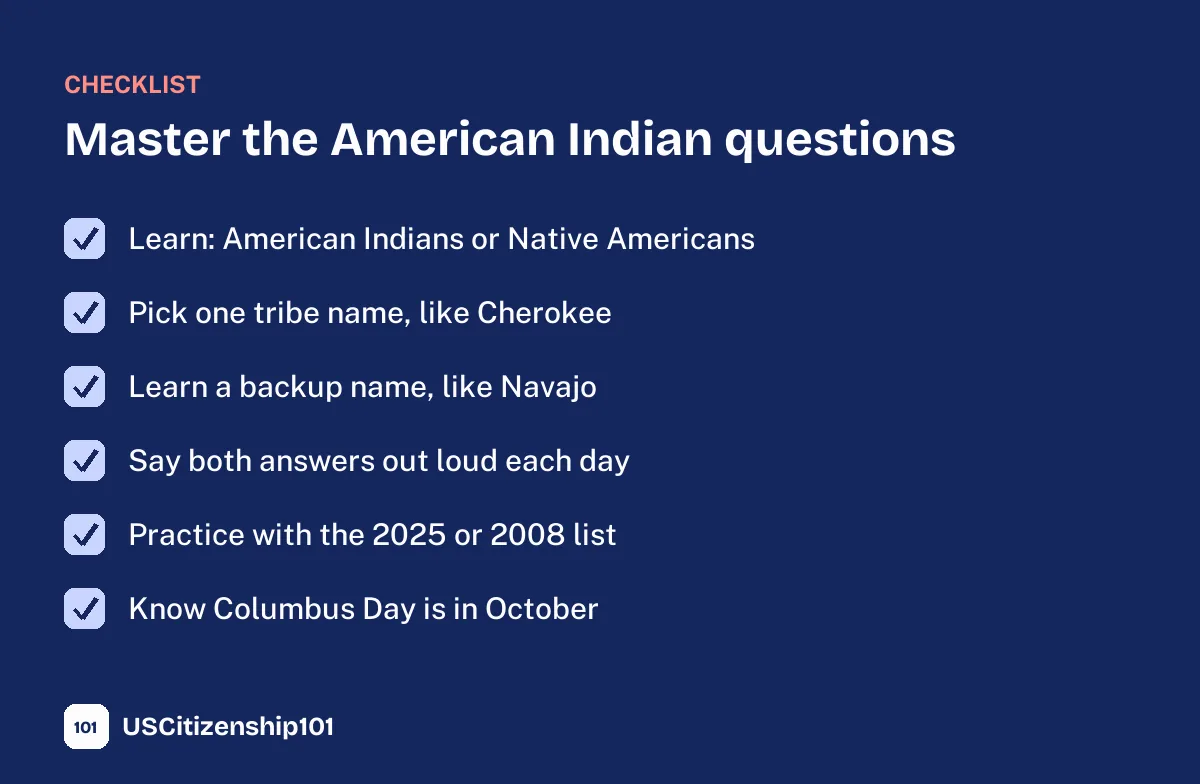
Of all the American Indian tribes, pick one name you can say clearly, and learn one backup. A good pair is Cherokee and Navajo. If you are nervous and the first name does not come out right, you can give the second. Practice saying the full sentence, “Cherokee,” or “One American Indian tribe is the Cherokee,” until it feels automatic.
If you already know another tribe from where you live, for example the Seminole in Florida or the Pueblo peoples in New Mexico, that is a great choice too, because a personal connection is easier to remember.
How to pronounce American Indian tribes
The civics test is spoken, so pronunciation matters. You do not need a perfect accent, but the officer must understand the name. Here is a simple guide for the most common American Indian tribes on the lists:
| Tribe | Say it like |
|---|---|
| Cherokee | CHAIR-uh-kee |
| Navajo | NAV-uh-ho |
| Sioux | SOO |
| Apache | uh-PATCH-ee |
| Seminole | SEM-ih-nole |
| Pueblo | PWEB-lo |
| Hopi | HO-pee |
| Choctaw | CHOCK-taw |
| Cheyenne | shy-AN |
| Lakota | luh-KO-tuh |
Listen to each name a few times, for example with the audio in our practice test or a pronunciation website, and repeat it out loud. Choose the name that feels easiest in your mouth.
A sample exchange at the interview
Here is how these two questions might sound during your civics test:
- Officer: “Who lived in America before the Europeans arrived?”
- You: “Native Americans.”
- Officer: “Name one American Indian tribe in the United States.”
- You: “Cherokee.”
Short answers are fine. You do not need to explain or give more than one name. If you do not hear the question clearly, you can politely ask the officer to repeat it: “Could you please repeat the question?”
A short guide to the American Indian tribes on the list
You do not need this history for the test, but a short story behind each name makes it much easier to remember. Here are some of the American Indian tribes on the official lists:
- Cherokee: originally from the Southeast. In the 1830s many Cherokee were forced to move west on the Trail of Tears. Today there are Cherokee nations in Oklahoma and North Carolina.
- Navajo: from the Southwest, in parts of Arizona, New Mexico, and Utah. The Navajo Nation has the largest reservation by area. Navajo Code Talkers helped the United States in World War II.
- Sioux, Lakota, and Teton: peoples of the Great Plains. The Lakota, also called the Teton Sioux, are one of the main Sioux groups.
- Iroquois: a confederacy of nations in the Northeast, also called the Haudenosaunee. Its members include the Mohawk, Oneida, Onondaga, Cayuga, Seneca, and Tuscarora, all of which are on the 2025 list.
- Apache: peoples of the Southwest, known for leaders such as Geronimo.
- Pueblo and Hopi: peoples of New Mexico and Arizona, famous for villages built of adobe and stone.
- Seminole: from Florida, with nations today in Florida and Oklahoma.
- Choctaw and Creek: peoples of the Southeast who were also forced west in the 1830s. The Creek are also known as the Muscogee.
- Chippewa: also called the Ojibwe, from the Great Lakes region.
- Cheyenne, Crow, and Blackfeet: peoples of the Great Plains and northern Rocky Mountains.
- Shawnee: from the Ohio Valley, known for the leader Tecumseh.
- Huron and Mohegan: peoples of the Great Lakes and New England.
- Inupiat and Inuit: Indigenous peoples of Alaska and the Arctic.
- Arawak: Indigenous peoples of the Caribbean, among the first to meet Columbus in 1492.
Memory tricks for American Indian tribes
- Link American Indian tribes to places: “Navajo, Arizona,” “Seminole, Florida,” “Cherokee, Oklahoma.”
- Use a story: “Navajo Code Talkers helped win the war.”
- Link a name to a picture: imagine a Pueblo village or the Great Plains for the Sioux.
- Say it out loud: the test is oral, so practice speaking, not only reading.
- Use spaced review: say both answers once a day for a week, then twice a week.
Connecting American Indian tribes to other civics questions
These questions sit in the American History section with the colonial period and independence. It helps to learn them together with nearby questions, such as why colonists came to America, who the Pilgrims were, and what happened in 1776. The story of America begins with the people who were already here, and the European settlers who arrived later.
The holidays question is also connected. On the 2025 test you name three national U.S. holidays, and on the 2008 test you name two. Columbus Day and Thanksgiving are both accepted answers, and both are on the English reading and writing vocabulary lists.
Columbus Day, Indigenous Peoples’ Day, and the English test
Columbus Day is a federal holiday on the second Monday of October. In 2026 it falls on October 12. Many states and cities also recognize the day as Indigenous Peoples’ Day, to honor the first peoples of the Americas, including the American Indian tribes on the civics test.
For the English test, “Columbus Day” is on both the reading and the writing vocabulary lists, and “October” and “American Indians” are on the writing list. Practice sentences like these:
- Reading: When is Columbus Day?
- Writing: Columbus Day is in October.
- Writing: American Indians lived here first.
Our USCIS vocabulary list guide has many more practice sentences.
American Indian tribes today
American Indian tribes are not only part of history. Today, federally recognized tribes are sovereign nations with their own governments, courts, and laws, and they have a government-to-government relationship with the United States. The Bureau of Indian Affairs, part of the Department of the Interior, works with these tribal governments. Many American Indians live on reservations, and many more live in cities across the country.
American Indians born in the United States have been U.S. citizens since the Indian Citizenship Act of 1924. Like all citizens, they vote in federal, state, and local elections, and many serve in the U.S. armed forces at high rates.
A 7-day plan for these two questions
- Day 1: read both questions and answers out loud five times.
- Day 2: choose your tribe name and your backup, and practice pronouncing them.
- Day 3: learn one fact about your tribe, such as where it comes from.
- Day 4: ask a friend or family member to ask you both questions.
- Day 5: practice the related holiday questions and the Columbus Day sentences.
- Day 6: take a full practice test and check these two answers.
- Day 7: review once more, then move them to your weekly review list.
Quick self-check
Cover the answers and test yourself:
- Who lived in America before the Europeans arrived? (American Indians or Native Americans)
- Name one American Indian tribe in the United States. (Cherokee, Navajo, Sioux, or another on the list)
- When is Columbus Day? (The second Monday in October)
- Name one national U.S. holiday in the fall. (Columbus Day, Veterans Day, or Thanksgiving)
If you answered all four without looking, you are ready for these questions.
State names that come from American Indian tribes
Another way to remember American Indian tribes is to notice how many place names come from them. About half of the 50 states have names with American Indian origins. A few examples:
- Utah is named after the Ute people.
- North Dakota and South Dakota are named after the Dakota, one of the Sioux groups.
- Massachusetts is named after the Massachusett people.
- Illinois, Kansas, Missouri, and Iowa are named after American Indian tribes that lived in those regions.
- Oklahoma comes from Choctaw words meaning “red people.”
The civics test also asks about the states that border Canada and Mexico, and many of those names, such as Dakota and Minnesota, also have American Indian roots. Seeing these names on a map every day is an easy reminder of the American Indian tribes that lived here first.
American Indian tribes on the 65/20 test
If you qualify for the 65/20 option, you study only 20 questions and can take the civics test in your own language with an interpreter. On the 2025 test, “Who lived in America before the Europeans arrived?” is one of those 20 questions, but the question naming American Indian tribes is not. That means you only need to learn “American Indians” or “Native Americans.” Practice the 20 questions alone in our practice test by checking the 65/20 option.
Common mistakes to avoid
- Naming a country or a person instead of a tribe. “Mexico” or “Geronimo” is not a tribe name.
- Saying “Indians” alone for the first question. Say “American Indians” or “Native Americans.”
- Giving a name you cannot pronounce. Pick a short name you can say clearly.
- Studying the wrong list. Use the list for your test version. See the 2025 civics test if you are not sure.
- Answering in another language. Unless you qualify to take the civics test in your language, answer in English.
How to practice these questions
Use our free civics practice test. Choose the American History topic to practice these questions, or use flashcards mode to say the answer before you flip the card. Add the questions you miss to your mistakes review. Five minutes a day for a week is enough for most people to answer both questions about American Indian tribes without thinking.
Why these questions matter
The civics test is meant to help new citizens understand the country they are joining. Knowing that American Indians lived here long before Europeans arrived, and that many American Indian tribes still live here today as sovereign nations with their own governments, is part of understanding American history. Many place names, such as Dakota, Massachusetts, and Ohio, come from American Indian words.
Where to learn more
If you want to go beyond the test, there are excellent free resources. The Smithsonian’s National Museum of the American Indian has locations in Washington, D.C., and New York City, and its website has stories, photos, and videos about Native peoples across the Americas. Many tribal nations run their own museums and cultural centers, and many welcome visitors. Your local library can also help you find simple books in English about American Indian tribes, which is good reading practice for the English test at the same time.
Learning a little more makes the answers stick. When you know that the Navajo Code Talkers used their language to send secret messages in World War II, or that the Cherokee created their own writing system in the 1800s, the names on the civics list stop being just words to memorize. They become part of the history of the country you are about to join.
Frequently asked questions
Do I need to name more than one of the American Indian tribes?
No. One correct name of one of the American Indian tribes is enough.
Is “Native Americans” correct for the first question?
Yes. Both “American Indians” and “Native Americans” are accepted.
Can I name American Indian tribes that are not on the list?
Officers have a list of federally recognized tribes, so another correct tribe may be accepted. To be safe, use a name from the official list, such as Cherokee or Navajo.
Are these questions on both the 2025 and 2008 tests?
Yes. They are questions 74 and 117 on the 2025 test, and 59 and 87 on the 2008 test.
Will the officer ask me about the history of a tribe?
No. The officer only asks the questions on the official list. You just need to give an accepted answer, such as one tribe name. The history in this guide is only to help you remember.
Is the Iroquois still an accepted answer?
Iroquois is on the 2008 list. The 2025 list names the nations of the Iroquois Confederacy, such as the Mohawk and Seneca, instead.
Final thoughts
The questions about American Indian tribes are two of the simplest on the civics test. Learn “American Indians” or “Native Americans” for the first question, choose one tribe name like Cherokee or Navajo for the second, and say both out loud every day. This October, as Columbus Day and Indigenous Peoples’ Day come around, you will have two more reasons to remember them.
Sources: USCIS, Study for the Test (2025 and 2008 civics questions); Bureau of Indian Affairs. Last reviewed September 2026.
Free tools
This article is for general education, not legal advice. Always confirm requirements at uscis.gov.