What to Expect at Your USCIS Citizenship Interview: A Full Walkthrough
A minute-by-minute walkthrough of interview day, from security to your results, with what to bring and how to handle each part.

On this page
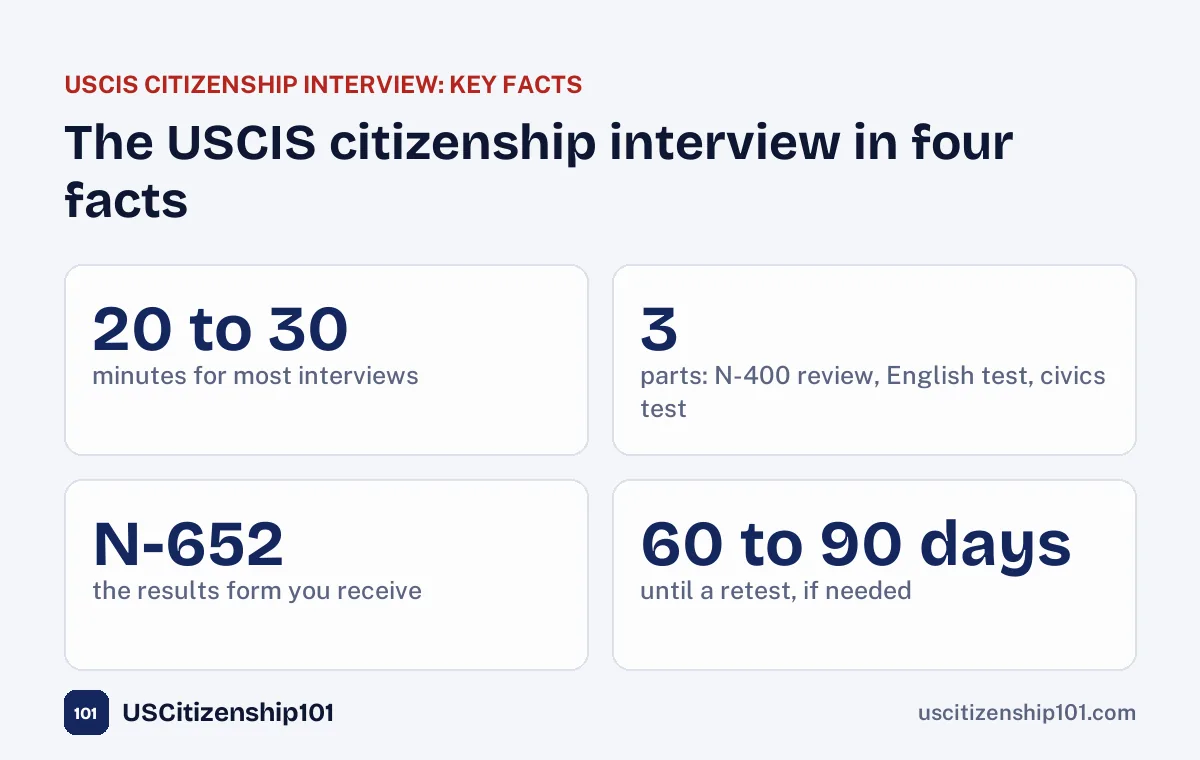
The USCIS citizenship interview is the step where an immigration officer meets you in person, reviews your application, and gives you the English and civics tests. For most people it lasts 20 to 30 minutes, and it is the moment that decides whether your application is approved. Knowing exactly what happens takes away most of the stress.
This guide walks you through the USCIS citizenship interview from the moment you arrive at the building to the moment you receive your results, with what to bring, what the officer will ask, and how to handle each part.
Key points about the USCIS citizenship interview
- The USCIS citizenship interview usually takes 20 to 30 minutes.
- It has three main parts: N-400 review, English test, and civics test.
- You are placed under oath at the start.
- You receive your results on Form N-652 at the end.
- If you miss a test part, you get a free retest 60 to 90 days later.
Before the interview: your notice
USCIS mails your interview notice (Form I-797C) several weeks before the date, and it also appears in your online account. Read it carefully. It lists the date, time, office address, and any documents you must bring. If you cannot attend, follow the instructions to reschedule as early as possible, because rescheduling can add months.
What to bring
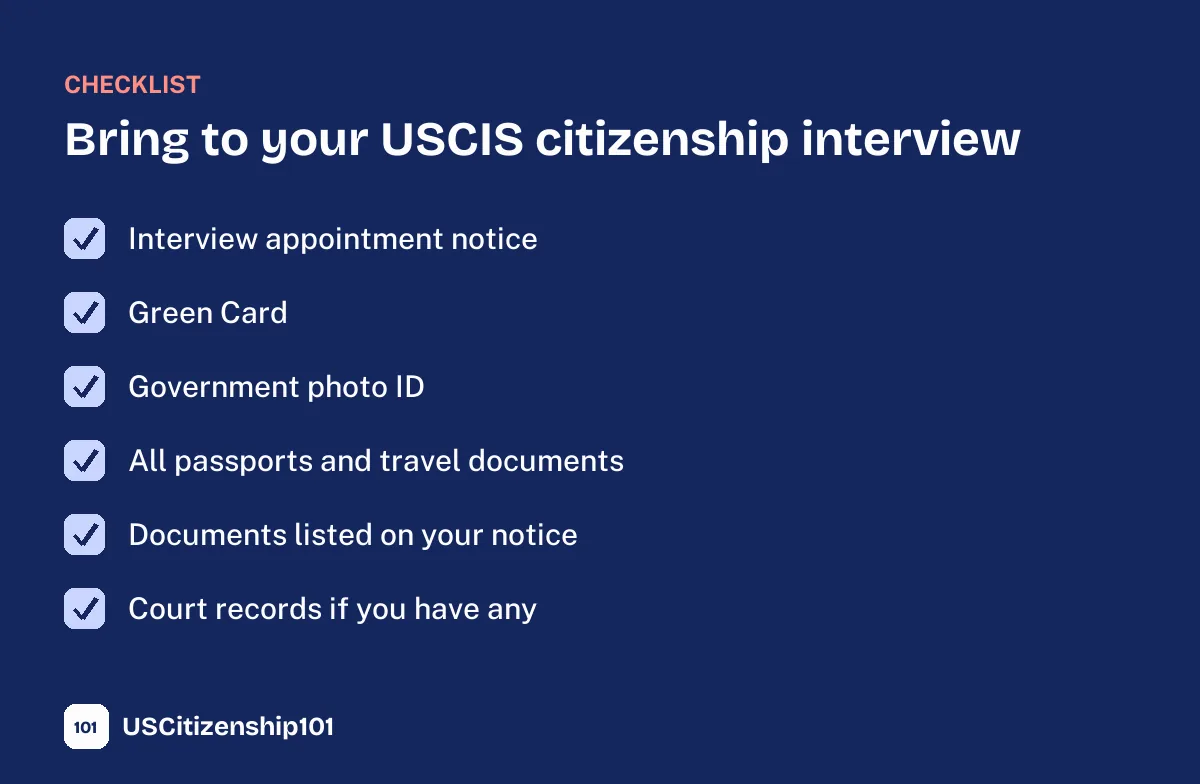
- Your interview notice.
- Your Green Card.
- A state-issued ID or driver’s license.
- All passports and travel documents, including expired ones.
- Every document your notice lists, such as marriage or divorce certificates, tax transcripts, or proof of child support.
- Certified court records for any arrest, citation, or charge.
- Your interpreter, if you qualify for an age-based exception.
Arrival and security
Arrive about 30 minutes early, but not much earlier, because some buildings only let you in shortly before your appointment time. Field offices are federal buildings with airport-style security: you will pass through a metal detector and your bag will be scanned. Leave sharp objects and large bags at home. After security, check in at the reception window with your notice, then wait until your name or number is called. Waiting times vary, so bring patience and keep your documents on your lap.
Step 1: The oath to tell the truth
The officer calls you and takes you to their office. Before sitting down, you will be asked to raise your right hand and swear or affirm that you will tell the truth. From this point, everything you say is under oath, and your spoken English is being assessed.

Step 2: Identity and documents
The officer checks your identity with your Green Card and ID, may take your fingerprints or photo, and reviews your travel documents. Hand documents over when asked. Keep your folder organized in the order your notice lists items, so you can find anything quickly when the officer asks.
Step 3: Review of your N-400
This is the longest part of the USCIS citizenship interview. The officer goes through your application with you: your name, addresses, jobs, family, marriage, time outside the United States, and the “have you ever” eligibility questions. The officer may update your answers if something changed. Answer briefly and truthfully, and ask for a repeat if you do not understand a question.
Practice these questions with our guide to citizenship interview questions.
Step 4: The English test
- Speaking: judged throughout the conversation.
- Reading: read 1 of up to 3 sentences out loud correctly.
- Writing: write 1 of up to 3 dictated sentences correctly.
The reading and writing sentences use words from the USCIS vocabulary list. See the citizenship English test guide.
Step 5: The civics test
The officer asks civics questions out loud, one at a time, and waits for your answer before moving on. If USCIS received your N-400 on or after October 20, 2025, you take the 2025 civics test: up to 20 questions, 12 correct to pass. If earlier, you take the 2008 test: up to 10 questions, 6 correct to pass. The officer stops once you pass or can no longer pass.
Step 6: Signing and results
At the end, you may sign your application and any changes, the photos, and a few other items. Read what you sign, and ask if anything is unclear. The officer then gives you Form N-652 with the result:
- Congratulations, your application has been recommended for approval: you passed.
- A decision cannot yet be made: the officer needs more time or information.
- You will be given another opportunity: you need to retake English or civics.
- Your application is denied: you receive a written decision explaining why.
A sample USCIS citizenship interview, start to finish
Every USCIS citizenship interview is a little different, but most follow this pattern:
- Officer: Good morning, please follow me. Before you sit, raise your right hand. Do you swear to tell the truth?
- You: Yes, I do.
- Officer: Please sit. May I see your Green Card and ID? Thank you. Is your address still 15 Maple Avenue?
- You: Yes, it is.
- Officer: Are you still working at Riverside Market?
- You: Yes, as a manager.
- Officer: Since you filed, have you traveled outside the United States?
- You: Yes, one trip to Vietnam, from March 2 to March 20.
- Officer: Have you ever been arrested or cited by police?
- You: No, never.
- Officer: Are you willing to take the full Oath of Allegiance?
- You: Yes.
- Officer: Now please read this sentence: “Who lives in the White House?”
- You: Who lives in the White House?
- Officer: Good. Please write: “The President lives in the White House.”
- Officer: Now the civics questions. What is the supreme law of the land?
- You: The Constitution.
The civics questions continue until you reach the passing score. Then the officer prints Form N-652 and explains the next step. The whole USCIS citizenship interview in this example took about 25 minutes.
Special cases at the USCIS citizenship interview
Marriage-based applications
If you applied after 3 years of marriage to a U.S. citizen, expect questions confirming that you still live together, and bring evidence such as joint tax transcripts, a lease, and bank statements. See citizenship through marriage.
Arrests or citations
The officer will ask about each incident. Bring certified court dispositions and proof that you completed any sentence or paid any fine. Answer honestly and briefly.
Long trips abroad
If you spent six months or more outside the country at once, expect questions about your ties to the United States during that time. Bring proof such as tax returns, a lease, and employment records. See the continuous residence requirement.
Age or disability exceptions
If you qualify for 50/20, 55/15, or 65/20, bring an interpreter; the USCIS citizenship interview will be conducted through them and you will skip the English test. If you filed Form N-648, the officer will review it and may ask questions about your condition. See citizenship test exemptions.
How long the USCIS citizenship interview lasts
Most interviews take 20 to 30 minutes. Simple cases with no travel issues or records can be even faster. The USCIS citizenship interview can take longer if you have several trips, a marriage-based case, a criminal record, an interpreter, or documents the officer needs to review carefully. The waiting time before the interview is often longer than the interview itself, so plan to spend two to three hours at the office.
Your rights at the USCIS citizenship interview
- You may ask for a repeat or for the question to be said another way.
- You may bring an attorney or accredited representative who has filed Form G-28.
- You may request accommodations for a disability, such as extra time or a sign language interpreter.
- You may ask to speak with a supervisor if you believe the interview is not being conducted properly.
- You will receive your results in writing on Form N-652.
Common problems and solutions
- You forgot a document: the officer may give you a request to submit it later. Send it by the deadline.
- You did not understand a word: ask what it means. Officers can rephrase.
- You remember a mistake on your N-400: tell the officer. Corrections are made during the USCIS citizenship interview.
- You froze on a civics question: take a breath. You can miss several and still pass.
- Your name was not called: after a long wait, politely ask at the reception window.
The night before your USCIS citizenship interview
- Put all documents in one folder and check them against your notice.
- Review the civics questions you find hardest and the current officials.
- Reread your N-400 copy.
- Plan your route and leave extra time for security.
- Sleep early.
What the officer is checking
The officer’s job during the USCIS citizenship interview is to confirm that you are eligible and that your application is true. Specifically, they check that:
- You are the person named in the application.
- You meet the residence and physical presence requirements.
- You have good moral character during the required period.
- You can speak, read, and write basic English, unless exempt.
- You know basic U.S. history and government.
- You support the Constitution and are willing to take the oath.
Seeing the USCIS citizenship interview this way helps: every question relates to one of these six points.
What each result on Form N-652 means
Recommended for approval
You passed the tests and your file is complete. You will be scheduled for the oath, possibly the same day. Until you take the oath, you are still a permanent resident.
A decision cannot yet be made
The officer needs something else, such as a missing document or a supervisor review. If you receive a request for evidence (often Form N-14), send everything requested before the deadline.
Another opportunity to take the test
You did not pass English, civics, or both. You will be scheduled for a retest 60 to 90 days later and will only retake the part you missed.
Denied
You will receive a written decision with the reasons. You may request a hearing with Form N-336 within 30 days, or file a new N-400 later if you become eligible.
Staying calm during the USCIS citizenship interview
- Remember that officers interview many people every day and expect some nervousness.
- Take a breath before each answer.
- Focus on one question at a time.
- If you make a mistake, correct it calmly and move on.
- Remember that you can miss several civics questions and still pass.
After you leave the office
- Keep your N-652 with your other immigration documents.
- Check your USCIS account for updates and new notices.
- Respond immediately to any request for evidence.
- Do not travel for long periods before your oath ceremony.
- If approved, prepare for the ceremony and your passport application.
These simple steps make sure the good work you did at your USCIS citizenship interview leads straight to the oath.
The USCIS citizenship interview at a glance
| Time | What happens |
|---|---|
| 30 minutes before | Arrive, pass security, check in |
| Waiting period | Wait to be called; review flashcards |
| Minute 0 | Oath to tell the truth |
| Minutes 1 to 3 | Identity and document check |
| Minutes 3 to 18 | Review of your N-400 |
| Minutes 18 to 22 | Reading and writing test |
| Minutes 22 to 28 | Civics test |
| Final minutes | Signatures and Form N-652 |
Some officers do the tests before the application review. The order can vary, but all parts are always included unless you are exempt.
Myths about the USCIS citizenship interview
- “The officer is trying to trick me.” No. Officers confirm your eligibility; clear answers make their job easy.
- “One wrong answer means failure.” No. You can miss several civics questions and still pass.
- “I must speak perfect English.” No. Basic, understandable English is enough.
- “Asking for a repeat looks bad.” No. It is normal and expected.
- “If I fail, I lose my Green Card.” No. Failing a test part leads to a retest, and your permanent resident status is unchanged.
Preparing in the weeks before
The best preparation for the USCIS citizenship interview starts a month ahead. Study civics daily, practice reading and writing sentences, and rehearse your N-400 answers out loud with someone. A week before, gather your documents and review your trips. The day before, rest. Applicants who follow this rhythm usually describe the USCIS citizenship interview as easier than they expected.
Tips from officers’ point of view
While officers do not publish advice as a group, the same themes come up again and again in official USCIS guidance and in the experiences of applicants:
- Be on time and organized. A tidy folder of documents speeds up the review.
- Answer only what is asked. Extra stories can create new questions.
- Be consistent with your application. If something changed, say so.
- Be honest about difficult history. Disclosure with documents is always better than silence.
- Stay polite and calm, even if you are nervous or the wait was long.
These habits make the interview smoother for everyone and let the officer focus on your eligibility rather than on missing information.
After the interview
If you were approved, you will take the Oath of Allegiance, sometimes the same day and sometimes weeks later. See the oath of allegiance ceremony guide. If you need a retest, read what happens if you fail the citizenship test. If a decision cannot yet be made, respond quickly to any request for evidence.
How to prepare
- Follow a civics test study plan for four weeks.
- Take full mock tests in our free civics practice test.
- Practice with our mock interview, which reads questions aloud.
- Reread your N-400 and list your trips abroad.
- Read our citizenship interview tips.
Frequently asked questions
Can someone come with me?
An attorney or accredited representative may attend. Interpreters may attend if you qualify for an exception. Family members usually wait outside.
Can I bring my phone?
Yes, in most offices, but keep it silent and put away during the USCIS citizenship interview. Some offices restrict photos inside the building.
Will the officer tell me my civics score?
Usually you learn whether you passed rather than an exact score. The result appears on Form N-652.
What should I wear?
There is no dress code. Neat, business casual clothing is a good choice, and comfortable shoes help if you need to wait or stand in line at security.
What if I am late?
Go anyway and explain at check-in. If you miss the interview, contact USCIS right away to reschedule.
Can the USCIS citizenship interview happen online?
Naturalization interviews are generally held in person at a field office. Follow your notice for the exact location.
What if my case is complicated?
Consider having an attorney attend your USCIS citizenship interview, especially if you have a criminal record, long absences, or past immigration issues.
Is the interview recorded?
Generally no, but the officer takes notes and updates your application.
Final thoughts
The USCIS citizenship interview is structured and predictable: oath, document check, application review, English, civics, and results. Prepare each part, bring your documents, answer honestly, and you will walk out with your N-652 in hand.
Sources: USCIS, The Naturalization Interview and Test; USCIS Form N-652. Last reviewed September 2026.
Free tools
This article is for general education, not legal advice. Always confirm requirements at uscis.gov.