What Happens If You Fail the Citizenship Test? Retest Rules Explained
You get a second chance. Here is how the USCIS retest works, what you retake, and how to use the weeks in between to pass.
On this page
If you fail the citizenship test, your application is not over. USCIS gives every applicant a second chance to pass the English and civics portions of the naturalization test. The retest is free, it usually happens 60 to 90 days after your first interview, and you only retake the part you did not pass.
This guide explains exactly what happens when you fail the citizenship test, what the results notice means, when the retest takes place, what you have to retake, what happens if you do not pass a second time, and how to prepare so that the second attempt is your last.
Key points if you fail the citizenship test
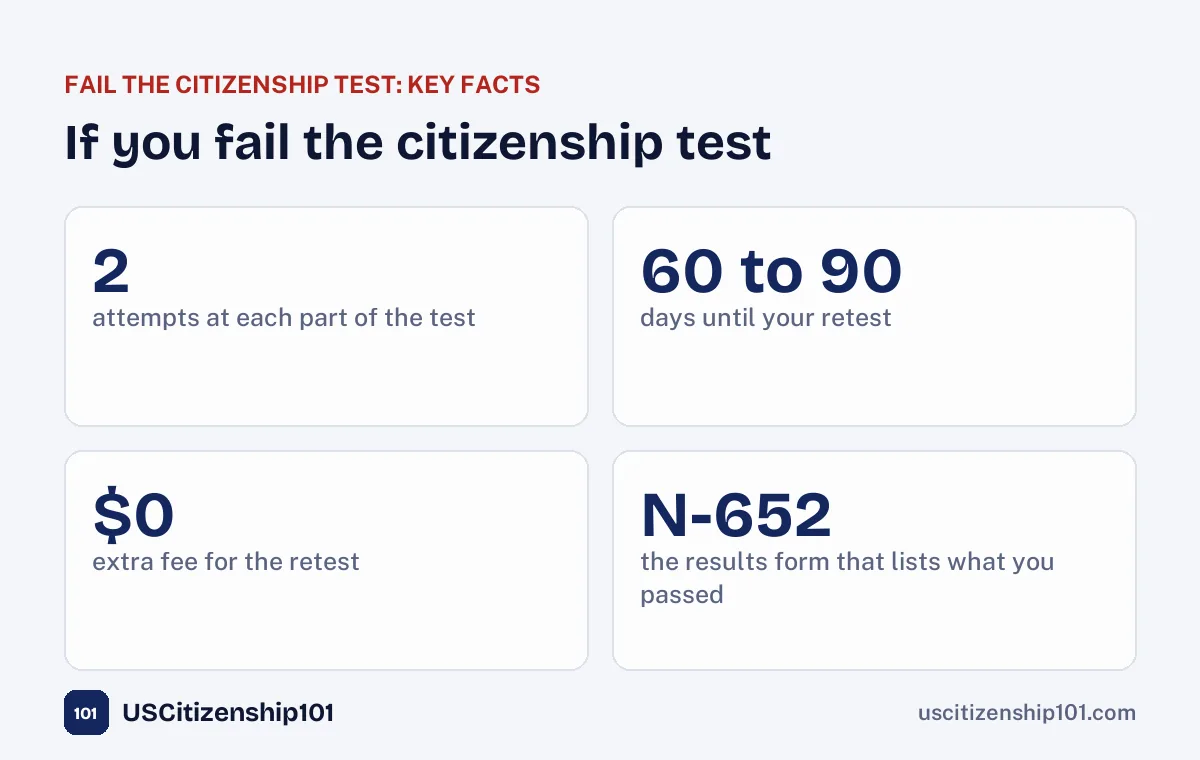
- You get two chances to pass the English test and the civics test.
- If you fail the citizenship test at your first interview, the retest is usually scheduled 60 to 90 days later.
- You only retake the part you failed. The retest has no extra fee.
- If you fail the same part twice, USCIS denies the application. You can apply again later with a new N-400.
- The officer gives you Form N-652, which lists your results.
What it means to fail the citizenship test
The naturalization test has two parts, English and civics. You can pass one and fail the other, and each part is scored separately. People often say they failed the citizenship test when they actually missed only one section.
The civics part
- 2025 version (N-400 received on or after October 20, 2025): the officer asks up to 20 questions from a list of 128. You need 12 correct. If you give 9 wrong answers, you can no longer reach 12, so that attempt ends.
- 2008 version (N-400 received before October 20, 2025): the officer asks up to 10 questions from a list of 100. You need 6 correct. Five wrong answers ends the attempt.
The English part
- Reading: you must read 1 of up to 3 sentences correctly out loud.
- Writing: you must write 1 of up to 3 sentences correctly.
- Speaking: there is no separate speaking test. The officer judges your spoken English during the whole interview.
If you do not meet the standard for any of these, the officer records that part as not passed. You are not asked to leave. The officer usually finishes reviewing your application before explaining the result.
What happens right after you fail the citizenship test
At the end of the interview the officer gives you Form N-652, Naturalization Interview Results. This one-page form shows which parts you passed and which you did not. Read it carefully before you leave, and ask the officer if anything is unclear. Keep the form, because it tells you exactly what to study.
Your case is marked as continued, not denied. That means USCIS will schedule a second examination. You do not file a new form or pay anything for it. When you fail the citizenship test the first time, the rest of your application stays active and everything you already passed stays passed.
When the retest happens
Under federal regulations (8 CFR 312.5), USCIS schedules the re-examination no earlier than 60 days and no later than 90 days after your first interview. You receive a new appointment notice by mail and in your USCIS online account if you have one.
The retest usually happens at the same field office. It is shorter than the first interview, because the officer only tests the part you missed and may ask a few follow-up questions about your application.
If you cannot attend the retest date
Contact USCIS before the appointment to reschedule. Missing a retest without rescheduling can lead to your case being closed or denied. Rescheduling is possible, but it may push your retest beyond the 90-day window, so only ask if you truly cannot attend.
What you retake after you fail the citizenship test
| First interview result | At the retest you take |
|---|---|
| Failed civics, passed English | Civics only |
| Failed reading, passed writing and civics | Reading only (speaking is judged again in conversation) |
| Failed writing, passed reading and civics | Writing only |
| Failed both English and civics | Both parts |
At the retest you take the same version of the civics test as the first time. If you fail the citizenship test on the 2025 version, your retest is also the 2025 version, with 20 questions and 12 needed to pass. The questions are drawn from the same official list but are usually different questions.

What happens if you fail the citizenship test twice
If you fail the same part a second time, USCIS denies your N-400. This is not a permanent bar to citizenship. It simply ends this application.
- Apply again: you may file a new N-400 whenever you meet the requirements. You pay the filing fee again and go through the full process, including a new interview.
- Ask for a review: you may file Form N-336, Request for a Hearing on a Decision in Naturalization Proceedings, within 30 days of the denial (33 days if the decision was mailed). This is meant for cases where you believe the officer made an error. It has its own fee.
If you fail the citizenship test twice, take time to prepare properly before you file again. Many people who fail twice passed easily on their next application after a few months of steady study.
Why people fail the citizenship test
Knowing the common reasons helps you avoid them at the retest.
- Studying the wrong version. Someone who filed after October 20, 2025 but studied the old 100-question list will struggle with the 2025 questions.
- Nerves. Many applicants know the answers but freeze in front of an officer. Practicing out loud with another person helps a lot.
- Recognizing, not recalling. Multiple choice practice makes people feel ready, but the real test has no options. You must say the answer yourself.
- “Name two” questions. Giving one item when the question asks for two counts as wrong.
- Current officials. Answers about the President, Vice President, Speaker, and Chief Justice change. See civics test answers that change.
- Writing details. Missing words, missing capital letters at the start, or words that change the meaning can cause a failed writing sentence.
- Not understanding a question. It is allowed to ask the officer to repeat a question. Do not guess when you did not hear it.
For more, read our guide to citizenship test mistakes.
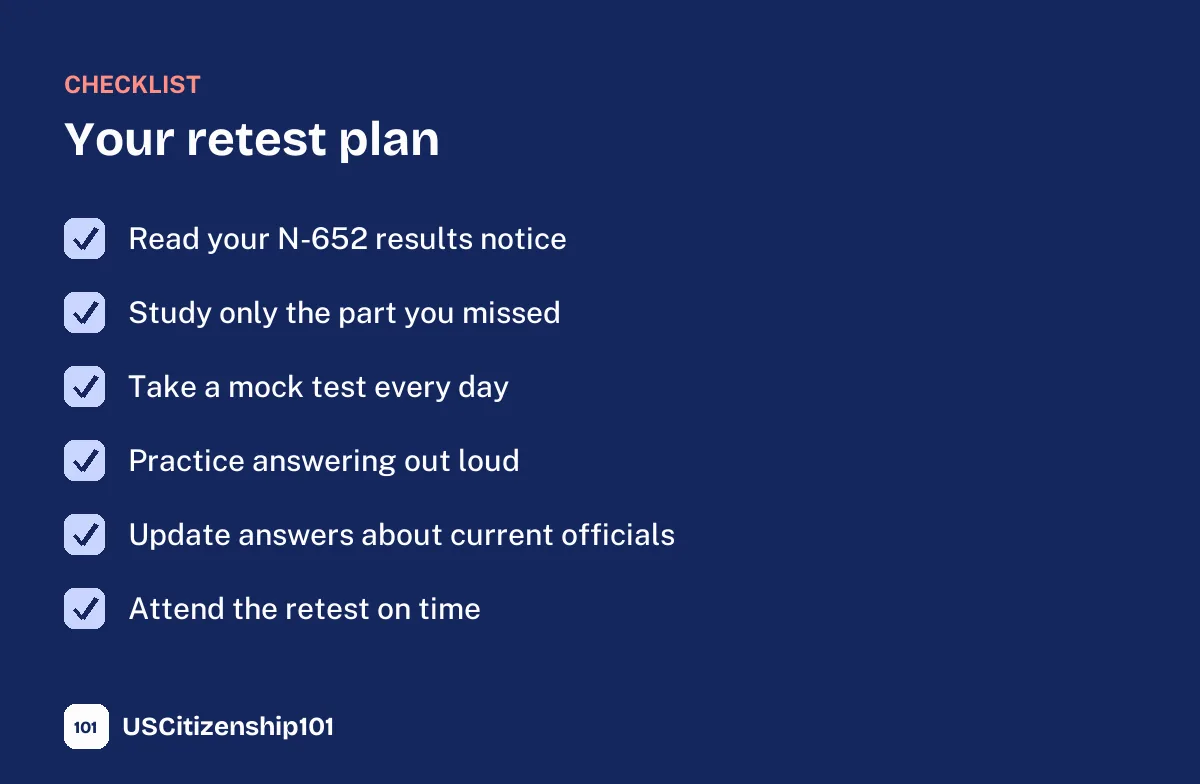
5 easy steps to pass the retest
You now know exactly which part caused trouble, which makes studying far more efficient than the first time. Use the weeks before your retest well.
Step 1: Read your N-652 carefully
Confirm which part you missed. If it was civics, confirm your version by checking the received date on your N-400 receipt notice.
Step 2: Focus only on what you missed
If you fail the citizenship test on civics only, put all your time into civics. If it was writing, practice dictation every day. Do not spread your effort across parts you already passed.
Step 3: Take a mock test every day
Our free civics practice test follows the real rules and stops at 12 correct or 9 wrong on the 2025 version. When you pass it five days in a row, you are ready.
Step 4: Practice out loud with a person
Ask a friend or family member to read questions to you. Answering a real voice is the best way to beat interview nerves. Our mock interview also reads questions aloud.
Step 5: Review your mistakes until they disappear
Use “Review mistakes” mode in the practice test to drill only the questions you missed. Repeat each one until you answer it correctly twice in a row.
If you failed reading or writing
The English sentences on the test use words from the official USCIS vocabulary lists. That makes them very predictable. If you fail the citizenship test on reading or writing, this plan works well:
- Learn every word on the USCIS vocabulary list, including spelling.
- Practice with our English practice tool: listen to a sentence, type it, and check your mistakes.
- Write by hand too, since the real test is on paper or a signature pad.
- Pay attention to capital letters at the start of sentences and names, and the final period or question mark.
- Read sentences out loud every day. Clear pronunciation matters more than a perfect accent.
Read more in our full guide to the citizenship English test.
If you failed civics
If you fail the citizenship test on the civics part, study by topic rather than in list order. Group all the questions about Congress together, then the President, then the courts, then history, then symbols and holidays. A civics test study plan helps you cover everything in four weeks, which fits neatly into the 60 to 90 days before your retest.
Pay special attention to questions with more than one part, such as “Name two national U.S. holidays.” Learn at least three answers for these so you never run out.
Does it affect your Green Card if you fail the citizenship test?
No. If you fail the citizenship test, you remain a lawful permanent resident with the same rights as before. Your Green Card stays valid, you can keep working and living in the United States, and you can still travel with your Green Card. Failing the test only affects your naturalization application, not your permanent resident status.
One practical tip: if your Green Card is close to expiring, renew it on time with Form I-90 even while your N-400 is pending. Do not assume that your citizenship will arrive first, especially if you need a retest.
How family and friends can help
People who fail the citizenship test often do better the second time when they practice with someone else. Ask a family member or friend to:
- Read civics questions to you at random, in the same calm voice an officer would use.
- Dictate the practice writing sentences while you write them by hand.
- Listen as you read sentences out loud and point out words that are unclear.
- Quiz you on the answers that change, such as the names of current officials.
Ten minutes of practice with a partner each evening can make a big difference to your confidence.
A 60-day retest study schedule
Most people who fail the citizenship test have about two months before the second attempt. This schedule assumes the civics part was missed. If English was the problem, replace the civics topics with daily reading and dictation practice.
| Days | What to do | Daily time |
|---|---|---|
| 1 to 7 | Principles of government: the Constitution, Bill of Rights, and Declaration of Independence | 25 minutes |
| 8 to 21 | System of government: Congress, the President, the courts, and the states | 30 minutes |
| 22 to 35 | American history from the colonies to today | 30 minutes |
| 36 to 42 | Symbols, holidays, rights and responsibilities | 20 minutes |
| 43 to 60 | One full mock test every day, then review mistakes | 30 minutes |
Short daily sessions beat long weekend sessions. Your memory builds between sessions, especially when you sleep.
How to stay calm on retest day
Many people fail the citizenship test because of nerves, not a lack of knowledge. These habits help:
- Arrive early. Plan to reach the building 30 minutes before your appointment so you are not rushed through security.
- Bring your documents. Your retest notice, Green Card, and ID. Being organized helps you feel in control.
- Breathe before each answer. A two-second pause is normal and gives your memory time to work.
- Speak clearly, not fast. Officers are listening for the right answer, not a perfect accent.
- Ask for repeats. “Could you please repeat the question?” is always acceptable.
- Remember the math. On the 2025 version you can miss up to 8 questions and still pass.
What if you moved before the retest?
If you move after you fail the citizenship test and before the retest, update your address with USCIS within 10 days using the online change of address tool. Your case normally stays with the field office that interviewed you. If you moved far away, USCIS may transfer the case, which can change the retest date. Keep checking your online account so you do not miss a notice.
Real-world example timeline
Here is how the process often looks for someone who needs a second attempt:
- Day 0: Interview. The applicant passes English and gets 10 of 20 civics answers right on the 2025 version. The officer gives them Form N-652 showing the civics part was not passed.
- Weeks 1 to 8: The applicant studies civics for 30 minutes a day and takes one mock test daily in the final three weeks.
- Around day 75: Retest at the same field office. The officer asks civics questions only, and the applicant reaches 12 correct answers after 14 questions.
- Same day or weeks later: Approval and an invitation to the oath ceremony.
This pattern is very common. People who fail the citizenship test once usually pass comfortably the second time because they finally know what to expect.
Could you qualify for an exception?
Some applicants who fail the citizenship test may actually qualify for an easier test:
- 50/20: age 50 or older and a permanent resident for 20 years at filing. No English test, civics in your language.
- 55/15: age 55 or older and a permanent resident for 15 years at filing. Same as above.
- 65/20: age 65 or older with 20 years as a resident. No English test, and only 20 civics questions to study.
- Medical disability: a doctor can certify a disability that prevents learning English or civics using Form N-648.
These need to be claimed based on your situation when you filed. See citizenship test exemptions for details.

Frequently asked questions
Do I pay again if I fail the citizenship test?
No. The retest is part of the same application and has no fee. You only pay again if your application is denied and you file a new N-400.
Will the retest questions be the same?
Usually not. The officer chooses from the same official list, so study all of it, not just the questions you missed.
Can I bring someone to help me at the retest?
You cannot get help answering test questions. Applicants who qualify for an age-based exception may bring an interpreter for the civics test.
Is it common to fail the citizenship test?
Most applicants pass, especially on the second try. Failing one part once is common enough that the law builds in a second chance.
Can I take the retest earlier than 60 days?
No. The regulation sets the window at 60 to 90 days after the first interview.
Final thoughts
It is disappointing to fail the citizenship test, but it is also one of the most fixable problems in the naturalization process. You know exactly which part to study, you have up to three months, and the retest is free. Study the right version, practice out loud every day, and walk into your second appointment with confidence.
Sources: USCIS, Study for the Test; 8 CFR 312.5 (re-examination); USCIS Form N-652 and Form N-336. Last reviewed September 2026. General information, not legal advice.
Free tools
This article is for general education, not legal advice. Always confirm requirements at uscis.gov.