Citizenship Through Marriage: The 3-Year Rule for Spouses of U.S. Citizens
How spouses of U.S. citizens can apply for citizenship after 3 years instead of 5, what "living in marital union" means, and what evidence to bring.
On this page
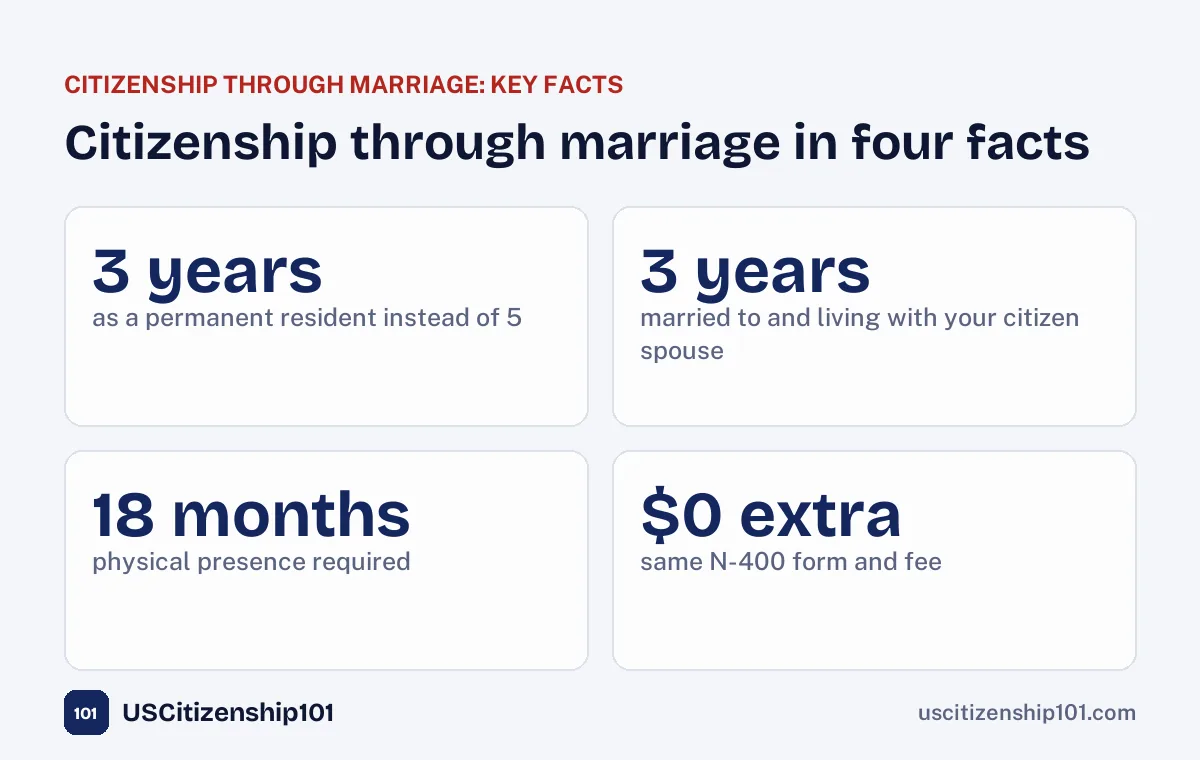
Citizenship through marriage does not mean that marrying a U.S. citizen makes you a citizen automatically. It means that if you are a permanent resident married to a U.S. citizen, you may apply for naturalization after 3 years instead of the usual 5. This shorter path is one of the most common ways people become citizens, and it uses the same Form N-400 as everyone else.
This guide explains how citizenship through marriage works: who qualifies, what “living in marital union” means, how to count the 3 years, the evidence to include, what the officer may ask, and special cases such as spouses of citizens working abroad.
Key points about citizenship through marriage
- Citizenship through marriage lets you apply after 3 years as a permanent resident.
- You must have been married to and living with the same U.S. citizen spouse for those 3 years.
- Your spouse must have been a U.S. citizen for the whole 3 years.
- You need 18 months of physical presence and 3 years of continuous residence.
- You still take the English and civics tests.
Who qualifies
To use the 3-year path, you must meet all of these on the day you file:
- Be at least 18 years old.
- Have been a permanent resident for at least 3 years.
- Have been married to and living in marital union with your U.S. citizen spouse for the past 3 years.
- Your spouse has been a U.S. citizen for those 3 years.
- Have 3 years of continuous residence and at least 18 months of physical presence.
- Have lived in your state or USCIS district for 3 months.
- Show good moral character for the 3-year period.
- Pass the English and civics tests, unless exempt.
What “living in marital union” means
You and your spouse must actually live together as a married couple during the 3 years. Legal separation or a formal separation agreement generally breaks marital union. Temporary separations for work or family reasons, where you remain married and intend to live together, may not, but you should be ready to explain them. If you divorce, or your spouse dies, before you naturalize, you usually lose eligibility for the 3-year path and must use the 5-year path instead.
How to count the 3 years
Three separate periods must all reach 3 years by the time you file (with the 90-day early filing window applying to residence):
- Your time as a permanent resident.
- Your time married to and living with your spouse.
- Your spouse’s time as a U.S. citizen.
If your spouse naturalized one year after you married, the 3 years of their citizenship start from their naturalization date, not your wedding date. The latest of the three dates controls when you can file for citizenship through marriage.

Evidence to include
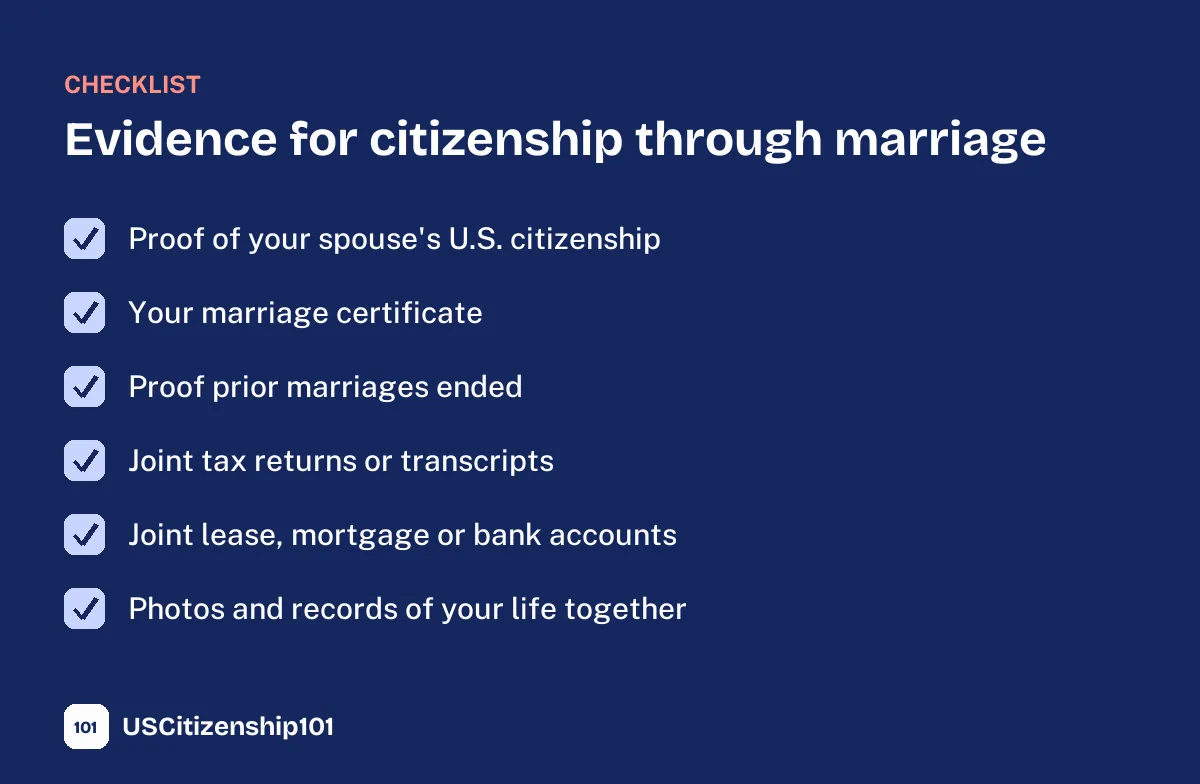
- Your spouse’s citizenship: U.S. birth certificate, Certificate of Naturalization or Citizenship, or U.S. passport.
- Your marriage: marriage certificate.
- Prior marriages ended: divorce decrees or death certificates for any previous marriages of either spouse.
- Living together: joint IRS tax transcripts, lease or mortgage, bank statements, insurance, children’s birth certificates.
Bring originals of these documents to your interview. Check the current Form N-400 instructions for required documents. See how to fill out Form N-400.
Interview questions
The officer confirms you still live together and may ask:
- When and where did you marry?
- When did your spouse become a citizen?
- Do you live together? Since when?
- Do you file taxes jointly?
- Have either of you been married before?
- Do you have children together?
Answer naturally and consistently with your application. Your spouse usually does not need to attend the naturalization interview unless USCIS asks. See citizenship interview questions.
3-year path vs. 5-year path
| Citizenship through marriage (3-year) | Standard (5-year) | |
|---|---|---|
| Permanent residence required | 3 years | 5 years |
| Physical presence | 18 months | 30 months |
| Good moral character period | 3 years | 5 years |
| Marriage requirement | Married to and living with a citizen for 3 years | None |
| Form and fee | Same N-400 and fee | Same N-400 and fee |
| Tests | English and civics | English and civics |
If you qualify for both paths, you can choose. Most couples use citizenship through marriage because it is faster, but if your marriage has recently changed, the 5-year path may be simpler.
Three example couples
Ana and Mark
Ana received her Green Card through marriage to Mark, a U.S.-born citizen, on June 1, 2023. They have lived together the whole time. Ana can file up to 90 days before June 1, 2026, using citizenship through marriage.
Raj and Priya
Raj became a permanent resident in 2020 through work. He married Priya, a permanent resident, in 2021. Priya naturalized in March 2024. For the 3-year path, Priya must have been a citizen for 3 years, so Raj cannot use it until March 2027. But by 2025 Raj reaches 5 years as a resident, so he can simply use the standard 5-year path sooner.
Lucia and Tom
Lucia has been a resident for 4 years and married to Tom, a citizen, for 3.5 years, but they legally separated last year. Because marital union ended, Lucia cannot use citizenship through marriage. She will wait until she reaches 5 years as a resident and apply on the standard path.
Conditional residents and Form I-751
If you received a two-year conditional Green Card through a recent marriage, the time as a conditional resident counts toward your 3 years. You must file Form I-751 to remove conditions during the 90 days before your conditional card expires. You may file your N-400 while the I-751 is still pending; USCIS often reviews both together at the naturalization interview. Bring evidence of your ongoing marriage, because it supports both cases.
If your marriage changes during the process
- Divorce or legal separation before the oath: you generally no longer qualify for citizenship through marriage. If you also meet the 5-year requirements, USCIS may be able to consider you under that path; otherwise you may need to wait and reapply.
- Death of your spouse: you generally lose eligibility for the 3-year path, though other options may exist for some widows and widowers. Get legal advice.
- Your spouse loses citizenship: this is rare, but it would also end eligibility for the 3-year path.
Report any change in marital status to the officer at your interview, and on Form N-445 before the oath.
Common mistakes
- Counting from the wedding date only: all three periods must reach 3 years, including your spouse’s citizenship.
- Weak evidence of living together: include joint documents that cover the whole period.
- Missing prior divorce records: prove that any earlier marriage of either spouse legally ended.
- Different addresses on records: explain any time living apart, with evidence.
- Forgetting physical presence: you still need 18 months inside the United States.
Timeline and cost
The application for citizenship through marriage costs the same as any N-400: $710 online or $760 on paper, with reduced fees and waivers for some applicants. After filing, the process is the same as for everyone: biometrics, background checks, interview, tests, and the oath. See the naturalization timeline and N-400 filing fee.
Prepare together as a couple
Citizenship through marriage is a shared milestone. Gather joint documents together, review your N-400 answers about your marriage so your details match, and let your spouse quiz you on civics questions each evening. Many couples say preparing together made the interview far less stressful. Our free civics practice test works well for studying together.
Step by step: applying for citizenship through marriage
- Check your three dates: your Green Card date, your marriage date, and your spouse’s citizenship date. The latest one plus 3 years is your eligibility date.
- Use the early filing window: you may file up to 90 days before you reach 3 years of permanent residence, as long as the other conditions are met. See N-400 early filing.
- Gather evidence: your spouse’s citizenship proof, marriage certificate, divorce records, and joint documents.
- File Form N-400: choose the eligibility option for spouses of U.S. citizens, and list your marital history carefully.
- Attend biometrics: if scheduled.
- Prepare for the interview: study civics and English, and review your marriage details.
- Interview and tests: bring originals of your marriage documents.
- Oath: take the Oath of Allegiance and receive your certificate.
Strong vs. weak evidence of living together
| Stronger evidence | Weaker on its own |
|---|---|
| Joint IRS tax transcripts for each year | A single photo together |
| Joint lease or mortgage covering the period | Letters from friends only |
| Joint bank statements with regular activity | An account opened just before filing |
| Birth certificates of children together | Social media posts |
| Joint health or car insurance | One utility bill |
Combine several stronger documents that cover the whole 3-year period. This is the best way to support an application for citizenship through marriage.
Same-sex marriages
Same-sex marriages are treated the same as all other marriages for immigration purposes, as long as the marriage is legally valid where it took place. Citizenship through marriage is available on exactly the same terms.
Military spouses
Spouses of U.S. service members may have additional options, including special rules when the service member is stationed abroad and, in some cases, the ability to complete parts of the naturalization process overseas. Ask the legal assistance office at your base or USCIS for current guidance.
What about our children?
Children under 18 with Green Cards who live with a U.S. citizen parent usually become citizens automatically. If your spouse is already a citizen, your children may already be citizens once they have Green Cards and live with your spouse. When you naturalize, any remaining children in that situation may become citizens as well. See Form N-600 for how to get proof.
After you become a citizen
Once citizenship through marriage is complete, you can vote, apply for a U.S. passport, and sponsor more relatives. You and your spouse now share the same citizenship status, which simplifies travel and future family petitions.
Myths about citizenship through marriage
- “Marriage makes you a citizen automatically.” False. You still apply, interview, test, and take the oath.
- “You can apply 3 years after the wedding.” Only if you have also had your Green Card for 3 years and your spouse was a citizen for those 3 years.
- “The interview is only about the marriage.” No. The officer reviews your whole application and gives the English and civics tests.
- “Living apart for work disqualifies you.” Not necessarily. Temporary separations with continued marriage may be explained with evidence.
- “You must bring your spouse.” Usually not, unless USCIS asks.
How to prepare for the interview
An interview for citizenship through marriage follows the normal format, with some extra questions about your spouse. Prepare by:
- Rereading the marital history section of your N-400 so your dates are fresh.
- Bringing originals of your marriage certificate, your spouse’s citizenship proof, and divorce records.
- Bringing recent joint documents, such as the latest tax transcript and a bank statement.
- Studying for the civics test with our free civics test study plan.
- Practicing reading and writing sentences on our English practice page.
With this preparation, citizenship through marriage is one of the most straightforward paths to becoming a U.S. citizen.
Checklist before you file
- I have been a permanent resident for at least 3 years, or will be within 90 days.
- I have been married to and living with my spouse for 3 years.
- My spouse has been a U.S. citizen for the past 3 years.
- I have spent at least 18 months inside the United States during that time.
- I have lived in my state or district for at least 3 months.
- I have my spouse’s citizenship proof, our marriage certificate, and records ending any prior marriages.
- I have joint documents showing we live together.
- I have disclosed every arrest or citation, with court records.
If you can check every box, you are ready to file for citizenship through marriage. If not, the standard 5-year path may be the better choice, or you may simply need to wait a little longer. Our guide to citizenship requirements covers the general rules that apply to everyone.
Special case: spouses of citizens working abroad
If your U.S. citizen spouse works abroad for the U.S. government, certain American companies or their subsidiaries, certain international organizations, or as a religious worker, you may be able to naturalize without any residence period in the United States. You generally must intend to live abroad with your spouse during the assignment and return to the U.S. afterward. This special provision has specific requirements, so read the instructions carefully or consult an attorney.
Special case: survivors and abuse
If you were subjected to battery or extreme cruelty by your U.S. citizen spouse, you may be able to use the 3-year path even though you no longer live together. Talk to an immigration attorney or a nonprofit that helps survivors.
Frequently asked questions
Does marrying a citizen make me a citizen?
No. Citizenship through marriage still requires a Green Card, the N-400, the interview, the tests, and the oath. Marriage only shortens the waiting period before you can apply.
Is it faster than the 5-year path?
You can file sooner. Processing after filing is the same.
Does my spouse need to come to the interview?
Usually no. The officer may ask about your marriage and review your evidence. USCIS will tell you if your spouse must attend.
Can I use citizenship through marriage if my spouse is a permanent resident?
No. Your spouse must be a U.S. citizen, and must have been one for the full 3 years.
How long does citizenship through marriage take after filing?
The same as any naturalization case. It depends mainly on your local USCIS field office, from a few months to over a year.
Can I switch from the 3-year to the 5-year path?
If your circumstances change and you meet the 5-year requirements, USCIS can consider that basis. Explain the change at your interview or file a new application if needed. An attorney can help you decide.
What if we married abroad?
That is fine. Bring the foreign marriage certificate with a certified English translation.
What if we separated temporarily?
Explain the circumstances and bring evidence that you remained married and intended to live together.
Getting help
Most couples can prepare an application for citizenship through marriage on their own. Consider help from a licensed immigration attorney or DOJ-accredited representative if either spouse has a complicated marriage history, if you lived apart for long periods, if your Green Card was obtained through a marriage that ended, or if you have any criminal record. Many nonprofit organizations offer free or low-cost consultations.
Final thoughts
For many couples, citizenship through marriage is the fastest route to the oath. Citizenship through marriage can shorten your wait by two years. Check that all three 3-year periods are met, gather strong evidence of your life together, and prepare for the English and civics tests like any other applicant.
Sources: USCIS Policy Manual, Volume 12, Part G (Spouses of U.S. Citizens); INA section 319. Last reviewed September 2026. General information, not legal advice.
Free tools
This article is for general education, not legal advice. Always confirm requirements at uscis.gov.