The Naturalization Process Explained: From Green Card to U.S. Citizen
A clear explanation of each stage of naturalization, what USCIS does behind the scenes, and how to move through it without delays.
On this page
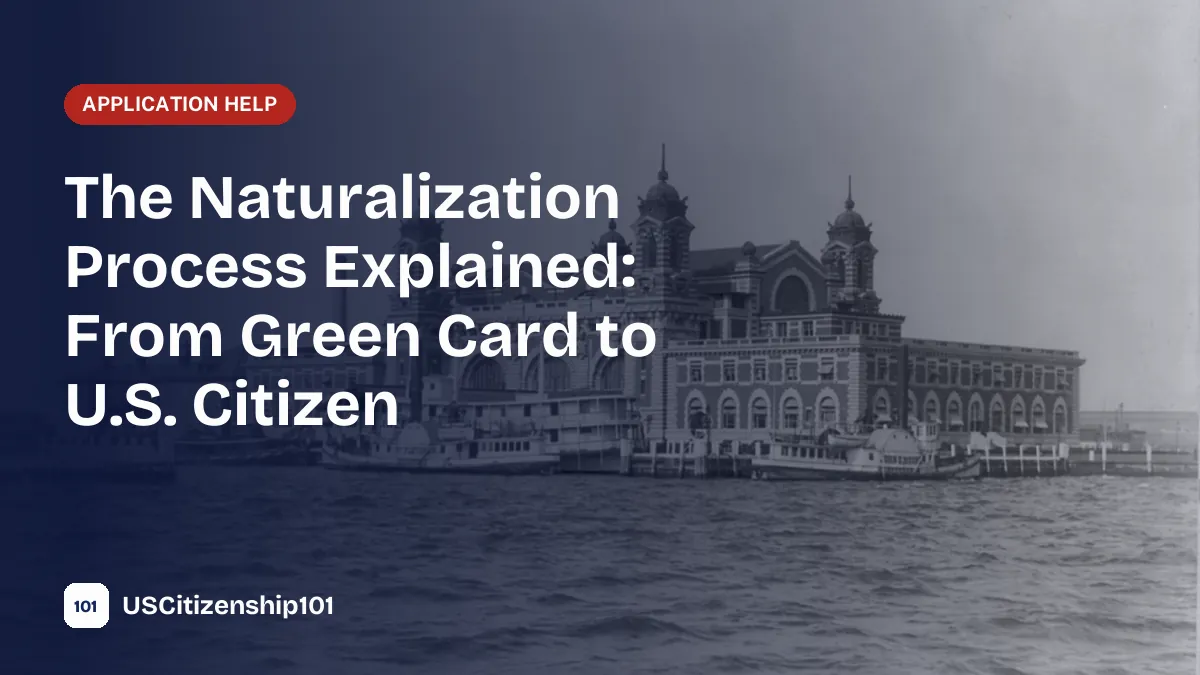
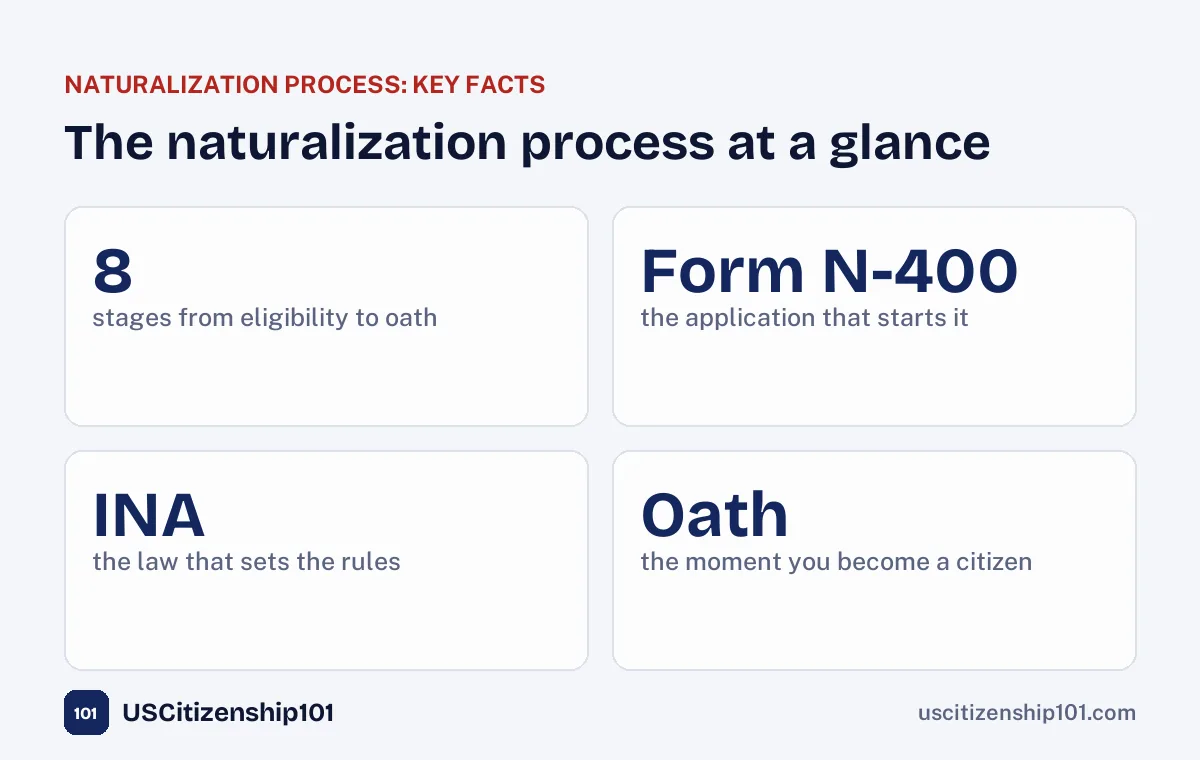
The naturalization process is the legal path that allows a lawful permanent resident to become a United States citizen. It is governed by the Immigration and Nationality Act (INA) and managed by U.S. Citizenship and Immigration Services (USCIS). Millions of immigrants have completed the naturalization process, from the first arrivals at Ellis Island to the new citizens sworn in every week across the country today.
This guide explains the naturalization process stage by stage: what you do, what USCIS does behind the scenes, how long each part typically takes, and how to keep your case moving smoothly.
Key points about the naturalization process
- The naturalization process starts with Form N-400 and ends with the Oath of Allegiance.
- Most applicants need 5 years as a permanent resident, or 3 years if married to a U.S. citizen.
- USCIS runs background checks and interviews every applicant.
- You must pass an English test and a civics test, unless exempt.
- Total time depends mostly on your local USCIS field office.
Stage 1: Eligibility
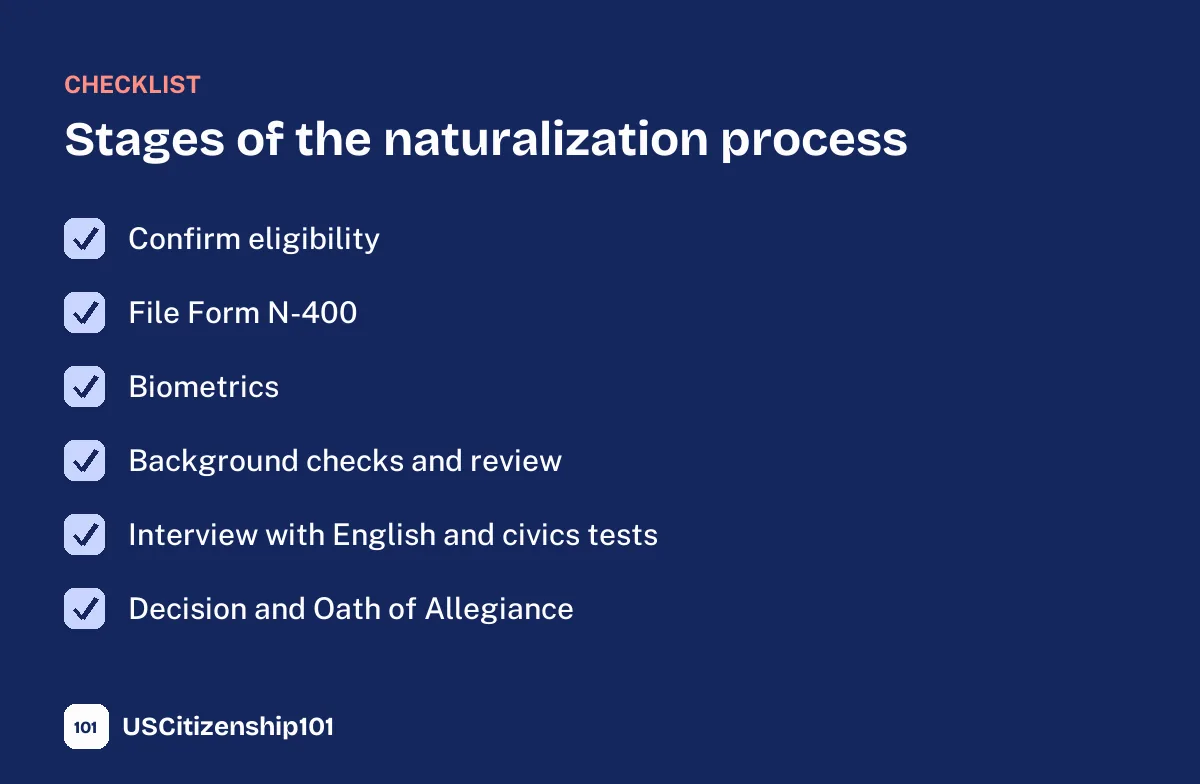
The naturalization process begins before you file anything. You must meet the legal requirements, including age (18 or older), permanent residence for the required period, continuous residence, physical presence, residence in your state or district for 3 months, good moral character, English and civics knowledge, and attachment to the principles of the Constitution. Review the complete list of citizenship requirements.
Stage 2: Filing Form N-400
You apply by filing Form N-400 online or by mail with the filing fee. USCIS sends a receipt notice, which starts the official naturalization process. Our guides explain how to fill out Form N-400 and the N-400 filing fee.
Stage 3: Biometrics
USCIS may schedule you at an Application Support Center to take fingerprints, a photo, and your signature. These are used for FBI background checks and to produce your naturalization certificate. See the biometrics appointment guide.
Stage 4: Background checks and file review
Behind the scenes, USCIS checks your fingerprints and name against government databases, reviews your immigration file (the “A-file”), and confirms your eligibility. If something is missing, it may send a Request for Evidence. This is usually the longest part of the naturalization process, and your case status may not change for a while.

Stage 5: The interview
A USCIS officer interviews you at your local field office. You are placed under oath, the officer reviews your N-400, and you take the English and civics tests. Read what to expect at the USCIS citizenship interview.
Stage 6: The tests
- English: read 1 of up to 3 sentences, write 1 of up to 3 sentences, and show you can speak and understand basic English.
- Civics: on the 2025 civics test, answer 12 of up to 20 questions correctly; on the 2008 test, 6 of up to 10.
Some older applicants and people with qualifying disabilities are exempt from parts of the tests. See citizenship test exemptions.
Stage 7: The decision
The officer gives you Form N-652 with the result: granted, continued (for more evidence or a retest), or denied. If you need a retest, it happens 60 to 90 days later. If denied, you can request a hearing with Form N-336.
Stage 8: The Oath of Allegiance
The naturalization process ends when you take the Oath of Allegiance at a ceremony and receive your Certificate of Naturalization. You are a citizen from that moment. See the oath of allegiance ceremony guide.
A short history of the naturalization process
The naturalization process is almost as old as the country. Congress passed the first Naturalization Act in 1790, requiring two years of residence and limiting citizenship to “free white persons.” In 1795 the residence period was raised to five years, the same period most applicants face today. After the Civil War, an 1870 law opened naturalization to people of African descent. The Basic Naturalization Act of 1906 created a federal agency to oversee the process, standardized forms, and required applicants to speak English.
The Immigration and Nationality Act of 1952 brought the rules together into one law and removed racial barriers to naturalization entirely. In 2003, after a government reorganization, U.S. Citizenship and Immigration Services took over the naturalization process within the Department of Homeland Security. The civics test was redesigned in 2008 and again for applications filed from October 20, 2025.
Who is involved in the naturalization process
- USCIS receives your application, schedules appointments, interviews you, and decides your case.
- The FBI runs fingerprint and name checks as part of the background review.
- Federal courts hold some oath ceremonies, especially when a name change is requested, and can review cases in certain circumstances.
- You, and optionally an attorney or accredited representative, provide accurate information and attend each appointment.
Documents at each stage
| Stage | Document you receive or use |
|---|---|
| Filing | Form N-400; receipt notice I-797C |
| Biometrics | Appointment notice I-797C, stamped at the appointment |
| Review | Request for Evidence, if needed |
| Interview | Interview notice; Form N-652 results |
| Oath | Form N-445 ceremony notice; Certificate of Naturalization |
Keep every notice in one folder. Together they document your entire naturalization process.
Your A-file
USCIS keeps an “alien file,” or A-file, for every permanent resident, identified by your A-number. It contains your immigration history: visa applications, your Green Card case, and any past petitions. During the naturalization process, the officer reviews this file alongside your N-400, which is why consistency matters. If your N-400 contradicts earlier records, expect questions.

Special paths through the naturalization process
Military service
Members of the U.S. armed forces may naturalize under special provisions, sometimes without the usual residence period, and without the filing fee. Service during designated periods of hostilities allows applicants to naturalize even without a Green Card.
Spouses of U.S. citizens
If you have been married to and living with a U.S. citizen for 3 years, you can apply after 3 years of permanent residence instead of 5. Some spouses of citizens who work abroad for certain employers can naturalize without a residence period. See citizenship through marriage.
Children
Children do not use the adult naturalization process in most cases. Children under 18 with Green Cards who live with a U.S. citizen parent usually become citizens automatically, and some children living abroad can obtain citizenship through a separate application.
How to keep the naturalization process moving
- File the correct, current form with the correct fee.
- Answer every question and include required evidence.
- File online if possible, so you see notices immediately.
- Keep your address updated within 10 days of moving.
- Attend every appointment, or reschedule properly in advance.
- Respond to any Request for Evidence completely and quickly.
- Prepare well for the tests so you pass the first time.
What can go wrong, and how to fix it
- Rejected application: usually a fee or signature problem. Fix it and refile.
- Request for Evidence: send exactly what is requested before the deadline.
- Failed test: you get a free retest 60 to 90 days later. See what happens if you fail the citizenship test.
- Long delay: if outside posted processing times, submit a case inquiry; if more than 120 days after your interview without a decision, talk to an attorney about court options.
- Denial: request a hearing with Form N-336 within 30 days, or reapply when eligible.
An example journey
Here is how the naturalization process looked for one illustrative applicant, Grace, who became a permanent resident in 2020:
- Early 2025: Grace calculates that she will reach 5 years in March and files online 80 days early.
- Four weeks later: her biometrics appointment takes 20 minutes.
- The next few months: her status shows little change while background checks run. She studies civics every morning.
- Interview day: she answers questions about two trips abroad, reads and writes one sentence each, and passes the civics test after 13 questions.
- Three weeks later: she takes the oath at a courthouse ceremony with her family watching, and applies for a passport the next week.
Checklist for each stage
- Before filing: confirm eligibility, count your 90-day early filing date, gather 5 years of history, and order court records if needed.
- Filing: use the current form, answer every question, attach evidence, pay the correct fee, and save the receipt.
- Biometrics: bring your notice and ID, arrive on time, and keep the stamped notice.
- Waiting: study civics and English daily, update your address if you move, and avoid long trips.
- Interview: bring every document on your notice, reread your N-400, and arrive early.
- Oath: bring Form N-445 and your Green Card, and check your certificate before leaving.
Costs across the naturalization process
The main cost of the naturalization process is the filing fee: $710 online or $760 on paper, with a $380 reduced fee and full waivers available for some applicants. The fee covers biometrics, the interview, a retest if needed, and the ceremony. Other possible costs include court records, translations, travel to appointments, optional legal help, and your passport after the ceremony.
Official civics questions about citizenship itself
The civics test includes questions about the naturalization process and the rights and duties of citizens. Here is the complete Rights and Responsibilities section of the 2025 test:
- There are four amendments to the U.S. Constitution about who can vote. Describe one of them. Citizens eighteen (18) and older (can vote).; You don’t have to pay (a poll tax) to vote.; and other answers
- Who can vote in federal elections, run for federal office, and serve on a jury in the United States? Citizens; Citizens of the United States; and other answers
- What are three rights of everyone living in the United States? Freedom of expression; Freedom of speech; and other answers
- What do we show loyalty to when we say the Pledge of Allegiance? The United States; The flag
- Name two promises that new citizens make in the Oath of Allegiance. Give up loyalty to other countries; Defend the (U.S.) Constitution; and other answers
- How can people become United States citizens? Be born in the United States, under the conditions set by the 14th Amendment; Naturalize; and other answers
- What are two examples of civic participation in the United States? Vote; Run for office; and other answers
- What is one way Americans can serve their country? Vote; Pay taxes; and other answers
- Why is it important to pay federal taxes? Required by law; All people pay to fund the federal government; and other answers
- It is important for all men age 18 through 25 to register for the Selective Service. Name one reason why. Required by law; Civic duty; and other answers
What changes when the naturalization process ends
When the naturalization process ends with the oath, several things change right away:
- You can vote in federal elections once you register.
- You can apply for a U.S. passport. See passport after naturalization.
- You no longer need to renew a Green Card or carry it.
- You can sponsor more family members for immigration.
- You may serve on juries and run for most public offices.
- Your children under 18 with Green Cards who live with you may become citizens automatically.
You also accept the responsibilities of citizenship. Read rights and responsibilities of U.S. citizens.
The naturalization process for people with disabilities
USCIS makes the naturalization process accessible. You can request accommodations such as a sign language interpreter, extra time, wheelchair access, or, in some cases, an interview at home if you cannot travel. If a physical or developmental disability or mental impairment prevents you from learning English or civics, a licensed medical professional can complete Form N-648 to request an exception. In rare, severe cases, the oath itself can be waived.
Mistakes that slow the naturalization process
- Filing more than 90 days before eligibility, which leads to denial.
- Leaving out trips, addresses, or jobs, which creates gaps and questions.
- Not disclosing arrests or citations, which can be treated as a lack of honesty.
- Missing appointments without rescheduling.
- Not updating your address after a move.
- Studying the wrong civics test version and needing a retest.
Each of these is easy to avoid with careful preparation. Our guide to citizenship test mistakes covers the testing side in detail.
Involving your family
The naturalization process affects your whole family. Talk with your spouse and children about the timeline, ask them to help you practice civics questions, and plan together for the ceremony. If your children may become citizens through you, learn how to get proof of their citizenship once you naturalize.
Preparing for the tests during the process
The waiting stages are the best time to prepare. Start studying the day you file, because interviews are sometimes scheduled sooner than expected. Follow a daily routine of 20 to 30 minutes: learn a few civics questions, say the answers out loud, and read and write a couple of English sentences. In the final week, take full mock tests in our free practice test until passing feels routine. Also reread your N-400, because the officer will ask about it. Our civics test study plan lays out four weeks day by day, and our mock interview helps you rehearse the personal questions.
How long the naturalization process takes
The total time varies widely by field office, from a few months to more than a year. Check current estimates on the USCIS processing times page, and read our naturalization timeline for details on each stage and what causes delays.
Frequently asked questions
Can I work and travel during the naturalization process?
Yes. You keep all the rights of a permanent resident during the naturalization process. You can change jobs and travel, but avoid long trips abroad, plan travel around your appointments, and keep records of your dates.
Do my children go through the naturalization process too?
Children under 18 with Green Cards who live with you often become citizens automatically when you naturalize. See Form N-600.
Is the naturalization process the same in every state?
Yes. It is a federal process with the same rules everywhere. Only processing times differ by field office.
Do I need a lawyer for the naturalization process?
Not always. Many people complete it on their own. A lawyer is wise if you have a criminal record, long trips abroad, or past immigration problems.
What happens to my Green Card during the naturalization process?
You keep using it as normal until the oath ceremony, where you return it to USCIS. If it will expire while your case is pending, renew it.
Can I stop the naturalization process once it starts?
You can ask USCIS to withdraw your application, but the fee is not refunded, and if you want citizenship later you must start the naturalization process again with a new application and fee. Talk to an attorney before withdrawing.
Final thoughts
The naturalization process is long but well defined. Confirm your eligibility, file a complete application, attend every appointment, prepare for the tests, and answer honestly. Each stage brings you closer to the day you raise your hand and become a U.S. citizen.
Sources: USCIS, 10 Steps to Naturalization; USCIS Policy Manual, Volume 12; Immigration and Nationality Act. Last reviewed September 2026.
Free tools
This article is for general education, not legal advice. Always confirm requirements at uscis.gov.